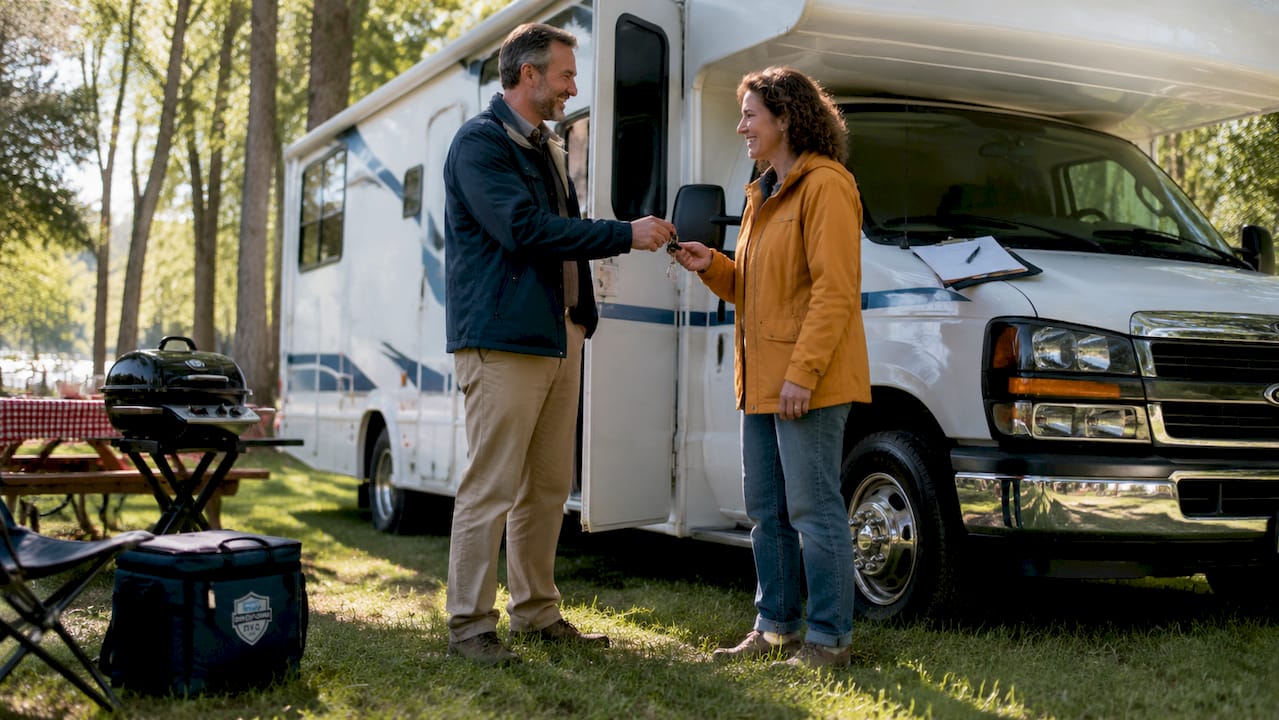
A private party RV sale is defined as a direct transaction between an individual buyer and an individual seller, with no dealership involved. This is the standard industry term you’ll see on loan applications, insurance forms, and DMV paperwork. Pricing typically falls between NADA Trade-in and Retail values, which means buyers often pay less than dealer retail while sellers pocket more than a trade-in offer. The catch is real: every private party RV transaction is sold as-is, with no warranty, no reconditioning, and no dealer standing behind the deal. Both buyers and sellers must manage title verification, inspections, financing, and paperwork on their own.
What is a private party RV sale vs. a dealer sale?
The core difference comes down to overhead, protection, and price. Dealers recondition inventory, offer financing in-house, and handle DMV paperwork. Private sellers do none of that. What you gain in price savings, you give up in convenience and safety nets.
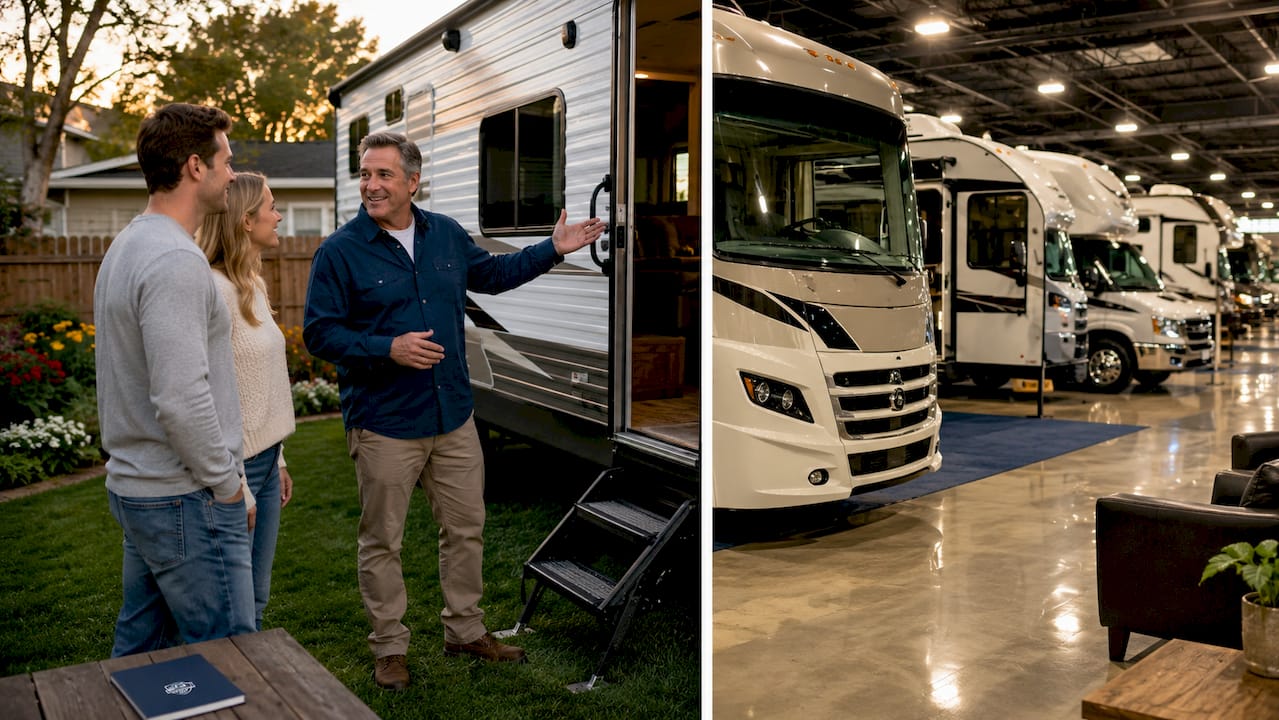
Here is a direct comparison of the two transaction types:
| Factor | Private Party Sale | Dealer Sale |
|---|---|---|
| Price | Between trade-in and retail value | At or above retail value |
| Warranty | None, sold as-is | Often included or available |
| Inspection | Buyer arranges independently | Dealer reconditions before sale |
| Financing | Buyer secures separately | In-house financing available |
| Paperwork | Buyer and seller handle it | Dealer manages title and DMV |
| Negotiation | More flexible | Less flexible |
Private sellers price lower because they carry no overhead costs. That lower price can be misleading, though. If the RV needs a new refrigerator, water heater, or slide-out motor, you could easily spend $1,000 or more before your first camping trip. The advantages of a private RV sale are real, but they reward prepared buyers and organized sellers.
The key advantages for buyers in a private party RV transaction:
- Lower purchase price with room to negotiate
- Direct access to the owner’s maintenance history and usage story
- No dealer add-ons, documentation fees, or upsells
The key advantages for sellers going the private route:
- Higher net proceeds compared to a dealer trade-in
- Full control over pricing, timing, and buyer selection
- No commission paid to a third party
How to buy an RV from a private seller: step by step
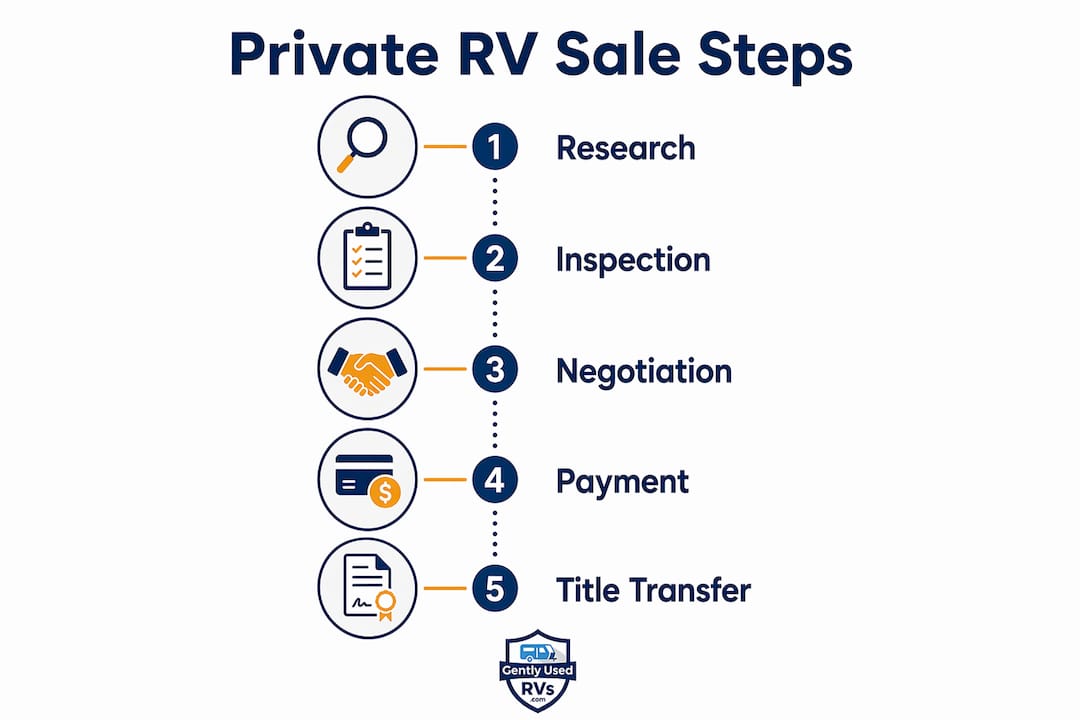
Buying an RV from a private seller follows a specific sequence. Skipping any step puts your money and your title at risk.
- Search and shortlist. Use geotargeted platforms to find RVs near you. Review listing photos, specs, and asking price against NADA values before reaching out.
- Verify the title and lien status. Ask the seller for the title upfront. Confirm the VIN matches the title and run a lien check through your state DMV or a service like Carfax. A seller who cannot produce a clean title is a red flag.
- Arrange an independent RV inspection. Replacing a major RV appliance can cost over $1,000. A professional inspector charges $150–$400 and can identify roof leaks, slide-out failures, and electrical issues before you commit. This is not optional.
- Secure financing or prepare certified payment. If you need a loan, contact your bank or credit union before you make an offer. Most lenders require the year, make, model, and VIN. Have a cashier’s check or wire transfer ready for closing day.
- Execute the bill of sale. A written bill of sale should include both parties’ names and addresses, the VIN, sale price, odometer reading, and an explicit as-is statement. Both parties sign it.
- Complete the title transfer. The seller signs the title over to you. You take it to your local DMV with the bill of sale and payment receipt to register the RV in your name.
- Get insurance before you drive it home. Most states require proof of insurance before you can register a vehicle. Call your insurer the day of closing.
Pro Tip: If a seller refuses a third-party inspection, walk away immediately. RV expert Mark Polk calls this a non-negotiable rule. A seller with nothing to hide welcomes the scrutiny.
For a deeper breakdown of the full private seller buying process, Gentlyusedrvs has a dedicated 2026 guide covering every step in detail.
How do you sell an RV privately with success and security?
Selling your RV privately takes preparation, patience, and a clear process. Plan for a 30–90 day timeline to complete the sale, especially if you carry a loan on the unit.
Price it right from day one
Set your asking price between the NADA Trade-in Value and the NADA Retail Value. Price too high and buyers scroll past. Price too low and you leave money on the table. Check comparable listings in your region to calibrate. Gentlyusedrvs has a dedicated guide on pricing your used RV to help you land in the right range fast.
Build a listing that attracts serious buyers
Your listing is your first impression. Serious buyers want facts, not fluff. Include the year, make, model, floor plan, mileage or hours, recent maintenance, and any known issues. Photos matter enormously. Shoot in daylight, cover every room, and include the exterior from all four sides.
Here is what every strong private RV listing must include:
- Full VIN and title status (clean or salvage)
- Accurate mileage or generator hours
- List of recent repairs and service records
- Honest disclosure of any known defects
- Asking price with your floor price in mind but not listed
Handle the lien before you list
If you owe money on your RV, contact your lender before you accept any offers. The lien payoff must happen simultaneously with the buyer’s payment at closing. This is the most common point of failure in private RV sales. Coordinate with your lender on their payoff process and get a 10-day payoff quote in writing.
Pro Tip: Remove your license plates the day of sale. In many states, plates stay with the seller, not the vehicle. Driving away on your plates creates liability that follows you.
Sellers who want to understand the full financial upside of going private should read Gentlyusedrvs’s breakdown of selling without commission.
What are the biggest risks in private party RV sales?
Private party RV transactions carry real risks on both sides. Knowing them in advance is the difference between a clean deal and a costly mess.
“Transaction failures arise mostly from poor legal paperwork preparation and unverified lien payoff arrangements.” The fix is simple: verify everything in writing before money changes hands.
For buyers, watch for these warning signs:
- Seller cannot produce the original title or says it is “in the mail”
- Price is dramatically below market value with no clear explanation
- Seller pushes for wire transfer to an out-of-state account
- Seller refuses an independent inspection or rushes the closing
- VIN on the RV does not match the VIN on the title
For sellers, protect yourself with these practices:
- Never sign the title over until payment clears in full
- Accept only cashier’s checks, wire transfers, or escrow services
- Verify the buyer’s identity with a government-issued photo ID
- Use a written bill of sale every time, even if your state does not require it
Title errors are a silent deal killer. Signing or altering a title with a typo, wrong ink color, or incorrect information can invalidate the document entirely. That means weeks of delays and potential legal headaches for both parties. Write clearly, use black ink, and never use correction fluid on a title.
The Gentlyusedrvs RV scam safety guide covers the most common fraud patterns targeting private buyers and sellers in 2026, including fake escrow schemes and title washing.
Key takeaways
A successful private party RV sale depends on verified titles, independent inspections, and secure payment methods handled in the correct sequence.
| Point | Details |
|---|---|
| Definition is clear | A private party RV sale is a direct, dealer-free transaction between two individuals. |
| Price sits in the middle | Expect pricing between NADA Trade-in and Retail values, not at dealer retail. |
| Inspection is non-negotiable | A third-party inspection protects buyers from costly hidden defects over $1,000. |
| Lien payoff is the top failure point | Coordinate simultaneous closing with your lender before accepting any buyer funds. |
| Documentation protects both sides | A signed bill of sale with VIN, price, and as-is language prevents disputes. |
What i’ve learned after years of watching private RV deals go wrong
I’ve seen buyers lose thousands because they trusted a handshake over a title check. I’ve seen sellers get stuck holding a signed title while a buyer’s check bounced. The private RV sale process is genuinely one of the better ways to buy or sell a recreational vehicle. But it punishes people who skip steps.
The single biggest mistake I see buyers make is treating the asking price as the total cost. Factor in a $300 inspection, potential repairs, registration fees, and insurance before you decide a deal is a good one. Experienced buyers focus on maintenance history and condition, not just the sticker price. That mindset shift alone will save you money.
For sellers, my honest advice is to get your paperwork in order before you post a single photo. Know your payoff amount. Have your title in hand. Decide on your floor price. Sellers who walk into negotiations prepared close faster and at better prices.
The private sale market rewards preparation. It does not forgive shortcuts. Go in with your eyes open, get everything in writing, and do not let excitement override your judgment on a $30,000 purchase.
— Christopher
Find your next RV on Gentlyusedrvs

Gentlyusedrvs is a free classifieds marketplace built specifically for private party RV transactions across the United States, Canada, and internationally. Sellers list at no cost with no commissions. Buyers browse without creating an account. Search results are geotargeted, so you see the closest listings first. If you are ready to buy, explore current RV listings to see real private party deals available right now. Not sure which RV type fits your needs? The Gentlyusedrvs RV types guide covers every category from Class A motorhomes to teardrop trailers so you shop with confidence.
FAQ
What does “as-is” mean in a private RV sale?
As-is means the buyer accepts the RV in its current condition with no warranty or seller obligation to repair defects found after the sale. A written bill of sale with an explicit as-is statement protects both parties.
How do i check for a lien on a private party RV?
Request the title from the seller and run a VIN check through your state DMV or a service like Carfax. A lienholder’s name on the title means the loan must be paid off at or before closing.
Is a bill of sale required for a private RV sale?
A written bill of sale is not legally required in every state, but it is strongly recommended. It documents the VIN, sale price, buyer and seller information, and the as-is condition to prevent disputes.
How long does a private RV sale typically take?
Sellers should plan for a 30–90 day timeline from listing to closing. Sales with clean titles and no outstanding loans close faster than those requiring lien payoff coordination.
What payment methods are safe in a private party RV transaction?
Cashier’s checks, wire transfers, and verified escrow services are the safest options. Personal checks and cash carry significant fraud risk and should be avoided in high-value transactions.