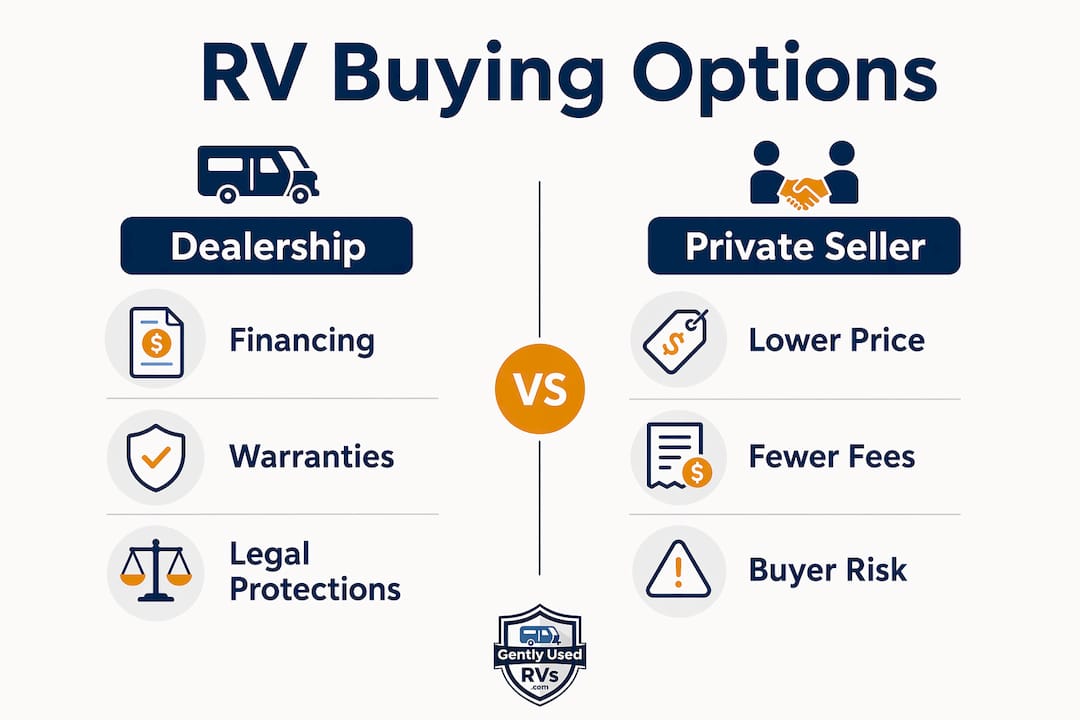
Buying an RV from a dealership is defined by structured protections, financing access, and legal accountability, while buying from a private seller trades those safeguards for a lower purchase price. The choice between an RV dealership vs private seller is one of the most consequential decisions a first-time buyer makes, and the wrong call can cost thousands. Dealerships offer warranties, titling support, and federal recall compliance. Private sellers offer flexibility and price. Neither is universally better. What matters is knowing exactly what you’re giving up with each option before you sign anything.
What are the real differences between RV dealership vs private seller?
Buying an RV from a dealership means you’re entering a regulated transaction. Dealers are licensed, bonded, and required by federal law to address open recalls before delivery. That single protection alone can save you from inheriting a dangerous mechanical defect at no cost to you. Private sellers carry no such obligation.
Private sellers, on the other hand, typically price their RVs below dealer retail because they have no overhead to recover. No lot fees, no service department, no commissioned salespeople. That gap can be meaningful, especially on Class A motorhomes or fifth wheels where dealer markups run high. But lower price does not mean lower total cost, and that distinction matters enormously for first-time buyers.
The industry terms for these two channels are “franchised or independent dealership” and “private party sale.” Both appear on platforms like Gentlyusedrvs, which lists inventory from private sellers and dealers side by side. Knowing which type of seller you’re dealing with before you start negotiating is step one.
What are the benefits of buying an RV from a dealership?
RV dealership advantages cluster around three areas: financing, protection, and convenience. For first-time buyers who don’t have $40,000 to $150,000 in cash, dealer financing is often the only realistic path to ownership.
RV loan terms run 10 to 20 years with the most competitive interest rates reserved for buyers with credit scores of 700 or above. That long repayment window keeps monthly payments manageable, though it also means you pay significantly more in total interest over the life of the loan. Buyers with scores below 700 should expect higher rates or may need a co-signer.
Beyond financing, dealerships offer:
- Warranty coverage. Most certified pre-owned or new RV sales include manufacturer or dealer warranties covering major systems. Coverage varies widely, so read the fine print before assuming everything is included.
- Trade-in options. If you already own an RV or a vehicle, dealers can apply trade-in value toward your purchase, reducing the financed amount.
- Titling and paperwork. Dealers handle DMV filings, registration, and title transfers. For a first-time buyer, this removes a genuinely confusing process.
- Recall compliance. Federal law requires dealers to resolve any open safety recalls before handing over the keys.
The catch is fees. Dealerships add document prep fees, freight pass-throughs, paint sealant packages, extended warranties, and GAP insurance to the advertised price. Doc fees alone range from $0 to $400 depending on the state. These add-ons are often presented as standard, but most are negotiable or optional.
Pro Tip: Ask for an itemized out-the-door price in writing before discussing monthly payments. Dealers who shift the conversation to monthly figures are obscuring the total cost.
What are the advantages and risks of buying an RV from a private seller?
Private RV sales pros and cons come down to one core trade-off: you save money upfront, but you absorb all the risk. There is no warranty, no financing department, and no one to call if the roof leaks three weeks after purchase.
The price advantage is real. Private sellers avoid dealer overhead, so their asking prices reflect actual market value more closely than dealer sticker prices. On a used travel trailer or Class C motorhome, that difference can range from a few thousand dollars to well over $10,000 depending on the unit’s age and condition.
The risks, however, are serious:
- Title liens. You must verify the title is clean and all liens are paid before handing over any money. Buying an RV with an outstanding lien means the lender can legally repossess it from you, even though you paid the seller in full. Run a VIN check and confirm the title is free and clear.
- Hidden maintenance issues. Aging components like tires, roof seals, slide-out mechanisms, and water heaters may be near failure without obvious signs. Private sellers are not required to disclose known defects in most states.
- No return policy. Private sales rarely include any cooling-off period or return option. Once money changes hands, the deal is done.
- No financing. Most private sellers require cash or a cashier’s check. If you need financing, you’ll need to secure a personal loan or RV loan from a bank or credit union before approaching a private seller.
Pro Tip: Before paying a private seller, pull a vehicle history report using the RV’s VIN and hire an independent inspector. The $200 to $400 inspection fee is cheap insurance against a $5,000 surprise.
Our RV scam safety guide covers the most common red flags in private sales, including fake titles, odometer fraud, and wire transfer scams. Read it before you browse any private listings.
How do inspections and warranties differ between dealerships and private sellers?
The inspection gap between dealerships and private sellers is wider than most first-time buyers expect. Dealer pre-delivery inspections (PDIs) are designed to prepare the unit for sale, not to protect the buyer’s interests. Dealership inspections focus on quick turnover rather than long-term reliability, which creates a real conflict of interest. A dealer’s service team is motivated to get the unit off the lot, not to find every flaw.
Independent NRVIA-certified inspectors operate under a completely different mandate. An NRVIA-certified inspection covers deep mechanical and structural issues that dealer PDIs routinely miss, including roof membrane integrity, slide-out alignment, electrical system load testing, and appliance function. This is the inspection that actually protects you.
Here’s how the two purchase paths compare on inspections and warranties:
| Factor | Dealership purchase | Private seller purchase |
|---|---|---|
| Pre-sale inspection | Dealer PDI (seller-focused) | Usually none |
| Independent inspection | Allowed, sometimes restricted | Strongly recommended |
| Warranty coverage | Manufacturer or dealer warranty available | No warranty, sold as-is |
| Recall resolution | Required by federal law before delivery | Buyer’s responsibility |
| Inspection cost to buyer | $150 to $500 for independent inspector | $150 to $500 for independent inspector |
Professional RV inspections cost $150 to $500 and can reveal defects that save buyers $5,000 to $10,000 in post-purchase repairs. That math makes an independent inspection non-negotiable regardless of where you buy.
Dealers generally cooperate with third-party inspections, though some restrict access on newer units or require scheduled appointments. If a dealer refuses an independent inspection outright, treat that as a serious warning sign.
Pro Tip: Search the NRVIA directory at nrvia.org to find a certified inspector near the seller’s location. Always hire your own inspector, never the one the seller recommends.
What hidden costs and financing factors should you watch for?
The advertised price on an RV is rarely the price you pay at a dealership. Understanding the full cost structure before you negotiate protects you from a common trap that catches first-time buyers off guard.
Dealership fees to expect and challenge
- Document preparation fee. Ranges from $0 to $400 depending on the state. This is often non-negotiable but worth asking about.
- Dealer prep fee. Covers cleaning and setup. Sometimes legitimate, sometimes pure padding.
- Extended warranty markup. Dealers earn significant profit on third-party warranties. Get the warranty details and price it independently before agreeing.
- GAP insurance. Covers the difference between what you owe and what the RV is worth if it’s totaled. Useful, but often overpriced at the dealer level.
- Freight or destination charges. Sometimes passed through on new units. Ask whether this was already included in the MSRP.
Demanding an itemized out-the-door price in writing before any financing discussion is the single most effective tactic for controlling total cost at a dealership.
Financing: dealer vs pre-approved loan
- Dealer financing is convenient but often carries a markup above the lender’s base rate. The dealer earns a fee for placing your loan.
- Pre-approval from a bank or credit union removes that leverage entirely. Walk into the dealership with a pre-approved rate and use it as your benchmark.
- Private purchases typically require cash or a pre-arranged personal loan. Credit unions often offer competitive RV loan rates for private party purchases, so call yours before you start shopping.
Private sales carry fewer fees but shift all repair costs to you immediately. A private seller won’t cover a failed water pump or a cracked roof seal discovered the week after purchase. Budget a repair reserve of at least $1,500 to $3,000 when buying privately, especially on units older than five years.
How to decide which option fits your needs as a first-time buyer
The right choice between a dealership and a private seller depends on four factors specific to your situation.
- Your financing situation. If you need a loan, a dealership or a pre-approved bank loan is your path. Private sellers almost universally require cash or certified funds.
- Your risk tolerance. Dealerships provide more protection. Private sellers require more diligence. If you’re not comfortable doing a VIN check, hiring an inspector, and verifying a title independently, start with a dealer.
- Your budget for due diligence. An independent inspection costs $150 to $500. If you’re buying privately and skipping that step to save money, you’re taking a gamble that rarely pays off.
- Your timeline. Dealers can often complete a transaction in one to three days. Private sales can drag on through negotiation, inspection scheduling, and title verification.
Pro Tip: Browse both dealer and private listings on Gentlyusedrvs before committing to either path. Comparing real asking prices side by side gives you a concrete sense of the price gap and helps you decide whether the savings justify the added work.
Check the RV types guide to narrow down which Class A, B, or C motorhome, travel trailer, or fifth wheel fits your camping style before you start price comparisons. Knowing your category first makes every other decision cleaner.
Key takeaways
Dealerships offer financing, warranties, and legal protections that private sellers cannot match, but independent inspections and pre-approved financing are non-negotiable safeguards for both purchase paths.
| Point | Details |
|---|---|
| Dealership protections | Dealers must resolve open recalls, handle titling, and often provide warranty coverage. |
| Private seller savings | Private sellers typically price below dealer retail but sell as-is with no warranty or return option. |
| Independent inspections | NRVIA-certified inspections cost $150 to $500 and can prevent $5,000 to $10,000 in hidden repair costs. |
| Pre-approved financing | Bank or credit union pre-approval removes dealer leverage and typically yields better interest rates. |
| Title verification | Always confirm a clean title and zero liens before paying any private seller. |
What I’ve learned after watching buyers get burned on both sides
I’ve seen first-time buyers walk away from dealerships convinced they got a great deal, only to discover $3,000 in add-ons buried in the financing paperwork. I’ve also seen buyers hand $25,000 in cash to a private seller for an RV with a lien the seller “forgot” to mention. Both situations are avoidable, and both come down to the same root cause: buyers who didn’t ask the right questions before the money moved.
The dealership vs private seller debate gets framed as a simple price comparison, but that framing misses the real issue. The question isn’t which option is cheaper. The question is which option you’re prepared to handle correctly. A dealership purchase with no independent inspection and no itemized pricing review is not safer than a private sale. It’s just a different set of risks with a friendlier face on them.
My honest recommendation for first-time buyers: start with a dealership if you need financing or if the idea of a title lien search makes your head spin. But don’t assume the dealer’s inspection protects you. Hire an NRVIA-certified inspector regardless. And if you go the private seller route, treat the title verification and independent inspection as mandatory costs, not optional ones. The buyers who save the most money are the ones who show up prepared, not the ones who trust the seller’s word.
— Christopher
Find your next RV with confidence on Gentlyusedrvs
Whether you’re leaning toward a dealership or a private seller, the smartest first move is browsing real listings to understand what’s actually available in your price range and region.

Gentlyusedrvs lists inventory from both private sellers and verified dealers across the United States, Canada, and internationally, all in one place. Search by RV type, location, and price without creating an account. Use the RV dealer directory to find trusted dealerships near you, or browse the full used RV marketplace to compare private and dealer listings side by side. Every search result is geotargeted, so you see the closest options first. No commissions, no hidden platform fees, and no pressure.
FAQ
Is buying from an RV dealership safer than a private seller?
Dealerships offer more legal protections, including recall resolution, titling support, and warranty options, making them generally safer for first-time buyers. Private sales can be equally sound with proper title verification and an independent inspection.
What fees should I expect at an RV dealership?
Common dealership fees include document prep ($0 to $400), dealer prep charges, extended warranty markups, and GAP insurance. Always request an itemized out-the-door price in writing before discussing financing.
Do I need an inspection when buying from a private seller?
Yes. Private sellers rarely provide any inspection or warranty, and independent NRVIA-certified inspections costing $150 to $500 can uncover defects that save buyers thousands in post-purchase repairs.
Can I finance an RV purchased from a private seller?
Most private sellers require cash or certified funds. You can finance a private party RV purchase through a bank or credit union by securing a pre-approved loan before approaching the seller.
What is the biggest risk in a private RV sale?
The biggest risk is an undisclosed title lien. Buying an RV with an outstanding lien means the lender can repossess the vehicle from you even after you’ve paid the seller in full. Always run a VIN check and confirm a clean title before any money changes hands.