Why Private Seller RVs Are Cheaper: 2026 Buyer’s Guide

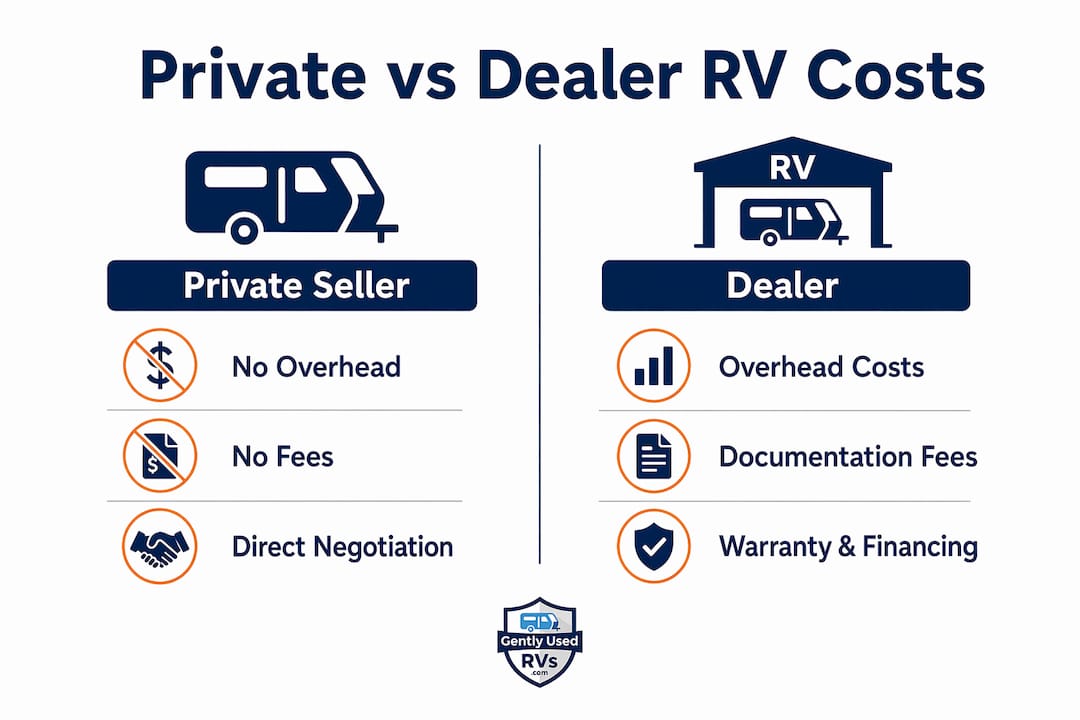
Private seller RVs cost less than dealer units because individual owners carry zero dealership overhead, no floor-plan financing costs, and no built-in profit margins to protect. This is the core reason why private seller RVs are cheaper, and it holds true across Class A motorhomes, fifth wheels, and travel trailers alike. In 2026’s softening used RV market, that price gap has widened further, giving informed buyers real leverage. The tradeoff is real, though. You get a lower sticker price and a longer to-do list. This guide breaks down exactly where the savings come from, what risks you take on, and how to decide if a private purchase is right for you.
Why private seller RVs are cheaper than dealer units
The short answer: no overhead, no margin. A private seller is a person who bought an RV, used it, and now wants to sell it. They are not running a business. They do not have a sales team, a service bay, a finance office, or a lot full of units they are paying interest on every month. All of those costs disappear from the transaction, and the price reflects that directly.
Dealers, by contrast, operate on a cost structure that requires every unit to cover its share of the business. The industry term for what you are comparing is “private party value” versus “dealer retail value,” and the gap between those two figures is not accidental. It represents real expenses the dealer must recover. Understanding that gap is how you shop smarter, whether you end up buying from a private owner or a dealership.

The 2026 used RV market has added another layer to this dynamic. Pricing has softened on non-premium units, and buyers who understand current conditions are finding more negotiation room than they had in 2022 or 2023. Private sellers, who typically price based on what they need to recoup rather than what the market will bear at peak, are often the fastest path to a fair deal.
What dealer pricing actually includes
Dealer asking prices are not arbitrary. They reflect a layered cost structure that most buyers never see. Breaking it down helps you understand why the same RV can carry a price tag thousands of dollars higher on a dealer lot than in a private driveway.
Here are the key components baked into dealer pricing:
- Dealer invoice vs. MSRP: The dealer invoice price often sits 30 to 40 percent below MSRP on new units. On used units, the dealer buys at wholesale or trade-in value, then marks up to retail. That markup is profit margin, plain and simple.
- Floor-plan interest: Dealers finance their inventory through floor-plan loans. On a $40,000 unit, floor-plan carrying costs can run $250 to $350 per month. The longer a unit sits, the more it costs the dealer, and that cost gets built into the price.
- Reconditioning and PDI fees: Before a used RV hits the lot, dealers typically run it through a pre-delivery inspection and reconditioning process. That work commonly costs $1,500 to $5,000 per unit and gets added to the asking price.
- Dealer pack: This is a fixed margin amount, typically $1,000 to $3,000, embedded in the sticker price to cover administrative costs and protect dealer profit. Buyers rarely see it listed separately.
A private seller has none of these costs. They paid what they paid for the RV, they know what they owe on it, and they want to sell it. That simplicity is what makes private party pricing consistently lower than dealer retail.
Pro Tip: Before you negotiate with any seller, look up the unit’s value in both “private party” and “dealer retail” tiers using resources like NADA Guides or Black Book data. Comparing the right valuation baseline is the only way to know if a private seller’s price is genuinely cheaper or just priced from a different starting point.
How much can you actually save buying private party in 2026?
The savings are real and quantifiable. A 2026 analysis of private sale versus consignment pricing found that selling privately can net $8,000 to $12,000 more than going through a consignment dealer on a $100,000 RV. That same gap works in the buyer’s favor. When a dealer takes a consignment commission of 10 to 15 percent, or marks up a trade-in to dealer retail, the buyer absorbs that cost. Buying direct from the owner removes it entirely.
The 2026 market context matters here. Softer pricing on used units means private sellers who need to move their RV are more motivated than they were during the post-pandemic demand spike. That motivation translates directly into negotiation flexibility that you simply do not get at a dealership with a fixed sticker price and a finance manager waiting in the back office.
Here is a realistic comparison of what the numbers look like:
| Scenario | Dealer retail price | Private party price | Estimated savings |
|---|---|---|---|
| Class C motorhome ($60K range) | $62,000–$65,000 | $54,000–$57,000 | $5,000–$8,000 |
| Travel trailer ($35K range) | $36,500–$39,000 | $31,000–$34,000 | $3,000–$5,000 |
| Class A motorhome ($100K range) | $104,000–$110,000 | $92,000–$98,000 | $8,000–$12,000 |
“Private-party sales can provide additional negotiation flexibility beyond dealership purchases, particularly in a softening 2026 market where buyers hold more leverage on non-premium units.” — RV Showoff, 2026 buyer’s guide
Timeline is another practical advantage. Private sales typically close in 30 to 60 days, compared to 90 to 120 days for consignment arrangements. If you find the right unit and move decisively, you can be on the road faster than any dealer process allows.
What risks come with buying from a private RV seller?
Lower price does not mean lower risk. Private sales are almost always completed as-is, and that single phrase carries significant weight. You need to understand what it means before you hand over a check.
The core risks buyers face in private RV transactions include:
- No warranty coverage: Private sellers do not offer manufacturer warranties or dealer service guarantees. Once the sale closes, any mechanical issue is your problem and your expense.
- Undisclosed defects: Water intrusion, roof damage, dated tires, worn brakes, and electrical issues are common in used RVs. A dealer would have reconditioned or disclosed these after taking a unit in trade. A private seller may not even know they exist, or may not volunteer the information.
- Title and lien issues: Some private sellers still owe money on their RV. If the title is not clear, you could inherit a lien. Always run a VIN check and confirm the title is free before paying.
- Limited legal recourse: “As-is” language generally limits implied warranty rights. It does not, however, protect a seller against fraud or misrepresentation. Your documentation of the transaction is your real protection.
The buyer’s due diligence checklist for private purchases should include a professional RV inspection, a full test drive, a VIN and title check, and a written bill of sale that documents the condition at time of sale. These steps cost time and sometimes money, but they protect the savings you worked to find. Skipping them is how a $10,000 discount turns into a $15,000 repair bill.
Pro Tip: Hire a certified RV inspector before closing any private sale. The inspection typically costs $150 to $400 and can reveal water damage, roof delamination, or mechanical problems that are invisible to the untrained eye. Think of it as insurance on your savings. You can also review the RV scam safety guide on Gentlyusedrvs for red flags specific to private transactions.
Private seller vs. dealer: a total cost of ownership comparison
Sticker price is only one number. Total cost of ownership tells the real story, and that calculation looks different for private purchases versus dealer purchases.
Dealers offer things private sellers cannot. Certified pre-owned programs, dealer warranties, on-site financing through lenders like Good Sam Finance Center or dealer-captive lenders, and service departments that stand behind the sale all add genuine value. For a first-time buyer or someone who is not comfortable with inspections and paperwork, those services are worth paying for. The dealer directory on Gentlyusedrvs lists vetted dealerships across the country if that route makes more sense for your situation.
That said, dealer fees add up fast. Documentation fees, delivery charges, prep fees, and extended warranty upsells can add $2,000 to $5,000 to a transaction that already carries dealer retail markup. Buyers who do not read the final purchase agreement carefully often pay more than they expected. The 2026 pricing guide on Gentlyusedrvs covers how these fees are structured and where negotiation room typically exists.
Private sales give you direct price control. You negotiate one-on-one with the owner, there is no finance manager adding products to your contract, and the price you agree on is the price you pay. For buyers who do their homework, that directness is a significant advantage. The 2026 RV market conditions favor buyers who understand current softness and use it to their advantage in private negotiations.
Key takeaways
Private seller RVs are cheaper because individual owners carry none of the overhead, floor-plan costs, or embedded dealer margins that inflate dealership pricing, but buyers must account for inspection costs, as-is risk, and paperwork effort to confirm the savings are real.
| Point | Details |
|---|---|
| No overhead means lower prices | Private sellers skip floor-plan interest, reconditioning fees, and dealer pack, saving buyers thousands. |
| Savings range from $3K to $12K | On units priced $35K to $100K, private party pricing consistently undercuts dealer retail by a meaningful margin. |
| As-is sales require due diligence | Always get a professional inspection, VIN check, and clear title before closing any private transaction. |
| 2026 market favors private buyers | Softening prices and motivated sellers give buyers more negotiation leverage than in recent years. |
| Total cost includes your time | Factor in inspection fees, paperwork effort, and potential repairs when comparing private vs. dealer pricing. |
When buying private actually makes sense
I have watched buyers save $10,000 on a private RV purchase and buyers lose $8,000 because they skipped an inspection on a unit with a compromised roof. The difference was not luck. It was preparation.
My honest take: private purchases make the most sense for buyers who are comfortable doing their homework. If you can read an RV inspection report, understand what a clear title looks like, and negotiate without a salesperson managing the conversation, you are well-positioned to capture real savings. The 2026 market is genuinely favorable right now. Motivated private sellers, softer pricing on Class C motorhomes and travel trailers, and less competition from buyers than we saw in 2021 and 2022 all point in your direction.
Where I see buyers get into trouble is when they treat the lower sticker price as the finish line. The inspection, the title check, the bill of sale, and the VIN verification are not optional extras. They are the work that makes the savings stick. A $500 inspection on a $55,000 private purchase is not a cost. It is a guarantee that the deal you think you are getting is the deal you are actually getting.
For first-time buyers or anyone who is not confident managing the transaction independently, a dealer purchase with a warranty and financing support is the smarter call. There is no shame in paying for peace of mind. But if you know what you are doing, or you are willing to learn, private party is where the real value lives in 2026.
— Christopher
Find your next RV on Gentlyusedrvs

Gentlyusedrvs is a free online classifieds marketplace connecting private sellers and dealerships with buyers across the United States, Canada, and internationally. Whether you are searching for a Class A motorhome, a fifth wheel, or a compact travel trailer, you can browse listings without creating an account and see the closest available units based on your location. Private sellers list at no cost, which means the prices you see reflect what owners actually want, not what a dealer needs to cover overhead. Explore the full RV types guide to narrow your search by category, or browse used RVs for sale right now to see what is available near you.
FAQ
Why are private seller RVs cheaper than dealer RVs?
Private sellers do not carry dealership overhead, floor-plan financing costs, reconditioning fees, or dealer pack margins. Those costs, which can total $5,000 or more per unit, are absent from private transactions, which is why private party pricing is consistently lower than dealer retail.
How much cheaper is a private seller RV compared to a dealer?
On a $100,000 RV, private party pricing typically runs $8,000 to $12,000 below dealer retail. On smaller units in the $35,000 to $60,000 range, buyers commonly save $3,000 to $8,000 by purchasing from an individual owner rather than a dealership.
What is the biggest risk of buying an RV from a private seller?
Private sales are almost always completed as-is, meaning the buyer has limited recourse if mechanical or structural issues appear after the sale. A professional RV inspection before closing is the most effective way to protect your investment.
Can you negotiate the price with a private RV seller?
Yes, and often more effectively than at a dealership. Private sellers are not bound by sticker price policies or finance office add-ons, so one-on-one negotiation tends to be more direct. In 2026’s softer market, motivated sellers have additional incentive to meet a serious buyer’s offer.
What should I check before buying an RV from a private seller?
Run a VIN check to confirm there are no outstanding liens, hire a certified RV inspector to assess mechanical and structural condition, verify the title is clear and in the seller’s name, and get a written bill of sale that documents the agreed condition at time of purchase.