
Selling your RV without commission is defined as a private sale where you, not a dealer, control the transaction and collect the full proceeds. RV consignment commission fees typically range from 8% to 15% of the sale price, meaning a $100,000 Class A motorhome sale could cost you $8,000 to $15,000 in dealer fees alone. That is real money left on the table. Platforms like RVezy and Gentlyusedrvs let you list, price, and sell your RV privately without paying a cent in commissions, giving you direct control over every step of the process.
Why sell an RV without commission: the core financial case
The math behind avoiding consignment fees is straightforward, and it favors private sellers decisively. Commission percentages of 10% to 15% are standard across consignment dealers like Camping World, and those figures do not include the additional charges that quietly pile up. Preparation fees, detailing costs, storage charges, and insurance during the consignment period all reduce your net proceeds further. For most sellers, the total cost of consignment is not 10%. It is closer to 15% to 20% once you account for every line item.
Consider a realistic example. You list a $75,000 fifth wheel with a consignment dealer at a 12% commission rate. That is $9,000 gone before you see a dollar. Add two months of storage at $150 per month and a $500 detailing fee, and your actual take-home drops to roughly $64,700. A private sale at the same price nets you the full $75,000, minus only your own time and any listing fees you choose to pay.

Consignment periods typically last 1 to 3 months, during which your RV sits on a dealer lot while you continue paying insurance and registration. This is not a passive waiting period. It is an active cost drain. Sellers who move to private platforms cut those carrying costs entirely.
Pro Tip: Before signing any consignment contract, request a full written breakdown of every fee beyond the commission percentage. Preparation, storage, and insurance charges are often disclosed only in the fine print.
| Sale Method | Gross Sale Price | Estimated Fees | Net Proceeds |
|---|---|---|---|
| Consignment (12% commission + extras) | $75,000 | $10,300 | $64,700 |
| Private sale (free listing platform) | $75,000 | $0 | $75,000 |
| Private sale (paid listing upgrade) | $75,000 | $200 | $74,800 |
What are the real pros and cons of selling your RV privately?
Private RV sales give you financial and operational advantages that consignment simply cannot match. Here is what you gain and what you take on.
Advantages of selling privately:
- You keep the full sale price. Zero listing fees on platforms like RVezy mean no upfront costs and no commission deductions at closing.
- You set your own price and adjust it in real time based on market response, without waiting for dealer approval.
- You avoid ongoing storage and insurance costs that accumulate during consignment periods.
- You control the timeline. A motivated private seller with good photos and accurate pricing can close faster than a dealer lot with dozens of competing units.
- You communicate directly with buyers, which builds trust and often speeds up negotiations.
Disadvantages to plan for:
- You manage all marketing yourself, including photos, listing copy, and platform selection.
- Buyer screening falls entirely on you. Verifying a buyer’s identity, confirming financing, and arranging safe showings takes real effort.
- Paperwork and legal transfer steps require attention. Title transfers, bill of sale documents, and lien releases must be handled correctly to protect both parties.
- Your reach is initially limited compared to a dealer network, though paid listing tiers on platforms like Gentlyusedrvs can expand your visibility statewide or nationwide.
The tradeoff is clear. Private selling costs you time and personal effort. Consignment costs you money. For most sellers, the financial savings from avoiding commissions outweigh the added workload, especially when good tools and platforms reduce that workload significantly.
Pro Tip: Use a used RV pricing guide to set a competitive asking price before you list. Overpricing is the single biggest reason private RV sales stall.
How to sell your RV without commission: practical steps that work
Selling privately without paying commission fees is not complicated, but it does require a deliberate process. Follow these steps to protect yourself and maximize your sale price.
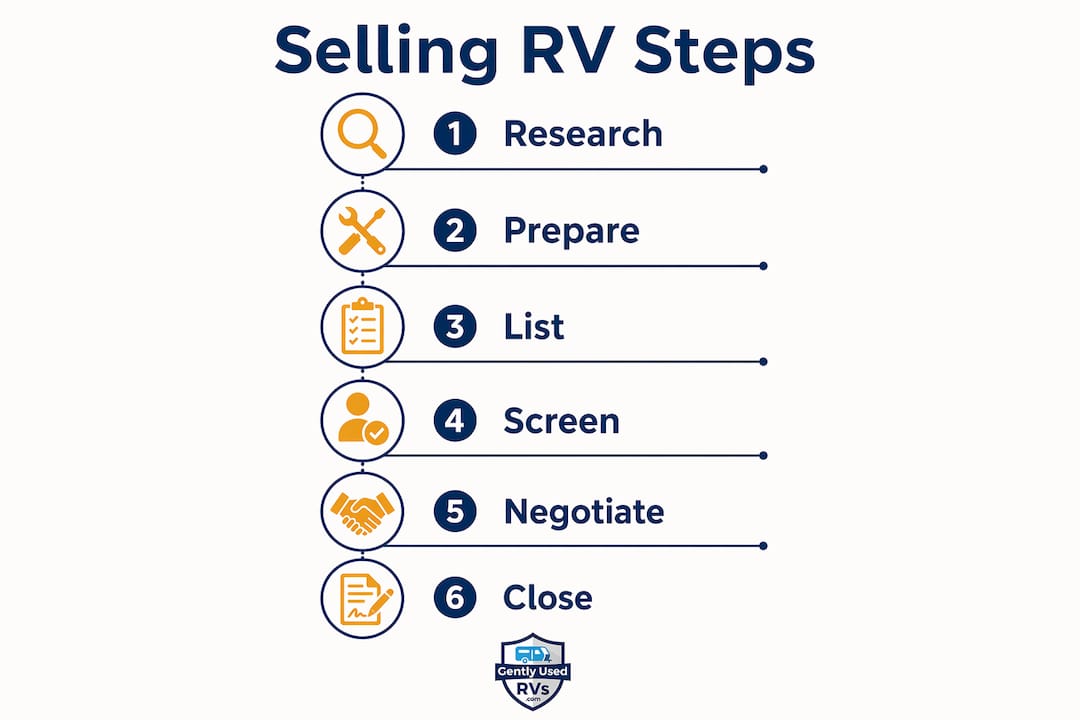
1. Research your RV’s market value accurately. Check comparable listings on Gentlyusedrvs, RVezy, and other no-commission RV selling sites to understand what buyers are actually paying. Factor in your RV’s year, mileage, condition, and type. A Class B camper van commands different pricing than a travel trailer or a toy hauler.
2. Prepare your RV for sale. Clean the interior and exterior thoroughly. Address any mechanical issues that could give buyers a reason to negotiate down. Gather all documentation: title, maintenance records, warranty paperwork, and any recent inspection reports. Buyers who see organized paperwork trust sellers more and negotiate less aggressively.
3. Create a listing that sells. Take photos in good natural light, covering every angle inside and out. Write a description that leads with the most appealing features: floorplan, slide-outs, towing capacity, recent upgrades. Platforms like Gentlyusedrvs offer an AI-powered autofill tool that imports specs, photos, and pricing from any existing URL in seconds, cutting your listing setup time dramatically.
4. Screen buyers before showings. Private sellers bear full responsibility for vetting buyers, managing test drives, and completing legal transfer steps. Ask for a name, phone number, and confirmation of financing or cash availability before scheduling an in-person visit. Meet in a public location for initial conversations when possible.
5. Negotiate with confidence. Know your floor price before any conversation starts. Buyers will test you. A well-prepared seller who knows the comparable market data holds the stronger position.
6. Close the sale safely. Use a bill of sale that includes the VIN, sale price, date, and both parties’ signatures. Transfer the title according to your state’s DMV requirements. For large transactions, consider using an escrow service to protect both buyer and seller during fund transfer.
| Platform | Commission | Listing Fee | Reach | Best For |
|---|---|---|---|---|
| Gentlyusedrvs | None | Free (upgrades available) | Local to nationwide | Private sellers, all RV types |
| RVezy | None | Free | National | Private sellers |
| Consignment dealer | 10%–15% | None upfront | Dealer network | Sellers prioritizing convenience |
When does paying a commission actually make sense?
Consignment is not always the wrong choice. There are specific situations where paying a dealer commission is a reasonable trade for the services provided.
- Limited time or capacity. If you are relocating, managing an estate sale, or simply cannot dedicate weekends to showings and negotiations, a consignment dealer handles the operational load. Consignment dealers manage marketing, financing, negotiations, and paperwork, which has real value for sellers who cannot or do not want to do those tasks.
- Remote location. Sellers in rural areas with limited local buyer traffic may benefit from a dealer’s established network and physical lot visibility.
- High-value or specialty units. For a $300,000 Class A diesel pusher, dealer financing options can widen the buyer pool significantly. Buyers who cannot pay cash outright need financing, and consignment dealers with lending relationships can close sales that private sellers cannot.
- RV condition concerns. If your RV needs significant repairs and you lack the time or budget to address them, a dealer experienced in as-is sales may move the unit faster than a private listing would.
- Desire for professional handling. Some sellers simply prefer handing off the process entirely. Consignment is a middle ground between a fast cash offer and a full private sale, offering professional handling at the cost of reduced net proceeds.
The honest calculation is this: if the commission and fees cost you $10,000 but save you 40 hours of effort and close the sale three months faster, the math may favor consignment. Run the numbers for your specific situation before deciding.
Key takeaways
Selling your RV without commission through a private sale is the most direct way to maximize net proceeds, provided you invest the time to price, market, and close the transaction correctly.
| Point | Details |
|---|---|
| Commission fees are significant | Consignment dealers charge 8% to 15%, costing $8,000 to $15,000 on a $100,000 RV. |
| Carrying costs add up fast | Storage, insurance, and prep fees during 1 to 3 month consignment periods reduce net proceeds further. |
| Private platforms eliminate fees | Sites like Gentlyusedrvs offer free listings with no commission, keeping your full sale price intact. |
| Private selling requires effort | Buyer screening, showings, negotiations, and paperwork all fall on the seller in a private transaction. |
| Consignment has valid use cases | Limited time, remote location, or high-value units with financing needs can justify paying a commission. |
My honest read on the commission question
I have watched sellers make the same mistake repeatedly. They hand their RV to a consignment dealer because it feels easier, then spend three months watching their net proceeds shrink while the dealer’s lot fills up with competing inventory. The commission is the visible cost. The invisible costs, storage, insurance, the opportunity cost of not having that cash in hand, are what really sting.
That said, I have also seen private sellers sabotage themselves by overpricing, taking bad photos, and refusing to negotiate. A private sale is only more profitable if you execute it well. Sloppy listings attract lowball offers or no offers at all.
The sellers who come out ahead are the ones who treat the sale like a transaction worth preparing for. They research pricing using tools like the RV types guide to understand their specific segment, they invest an afternoon in cleaning and photography, and they use platforms that give them real reach without charging for it. That combination consistently beats consignment on both speed and final price.
One more thing worth saying plainly: consignment contracts restrict your flexibility. Once you sign, you often cannot list elsewhere or adjust your strategy for weeks. If the market shifts or a better buyer appears through a different channel, you are locked out. Private selling keeps your options open. That flexibility has real value, even if it does not show up on a fee schedule.
— Christopher
List your RV for free on Gentlyusedrvs
If you are ready to sell your RV without paying commission fees, Gentlyusedrvs gives you everything you need to get started at no cost.

Post a free listing in minutes using the AI-powered autofill tool, which pulls your RV’s year, make, model, specs, and photos directly from any existing URL. Your listing goes live immediately and is visible to local buyers within a 20-mile radius. Need more reach? Upgrade to Silver for statewide visibility or Gold for nationwide exposure with live buyer chat and appointment scheduling built in. There are no commissions, no hidden fees, and no contracts. Browse the RV types guide to confirm your category, then list your RV for free and start connecting with real buyers today.
FAQ
What is the typical commission fee for RV consignment?
RV consignment commission fees typically range from 8% to 15% of the final sale price. On a $100,000 RV, that translates to $8,000 to $15,000 paid directly to the dealer.
Can I really sell my RV privately with no fees at all?
Yes. Platforms like Gentlyusedrvs offer free listings with no commission and no upfront charges, so you keep the full sale price. Optional paid upgrades expand your geographic reach but are never required.
How long does a private RV sale typically take compared to consignment?
Private sale timelines vary based on pricing, condition, and platform reach, but sellers avoid the 1 to 3 month consignment holding period and its associated carrying costs. A well-priced, well-photographed private listing can attract serious buyers within days.
What paperwork do I need to complete a private RV sale?
You need a signed bill of sale that includes the VIN, sale price, and date, plus a title transfer completed through your state’s DMV. If a lien exists on the RV, the lender must release it before the title can transfer to the buyer.
When should I consider consignment instead of selling privately?
Consignment makes sense when you have limited time, live in a remote area with low buyer traffic, or are selling a high-value unit where dealer financing can widen your buyer pool. For most sellers in standard situations, private selling delivers a higher net return.