You want it sold fast. Not “eventually” fast. Actually fast. Pricing a used RV for quick sale is the single biggest lever you control, and most sellers get it wrong in one of two ways: they price too high and watch the listing go cold, or they panic and leave thousands on the table. This guide cuts through both traps. You will learn how to read real pricing benchmarks, research comparable listings, pick the right selling method for your timeline, and avoid the mistakes that stall sales for weeks.
Table of Contents
- Key takeaways
- Pricing used RV for quick sale: understanding benchmarks
- How to research and price competitively
- Selling methods and their price tradeoffs
- Common pricing mistakes that slow your sale
- Finalizing your price and closing the deal
- My honest take on quick RV sale pricing
- List your RV where buyers are already looking
- FAQ
Key takeaways
| Point | Details |
|---|---|
| Use benchmark tiers | JD Power and NADA provide MSRP, low retail, and average retail values that set your pricing floor and ceiling. |
| Apply the 10% rule | Reducing average retail by roughly 10% puts your price in quick-sale territory without giving the RV away. |
| Match method to timeline | Instant cash offers close fast but pay less; consignment can net 10 to 15% more but takes longer. |
| Seasonality matters | Wholesale motorhome values can drop nearly 14% in winter, so time your listing or adjust expectations accordingly. |
| Preparation closes deals | Clean rigs with maintenance records sell faster and hold their asking price better than neglected ones. |
Pricing used RV for quick sale: understanding benchmarks
Before you type a single number into a listing, you need to understand the pricing tiers that every serious buyer and dealer already knows. These benchmarks are your map.
MSRP is the manufacturer’s suggested retail price. For a new unit like the 2026 A Liner Grand Ascape Series ST, that number sits at $35,250. Once an RV is used, MSRP becomes mostly irrelevant to buyers, but it tells you the ceiling of what anyone ever paid new.
Average retail is the number you actually care about. For that same model, JD Power pegs average retail at $31,450. This is what a buyer expects to pay at a dealership for a clean, well-maintained unit. Low retail ($26,100 for that model) reflects a unit with higher mileage, cosmetic wear, or mechanical concerns.
Wholesale is what dealers pay at auction. Quick sale prices often land closer to wholesale than retail, because buyers factor in reconditioning costs and their own resale margin. A practical rule: reduce low retail and average retail by about 10% to estimate the realistic range for a private quick sale.
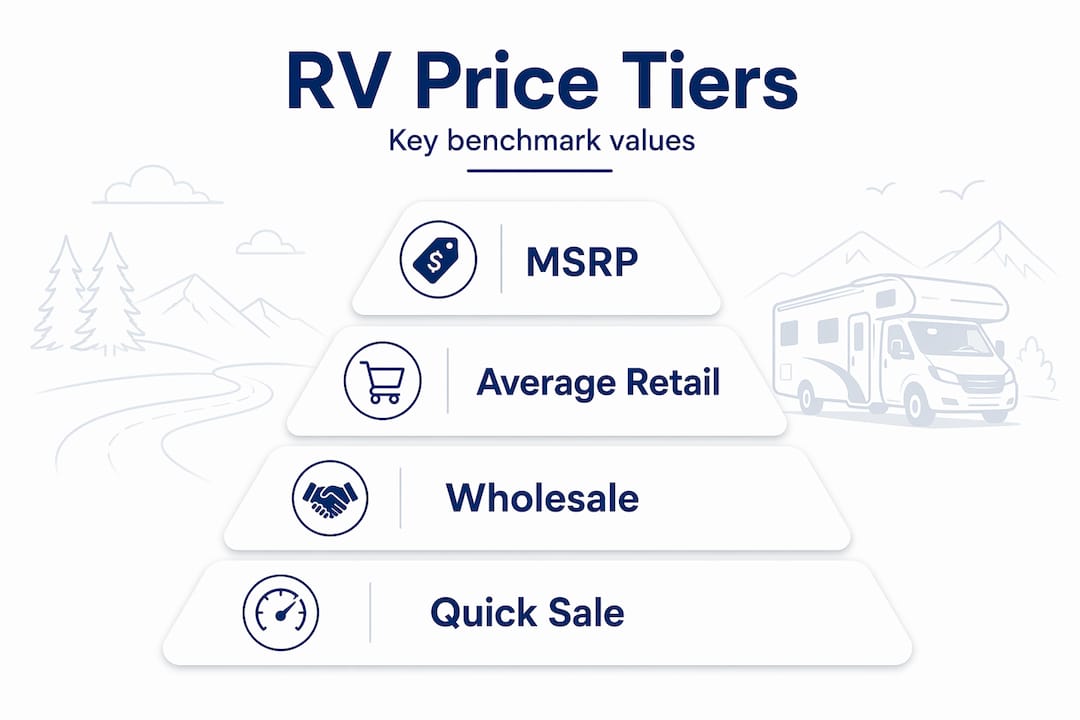
Here is how those tiers look in practice for a mid-range travel trailer:
| Pricing tier | Approximate value | What it means for you |
|---|---|---|
| MSRP | $35,250 | New price, not relevant for used sales |
| Average retail | $31,450 | Dealership price for a clean unit |
| Low retail | $26,100 | Dealership price for a worn unit |
| Quick-sale target | $23,500 to $28,300 | 10% below low and average retail |
| Wholesale/auction | $20,000 to $22,000 | What dealers pay; your floor |
Knowing these tiers protects you. If a buyer quotes you a wholesale number and calls it “fair market value,” you will know exactly what game they are playing.
Pro Tip: Submit your exact year, make, model, and floor plan when pulling valuations. Vague inputs produce vague numbers, and accurate valuation inputs minimize surprise price adjustments after a buyer inspects the unit.
How to research and price competitively
Benchmarks give you a range. Comparable listings give you a real number. Here is how to move from theory to a price tag that attracts fast offers.
-
Pull your JD Power or NADA valuation. Go to JD Power’s RV section and enter your exact year, make, model, and floor plan. Note both the low retail and average retail figures. These are your anchors.
-
Search active listings for your RV type. Browse platforms like Gentlyusedrvs to find units similar to yours in age, class, and condition. Look at listings for comparable travel trailers and note what sellers are asking. Pay attention to listings that show recent activity or “price reduced” tags.
-
Set your asking price slightly below the competition. Pricing slightly lower than comparable active listings is one of the most reliable ways to generate fast inquiries. You do not need to undercut by 20%. Even 5% below the next cheapest comparable unit puts you at the top of a buyer’s shortlist.
-
Factor in condition honestly. A unit with a soft spot in the floor, faded decals, or a non-functioning slide is not a low-retail unit. It is a wholesale unit. Price accordingly, or fix the issues first.
-
Check the season. Wholesale motorhome values dropped nearly 14% month-over-month as winter approached in late 2025, with towables falling over 7%. If you are listing in October or November, your price needs to reflect a softer market. Spring listings carry more leverage.
-
Clean and document everything. A spotless interior, freshly serviced generator, and a folder of maintenance records are not just nice touches. Thorough preparation actively reduces time on market and supports your asking price. Buyers feel confident making full-price offers on rigs that look cared for.
Pro Tip: Check a real listing near you for your RV class and note how long it has been posted. A listing sitting for 60-plus days is almost always overpriced. Use that as a warning for your own pricing.
Selling methods and their price tradeoffs
Speed and price pull in opposite directions. The method you choose determines how far you have to bend on one to get the other.
Instant cash offers are the fastest path to a closed deal. A dealer or online buyer quotes you a number, you accept, and the transaction closes in days. The catch is that instant offers prioritize speed and certainty at the cost of price. Expect offers in the wholesale-to-low-retail range. That is the price of convenience.
Private sale is where you have the most pricing control. You set the number, negotiate directly, and keep every dollar. The tradeoff is time and effort. You handle inquiries, showings, and paperwork. Done right, a private sale on a well-priced, well-presented RV can close in one to three weeks.
Consignment sits in the middle. A dealership markets and sells your RV at retail price, then takes a fee. Consignment can net owners 10 to 15% more compared to instant cash offers, but it requires patience. If your timeline is flexible and your unit is in strong condition, consignment can be worth it.
Trade-in is the most convenient option if you are buying another RV. Dealers often roll the trade value into the new purchase, and in some states, you only pay sales tax on the difference. The trade price will almost always be below private-sale value, but the tax savings and zero-hassle process make it competitive in practice.
Here is a quick comparison:
| Method | Typical price range | Speed | Best for |
|---|---|---|---|
| Instant cash offer | Wholesale to low retail | 1 to 5 days | Maximum urgency |
| Private sale | Low to average retail | 1 to 4 weeks | Best net price |
| Consignment | Near average retail | 4 to 12 weeks | Quality units, flexible timeline |
| Trade-in | Below low retail | Same day | Buying another RV |
Common pricing mistakes that slow your sale
Most RVs that sit unsold for months have one thing in common: the seller made at least one of these mistakes.
-
Anchoring to what you paid. What you paid in 2021 has no relationship to what the market will pay in 2026. Depreciation is real. Emotional attachment to your purchase price is the number one reason listings stall.
-
Ignoring seasonal timing. Listing a motorhome in December without adjusting for the seasonal wholesale drop is like pricing summer clothes in January. The market has moved. Your price needs to move with it.
-
Using retail comps for a non-retail-condition unit. If your RV has deferred maintenance, water stains, or outdated features, it does not belong in the same price bracket as a clean, move-in-ready unit. Buyers will spot the gap immediately and either lowball you or walk.
-
Skipping preparation. A dirty, cluttered RV signals neglect. Buyers mentally add repair costs to every flaw they see, often overestimating them. A $200 deep clean can protect thousands in perceived value.
-
Setting a price with no room to negotiate. Buyers expect to negotiate. If you price at exactly what you need, any offer feels like a loss. Build in a small buffer of 5 to 8% so you can meet buyers in the middle and still hit your target.
Finalizing your price and closing the deal
You have done the research, set a competitive price, and posted your listing. Now comes the part most sellers underestimate: reading the market’s response and acting on it.
-
Track your inquiry volume in the first week. A well-priced listing on a platform with good exposure should generate multiple inquiries within seven days. No inquiries after ten days is a clear signal to revisit your price.
-
Evaluate offers against your floor, not your ceiling. Your ceiling is what you hope to get. Your floor is the minimum you will accept based on your benchmark research. Any offer above your floor deserves a serious response, not a dismissal.
-
Qualify buyers before investing time. Ask upfront whether they are financing or paying cash, and whether they have seen similar units recently. Serious buyers answer these questions directly. Tire kickers dodge them.
-
Prepare your paperwork in advance. Have the title, maintenance records, and any disclosure documents ready before the first showing. Delays in paperwork kill deals that were otherwise closed. Buyers lose confidence fast when a seller seems unprepared.
-
Be transparent about condition. Disclose known issues in writing. This protects you legally and builds the kind of trust that gets deals signed. Buyers who feel informed are far less likely to back out after an inspection.
My honest take on quick RV sale pricing
I have watched sellers agonize over $500 for three weeks while their listing collected dust and their carrying costs climbed. That math never works out in the seller’s favor.
In my experience, the sellers who close fast are the ones who price with the market, not against it. They pull the JD Power numbers, look at what is actually selling nearby, and set a price that makes a buyer feel like they found a deal. That is not giving your RV away. That is understanding buyer psychology.

The biggest misconception I see is that a higher asking price gives you more negotiating room. Sometimes it does. More often, it just filters out serious buyers entirely. A buyer who sees a price that feels fair does not negotiate as hard. They just buy.
One more thing: market timing is underrated. If you can list in March or April rather than November, you are entering a market where seasonal demand lifts prices and buyers are motivated. That timing alone can be worth more than any negotiation tactic.
Preparation still beats everything when it comes to speed. A clean, documented, well-priced RV closes faster than a cheaper but neglected one. Every time.
— Christopher
List your RV where buyers are already looking
Ready to put your pricing strategy to work? Gentlyusedrvs makes it free to post your RV listing with no commissions and no hidden fees. Whether you are selling a Class A motorhome, a travel trailer, or a fifth wheel, your listing reaches real buyers searching in your area.

Before you post, browse the RV types guide to understand how your specific class and floor plan affect buyer demand and pricing expectations. Then list your RV for free and choose the exposure tier that matches your timeline. The Gold plan puts your listing in front of nationwide buyers with live chat and appointment scheduling built in. If speed is the priority, that visibility is worth it. Start your listing today at Gentlyusedrvs.com.
FAQ
What is a realistic quick-sale price for a used RV?
A realistic quick-sale price is typically 10% below the NADA or JD Power average retail value for your unit’s condition. Quick sale prices often land closer to wholesale than retail because buyers factor in reconditioning costs.
How do I find comparable RV listings to price mine?
Search active listings on marketplaces filtered by your RV’s year, make, model, and class. Focus on units that have sold or show recent activity rather than listings that have been sitting for months, which are likely overpriced.
Does the time of year affect how I should price my RV?
Yes, significantly. Motorhome wholesale values dropped nearly 14% as winter approached in late 2025. Listing in spring or early summer gives you more pricing leverage and a larger pool of motivated buyers.
Is a private sale or instant cash offer better for a quick sale?
It depends on how fast you need to close. Instant cash offers close in days but pay wholesale-level prices. A well-priced private listing on a high-traffic platform can close in one to three weeks at a meaningfully higher price.
Does cleaning and preparing my RV actually affect the sale price?
Yes. Preparation including maintenance records and minor repairs reduces time on market and supports your asking price. Buyers mentally discount every visible flaw, often by more than the actual repair cost.