What Is an RV Seller’s Market? Your 2026 Guide

If you’ve been telling yourself it’s a seller’s market before listing your RV, the current data will surprise you. Understanding what is an RV seller’s market, and recognizing whether one actually exists right now, is the difference between a quick sale and a listing that stagnates for months. The 2026 RV market has shifted meaningfully in buyers’ favor, and private sellers who don’t adjust their approach are paying the price. This guide breaks down the real conditions, the warning signs, and what you can do to sell smart regardless of where the market stands.
Table of Contents
- Key takeaways
- What is an RV seller’s market in 2026?
- How to recognize a seller’s market vs. a buyer’s market
- Practical strategies to sell your RV right now
- Understanding your selling options
- How timing affects your selling success
- My honest take on selling in today’s market
- List your RV where serious buyers are looking
- FAQ
Key takeaways
| Point | Details |
|---|---|
| Seller’s market definition | A seller’s market means demand outpaces supply, giving sellers pricing power and faster sales. |
| 2026 favors buyers | Nearly half of dealer RV inventory sits beyond 90 days, signaling a buyer-favoring market. |
| Pricing discipline matters most | Stale listings start with bad pricing; adjust early before book value drops further every 60 days. |
| Timing improves your odds | Listing in spring or early summer aligns with peak buyer demand and supports stronger prices. |
| Private sales pay more | Selling privately delivers the highest net return but requires more effort and broader marketing. |
What is an RV seller’s market in 2026?
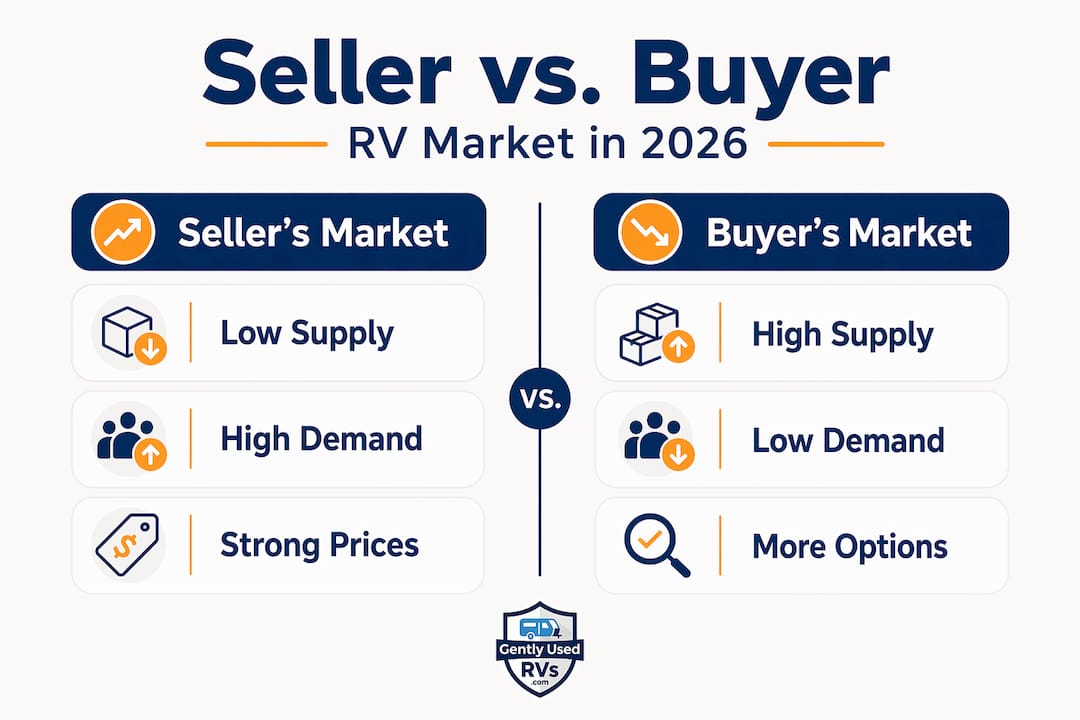
A seller’s market exists when demand for a product outpaces available supply. Sellers gain pricing power, negotiate from a position of strength, and typically close deals faster. In RV terms, that looked like 2020 and 2021, when factory shutdowns, stimulus checks, and a surge in outdoor recreation created a frenzy. RVs were selling above sticker price. Buyers were waiting months for delivery. That era is over.
The 2026 RV market tells a very different story. Used RVs average 117 days to sell on dealer lots, and nearly 50% of RV inventory sat beyond 90 days as of Q2 2026. That is not a seller’s market. That is a buyer’s market, and private sellers who treat it otherwise are setting themselves up for frustration.
| Market Type | Supply vs. Demand | Pricing Power | Average Days on Market | Negotiation Leverage |
|---|---|---|---|---|
| Seller’s market | Demand exceeds supply | High | Short (under 45 days) | Seller holds leverage |
| Buyer’s market | Supply exceeds demand | Low | Long (90+ days) | Buyer holds leverage |
So why does this matter to you as a seller? Because the strategy that works in a seller’s market, setting a high price and waiting, is the exact strategy that kills your sale in a buyer’s market. Economic pressures and discretionary spending define today’s conditions, and buyer persistence becomes the seller’s biggest challenge. Understanding where the market sits today is not just useful context. It is the foundation of every good decision you make from here.
Pro Tip: Check current listings in your region before setting your price. If similar RVs have been sitting for weeks without activity, that tells you more than any price guide alone.
How to recognize a seller’s market vs. a buyer’s market
Not all segments of the RV market move the same way. That nuance is where smart sellers find their edge. Knowing which category your RV falls into, and how it performs under current conditions, helps you price accurately and target the right buyers.
Here are the key indicators that tell you which type of market you are operating in:
- Days on market: When comparable listings close in under 30 days, sellers have leverage. When listings linger past 60 days, buyers are in control.
- Price reductions: Frequent price cuts across similar listings signal excess supply and weakening demand.
- Negotiation dynamics: In a seller’s market, buyers rarely push back hard on price. In a buyer’s market, every offer comes with counter-pressure.
- Inventory volume: More listings competing for the same pool of buyers shifts power quickly toward those buyers.
Some RV categories are holding up better than others. Fifth wheels demonstrate relative stability and better value retention because their buyers tend to be experienced, less price-sensitive, and actively shopping rather than casually browsing. Class B campervans attract a younger, adventure-focused demographic and maintain steady interest. Entry-level travel trailers and large Class A diesel pushers face the most pressure, with oversupply making competition fierce.
You can explore the full RV type breakdown to understand where your specific rig sits in the current market before you price it.
Pro Tip: If you own a fifth wheel or a Class B, you are in a more resilient segment. Lean into that positioning in your listing title and description to attract serious, experienced buyers.
Practical strategies to sell your RV right now
Selling into a buyer-favoring market is not a lost cause. It just requires more discipline, better preparation, and smarter marketing than sellers needed three years ago. Here is how to do it right.
-
Price based on today’s data, not what you paid. Use current comps from active listings in your region. RV book values decline every 60 days, so the price that felt right two months ago may already be out of step with reality. Check resources like NADA, J.D. Power, and the Gentlyusedrvs marketplace to see where comparable units are actually listed and selling.
-
Photograph like a professional. Buyers make decisions based on photos before they ever contact you. Use natural light, shoot from corner angles that show depth, include every slide-out position, and photograph all storage compartments. Dirty, dark, or sparse photo sets kill interest fast.
-
Document your maintenance history. A folder with receipts for oil changes, tire replacements, roof reseals, and any repairs signals that you cared for the unit. It reduces buyer skepticism and supports your asking price far better than words alone.
-
Choose the right sales channel for your timeline. Private sales return the most money but take the most effort. Dealer trade-ins are fast but costly. More on this in the next section.
-
Time your listing for maximum exposure. Spring and early summer are your strongest windows. Listing in March ahead of the peak travel season positions you to catch buyers who are actively planning.
- Write an honest, detailed description. Disclose known issues. Buyers who feel misled walk away or demand deep discounts at inspection.
- Respond to inquiries within hours, not days. Slow response is one of the most common reasons deals fall apart.
- Be ready to negotiate without panic. Know your walk-away number before you receive your first offer.
Pro Tip: Use the 2026 pricing guide from Gentlyusedrvs to calibrate your asking price against real market data before you go live.
Understanding your selling options

Every seller faces the same core trade-off: maximize your return or minimize your effort. The right answer depends on your timeline, your comfort with negotiation, and how much you know about the process.
| Selling Method | Net Return | Speed | Effort Level | Best For |
|---|---|---|---|---|
| Private sale | Highest | Slow to moderate | High | Sellers with time and market knowledge |
| Dealer trade-in | Lowest | Fast | Very low | Sellers prioritizing convenience |
| Consignment | Middle | Slow | Medium | Sellers wanting help without full trade-in loss |
| Outright dealer sale | Low to middle | Moderate | Low | Sellers who need a clean exit |
Private party sales yield the highest net proceeds, but you take on the full burden of marketing, screening buyers, handling paperwork, and managing showings. For sellers who are organized and patient, the financial upside is real and often significant compared to dealer alternatives.
Consignment sounds appealing as a middle path, but dealers take 10 to 15% commission on consigned RVs, and the timeline can stretch. Here is the part most sellers miss: consignment can lead to slow sales when the dealer prioritizes moving their own inventory over yours. Before signing a consignment agreement, get specific commitments in writing about how your unit will be marketed, where it will be listed, and how often the price will be reviewed.
Dealer trade-ins and outright dealer purchases offer speed and zero hassle, but expect an offer well below private market value. This route makes sense when you are buying another unit from the same dealer and can recoup some of the gap through negotiation on the new purchase, or when speed genuinely matters more than price.
How timing affects your selling success
Seasonal patterns in RV sales are more predictable than most sellers realize, and working with them rather than against them can meaningfully shorten your time on market.
Demand and pricing typically peak in spring and early summer, driven by buyers planning summer trips, families coming out of the school year, and the general energy that comes with warmer weather. If you can get your listing live by March or April, you are fishing when the fish are actually biting.
Here is what each season looks like from a seller’s perspective:
- Spring (March through May): Peak buyer activity. Listings move faster and command stronger prices. Competition is higher too, so presentation matters more.
- Summer (June through August): Strong demand continues but starts to soften toward late August as buyers shift into back-to-school mode.
- Fall (September through November): Fall buyers tend to be more serious and willing to plan ahead, but they expect better pricing to compensate for the seasonal slowdown. You have fewer tire-kickers but more negotiation pressure.
- Winter (December through February): Slowest period overall. If you must sell, lean into features like a four-season package, heated tanks, or generator capacity to appeal to year-round campers and snowbird travelers.
Pro Tip: If your RV has any winter-friendly features, highlight them specifically in your listing during fall and winter months. Buyers looking for year-round capability are a smaller but motivated segment.
My honest take on selling in today’s market
I’ve watched a lot of sellers hold firm on prices that made sense in 2021 and wonder why their phone never rings in 2026. The market has not gone back to those conditions, and waiting for it to return is a strategy that costs real money every month.
Here is what I’ve learned from watching this market closely. Sellers who cling to boom-year pricing face long-term inventory stagnation. And stagnant listings become invisible listings. The longer your RV sits without activity, the more buyers assume something is wrong with it, regardless of condition.
The sellers doing well right now are the ones who price aggressively from day one, document everything, and treat their listing like a product launch rather than a classified ad. Pricing discipline and speed outpace inventory size as the defining factors in 2026 sales success. A well-priced, well-photographed unit in a competitive segment will still sell. A beautiful RV at the wrong price will sit.
Private sellers can absolutely compete with professional dealers. But you need to meet the bar they set for marketing quality, response time, and transparency. Buyers have more choices than ever, and they will move on without a second message if your listing feels incomplete or your responses are slow. Treat every inquiry like it is your best lead, because in this market, it might be.
— Christopher
List your RV where serious buyers are looking
If you are ready to put what you have learned here into practice, Gentlyusedrvs is built for exactly this situation.

You can list your RV for free with no commissions and no hidden fees. The platform covers every RV type from Class A motorhomes to teardrop trailers, and an AI-powered autofill tool lets you import your listing details from any existing URL in seconds. When you are ready to reach more buyers, paid tiers extend your visibility from local to statewide to nationwide listings with live buyer chat included. Browse the RV types guide to understand where your rig fits in the current market before you price it. And if you want to protect yourself from lowball scams or fraudulent buyers, the scam safety guide is a free resource worth reading before your first showing.
FAQ
What is a seller’s market for RVs?
An RV seller’s market occurs when buyer demand exceeds available supply, giving sellers pricing power, faster sales, and limited negotiation pressure. The last true seller’s market in RVs was during 2020 and 2021.
Is 2026 a good time to sell an RV?
You can still sell successfully in 2026, but the market currently favors buyers. Nearly 50% of dealer inventory sat beyond 90 days as of Q2 2026, so pricing competitively and marketing well is more important than ever.
How often do RV values change?
RV book values can shift every 60 days, making it critical to check current market data regularly and adjust your asking price before your listing goes stale.
Which RV types hold value best right now?
Fifth wheels show better value retention due to a buyer base that is more experienced and less price-sensitive, making them one of the more resilient segments in the current market.
Should I sell privately or trade in to a dealer?
Private sales return the most money but require more effort. Dealer trade-ins offer speed and convenience at a significantly lower payout. If time is not a factor, private sale through a free platform like Gentlyusedrvs is typically the smarter financial choice.