
A private RV sale is the method of selling your recreational vehicle directly to another buyer, bypassing a dealership entirely. It consistently delivers higher net proceeds than a dealer trade-in because you capture the retail margin that dealers otherwise keep for themselves. On a typical $40,000–$60,000 RV, private sales can net $4,000–$8,000 more than what a dealer offers at the trade-in counter. That gap exists for a specific reason: dealers price trade-ins at wholesale, not retail. Understanding why private RV sale beats trade-in is the first step toward keeping that money in your pocket.
Why dealer trade-in values are always lower than private sale prices
Dealers do not pay retail for your RV. They pay wholesale, which reflects every cost they expect to absorb before reselling it. That includes reconditioning, lot fees, financing costs, insurance while it sits in inventory, and their own profit margin. Trade-in values typically land at 60–75% of private sale value, meaning a dealer offer of $32,000 on an RV worth $45,000 privately is not an insult. It is just math.

Dealers also carry inventory risk. If your Class A motorhome sits on the lot for four months, they pay carrying costs the whole time. That risk gets priced into your trade-in offer upfront. Trade-in values generally run 20–35% below fair market value once all those factors are accounted for.
Timing makes it worse. Trade-in offers can vary by $2,000–$5,000 between dealers based on their current inventory needs, regional demand, and the season. A dealer already stocked with fifth wheels in October has no urgency to pay top dollar for yours. Spring brings better offers because buyer demand rises and dealers need to restock.
- Reconditioning costs: Dealers budget for repairs, cleaning, and inspections before resale.
- Lot and carrying fees: Insurance, storage, and financing on unsold inventory all reduce what they can offer you.
- Profit margin: Dealers need room to mark up the RV for retail buyers.
- Inventory risk: If the unit does not sell quickly, their costs compound.
Pro Tip: Get trade-in quotes from at least three dealers before accepting any offer. The spread between the lowest and highest quote often reveals how much negotiating room exists.
What are the real financial benefits of selling your RV privately?
The core benefit of a private RV sale is simple: you set the price, and no dealer margin comes out of it. When you sell directly to another buyer, the full retail value goes to you. There are no reconditioning deductions, no lot fees, and no dealer profit built into the transaction. That is why selling without a commission consistently produces better returns for sellers who have the time and equity to make it work.
The financial advantages stack up quickly:
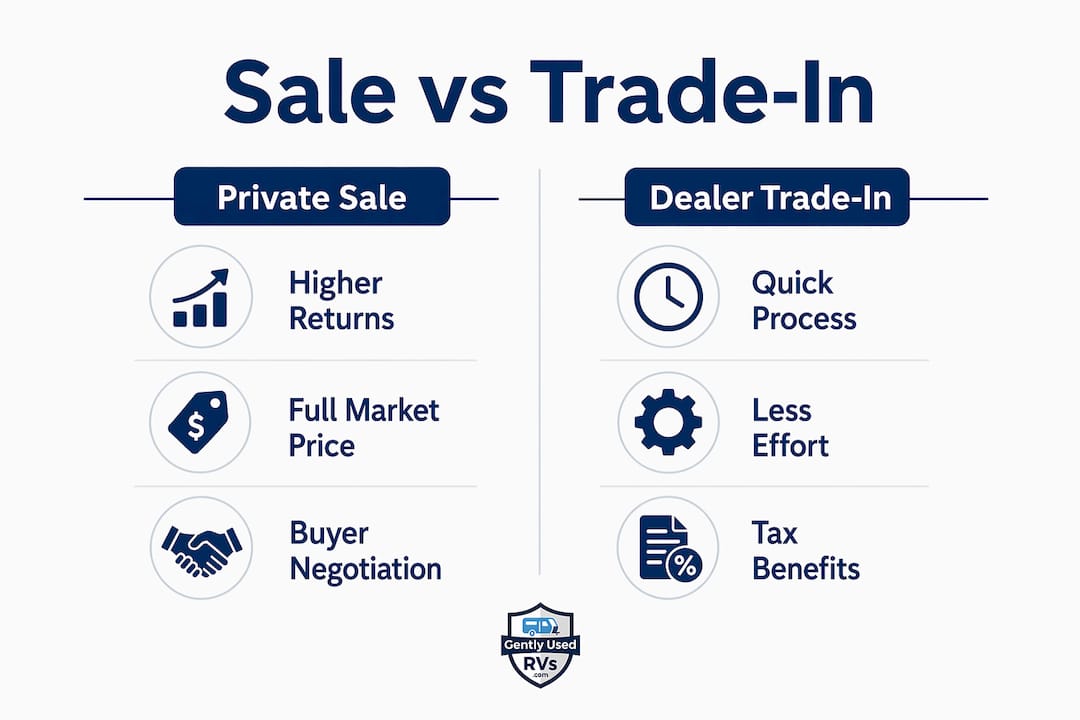
- Higher asking price: You price at retail, not wholesale. A $45,000 private sale versus a $32,000 trade-in offer is a real-world scenario, not an outlier.
- No commissions: Consignment arrangements typically charge 10–15% of the sale price. Private sales eliminate that entirely.
- Direct negotiation: You control the floor price and can walk away from low offers without pressure.
- Potential tax advantages: In some states, private sales reduce or eliminate sales tax obligations for the buyer, which can make your listing more attractive without lowering your price.
Pro Tip: Price your RV at the top of its fair market range when you first list it. You can always come down. Starting low leaves money on the table that you can never recover.
Sellers with equity-positive RVs benefit most. If you owe $20,000 on an RV worth $45,000 privately but only $36,000 at trade-in, the private sale does not just earn you more. It changes your financial position entirely. That $9,000 difference between a trade-in payoff and a private sale payoff is real money.
What are the time, effort, and risks of a private RV sale?
Private sales do not come free. The typical private sale takes 45–90 days from listing to closing, compared to a same-day dealer trade-in. A poorly executed sale can drag past six months and surrender much of its value advantage. You need to go in with clear expectations.
Here is what the process actually demands:
- Marketing your RV: Writing a detailed listing, taking professional photos, and posting across multiple platforms. This alone can take 10+ hours upfront.
- Screening buyers: Separating serious buyers from tire-kickers and avoiding common RV scams takes active effort and a healthy skepticism.
- Negotiating: You handle every offer, counteroffer, and walkaway directly. No sales team buffers the conversation.
- Managing financing and title transfer: Financed buyers require swift, secure documentation that private sellers must prepare and manage themselves. Missing a lender requirement can kill a deal at the last minute.
- Covering holding costs: Insurance, registration, and storage during an extended sale period add up. Holding costs erode your net gain the longer the sale drags on.
Sellers often underestimate the total time commitment. Marketing and negotiating a private sale can total 40+ hours. That is not a reason to avoid it. It is a reason to plan for it.
Pro Tip: Set a firm minimum price before you list. When a buyer pushes hard on price, knowing your floor keeps you from making an emotional decision you will regret.
When does a trade-in actually make more sense?
A trade-in is not always the wrong choice. The financial case for private sales is strong, but it assumes you have time, patience, and an RV that attracts buyers. Not every seller fits that profile.
Trade-in makes more sense in these situations:
- You need cash fast. A job relocation, medical expense, or new RV purchase with a tight timeline makes same-day trade-in completion genuinely valuable.
- Your RV is large or heavy. Class A diesel pushers and large fifth wheels have a narrower buyer pool. Finding a qualified private buyer takes longer, and holding costs accumulate faster.
- You are buying from the same dealer. Some states allow buyers to deduct the trade-in value from the purchase price of a new RV, reducing the sales tax owed. That tax credit can close the gap between trade-in and private sale proceeds.
- You want a guaranteed, hassle-free outcome. Dealers view trade-ins as a convenience service, and the lower price is effectively the fee for that convenience. For some sellers, that fee is worth paying.
The honest truth is that private sales are not always more profitable once you factor in opportunity costs, time spent on lowball offers, and the stress of managing the process. Know your priorities before you decide.
How to maximize your return when selling your RV privately
Treating your RV like a business asset is the difference between a fast, profitable sale and a frustrating one. Successful private sales hinge on high-quality marketing and active buyer qualification. Here is how to execute well:
Stage and photograph your RV professionally. Clean every surface, fix minor cosmetic issues, and shoot photos in good natural light. Listings with strong photos attract more inquiries and command higher prices. This is not optional if you want retail-level returns.
Gather your maintenance records. A complete service history builds buyer confidence and justifies your asking price. Buyers paying $40,000+ privately want proof the RV was cared for. A folder of receipts and service logs is worth more than any price reduction.
Price your RV accurately from the start. Research comparable listings by year, make, model, mileage, and condition. Overpricing kills momentum. Underpricing leaves real money behind.
Screen buyers before showing the RV. Ask about financing pre-approval, intended use, and timeline. Buyers who cannot answer basic questions are often not serious. Protecting your time protects your sale.
Time your listing to market demand. Spring and early summer are peak buying seasons for RVs. Listing in February or march puts you in front of buyers actively planning their camping season. Listing in november means competing against a shrinking buyer pool.
Pro Tip: Post your listing on Gently Used RVs for free and use the platform’s geotargeting to reach buyers in your region first. Upgrading to a Silver or Gold plan expands your reach statewide or nationwide when local demand is thin.
Key Takeaways
A private RV sale consistently outperforms a dealer trade-in on net proceeds, but only when the seller commits the time, preparation, and buyer management the process requires.
| Point | Details |
|---|---|
| Trade-in discount is structural | Dealer offers run 20–35% below fair market value to cover overhead, reconditioning, and profit. |
| Private sales earn more | Sellers can net $4,000–$8,000 more on a $40,000–$60,000 RV by selling directly to a buyer. |
| Time investment is real | A well-run private sale takes 45–90 days and 40+ hours of active seller effort. |
| Trade-in suits specific sellers | Speed, large RV size, or a same-dealer tax credit can make trade-in the smarter financial choice. |
| Preparation drives results | Professional photos, maintenance records, and accurate pricing separate fast sales from slow ones. |
My honest read on the trade-in vs. private sale decision
I have watched sellers leave thousands of dollars on the table because they accepted the first trade-in offer without questioning it. The dealer was not cheating them. The dealer was doing exactly what dealers do: pricing at wholesale to protect their margin. The seller just did not know the gap was that large.
That said, I have also seen sellers spend four months fielding lowball offers, dealing with no-shows, and finally accepting a price barely above what the dealer offered in the first place. Private sales are not automatically better. They are better when you execute them well.
The sellers who win at private sales share a few traits. They are organized. They have their paperwork ready. They know their floor price and they hold it. They treat buyer screening as non-negotiable, not optional. And they list on platforms that put their RV in front of real, local buyers rather than hoping the right person stumbles across a generic post.
If your RV has strong equity, you have 60–90 days of flexibility, and you are willing to put in the work, a private sale is almost always the right call financially. If you are in a hurry, selling a large Class A with a narrow buyer pool, or simply done with the hassle, a trade-in is a legitimate choice. The key is making that decision with accurate numbers in front of you, not assumptions.
The private party RV sale process is well-documented and manageable. You do not need to be a sales professional to do it well. You just need to be prepared.
— Christopher
Sell your RV privately with Gently Used RVs
Gently Used RVs gives private sellers a free platform to reach buyers across the United States, Canada, and internationally, with no commissions and no hidden fees. You keep every dollar of your sale price.

Listing is free and takes minutes. The AI-powered autofill tool imports your RV’s year, make, model, specs, and photos from any existing URL automatically. Sellers who want broader reach can upgrade to Silver for statewide visibility or Gold for nationwide exposure with live buyer chat. Browse the full RV types guide to understand your market segment, or list your RV today and start reaching buyers in your area right now.
FAQ
How much more can I get from a private RV sale vs. a trade-in?
Private sales typically net $4,000–$8,000 more than a dealer trade-in on a $40,000–$60,000 RV, because trade-in offers run 20–35% below fair market value to cover dealer overhead and profit.
How long does a private RV sale take?
A well-executed private sale takes 45–90 days. Poorly managed sales can stretch past six months and lose much of their financial advantage over a trade-in.
What are the biggest risks of selling an RV privately?
The main risks are scams, unqualified buyers, and financing complications. Screening buyers carefully and understanding title transfer requirements before listing reduces these risks significantly.
Is a trade-in ever the better financial choice?
Yes. If you are buying from the same dealer and your state allows a sales tax deduction on the trade-in value, the tax savings can close the gap between trade-in and private sale proceeds substantially.
What is the best way to sell an RV privately?
Stage the RV, gather maintenance records, price it accurately using comparable listings, and post on a platform like Gently Used RVs that geotargets buyers by location. Listing in spring maximizes buyer demand and speeds up your sale.