How to Price a Used RV: 2026 Seller’s Guide

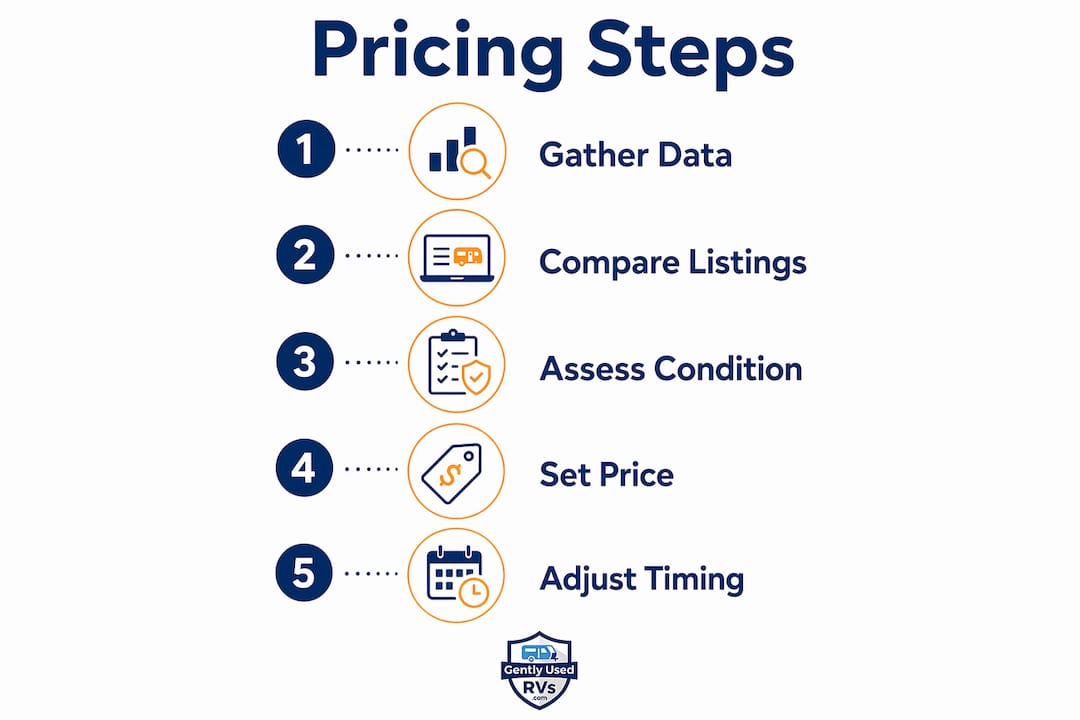
Pricing a used RV is the process of combining official valuation data, live market comparisons, and condition-based adjustments to arrive at a fair market value that attracts buyers fast. This is how to price used rv explained in practical terms: you start with NADA (JD Power) guides to establish a baseline, then cross-reference 5–8 active private listings within 500 miles to find where your RV sits competitively. Timing matters too. Selling in peak season or adjusting for a softened 2026 market can mean the difference between a quick sale and months of silence. Get the combination right, and you sell faster and for more money.
How to price a used RV: NADA, trade-in, and retail values
NADA (now published under JD Power) is the industry-standard valuation tool for used RVs. It gives you two critical numbers: trade-in value and retail value. Understanding the gap between them is the foundation of every smart pricing decision.
Trade-in value is what a dealer will offer you. It is always lower than retail because dealers price using a formula that subtracts reconditioning costs, a profit margin, and a risk buffer from the retail value. That formula explains why a dealer’s offer can feel insulting. It is not personal. It is math.

Retail value is what a dealer would charge a buyer for the same RV after reconditioning. As a private seller, you have a real advantage here. You do not carry dealer overhead, so you can price below retail and still walk away with more than a trade-in would net you.
The right private seller price sits between trade-in and retail, leaning closer to retail when your RV is in excellent condition. Here is how to build your range:
- Pull the NADA trade-in value for your exact year, make, model, and trim.
- Pull the NADA retail value for the same unit.
- Calculate the midpoint. That midpoint is your starting anchor.
- Adjust upward for low mileage, recent upgrades, or a clean service record.
- Adjust downward for age, cosmetic wear, or any mechanical issues.
Pro Tip: NADA values are a floor and ceiling, not a final price. The real market is what active listings near you are actually asking. Use NADA to set your range, then use live listings to find your exact number.
One more thing to keep in mind: NADA values do not always reflect current wholesale auction floors. Dealers rely on wholesale auction data beneath the consumer guides to determine their real offers. That means NADA retail can sometimes run higher than what the actual market supports. Always verify against live listings before you commit to a number.
Why comparing active listings sharpens your asking price
NADA gives you a range. Active listings tell you where buyers are actually shopping. Both are required for a defensible asking price.
The goal is to find 5–8 private listings that closely match your RV in type, age, mileage, and condition. A 500-mile search radius is the right scope. It is wide enough to capture meaningful data but tight enough to reflect your actual buyer pool. Here is a step-by-step process:
- Search for your RV type (Class A, fifth wheel, travel trailer, etc.) on listing platforms within 500 miles.
- Filter by model year within two years of yours, either direction.
- Note the asking prices of private sellers only. Dealer listings carry overhead costs that inflate prices.
- Rank those listings from lowest to highest asking price.
- Identify the lower third of that range. That is your competitive target zone.
Pricing in the lower third of comparable active listings is the single most effective way to attract serious buyers quickly. Buyers browsing listings compare multiple options at once. A price in the lower third signals value without screaming desperation.
The biggest mistake sellers make is padding the price to leave room for negotiation. That strategy backfires. Serious buyers filter by price range and never see your listing. The buyers who do inquire are bargain hunters who will grind you down anyway. You end up at the same final number, but after weeks of wasted time.
Pro Tip: Screenshot your comparable listings when you set your price. Markets shift. If you need to justify your price to a buyer or adjust it later, that documentation shows your reasoning was grounded in real data, not guesswork.
How does timing affect used RV pricing and sale speed?
Timing is a pricing variable most sellers ignore. It should not be. The month you list your RV can shift its effective value by a meaningful margin.
Peak selling season runs from February through April. Buyers are planning summer trips, tax refunds are landing, and demand spikes. Listing during this window can yield prices 10–15% higher than off-peak months like June through August. That is a real dollar difference on a $40,000 RV.
The 2026 market adds another layer of complexity. Wholesale motorhome values averaged around $62,000 in Q2 2026, and mid-range towables have seen significant price drops compared to prior years. Buyers in 2026 are focused on monthly payment affordability, with the strongest demand concentrated in the $25,000–$50,000 price range. If your RV falls in that band, you have a real audience. If it sits above it, your pricing strategy needs to be sharper.
| Market Condition | Recommended Strategy |
|---|---|
| Peak season (Feb–Apr) | Price at or near midpoint of NADA range |
| Off-peak (Jun–Aug) | Price in lower third of comparable listings |
| Softened 2026 market | Prioritize speed; price competitively from day one |
| High-demand $25k–$50k range | Hold firm on price; buyer pool is active |
| Above $50k in soft market | Adjust early; avoid extended days on market |
The 90-day rule is worth knowing. Inventory sitting beyond 90 days forces deep discounts that erode your net return. Dealers manage this with micro-adjustments of 1–3% in days 31–60 to stay competitive before the forced markdown hits. Private sellers should apply the same discipline.
“If your listing has been live for 30 days with no serious inquiries, the market is telling you something. A 3–5% price reduction at that point costs you less than another 60 days of carrying costs and eventual desperation pricing.”
Check your listing’s performance at the two-week mark. Zero inquiries in 14 days is a clear signal your price is too high by roughly 5–7%. Adjust early and re-enter the competitive band before your listing goes stale.
Why RV condition and presentation directly affect your sale price
Condition is the most controllable variable in your pricing equation. A clean, well-maintained RV commands a higher price and sells faster. A neglected one forces you to discount, often more than the cost of fixing it would have been.
The math on professional detailing is compelling. A professional interior detail costing $300–$500 can increase your resale value by $1,000–$2,000. That is a 3x to 5x return on a straightforward investment. Most sellers skip it and then wonder why buyers lowball them.
Here is what buyers and dealers both evaluate when they assess condition:
- Interior cleanliness: Stains, odors, and worn upholstery are the first things a buyer notices. They signal neglect even when the mechanical systems are fine.
- Exterior condition: Faded decals, oxidized fiberglass, and roof sealant cracks all suggest deferred maintenance. A wash, wax, and fresh sealant cost very little.
- Mechanical reliability: A recent service record, fresh tires, and working appliances remove buyer hesitation. Buyers price in risk. Remove the risk, and they stop discounting.
- Slide-outs and awnings: These are high-anxiety items for buyers. Demonstrate they work smoothly. If they do not, fix them or price accordingly.
- Documentation: Service records, original manuals, and receipts for upgrades add perceived value. They show you cared for the RV.
A clean and mechanically sound RV reduces the reconditioning cost a dealer would factor into a trade-in offer. For private sales, it removes the buyer’s justification for a lowball offer. Think of condition improvements as pre-negotiation. Every dollar you spend on presentation is a dollar you protect in your asking price.
The used rv resale value of your specific unit is not fixed. You have real control over it. A $200 detail, a $50 tube of roof sealant, and a $30 tire pressure check can shift buyer perception by thousands of dollars.
## what i’ve learned about pricing rvs after years of watching sellers get it wrong
I have watched sellers repeat the same two mistakes so consistently that they almost feel like a tradition. The first is padding the price for negotiation room. The second is waiting too long to adjust when the market pushes back.
The padding strategy feels logical. You think, “I’ll ask $45,000 and accept $40,000.” What actually happens is that buyers searching up to $40,000 never see your listing. The buyers who do find it at $45,000 either skip it or open with a $35,000 offer. You end up negotiating from a worse position than if you had priced honestly from the start. Realistic pricing attracts faster sales and better-quality buyers. That is not a theory. It is what the data consistently shows.
The second mistake is emotional attachment to a number. I understand it. You bought that RV, made memories in it, and maintained it well. But the market does not pay for memories. It pays for condition, comparables, and timing. When your listing sits for 45 days with two lowball inquiries, the answer is almost never “wait longer.” It is almost always “adjust the price now.”
What I recommend to every seller: document everything before you list. Photograph the service records. Take a short video of the slide-outs working, the appliances running, and the exterior in good light. Buyers who can see evidence of care will pay more and negotiate less. That documentation also gives you confidence to hold your price when a buyer tries to discount you for imaginary problems.
One more thing. If you are selling in the current 2026 market, check the 2026 seller’s market conditions before you set your number. The market has softened. Pricing as if it is 2021 will cost you months and margin.
— Christopher
List your RV on Gentlyusedrvs and reach serious buyers
Once you have your price dialed in, the next step is getting it in front of the right buyers. Gentlyusedrvs is a free marketplace built for exactly this. You can list your RV for free with no commissions and no hidden fees, and buyers can find your listing without even creating an account.

The platform covers every RV type, from Class A motorhomes to teardrop trailers. If you are not sure how your RV fits into the broader market, the RV types guide breaks down each category with pricing context that helps you position your listing accurately. Upgrade options like Gold ($199 for 6 months) give your listing nationwide visibility with live buyer chat and appointment scheduling built in. Start free, price smart, and sell faster at Gentlyusedrvs.
FAQ
What is the best starting point for pricing a used RV?
Start with NADA (JD Power) to establish your trade-in and retail value range, then compare 5–8 active private listings within 500 miles to find where your price should land competitively.
How much does RV condition affect the sale price?
Condition has a direct and measurable impact. A professional detail costing $300–$500 can increase resale value by $1,000–$2,000, and a clean mechanical record removes the buyer’s justification for lowball offers.
When is the best time of year to sell a used RV?
February through April is peak demand season. Listing during this window can yield prices 10–15% higher than off-peak months, making timing one of the most underused pricing tools available to private sellers.
What should i do if my listing gets no inquiries?
Zero inquiries in the first 14 days signals your price is likely 5–7% too high. Drop the price into the competitive band immediately rather than waiting, since listings that sit too long lose buyer confidence regardless of price.
Should i price high to leave room for negotiation?
No. Padding your price for negotiation room filters out serious buyers who search within a set price range. Pricing at realistic market value attracts faster offers and better-quality buyers from the start.
Key takeaways
Accurate used RV pricing requires NADA valuation data, live market comparisons, condition investment, and timing awareness working together to produce a competitive and realistic asking price.
| Point | Details |
|---|---|
| Start with NADA values | Use JD Power trade-in and retail figures to define your minimum and maximum price range. |
| Compare active listings | Find 5–8 similar private listings within 500 miles and price in the lower third of that range. |
| Time your listing | Listing in February through April can yield 10–15% more than off-peak months. |
| Invest in condition | A $300–$500 professional detail can return $1,000–$2,000 in added resale value. |
| Adjust within 14 days | Zero inquiries in two weeks means your price is too high; drop 5–7% to re-enter the competitive band. |