
Late January through March is your sweet spot for selling an RV. Buyers are planning summer trips, tax refunds are landing in bank accounts, and fewer private sellers are competing for attention than during peak spring. If you’re in a warm-climate market like Arizona or Florida, or you’ve got a cash buyer knocking, that calendar can bend in your favor.
TL;DR:
- Listing your RV in late winter to early spring minimizes competition and aligns with increased buyer demand driven by tax refunds and upcoming trips.
- Selling before peak season (February to May) allows you to reach motivated buyers and secure better prices, especially in markets with low supply early in the year.
- Waiting for the spring or summer peak can incur significant storage, insurance, and depreciation costs that may outweigh the benefit of a higher sale price.
- Regional markets in warm-weather states like Florida and Arizona maintain steady demand year-round, making seasonal timing less critical there.
- Proper preparation, competitive pricing, and a disciplined negotiation approach are essential regardless of the season to maximize your sale’s success.
Table of Contents
- When to Sell an RV: Why Late Winter to Early Spring Works
- How Does Selling Timing Change by Season?
- Do Regional Markets Change the Best Time to Sell?
- What Does It Cost You to Wait for a Better Season?
- How Do You Decide: List Now or Wait for Peak Season?
- How Should You Prepare Your RV Before Listing?
- Where Should You Sell, and Does Timing Change by Channel?
- How Do You Set the Right Asking Price?
- What’s a Realistic Timeline for Listing Your RV?
- What Actually Determines the Right Time to Sell?
- List Your RV on Gently Used RVs During Your Best Selling Window
- Sources
When to Sell an RV: Why Late Winter to Early Spring Works
Timing your listing to catch this window isn’t guesswork. It’s math, psychology, and a little seasonal buyer behavior working together in your favor.
Tax refunds start hitting accounts in February, and for a lot of buyers, that check is the difference between “someday” and “let’s go look at RVs this weekend.” Cash flow shapes buying decisions more than people admit, and RV buyers are no exception. At the same time, anyone dreaming of a summer road trip starts shopping in late winter, not June. By the time summer actually arrives, serious buyers have already closed deals or narrowed their search.
Early-season RV shows add fuel to this fire. They put motorhomes and trailers in front of thousands of shoppers at once, and that attention spills over into private listings for weeks afterward. Industry guides point to tax refund season and early-year shows as reliable demand multipliers for private sellers specifically.
Here’s the part most sellers overlook: supply matters as much as demand.
- Fewer private sellers list in January and early February, so your rig faces less direct competition.
- By April and May, the market floods with listings, which pushes buyers to negotiate harder and compare more options.
- Listing before that flood means your RV gets seen by motivated buyers before they have twenty other choices open in browser tabs.
Most seller guides and market analyses point to this late winter to early spring window as the strongest for private listings, and the reasoning holds up: motivated buyers, lower supply, and cash in hand. Listing a bit earlier in spring, before the peak listing mania hits, tends to capture buyers who plan their trips early and often yields better offers than fighting for attention in the thick of peak season.
How Does Selling Timing Change by Season?
Each season carries its own rhythm, and knowing what to expect helps you decide whether to list now or hold for a better window.
- Spring (February through May): This is peak demand. List early in this window, ideally by mid-February, to reach decision-stage buyers before competition floods the market. Prices tend to be strongest here, and showings come quickly.
- Summer (June through August): Early summer still supports solid sales, especially for buyers who missed the spring rush but still want a trip before fall. By late summer, urgency fades. Buyers who wanted a rig for this season already bought one, and prices soften as a result.
- Fall (September through November): Fewer listings compete for attention, and the buyers who are shopping tend to be serious, not casual browsers. Foot traffic and inquiry volume drop, though, so expect a slower sale even if the eventual price holds up.
- Winter (December through mid-January): This is the slowest stretch for most of the country. Cold weather kills impulse shopping, and most buyers aren’t thinking about RVs until refund season approaches. Exceptions exist: Sun Belt markets and cash buyers keep moving even when everyone else has parked for the season.
Seasonal data from RV Buyers USA backs this pattern up: demand climbs from February through May, softens noticeably after July, and drops sharply after Labor Day. Plan around that curve, not around when it’s convenient for you to clean out the garage.
Do Regional Markets Change the Best Time to Sell?
National seasonal trends are a starting point, not a rulebook. Your local market can override the calendar entirely.
- Sun Belt and coastal markets in Arizona, Florida, and parts of California often sustain buyer demand through winter, since RV life doesn’t pause when there’s no snow to avoid.
- Snowbird and full-timer communities create a steady off-season buyer pool. These buyers shop in November and December specifically because they need a rig before heading south, not because a calendar told them to.
- Smaller local markets carry less urgency and fewer active buyers at any given time, which usually means pricing needs to stay more competitive regardless of season.
If you’re trying to sell an RV in Texas, a state with year-round outdoor recreation and a huge full-time RV population, winter listings can perform far better than they would in Minnesota. The same logic applies to selling an RV in Florida or Arizona, where warm-weather demand doesn’t fully disappear even in January.
What Does It Cost You to Wait for a Better Season?
Waiting for peak season sounds smart until you run the numbers on what that wait actually costs.
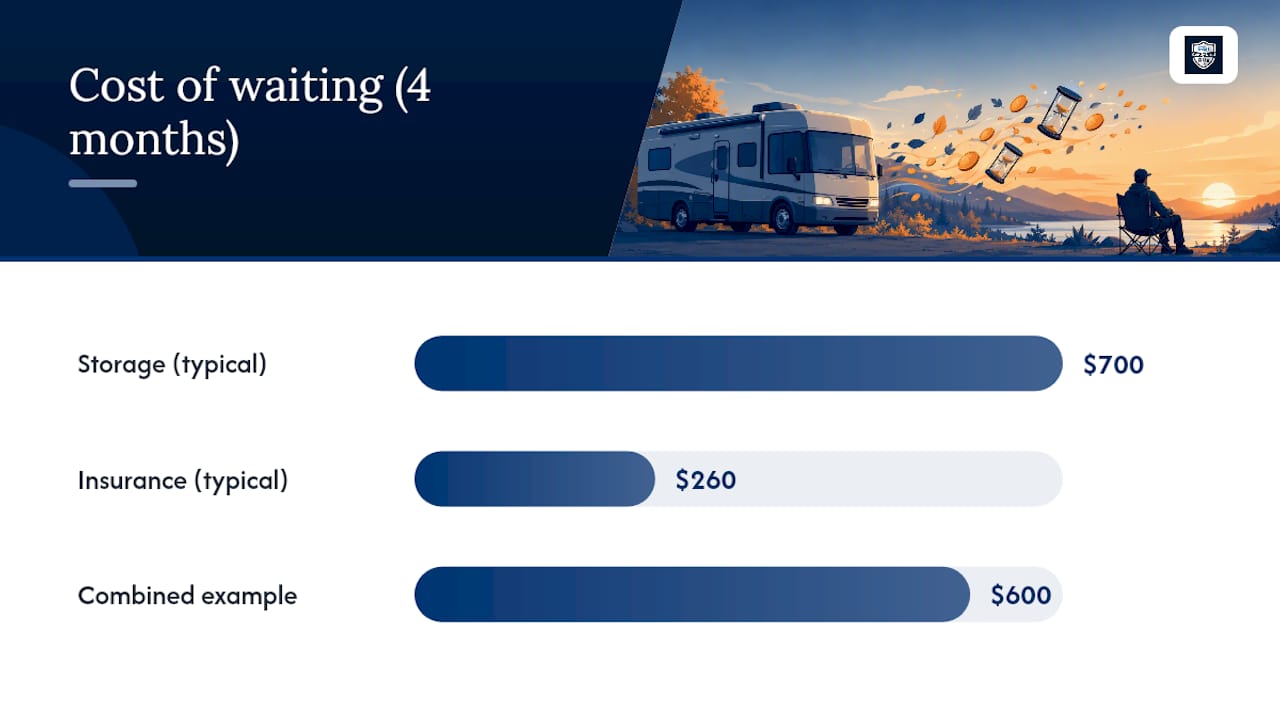
Every month you hold onto an RV instead of selling it, you’re paying to store it somewhere: whether that’s a storage lot, an insurance premium, or a slice of your driveway that could otherwise be used for something else. Add in continued depreciation, and the math gets less forgiving the longer you wait.
- Storage fees typically run $50 to $300 a month, depending on covered versus uncovered space and your region.
- Insurance on a stored RV still costs something, even at reduced rates, often $30 to $100 a month.
- Depreciation on a used RV commonly runs several percentage points of value per year, and it doesn’t pause while you wait for spring.
Pro Tip: Add up your monthly carrying costs, multiply by the number of months you’d wait, and compare that total against the realistic seasonal price bump for your rig. If the math doesn’t clear your carrying costs, sell now instead of banking on a better offer later.
A sample scenario makes this concrete. Say your RV carries $150 a month in storage and insurance combined. Waiting four months to hit peak season costs you $600 before you factor in depreciation. If your local market’s peak season bump is smaller than that, you’ve lost money by waiting, not made it. Sellers frequently underestimate how carrying costs eat into a seasonal price lift, and a modest bump can vanish entirely against a few months of holding expenses.
How Do You Decide: List Now or Wait for Peak Season?
A clear framework beats gut instinct every time, and this one only takes four steps.
- Know your BATNA. Your Best Alternative to a Negotiated Agreement is whatever you’d do if this sale falls through: trade it in, keep using it, or relist later. Value that alternative honestly.
- Translate BATNA into a reservation price. This is the lowest dollar figure you’ll accept before walking away. Setting this number in advance keeps emotion out of the negotiation later.
- Set your asking price above that floor. Leave room to negotiate without ever dipping below what you calculated as acceptable.
- Decide your cash-offer threshold. If a serious cash buyer shows up in October offering close to your reservation price, taking it usually beats gambling on a spring bump that carrying costs might erase anyway.
When you’re negotiating, avoid signaling urgency. Ask buyers what alternatives they’re considering. Use staged concessions instead of big price drops, moving down in small increments rather than caving all at once. Reframing your walk-away number as your “worst possible deal” rather than a casual bottom line triggers stronger loss aversion, which makes it easier to hold your ground when a lowball offer comes in. If you want more tactics for handling offers once they start coming in, negotiation tips built for RV sellers walk through common lowball scripts and how to respond.
How Should You Prepare Your RV Before Listing?
Timing gets you in front of buyers. Preparation gets you the offer you actually want.
- Detail thoroughly. A deep clean, inside and out, consistently returns more value than almost any other prep step you can take.
- Fix small cosmetic issues. Scuffed trim, worn seals, and dated fixtures are cheap to address and make a rig look cared for.
- Prioritize mechanical repairs that affect safety or function. Brakes, tires, and slide mechanisms matter more than cosmetic wear.
- Disclose issues you don’t fix. Buyers respect transparency, and undisclosed problems tend to surface during inspection anyway, killing deals late.
- Take photos in good light, from multiple angles, inside and out. Listings with more, better photos consistently outperform sparse ones.
- Gather your title, maintenance records, and any remaining warranties before you list, not after a buyer asks for them.
Seller guides consistently point to detailing, targeted repairs, strong photos, and complete records as the combination that improves both sale speed and final price. A detailing checklist built specifically for sellers can help you knock this out in a weekend instead of guessing what actually matters to buyers.
Where Should You Sell, and Does Timing Change by Channel?
The channel you choose changes how much seasonality matters and how much cash lands in your pocket.
- Private sale typically nets the most money, but it’s the most seasonal channel. Expect faster sales and stronger offers in your region’s peak window, and slower going the rest of the year.
- Dealer trade-in moves fast regardless of season, but you’ll usually net less than a private sale. It suits sellers who value speed over maximizing price.
- Consignment splits the difference: a dealer handles the sale for a cut of the proceeds, which smooths out some seasonal risk but still costs you margin.
- Cash buyers stay active even in slow months, since they price based on current market data rather than seasonal mood. Expect a lower offer in exchange for speed and certainty.
A smart approach combines channels: list privately to test the market while simultaneously entertaining a cash offer, so you keep upside potential without losing your fallback option. If a trade-in or consignment route fits your situation better than a private sale, browsing a dealer directory can help you compare local options before committing.
How Do You Set the Right Asking Price?
Pricing sits at the intersection of what your RV is worth and what the market will actually pay for it right now.
Start with a baseline from NADA (J.D. Power) valuation guides, then cross-check against comparable listings in your area. From there, adjust for upgrades like solar setups or newer tires, current mileage, overall condition, and how hot your local market happens to be. An RV with 40,000 miles and recent maintenance records will hold value better than an identical model with double the mileage and no service history, even if both left the factory the same year.
Set your asking price above your calculated floor to leave negotiating room, but stay realistic. Overpricing kills momentum in the first two weeks, which is exactly when a listing gets the most attention. A step-by-step pricing guide walks through how to weigh these adjustments without over-guessing your number.
What’s a Realistic Timeline for Listing Your RV?
A structured timeline keeps prep from dragging out and helps you hit your target selling window instead of missing it.
- Weeks 1 to 3: Handle detailing, cosmetic fixes, and any mechanical repairs you’re prioritizing.
- Weeks 4 to 5: Shoot photos, gather documents, and write your listing description.
- Weeks 6 to 8: Go live, respond to inquiries quickly, and schedule showings.
- Weeks 9 to 12: Field offers, negotiate using your reservation price as your floor, and close.
Need to move faster? You can compress this into four to six weeks by skipping non-essential cosmetic work, but expect fewer showings and possibly a lower final price. Whatever your timeline, confirm safe payment methods before handing over keys, verify funds have actually cleared before signing the title, and never release the title until payment is final.
What Actually Determines the Right Time to Sell?
Most advice on RV selling timing treats the calendar like gospel: list in March, don’t list in November, follow the script. That’s not wrong, but it’s incomplete, and treating it as a universal rule causes sellers to leave money on the table in both directions.
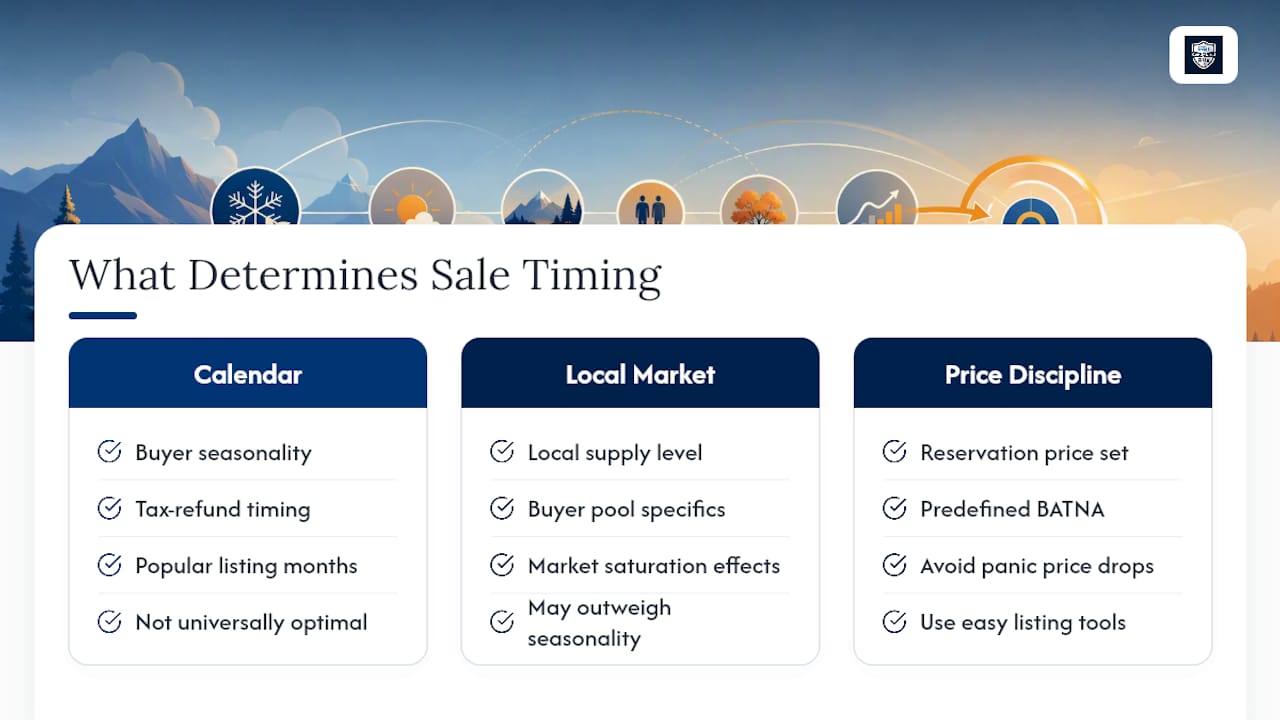
The seasonal pattern exists because buyer behavior clusters around trip planning and tax refunds, not because there’s something magical about March. If you’re sitting on a fifth wheel in Texas with a snowbird buyer pool circling in November, waiting for spring because a blog post told you to is a mistake. The same goes for a seller in a saturated Midwest market who lists in peak April alongside forty other similar rigs and wonders why offers are lower than expected. Supply matters as much as demand, and sometimes more.
What gets underused is the reservation-price discipline. Sellers get emotionally attached to a number they saw in a Facebook group or heard from a neighbor, then panic-drop the price the moment an offer comes in below it. A calculated BATNA and reservation price, built before you ever field an offer, does more to protect your bottom line than waiting for the “perfect” month ever will. Platforms that make listing and updating a price easy, like Gently Used RVs’s marketplace tools, give sellers room to test the market during a strong window without the friction of a slow, manual listing process. That combination, timing plus discipline, beats either one alone.
— Christopher
List Your RV on Gently Used RVs During Your Best Selling Window
Some online marketplaces are built to support a timing strategy where sellers list for free, then decide if they want more visibility during their peak window without paying a dealer’s commission. Some marketplaces feature an AI autofill tool that pulls year, make, model, specs, and photos straight from another listing URL in seconds, which means sellers can list quickly instead of losing their window to a slow listing process.

Geotargeting functionality can put listed RVs in front of nearby buyers first, targeting the audience most likely to convert during a high-demand season. Upgrading to wider geographic visibility can widen your buyer pool without having to wait for local buyer traffic that may be limited. Confirm your rig’s category using the RV types guide before you list, then create your free listing today and start reaching buyers while the season is still in your favor.
Sources
- How to Sell Your RV: The Complete Guide to Getting Top Dollar & Avoiding Common Mistakes | RVshare
- NADA (J.D. Power) valuation guides
- Reservation Price Negotiation: Set Your Walk-Away Point
- Stop Calling It a ‘Bottom Line’ | Psychology Today