What Is a Travel Trailer? Your 2026 Beginner’s Guide
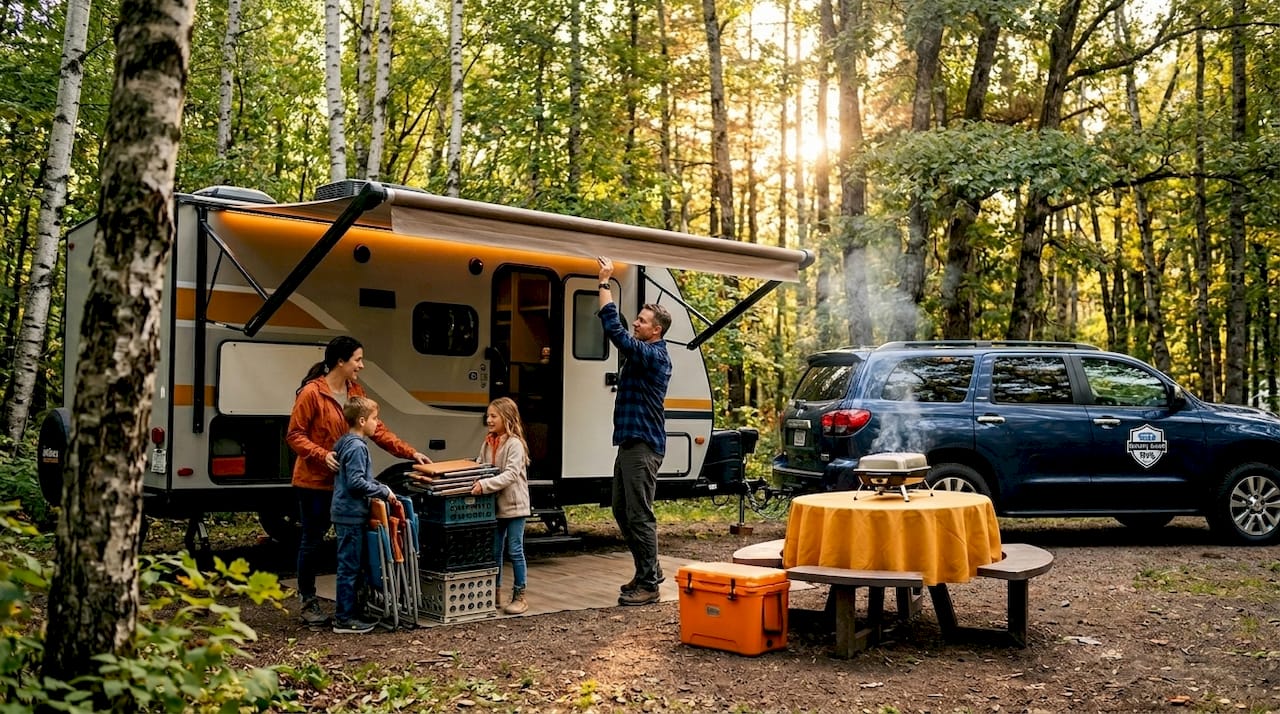
A travel trailer is defined as a towable dwelling drawn by an automobile or truck, equipped to serve as living quarters while traveling. Unlike a Class A or Class C motorhome, a travel trailer has no engine of its own. Your car, SUV, or pickup provides all the movement. That single distinction shapes everything about how you buy, tow, and live in one. Whether you are a solo weekend camper or a family planning a cross-country trip, understanding what a travel trailer is and how it works is the first step toward deciding if it fits your lifestyle.
What is a travel trailer, exactly?
A travel trailer is a portable home towed behind a separate vehicle, connecting via a hitch rather than sharing a chassis with an engine. The RV industry uses the term “towable RV” as the broader category, with travel trailers sitting alongside fifth wheels, pop-up campers, and toy haulers. Brands like Airstream, Keystone, Grand Design, and Forest River manufacture travel trailers across dozens of floor plans and price points. What separates a travel trailer from a camper van or motorhome is straightforward: the trailer relies on a tow vehicle for all propulsion, which means lower purchase prices and more flexibility once you are parked at a campsite.
The term “camper” is often used loosely to describe any RV, but in industry terms, a travel trailer is a specific towable category. Knowing the correct terminology matters when you are searching listings, comparing specs, or talking to dealers. You will see “bumper-pull trailer,” “conventional trailer,” and “travel trailer” used interchangeably in most marketplaces.
What types of travel trailers are there?
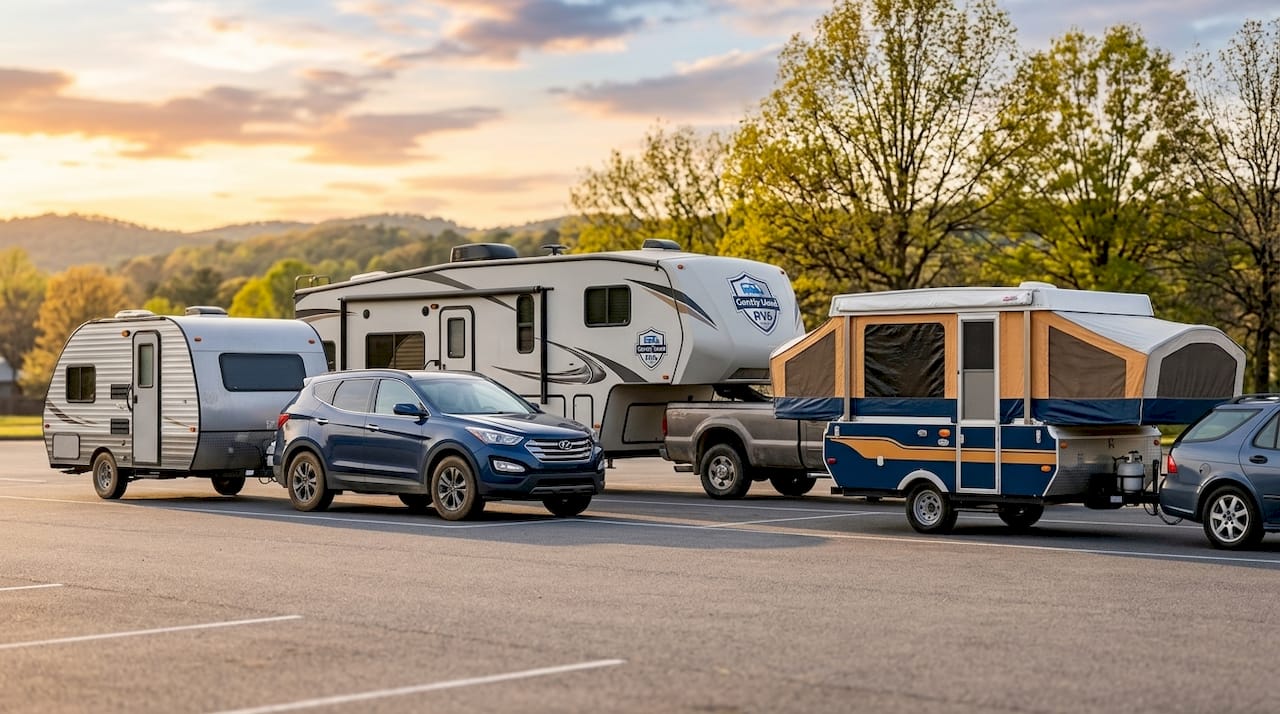
Travel trailers come in three primary configurations, each suited to different tow vehicles, budgets, and camping styles.
| Type | Typical Length | Hitch Required | Best For |
|---|---|---|---|
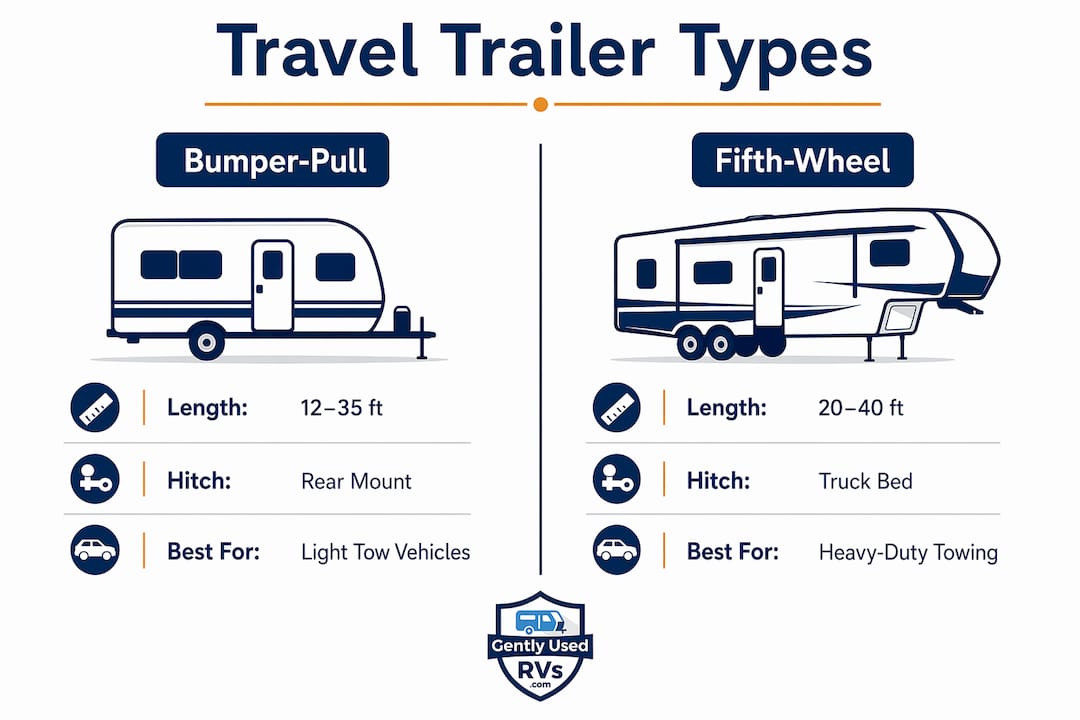
| Conventional (bumper-pull) | 12 to 35 feet | Ball mount receiver hitch | Cars, SUVs, half-ton trucks |
| Fifth-wheel | 22 to 40 feet | In-bed kingpin hitch | Three-quarter and one-ton pickup trucks |
| Pop-up / folding camper | 8 to 16 feet (unfolded) | Standard ball hitch | Compact cars, light-duty towing |
Conventional bumper-pull trailers are the most common type. They attach to a ball mount in your vehicle’s receiver hitch and range from compact teardrop models to full-size units with slide-outs. They work with a wide range of tow vehicles, which makes them the most accessible entry point for new buyers.
Fifth-wheel trailers use a kingpin hitch mounted in the truck bed, which delivers better weight distribution and significantly less sway than a bumper-pull setup. The trade-off is that you need a pickup truck, and the specialized hitch hardware adds cost. Fifth wheels are popular with full-timers and families who want maximum living space.
Pop-up campers fold down for towing and expand at the campsite, offering a lightweight and affordable way to get into towable RV life. They sacrifice some insulation and weatherproofing compared to hard-sided trailers, but they tow behind almost any vehicle.
What features do travel trailers include?
Travel trailers are designed to function as self-contained dwellings with sleeping areas, kitchens, bathrooms, and storage built into a compact floor plan. Modern units from manufacturers like Winnebago, Lance, and CrossRoads pack a surprising amount of livability into 20 to 30 feet of trailer.
Here is what you typically find inside a mid-range travel trailer:
- Sleeping: Fixed queen or king beds, convertible dinettes, or bunk beds in family-oriented floor plans
- Kitchen: Two to three burner propane stove, microwave, 12-volt refrigerator, and a sink with fresh water tank
- Bathroom: Wet bath or dry bath with toilet, shower, and vanity; some larger models include a separate tub
- Climate control: Rooftop air conditioning unit and a propane furnace for cold nights
- Utilities: Shore power hookup (30 or 50 amp), battery bank for dry camping, and fresh, gray, and black water tanks
- Storage: Exterior pass-through compartments, under-bed storage, and overhead cabinets
Floor plan choice is one of the most underrated decisions in the buying process. A rear-kitchen layout works well for couples who cook together. A bunkhouse floor plan makes sense for families with kids. A front-bedroom design with a rear living area suits full-timers who want clear separation between sleeping and living spaces.
Pro Tip: Before you fall in love with a floor plan online, spend time walking through the physical trailer at a dealership or RV show. Ceiling height, slide-out clearance, and bathroom size feel very different in person than they look in photos.
How do towing requirements and hitch types work?
Towing a travel trailer safely starts with one non-negotiable rule: your tow vehicle’s rated towing capacity must exceed the trailer’s loaded weight, not just its dry weight. Loaded trailer weight includes water in the tanks, food, gear, clothing, and any accessories you add after purchase. A trailer listed at 5,800 pounds dry can easily hit 7,500 pounds loaded. That gap catches new buyers off guard.
Here is a step-by-step framework for matching your tow vehicle to a trailer:
- Find your vehicle’s tow rating. Check the owner’s manual or the door jamb sticker, not third-party websites. Manufacturers set these ratings with specific hitch and brake controller configurations in mind.
- Calculate loaded trailer weight. Add the trailer’s dry weight plus water (8.3 pounds per gallon), gear, and personal items. A 30-gallon fresh tank alone adds 250 pounds.
- Check tongue weight. Tongue weight should be 10 to 15 percent of the loaded trailer weight. Too little causes trailer sway; too much overloads your hitch and rear axle.
- Match hitch class to trailer weight. Class III hitches handle up to 8,000 pounds; Class IV handles up to 14,000 pounds. Fifth-wheel hitches are rated separately and require a truck bed-mounted receiver.
- Add sway control if needed. Weight distribution hitches with integrated sway control bars are standard equipment for bumper-pull trailers over 5,000 pounds. They redistribute tongue weight across the tow vehicle’s front axle and reduce dangerous trailer oscillation.
Conventional bumper-pull trailers are more susceptible to sway than fifth wheels, particularly at highway speeds or in crosswinds. A fifth-wheel’s in-bed hitch geometry keeps the trailer centered over the rear axle, which is why experienced RVers often upgrade to fifth wheels for longer trips or heavier loads.
Pro Tip: Never rely on towing capacity alone when shopping. Pull up your vehicle’s payload sticker and subtract the hitch weight, passengers, and cargo you carry. That remaining number is your real-world towing headroom, and it is almost always lower than the advertised tow rating.
What are the benefits of travel trailers for recreational travel?
Travel trailers offer a combination of flexibility, affordability, and comfort that motorhomes simply cannot match at the same price point. Here is why they remain the most popular RV category in North America.
- Unhitch and explore. Once you park at a campsite, you unhitch and drive your tow vehicle freely. This flexibility is one of the biggest advantages over motorhomes, where moving the RV means packing up the entire campsite.
- Lower purchase price. Travel trailers cost less than motorhomes of comparable size, which opens RV life to buyers who cannot justify a six-figure motorhome purchase. A solid used bumper-pull trailer can be found for under $15,000.
- Easier maintenance. No engine, no transmission, no radiator. Trailer maintenance focuses on tires, brakes, bearings, seals, and the living systems inside. Most owners handle basic upkeep themselves.
- Size options for every lifestyle. A solo traveler can tow a 16-foot teardrop behind a Honda CR-V. A family of five can pull a 32-foot bunkhouse with a half-ton truck. The range of available sizes is unmatched in any other RV category.
- Diverse camping locations. Smaller travel trailers fit into national forest dispersed campsites and state park loops that Class A motorhomes cannot access. You get more destination options with less trailer.
- Storage when not in use. A travel trailer stores in a driveway, storage facility, or backyard without the complexity of storing a full motorhome. Many owners store theirs seasonally and tow it out for trips without any special licensing.
One practical note on storage: cover your trailer with a breathable RV cover if it sits outside for months. UV exposure degrades roof seals and sidewall graphics faster than most owners expect, and a failed roof seal is one of the most expensive repairs in the travel trailer world.
Key takeaways
A travel trailer is the most accessible, flexible, and affordable way to enter the RV lifestyle, provided you match the trailer’s loaded weight to your tow vehicle’s actual capacity before you buy.
| Point | Details |
|---|---|
| Core definition | A travel trailer is a towable RV with living accommodations but no engine of its own. |
| Three main types | Bumper-pull, fifth-wheel, and pop-up trailers each require different tow vehicles and hitches. |
| Weight matching is safety | Loaded trailer weight, not dry weight, determines whether your tow vehicle is truly capable. |
| Tongue weight matters | Keep tongue weight at 10 to 15 percent of loaded trailer weight to prevent dangerous sway. |
| Key lifestyle benefit | Unhitching at camp lets you explore locally without moving your entire living setup. |
Why weight management is the thing nobody tells you about
I have watched more first-time buyers get burned by the weight conversation than by any other single factor in the travel trailer buying process. They read the dry weight spec, confirm it sits under their truck’s tow rating, and sign the paperwork. Then they load up for their first trip and wonder why the truck feels sluggish and the trailer wanders at 65 mph.
The honest truth is that dry weight specs are marketing numbers. Real-world loaded weight is the number that matters, and it is almost always 1,000 to 2,000 pounds heavier than the sticker. Fill the water tank, pack the kitchen, load the bikes on the back rack, and add two adults with luggage. You will be shocked at how fast you approach your vehicle’s actual limit.
Floor plan selection is the other conversation that gets glossed over. People pick a floor plan because the photos look nice. What they should do is think hard about how they actually travel. Do you cook every meal? Get a real kitchen with counter space. Do you work remotely? Find a floor plan with a dedicated desk or dinette that does not convert to a bed. Do you camp in cold weather? Prioritize a four-season package with enclosed underbelly and heated tanks.
My strongest advice: rent a travel trailer for one weekend before you buy anything. Platforms like Outdoorsy and RVshare let you rent specific models. One night in a trailer you think you want will tell you more than six hours of YouTube research. You will either confirm your choice or save yourself from a very expensive mistake.
— Christopher
Find your next travel trailer on Gentlyusedrvs
Ready to put what you have learned into practice? Gentlyusedrvs is a free classifieds marketplace where private sellers and dealerships list travel trailers, fifth wheels, pop-up campers, and every other RV type across the U.S., Canada, and internationally. You can browse listings without creating an account, and search results are geotargeted so you see the closest available trailers first.

Start by exploring the RV types guide on Gentlyusedrvs to see how travel trailers compare to fifth wheels, truck campers, and motorhomes side by side. When you are ready to shop, listings include full specs, floor plan details, and photos so you can match a trailer to your tow vehicle before you ever contact a seller. You can also browse current inventory to see what is available near you right now, with no fees and no account required.
FAQ
What is the travel trailer definition in simple terms?
A travel trailer is a non-motorized RV towed by a car, SUV, or truck, equipped with sleeping, cooking, and bathroom facilities for use as a temporary dwelling while traveling.
How is a travel trailer different from a camper?
“Camper” is an informal term that covers many RV types. A travel trailer is a specific towable category with hard walls and full living amenities, while “camper” can also refer to truck campers, pop-up campers, or even motorhomes depending on context.
What vehicle do I need to tow a travel trailer?
The tow vehicle must have a rated towing capacity that exceeds the trailer’s loaded weight, which includes water, gear, and passengers. Most half-ton trucks and larger SUVs handle trailers up to 8,000 to 10,000 pounds with the correct hitch class installed.
What is the difference between a bumper-pull and a fifth-wheel trailer?
A bumper-pull trailer attaches to a ball mount in your vehicle’s receiver hitch, while a fifth-wheel uses a kingpin hitch mounted in a pickup truck bed. Fifth wheels offer better stability and higher weight capacity but require a pickup truck and specialized hardware.
Are travel trailers good for beginners?
Yes. Travel trailers are the most beginner-friendly towable RV category because they work with a wide range of tow vehicles, come in sizes from 12 to 40 feet, and cost less than motorhomes. Starting with a smaller bumper-pull model lets you learn towing basics before moving to larger units.