What Is a Pop-Up Camper? Your 2026 Buyer’s Guide
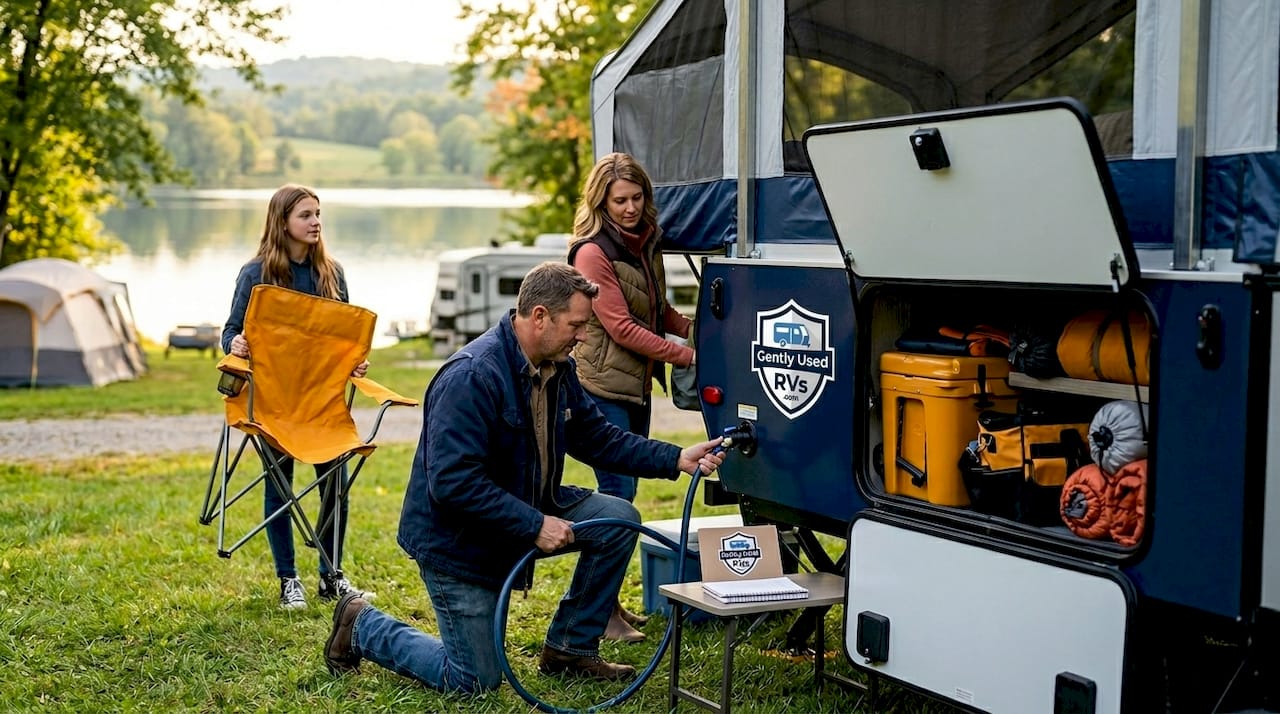
If you’ve ever spotted a low-slung trailer in a campground that somehow expanded into a full living space, you’ve already seen a pop-up camper in action. Understanding what is a pop-up camper matters if you’re tired of sleeping on the ground but not ready to commit to a full-sized RV. These rigs sit in a sweet spot between a tent and a travel trailer, offering real beds, a working kitchen, and weather protection at a fraction of the cost and towing complexity of larger units.
Table of Contents
- Key takeaways
- What is a pop-up camper?
- Pop-up camper features and amenities
- Pros and cons vs. other camping options
- Who should consider a pop-up camper
- Practical tips for first-time owners
- My honest take after years in the RV world
- Find your pop-up camper on Gentlyusedrvs
- FAQ
Key takeaways
| Point | Details |
|---|---|
| Lightweight and towable | Most pop-ups can be towed by an SUV or mid-size truck, making them accessible for more drivers. |
| Comfort upgrade from tents | They offer real sleeping surfaces, kitchenettes, and optional heating without the bulk of a motorhome. |
| Setup takes time and practice | Expect 15 to 30 minutes of hands-on work each time you arrive at a campsite. |
| Canvas care is non-negotiable | Drying tent materials fully after every trip is the single most important maintenance step. |
| Budget-friendly entry point | Used pop-up campers are among the most affordable RV options on the market today. |
What is a pop-up camper?
A pop-up camper is a lightweight, towable RV that collapses into a low-profile trailer for transport and then expands into a full living space when you reach camp. The base is typically a hard-sided box made from aluminum or fiberglass. The walls and sleeping sections that extend out are made from canvas or vinyl, which is what allows the unit to compress so dramatically for travel.
You’ll also hear these rigs called tent trailers, fold-down campers, or folding camper trailers. All of these names describe the same basic concept. The key mechanical feature is a lifting system, either manual crank or electric, that raises the roof and extends the sleeping bunks outward from the sides of the trailer.
Here’s what makes them structurally distinct from other trailers:
- Hard base: Protects your gear, appliances, and floor space during transit
- Soft walls: Canvas or vinyl panels connect the base to the raised roof, creating interior volume
- Slide-out bunks: Sleeping platforms extend from either end, dramatically expanding usable square footage
- Lifting mechanism: A hand crank or 12-volt electric system raises the roof with minimal effort
- Compact towing profile: When folded, many models stand under 5 feet tall, which makes parking and storage simple
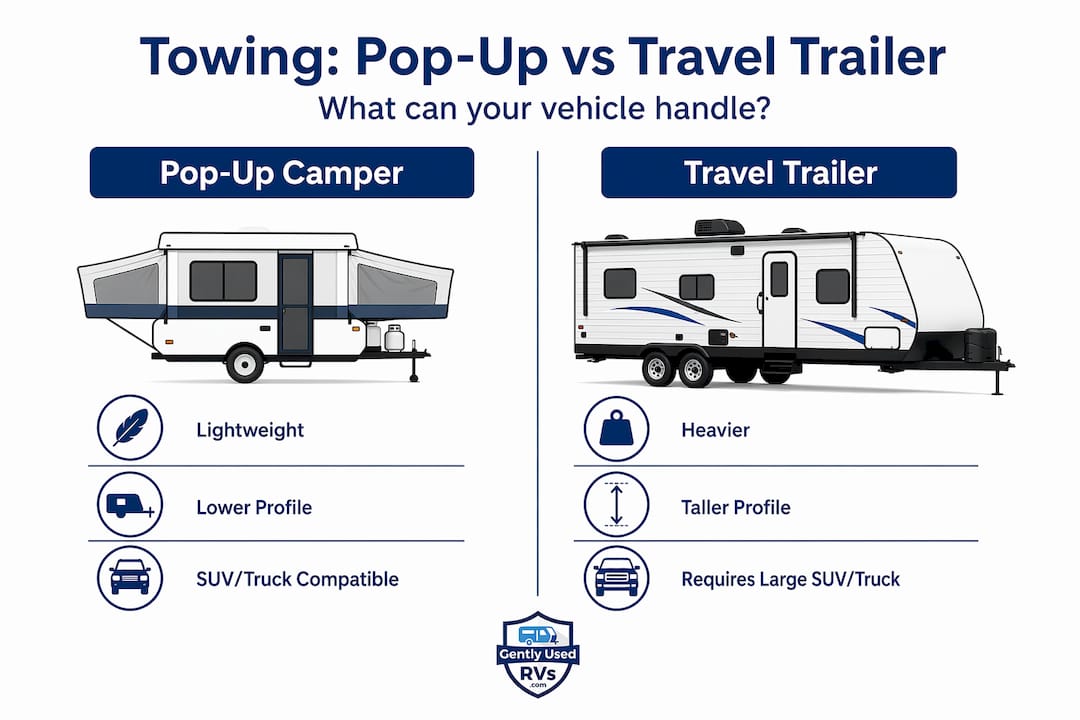
Towing requirements are one of the biggest reasons people choose pop-ups over traditional travel trailers. Many models weigh between 1,500 and 3,500 pounds, which puts them well within the towing capacity of popular vehicles like the Toyota 4Runner, Ford Explorer, or Honda Pilot.
Pro Tip: Before you buy, check your vehicle’s tow rating in the owner’s manual. The trailer’s gross vehicle weight rating (GVWR) should come in at least 10 to 15 percent below your vehicle’s maximum tow capacity to leave a safety margin.
Pop-up camper features and amenities
Pop-up campers have come a long way from the bare-bones fold-outs of the 1970s. In 2026, you can find models that range from stripped-down sleeping platforms to rigs with more amenities than some studio apartments.
Here’s how the tiers typically break down:
| Feature | Entry-Level | Mid-Range | High-End |
|---|---|---|---|
| Sleeping capacity | 2 to 4 (canvas bunks) | 4 to 6 (bunks + dinette) | 6+ (bunks, dinette, optional indoor bed) |
| Kitchen | None or cooler only | Sink, 2-burner stove | Sink, stove, refrigerator |
| Climate control | None | Furnace option | AC + heat |
| Bathroom | None | Portable toilet | Wet bath or cassette toilet |
| Power | 12V battery | Shore power hookup | Solar-ready, generator prep |
Higher-end models in 2026 offer heating, refrigerators, and even toilets, blurring the line between tent camping and full RV comfort. That upgrade in amenities does come with trade-offs. Each added feature adds weight, which affects your towing capacity requirements and fuel economy on the road.
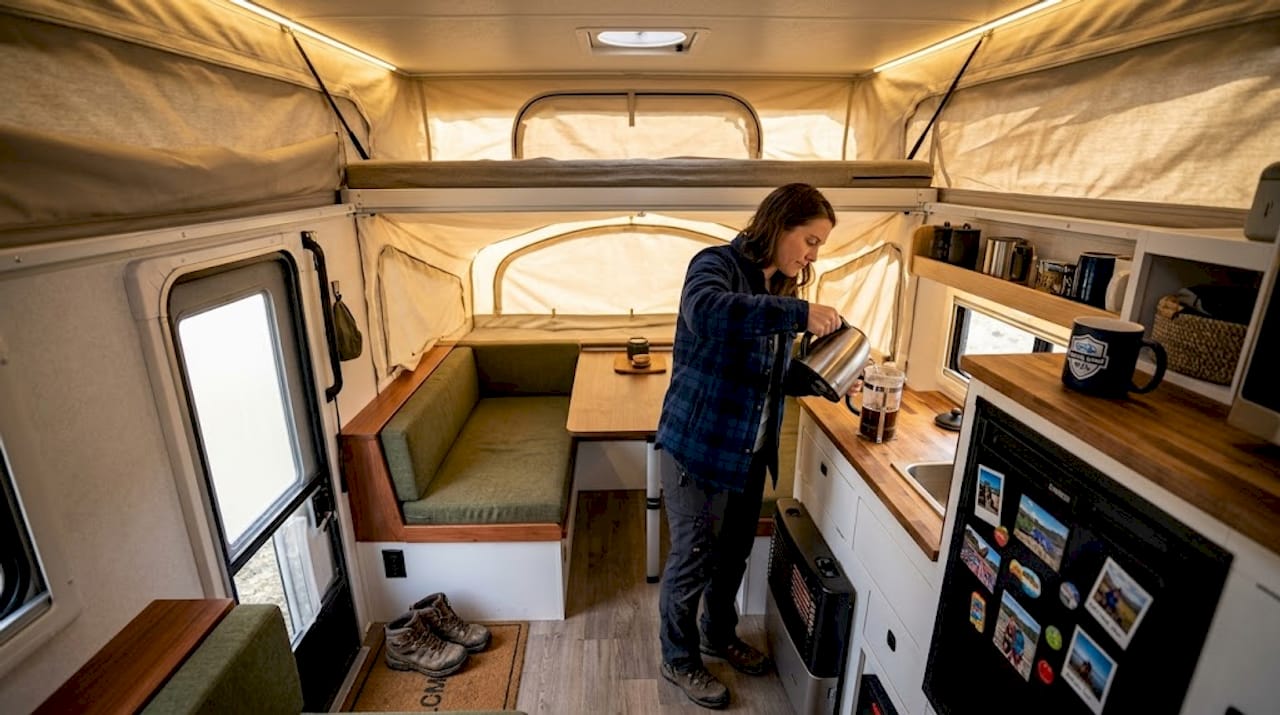
The latest trend worth watching is off-grid capability. Several manufacturers now ship pop-ups with roof-mounted solar panels, lithium battery banks, and composting toilet options. These features appeal to campers who want to get away from crowded hookup sites and spend time on public land or backcountry campgrounds.
Pairing your pop-up with the right outdoor gear matters too. Compact portable camp seating and folding tables extend your living area outside, which is where most pop-up campers end up spending their time anyway.
Pros and cons vs. other camping options
No piece of camping gear is perfect for every situation. Pop-up campers have real advantages and genuine drawbacks. Knowing both going in saves you from buyer’s remorse.
| Category | Pop-Up Camper | Hard-Sided Travel Trailer | Tent |
|---|---|---|---|
| Towing ease | Easy | Moderate to difficult | N/A |
| Fuel economy | Better (low wind drag) | Worse | N/A |
| Setup time | 15 to 30 minutes | Under 10 minutes | 10 to 20 minutes |
| Weather protection | Moderate | Excellent | Poor |
| Storage space | Compact | Large | Minimal |
| Cost (used) | Low | Moderate to high | Very low |
Pop-ups produce lower environmental impact compared to standard travel trailers, largely because the folded-down profile cuts wind resistance during towing. Less drag means your tow vehicle burns less fuel on highway miles. That adds up over a camping season, both at the pump and in terms of your carbon footprint.
The downsides are real though. Soft walls offer less protection against wildlife, cold temperatures, and security threats than the solid aluminum walls of a hard-sided trailer. If a bear decides your campsite is interesting, canvas is not much of a deterrent. In the same way, pop-ups are challenging to use comfortably in temperatures below about 30°F without a robust heating system.
Pro Tip: If you camp primarily in summer and shoulder-season months, pop-ups perform excellently. If you want to camp in snow or deep winter, look for a model with a propane furnace and heavy-duty insulation, or consider a hard-sided trailer instead.
Setup adds 15 to 30 minutes to your arrival routine versus the near-instant readiness of a travel trailer. That’s not a dealbreaker. But it’s something to factor in on short overnight trips when you want to maximize your time outdoors rather than setting up camp.
Who should consider a pop-up camper
Pop-up campers are not for everyone. But for a specific group of campers, they are almost the perfect fit.
You are likely a strong candidate for a pop-up if:
- You currently tent camp and want more comfort without buying a massive rig
- You drive an SUV, minivan, or mid-size truck that can’t tow a full travel trailer
- Your storage situation is limited to a standard home garage or driveway
- You camp mainly in spring, summer, and fall with occasional mild-weather shoulder season trips
- Your budget for a first camper is somewhere in the $3,000 to $15,000 range
The hybrid comfort and storage convenience of a pop-up makes it an ideal upgrade for tent campers. You keep the lightweight, easy-to-store footprint while gaining real sleeping surfaces, a protected kitchen, and bug-free evenings.
Where pop-ups fall short is with larger families who need hard-wall privacy or folks who camp in extreme weather regularly. A family of six crammed into canvas bunks in a rainstorm will quickly wish they had chosen something with solid walls and a real bathroom. The experience is also less suitable for remote, off-road adventures since most pop-up chassis sit low and are not built for rough trails.
Camping frequency matters too. If you camp 20 or more nights a year, the 15 to 30 minute setup time is easy to absorb. If you camp three or four weekends a year and hate fiddling with equipment, the setup routine might wear on you faster than you expect.
Practical tips for first-time owners
Buying and owning a pop-up camper smoothly comes down to knowing a handful of habits and doing them consistently.
-
Inspect before you buy. Check every seam of the canvas for tears, staining, or mildew smell. Pull the bunks all the way out and look for soft spots or water damage along the edges. Test the lift mechanism under power if it’s electric.
-
Dry the canvas completely before closing up. Canvas left damp causes mold and mildew that can destroy the tent walls within a single season. After every trip, set up the camper at home on a sunny day and let it air dry for several hours before folding it back down.
-
Practice setup at home before your first trip. Setup requires leveling, unlatching, and raising the camper in a sequence that takes practice to execute smoothly. Doing it once or twice in your driveway before your actual camping trip is worth every minute.
-
Lubricate the lift mechanism annually. A squirt of white lithium grease on the lift cable, pulleys, and hinges keeps the system working without binding or corrosion.
-
Store it covered and off-season ready. Use a fitted RV cover to protect the canvas from UV degradation and rodent damage during winter storage. Place mouse traps or deterrents inside. Disconnect the battery and remove perishables completely.
Pro Tip: When searching for used pop-up campers, treat online classifieds like any major purchase. Verify the seller’s identity, ask for the VIN, and inspect in person before any money changes hands.
My honest take after years in the RV world
I’ve watched hundreds of people walk into the used RV market expecting a quick, simple purchase, and I’ve seen just as many come out confused or burned because they underestimated what pop-up ownership actually involves.
Here’s what I’ve learned: the people who thrive with pop-up campers are the ones who genuinely enjoy the process of camping, not just the destination. Setting up camp, making coffee on a two-burner stove, and sleeping with canvas walls between you and the trees. That experience is not a compromise. For many campers, it’s the whole point.
What I’ve also seen is newcomers who expect instant gratification and skip the setup practice phase. Then their first real trip turns into a 45-minute struggle in a campground parking lot. That’s avoidable. Do the driveway dry run. Do it twice.
The environmental angle is real and underappreciated. Eco-conscious campers who care about fuel consumption and transit footprint will find pop-ups to be one of the most responsible RV choices out there. Smaller tow load, less fuel burned, less impact. That matters.
My honest advice: if you’re on the fence between a pop-up and a small travel trailer, rent both for a weekend before you commit. You’ll know within the first hour which one fits your style. No amount of reading replaces that.
— Christopher
Find your pop-up camper on Gentlyusedrvs
If you’re ready to start shopping, Gentlyusedrvs is one of the most practical places to look. It’s a free online classifieds marketplace where private sellers and dealerships list used RVs of every type, including pop-up campers at a wide range of price points. You can browse pop-up listings without creating an account, and search results are geotargeted so you see the closest rigs first.

Not sure how pop-up campers compare to travel trailers, fifth wheels, or Class C motorhomes? The RV types guide on Gentlyusedrvs breaks down every major RV category so you can compare features, weights, and price ranges side by side. Sellers list for free, and the platform includes an AI-powered listing tool that auto-fills specs from existing dealer pages. If you’re selling a pop-up or buying your first one, this is where we’d point you first.
FAQ
What does a pop-up camper look like when folded?
When folded for transport, a pop-up camper looks like a low rectangular trailer, typically under 5 feet tall. Most have a hard-sided base with canvas or vinyl material folded tightly inside.
How much does a used pop-up camper cost?
Used pop-up campers commonly range from $3,000 to $15,000 depending on age, condition, and features. Entry-level models with minimal amenities are often available under $5,000.
Can a regular car tow a pop-up camper?
Most pop-up campers weigh between 1,500 and 3,500 pounds, making them towable by many SUVs and mid-size trucks. Always verify your vehicle’s tow rating before purchasing any trailer.
How long does pop-up camper setup take?
Setup typically takes 15 to 30 minutes and involves leveling the trailer, unlatching, and raising the camper using a manual crank or electric lift system.
Are pop-up campers good for cold weather camping?
Pop-up campers with thin canvas walls offer limited insulation and are generally best suited for three-season camping. Models with propane furnaces and reinforced insulation can handle mild cold, but soft walls provide less protection than hard-sided RVs in extreme temperatures.