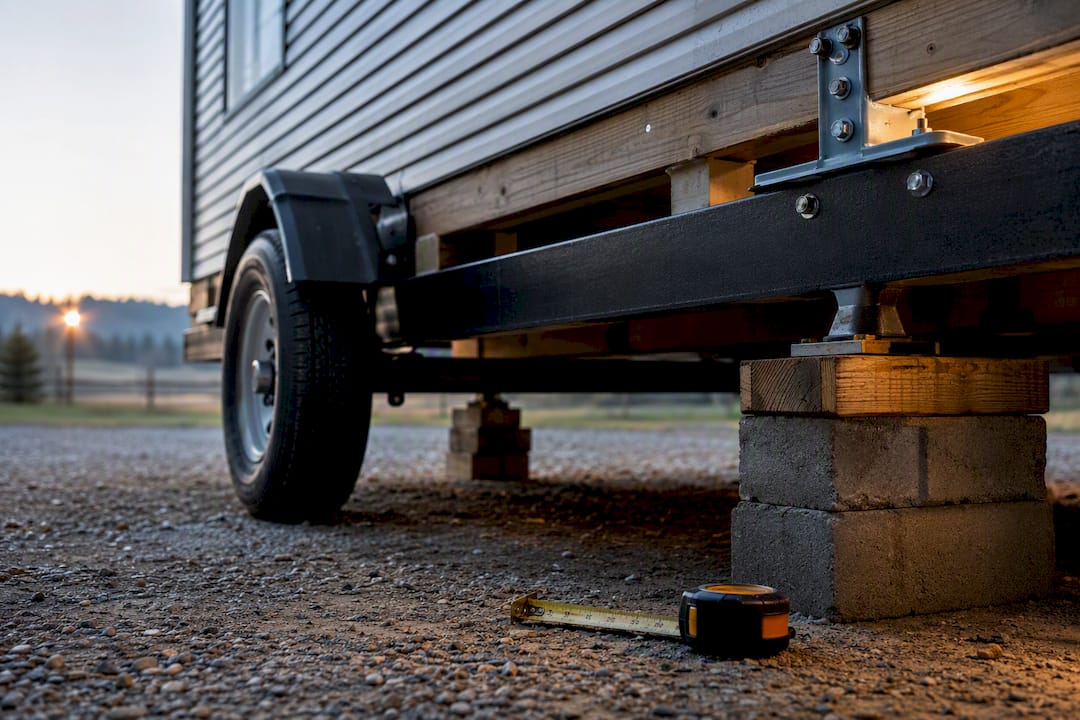
A park model is a certified RV, built to ANSI A119.5 standards and capped at 400 square feet, meant for resort lots and semi-permanent living. A tiny house is either a towable unit governed by RV-style rules or a foundation-built home under IRC Appendix Q, which is the legal path to full-time residency in most towns. The right pick depends entirely on where you plan to park it and how your county’s zoning office feels about that plan.
TL;DR:
- Moving a park model usually involves a professional trip, with transport costs potentially reaching thousands of dollars, which should be included in the budget.
- Foundation tiny homes are essentially permanent, requiring disconnection and reclassification if relocation is ever needed, making frequent moves impractical.
- Financing options depend heavily on certification: park models qualify for RV loans, while IRC tiny homes are eligible for construction loans or mortgages.
- Zoning restrictions are the primary barrier, with park models limited to RV parks and tiny houses needing specific local code approval or HOA permits.
- Buyers should verify certification and zoning before committing, as a unit’s legal placement and financing are determined by its classification and local regulations.
Table of Contents
- Park Model vs Tiny House: What the Codes Actually Say
- How Often Will You Actually Move It?
- What Will It Cost You, and How Do You Finance It?
- Where Can You Actually Put One Legally?
- Which One Actually Fits Your Situation?
- What Gently Used RVs Shows You Before You Buy
- A Straight Answer on Which One Wins
- Standards and Guides Worth Bookmarking
- Ready to Compare Real Listings Side by Side?
- Sources
Park Model vs Tiny House: What the Codes Actually Say
The whole park model vs tiny house debate boils down to paperwork before it ever gets to floor plans. Park models are certified under ANSI A119.5 standards, which the RV Industry Association enforces through a physical RVIA seal on the unit. That certification caps indoor living space at 400 square feet and classifies the structure as a recreational vehicle, not a house.
Tiny houses split into two different animals. A THOW (tiny house on wheels) rides on a trailer chassis and gets treated more like an RV for code purposes, though without the RVIA seal unless a builder specifically pursues it. A foundation tiny home follows the International Residential Code’s Appendix Q, the section written specifically for homes under 400 square feet that sit on a permanent foundation.
That paperwork determines almost everything downstream:
- Permits: park models and THOWs typically need RV park or campground placement; IRC-built tiny homes can pull residential building permits.
- Insurability: certified units are far easier for insurers to price; uncertified custom builds often get flagged as high risk.
- Lender treatment: banks and credit unions look at the certification first, then the loan type.
How Often Will You Actually Move It?
Park models technically sit on a chassis and wheels, but almost nobody moves one casually. Because of their width and weight, federal transport rules generally require a professional hauler with a wide-load permit, and most owners move the unit exactly once, from the dealer lot to its final site.
THOWs are built to stay within standard road limits, so a truck with the right towing capacity can pull one without special permits in most cases. That said, frequent moves still run into height, width, and length caps that vary by state.
Foundation tiny homes don’t move. Relocating one means disconnecting utilities, potentially reclassifying the structure, and paying for a full house move, which is neither cheap nor common.
- Park model: one professional move, rarely repeated
- THOW: frequent moves possible within road limits
- Foundation tiny home: essentially permanent
Pro Tip: Before you buy a park model, get a transport quote first. A wide-load hauler for a cross-state move can run into the thousands, and that number should factor into your total budget before you fall in love with a floor plan.
What Will It Cost You, and How Do You Finance It?
Price ranges vary more than most first-time buyers expect. Entry-level park models start around $45,000, climbing to $85,000 to $135,000 for loaded units with upgraded appliances and finishes. Tiny homes swing even wider, from roughly $30,000 for a DIY THOW build to $180,000 for a high-end IRC-compliant foundation home.
Financing follows the certification, not the floor plan. A certified park model qualifies for RV loans or chattel financing, similar to buying a travel trailer. An IRC-compliant foundation tiny home can qualify for a construction loan or a conventional mortgage, the same products used for standard site-built houses.
Insurance splits along the same lines. Park models typically carry RV or park-model-specific policies. Foundation tiny homes fall under homeowners or mobile-home coverage, depending on the lender and local rules. Resale also tends to favor certified structures. A Travel Trailer Size Options comparison shows how buyers often value clear categorization over custom character when it’s time to sell.
- Park model financing: RV loan or chattel loan
- THOW financing: often harder to secure without RVIA certification
- IRC tiny home financing: construction loan or mortgage possible
Where Can You Actually Put One Legally?
Zoning trips up more buyers than cost ever does. Here’s the order to check things in:
- Confirm the placement lane first. Park models generally belong in RV resorts, extended-stay campgrounds, or the small number of jurisdictions that allow them as accessory dwelling units.
- Identify your tiny house subtype. An IRC-built foundation home may qualify as a legal residence anywhere single-family zoning allows small footprints. A THOW usually needs an RV park, private land with a waiver, or a jurisdiction with explicit tiny-house ordinances.
- Call the county zoning office before you call a seller. Ask directly whether your intended structure type is permitted as a permanent or extended-stay dwelling on your specific parcel.
- Check HOA rules separately from county code. An HOA can prohibit a structure the county itself allows.
Pro Tip: If you can’t describe in one sentence exactly where the unit will sit and what code applies there, hold off on buying. Placement is the single most common deal-breaker buyers run into after the sale.
Which One Actually Fits Your Situation?
Park models suit buyers who want predictable ownership: a resort lot, a lake property, or a retirement site where full-time permanence isn’t the goal. You get a factory warranty, a known resale category, and a straightforward RV loan. Foundation tiny homes suit buyers chasing full-time legal residency where local code allows it, since IRC Appendix Q gives them standing as an actual house rather than a vehicle.
The tradeoffs run in predictable directions:
- Park models trade mobility for polish. You get a finished, certified product but lose the ability to relocate cheaply.
- THOWs trade permanence for flexibility. You can move when life changes, but financing and insurance stay harder to find.
- IRC tiny homes trade customization limits for legitimacy. Building to code means real design constraints, but you gain mortgage eligibility and resale as residential property.
Research on tiny-home downsizing also found meaningful drops in ecological footprint among owners, tied to smaller space driving less consumption across the board, a benefit that applies to any of these categories once someone commits to living smaller.
What Gently Used RVs Shows You Before You Buy
Gently Used RVs lists park models alongside every other RV category, which makes side-by-side comparison shopping realistic instead of theoretical. Listings are geotargeted, so you see units closest to your intended placement site first, and the AI autofill tool pulls specs directly from a dealer’s original posting so you’re not guessing at square footage or certification status.
Before you commit to either path, work through this checklist:
- Confirm ANSI A119.5 or RVIA certification on any park model listing.
- Pull your county’s zoning code for the exact parcel, not the general district.
- Request a transport quote if the unit needs to move.
- Compare RV loan terms against construction loan terms side by side.
The RV Types Guide breaks down how park models fit within the broader RV taxonomy if you’re still getting oriented.
A Straight Answer on Which One Wins
Most buyers overcomplicate this decision by falling for a floor plan before checking whether it can legally sit where they want it. The park model vs tiny house choice isn’t really about square footage. It’s about whether you want an RV-class product with resort placement and clean resale, or a residential-class structure that takes more work upfront but earns you a real address.
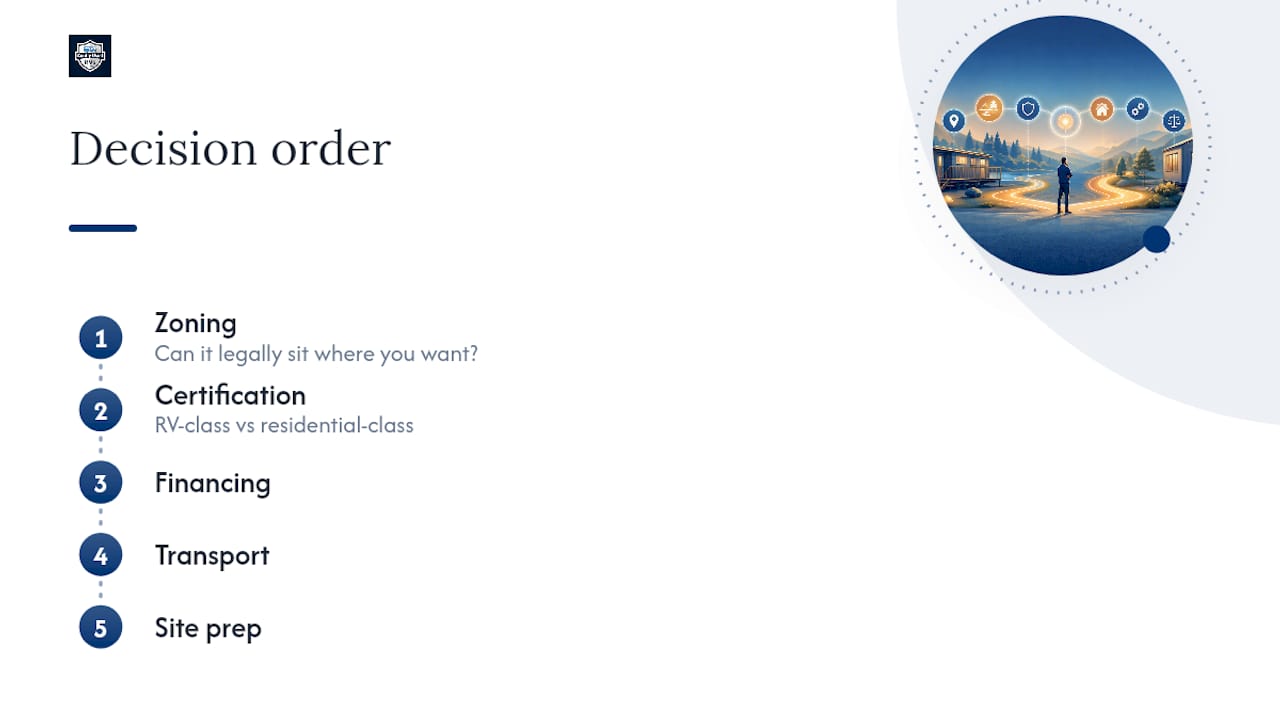
Work the decision in this order: zoning, then certification, then financing, then transport, then site prep. Skip a step and you’ll find out the hard way, usually after money has already changed hands.
— Christopher
Standards and Guides Worth Bookmarking
Check the RVIA’s standards page to verify park model certification before buying. Review IRC Appendix Q through your local building department for foundation tiny home code text. The PERCH comparison guide offers a useful breakdown of how financing pools differ across categories.
Ready to Compare Real Listings Side by Side?
Reading about certifications only gets you so far. At some point you need to see actual units, actual prices, and actual locations to make a real decision. Gently Used RVs gives you a free way to browse park models, travel trailers, and every other RV category without creating an account or paying a commission to look. Sellers post at no cost, so listings reflect real asking prices rather than dealer markup built around advertising fees.
Search results are geotargeted, meaning the park models and towable units closest to your intended site show up first, which matters when transport costs are part of your budget math. If you’re leaning toward a certified park model for a resort lot or retirement site, browse current listings to see what’s actually available near you right now, or check the RV dealer directory to connect with a seller who can walk you through certification paperwork in person.
Sources
- Association and ANSI-adopted standards | RV Industry Association (RVIA)
- People who downsize to tiny houses are more environmentally friendly, study finds
- Park Model vs Tiny vs Manufactured Home 2026 | PERCH