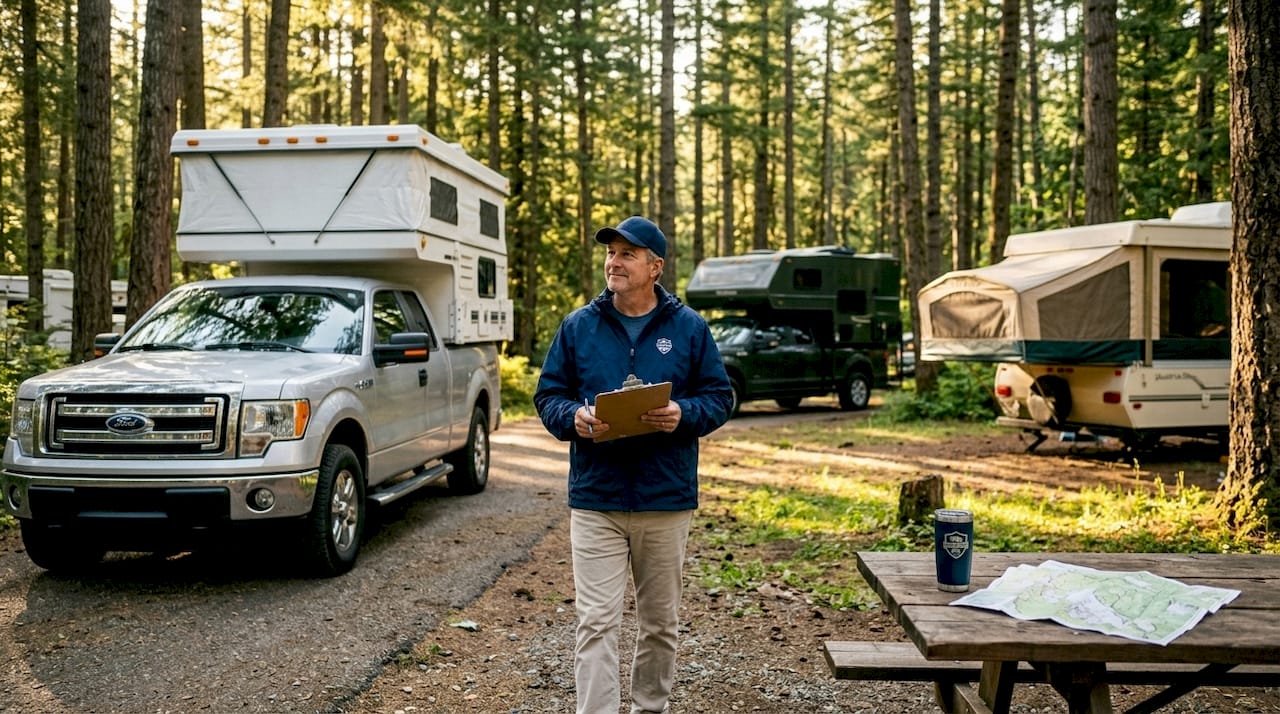
If you’re serious about truck camping, the sheer number of options can stop you cold before you ever hit the road. This truck camper types overview cuts through the confusion by breaking down every major style, from hard-side slide-ins to basic shells, so you can match the right camper to your truck, your terrain, and your travel habits. Get this decision wrong and you’re looking at overloaded axles, frozen pipes, or a setup so complicated it ruins your weekend. Get it right, and you’ve got one of the most capable and flexible rigs in the camping world.
Table of Contents
- Key takeaways
- 1. What to know before comparing truck camper types
- 2. Hard-side truck campers
- 3. Pop-up truck campers
- 4. Camper shells and toppers
- 5. Side-by-side truck camper comparison
- My honest take on choosing between truck camper types
- Find your next truck camper on Gentlyusedrvs
- FAQ
Key takeaways
| Point | Details |
|---|---|
| Payload is non-negotiable | Always calculate wet weight, not dry weight, before matching a camper to your truck. |
| Hard-side vs. pop-up trade-off | Hard-sides offer better insulation and amenities; pop-ups save weight and improve fuel economy. |
| Shells are not campers | Camper shells provide cargo protection but lack the habitat features of true slide-in campers. |
| Four-season means heated tanks | Real winter readiness requires heated plumbing and tanks, not just insulated walls. |
| Setup speed compounds on long trips | For daily movers, a simpler deployment system matters more than extra square footage. |
1. What to know before comparing truck camper types
Before you compare truck camper styles side by side, you need four criteria locked in. These are the filters that make every other decision easier.
Payload capacity is where most buyers get burned. Payload is your GVWR minus curb weight, and that number shrinks fast once you add passengers, gear, water, and food. A common mistake is trusting the dry weight listed in a brochure. Add 15 to 25 percent to dry weight to get a realistic loaded estimate, then confirm your truck can handle it. This is the single most overlooked step in the buying process.
Insulation and seasonality matter more than most people admit. A true four-season camper needs heated holding tanks and plumbing in addition to insulated walls. Marketing language about “winter ready” models often glosses over whether the tanks are actually protected from freezing. If you camp in temperatures below 32°F, this distinction could save you thousands in repair costs.
Setup complexity affects your quality of life on every trip. Some campers park and you’re done. Others require roof lifts, slide-out deployment, and leveling sequences that take 20 minutes or more. Setup time is a major usability factor for anyone moving camp frequently.
Habitat features round out the picture. Think about your non-negotiables: a wet bath versus a dry bath, a full kitchen versus a two-burner cooktop, and a fixed bed versus a dinette conversion. These features vary dramatically across truck camper types, and knowing your minimums before you shop saves a lot of backtracking.
Pro Tip: Before you visit a single dealership, pull your truck’s door jamb sticker and note the GVWR and curb weight. That math tells you exactly what payload you have to work with, and it should be the first number in every camper conversation.
2. Hard-side truck campers
Hard-side slide-in campers are what most people picture when they hear “truck camper.” These are rigid, fully enclosed units that slide into the bed of a pickup and are secured with turnbuckle tie-downs. They are the most self-contained option in the category.
The advantages are real and significant:
- Superior insulation with R-values ranging from R-13 to R-22 in walls, floors, and ceilings on quality models
- Full amenities including kitchen, bathroom, and dedicated sleeping area
- Excellent weather durability in rain, wind, and cold
- Consistent interior height without any setup required
The trade-offs are equally real. Hard-side campers are heavy. Wet weights typically run 2,500 to 4,000-plus pounds, which means most of them require a three-quarter ton or one-ton truck. You also sit higher on the road, which affects handling and wind resistance.
Popular models like the Lance 855S, Northstar TC650, and Arctic Fox 990 give you a sense of the range. Some are compact enough for a long-bed half-ton; others need a dually. Matching model to truck is critical, not optional.
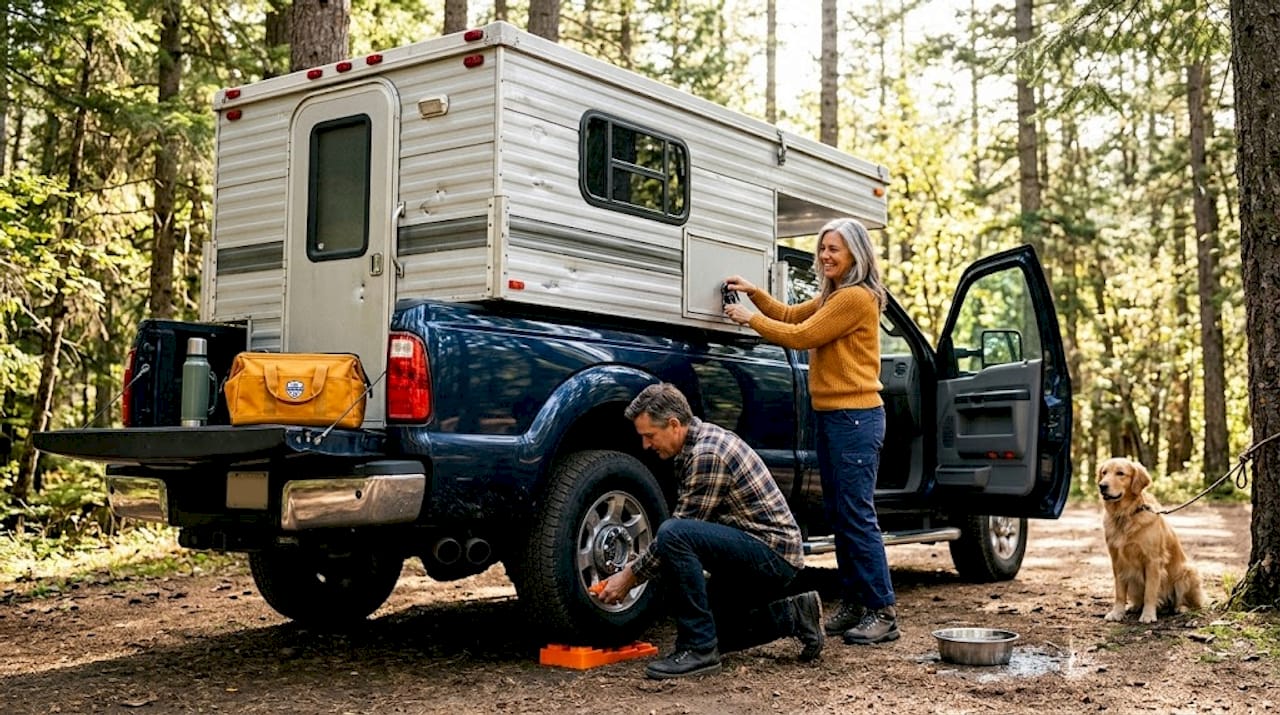
Pro Tip: If you’re shopping hard-side campers and plan any off-road use, look for models with composite construction rather than wood framing. Wood absorbs moisture and flexes on rough terrain, leading to delamination over time.
3. Pop-up truck campers
Pop-up truck campers use a hinged or crank-up roof that raises to create standing room inside the camper. When the roof is lowered for travel, the profile drops significantly, which changes the physics of the whole rig.
The benefits are worth understanding:
- Lighter weight, typically in the 1,000 to 2,000-pound range for most models
- Lower travel profile means better aerodynamics and fuel economy
- Easier payload fit for mid-size and half-ton trucks
- Popular with overlanders because the lower center of gravity improves off-road stability
The drawbacks are just as clear. Pop-up designs increase habitat volume by raising the roof, but the soft or semi-rigid side panels that expand with the roof provide far less insulation than a hard-side wall. Three-season use is the honest rating for most pop-up models unless they have supplemental heating and insulation packages.
Brands like Four Wheel Campers, Hallmark, and Northstar build well-regarded pop-up models that have strong followings among serious overlanders. The Four Wheel Campers Swift, for instance, is a compact pop-up that fits mid-size trucks and has earned a reputation for durability on rough trails. You can find listings like the 2025 Four Wheel Campers Swift if you want to see what these look like in practice.
4. Camper shells and toppers
This is where a lot of buyers get confused, and the confusion is understandable. Shells, toppers, and slide-in campers all sit in a truck bed, but they are architecturally and functionally very different things.
A camper shell is a fixed fiberglass or aluminum cap that covers the truck bed. Shells add enclosed cargo volume but have no habitat features. There is no standing room, no insulation worth mentioning, and no built-in living systems. Sleeping happens at bed height, and you’re essentially sleeping in a covered truck bed. Shells serve well as weather protection for gear, overlanding cargo, or a sleeping platform with a pad and sleeping bag.
A topper adds a hinged or liftable roof section to create more headroom. Toppers rest on bed rails and lack the fully insulated floors and walls of a slide-in camper. They give you more vertical space than a shell, but they still don’t deliver a proper living environment, especially in cold weather.
Here’s a quick comparison to keep these straight:
| Feature | Camper shell | Topper | Slide-in camper |
|---|---|---|---|
| Standing room | No | Limited | Yes (hard-side) |
| Insulation | Minimal | Minimal | Good to excellent |
| Kitchen/bath | No | No | Yes |
| Payload impact | ~400 lbs | ~500 lbs | 1,000 to 4,000+ lbs |
| Four-season capable | No | No | Yes (with heated tanks) |
Pro Tip: If your goal is sleeping in your truck bed on occasional trips without a big payload hit, a quality shell with an aftermarket sleeping platform and good sleeping bag is a legitimate and affordable setup. Just don’t confuse it with a truck camper.
5. Side-by-side truck camper comparison
Now that you know each type individually, here’s how they stack up across the criteria that matter most for choosing the right one.
| Camper type | Typical wet weight | Four-season ready | Setup complexity | Full amenities |
|---|---|---|---|---|
| Hard-side slide-in | 2,500 to 4,000+ lbs | Yes (best models) | Low to moderate | Yes |
| Pop-up slide-in | 1,000 to 2,000 lbs | Limited | Low to moderate | Partial |
| Topper | 400 to 700 lbs | No | Very low | No |
| Camper shell | 200 to 400 lbs | No | None | No |
Truck compatibility breaks down roughly like this. Shells and toppers fit any pickup, including compact and mid-size trucks. Most pop-up slide-ins work well on half-ton and mid-size trucks, making them the sweet spot for Ford F-150, Ram 1500, and Toyota Tacoma owners. Hard-side campers, especially larger floor plans, generally need a three-quarter ton or one-ton truck to stay within safe payload limits.
For camping style, the match is fairly predictable:
- Weekend warriors doing three-season camping: pop-up slide-in or compact hard-side
- Overlanders and off-road travelers: pop-up slide-in for the lower center of gravity
- Full-time or extended travel campers: hard-side with full amenities and four-season protection
- Minimalist or budget-focused campers: shell or topper with a sleeping platform setup
For frequent movers, deployment speed and mechanical simplicity are real factors. A camper that takes 30 minutes to set up every day adds hours of friction over a two-week trip. If you’re moving camp daily, prioritize a design you can deploy in under five minutes.
My honest take on choosing between truck camper types
I’ve talked with a lot of truck camper buyers over the years, and the same mistakes keep showing up. The biggest one is buying for the trip you imagine instead of the trips you actually take.
Most people picture themselves in a rugged hard-side camper parked in the mountains for a week. In reality, they move every two days, set up in the dark after long drives, and camp in fall temperatures, not winter. For that profile, a pop-up slide-in with a good sleeping bag and a small propane heater outperforms a heavy hard-side that takes forever to level and strains their half-ton.
The four-season question is where I see the most expensive mistakes. People buy a camper labeled “winter ready” and assume the walls handle everything. They don’t. Only heated plumbing and holding tanks give you reliable freeze protection. I’ve seen campers with beautiful R-value walls end up with cracked water lines because the tanks were unprotected. Ask specifically about tank heating before you sign anything.
My recommendation for most active travelers: if you own a half-ton or mid-size truck, start with a quality pop-up slide-in. You’ll cover more ground, burn less fuel, and have fewer setup headaches. If you own a one-ton and plan extended or full-time travel, a hard-side with heated tanks and a solid furnace is worth every pound.
— Christopher
Find your next truck camper on Gentlyusedrvs
Ready to put this research to work? Gentlyusedrvs makes it easy to browse used truck campers across every type and price range, all in one place. Whether you’re hunting for a lightweight pop-up slide-in or a fully loaded hard-side with four-season protection, the platform connects you with private sellers and dealerships across the United States and beyond.

Search is geotargeted, so you see the closest listings first. No account needed to browse. Start by exploring the full RV types guide to compare truck campers alongside other RV categories, or go straight to used RV listings and filter by truck camper to see what’s available near you right now. Listings are free to post and free to browse. No commissions, no hidden fees, just a straightforward marketplace built for the RV community.
FAQ
What are the main types of truck campers?
The four main types are hard-side slide-in campers, pop-up slide-in campers, camper toppers, and camper shells. Each varies significantly in weight, insulation, and living features.
Which truck camper type is best for a half-ton truck?
Pop-up slide-in campers are the best fit for most half-ton trucks because their wet weights typically fall between 1,000 and 2,000 pounds, staying within safe payload limits for trucks like the Ford F-150 or Ram 1500.
What makes a truck camper truly four-season capable?
A true four-season camper needs heated holding tanks and plumbing in addition to high R-value insulation in walls, floors, and ceilings. Wall insulation alone will not prevent frozen pipes in sub-freezing temperatures.
How do I calculate whether my truck can handle a camper?
Subtract your truck’s curb weight from its GVWR to find available payload, then add 15 to 25 percent to the camper’s dry weight to estimate real loaded weight. That loaded estimate must fall below your available payload number.
Are camper shells the same as truck campers?
No. Camper shells are fixed cargo covers with no insulation or living systems. True truck campers are slide-in units with sleeping quarters, kitchens, and in many cases, bathrooms and full climate control.