RV Classes Explained: A Practical Buyer’s Guide

RV classes are the three official motorized vehicle categories defined by size, chassis type, and intended use: Class A, Class B, and Class C. These are not informal labels. The Recreation Vehicle Industry Association (RVIA) recognizes this classification system, and every motorhome you shop for falls into one of these three groups. Understanding RV classes before you buy protects you from costly mismatches between the rig you purchase and the life you actually want to live. This guide breaks down each class with real specs, honest trade-offs, and clear guidance on which type fits your travel style.
What are the differences between class a, b, and c rvs?
The three motorhome classes differ by physical size, the chassis they are built on, and the lifestyle they support. Getting these distinctions right is the foundation of any smart RV purchase.
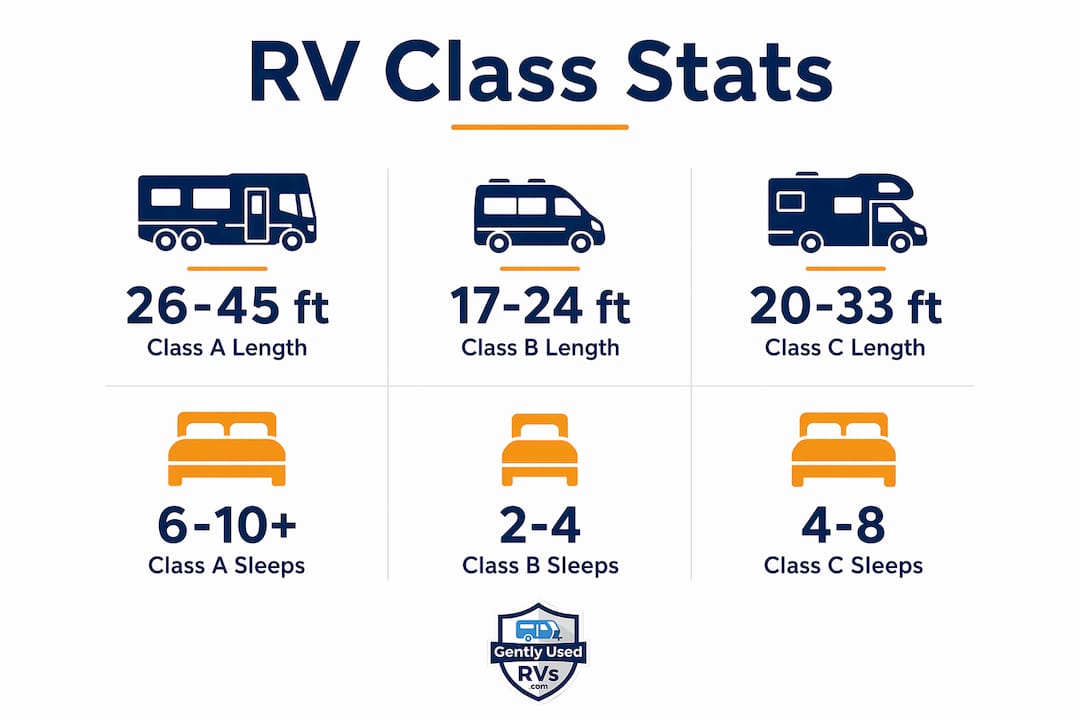
Class A motorhomes are the largest option on the road. They run 26–45 feet long, sleep 6–10 or more people, and are built on either a bus chassis or a heavy-duty truck chassis. Think of them as apartments on wheels. Most Class A models include full kitchens, residential-style bathrooms, and multiple slide-outs that expand the living area when parked. Fuel economy sits at 6–10 MPG. That number matters because a cross-country trip in a Class A will cost significantly more in fuel than the same trip in a smaller rig.
Class B motorhomes, also called camper vans, are built on a standard van chassis from manufacturers like Ford, Mercedes-Benz, or Ram. They run 17–24 feet long and typically sleep 1–2 people. Their fuel economy of 15–22 MPG is the best of any motorhome class. That efficiency comes at a trade-off: living space is tight, and every square foot has to work double duty.
Class C motorhomes sit between the other two in nearly every way. They measure 20–33 feet, sleep 4–8 people, and return 8–15 MPG. The defining visual feature is the over-cab area, which extends above the driver’s cab and typically serves as a sleeping loft or storage space. Class C units are built on a cutaway truck chassis, which gives them a familiar driving feel for anyone who has driven a large pickup or box truck.
| Feature | Class A | Class B | Class C |
|---|---|---|---|
| Length | 26–45 ft | 17–24 ft | 20–33 ft |
| Sleeping Capacity | 6–10+ | 1–2 | 4–8 |
| Fuel Economy | 6–10 MPG | 15–22 MPG | 8–15 MPG |
| Chassis Type | Bus or truck | Van | Cutaway truck |
| Best For | Full-timers, large families | Solo travelers, couples | Families, beginners |
How does your travel style determine the right RV class?
Travel style is the primary factor in choosing between motorhome classes. The specs matter, but they only make sense in the context of how and where you plan to travel.
Class A is the right fit if you plan to live in your RV full-time or travel with a large group. The extra square footage, full-size appliances, and slide-outs make long-term living genuinely comfortable. Many full-time RVers in Class A rigs set up in RV resorts with full hookups and treat the motorhome as a primary residence. The trade-off is that Class A units are harder to park in urban areas and are often too large for primitive campsites in national forests.
Class B is built for people who want to go everywhere. Solo travelers and couples who prioritize agility and fuel savings consistently choose this class. A Class B van fits in a standard parking space, which means you can drive into a city, park, and explore without unhooking anything. Off-grid travelers love Class B rigs because they can reach trailheads and backcountry spots that larger motorhomes cannot access. If stealth camping in urban areas is part of your plan, a Class B van blends in far better than a 40-foot diesel pusher.
Class C hits the sweet spot for families who want more space but are not ready to wrestle a bus-sized vehicle. The over-cab sleeping area adds meaningful capacity without adding the full footprint of a Class A. Class C is widely considered the best beginner motorhome because the driving experience is closer to a large truck than a commercial vehicle.
- Full-time living or large family travel: Class A
- Solo or couple travel, urban destinations, off-grid access: Class B
- Family travel, first-time buyers, campground variety: Class C
- Weekend warriors who want flexibility: Class C or Class B
Pro Tip: Before committing to a class, check the campground reservation systems for your top five destinations. Some state park loops have a 30-foot length limit, which rules out most Class A rigs entirely. Knowing your destinations first saves you from buying the wrong rig.
What are the common misconceptions about RV classes?
Several persistent myths confuse first-time buyers when they start researching RV categories. Clearing these up early saves real money and frustration.
The biggest terminology mistake is using “class” and “type” interchangeably. RV “class” refers exclusively to motorized units: Class A, B, and C. “Type” is the broader term that includes both motorized and towable units like travel trailers, fifth wheels, and pop-up campers. When a seller or dealer says “what type of RV are you looking for,” they mean the full spectrum. When they say “class,” they mean motorhomes only. Knowing this distinction helps you search smarter and communicate clearly with sellers.
The second common mistake is assuming Class B is mid-sized because it sits between A and C alphabetically. Class B is actually the smallest class, not the middle option. The naming convention reflects the order in which these categories were standardized, not their size. If you want to quickly identify a motorhome’s class without knowing the label, look at the chassis. Bus or heavy truck chassis means Class A. Standard van chassis means Class B. Cutaway truck chassis means Class C.
Pro Tip: Class B RVs often use a wet bath configuration, where the toilet and shower share the same small space. This works fine for solo travelers but becomes a real inconvenience for couples on longer trips. Always check the bathroom layout before you buy or rent a Class B.
One more myth worth addressing: you do not need a special commercial driver’s license to operate any of the three standard motorhome classes in most U.S. states. No special license is required for Class A, B, or C motorhomes in the vast majority of states. The entry barrier is similar to driving a large passenger vehicle. A few states have weight-based requirements for the heaviest Class A diesel pushers, so check your specific state’s DMV rules if you are buying at the top end of the size range.
What are the real-world pros and cons of each RV class?
Understanding the specs is one thing. Living with the trade-offs is another. Here is an honest look at what each class delivers in practice.
Class a: maximum comfort, maximum commitment
Class A motorhomes offer the most living space and the most amenities of any motorhome class. Residential refrigerators, washer-dryer combos, king-size beds, and full-length sofas are standard in many models. For full-timers, that comfort level is worth the investment. The challenges are real, though. Driving a large Class A requires practice, particularly managing tail swing, which is the outward arc the rear of the vehicle makes during turns. Tail swing causes a disproportionate share of beginner accidents in large motorhomes. Parking at grocery stores, gas stations, and urban destinations requires planning every stop in advance.
Class b: efficiency with limits
Class B motorhomes deliver the best fuel economy and the most driving flexibility of any motorhome class. The compact design constraints mean kitchen and bathroom space is genuinely limited. Counter space is minimal, storage requires creative packing, and two adults sharing a Class B for more than a week will feel the squeeze. One counterintuitive fact: Class B units are often the most expensive per square foot of any motorhome class. The engineering required to compress a kitchen, bathroom, sleeping area, and mechanical systems into a standard van footprint drives up manufacturing costs. You pay a premium for that compactness.
Class c: the practical middle ground
Class C motorhomes offer a genuine balance of space, drivability, and cost. Families get sleeping capacity for 4–8 people, a functional kitchen, and a proper bathroom without the driving anxiety that comes with a Class A. Campground access is broader because most Class C rigs fit within standard site length limits. Fuel economy in the 8–15 MPG range is a meaningful improvement over Class A without the sacrifice of Class B living space. For first-time buyers and growing families, Class C consistently delivers the best overall value.
| Class | Typical Price Range | Best Use Case | Biggest Drawback |
|---|---|---|---|
| Class A | $80,000–$500,000+ | Full-time living, large groups | Difficult to drive and park |
| Class B | $60,000–$150,000+ | Solo/couple travel, urban access | Limited living space |
| Class C | $50,000–$150,000 | Families, beginners | Less luxury than Class A |
Key takeaways
The right motorhome class depends on your travel frequency, group size, and destination types, not on which class sounds most impressive.
| Point | Details |
|---|---|
| Class A is for full-timers | Choose Class A if you need maximum living space and plan to travel or live in your RV long-term. |
| Class B prioritizes mobility | Class B delivers 15–22 MPG and fits standard parking spaces, ideal for solo travelers and urban destinations. |
| Class C suits beginners and families | Class C balances space and drivability, making it the most practical first motorhome for most buyers. |
| “Class” means motorized only | RV class refers exclusively to motorhomes. Towable units like travel trailers are “types,” not classes. |
| No special license needed | Most U.S. states require no commercial license to drive Class A, B, or C motorhomes. |
Why i think most buyers overthink the class decision
People spend weeks comparing specs and almost no time thinking about where they actually want to go. I have watched buyers fall in love with a 42-foot Class A diesel pusher, then realize six months later that every campsite they love has a 30-foot length limit. The rig was beautiful. It was also the wrong tool for their travel life.
My honest take: rent before you buy. Spend a week in a Class B van if you think you want one. You will know by day three whether the compact living works for you or drives you crazy. Do the same with a Class C. Most rental platforms have all three classes available, and a week of rental costs far less than a buying mistake on a $100,000 motorhome.
The other thing buyers underestimate is the driving learning curve for Class A. Tail swing is not a minor inconvenience. It is a real skill that takes practice to manage safely. If you are set on a Class A, take a driving course before your first solo trip. Organizations like the Family Motor Coach Association (FMCA) offer driver training programs specifically for large motorhomes.
One more thing: do not let the sticker price on a Class B fool you into thinking it is the budget option. Per square foot, Class B is often the most expensive motorhome you can buy. If budget is your primary concern, a well-maintained used Class C will almost always give you more value per dollar.
Browse the RV dealership vs. private seller guide on Gentlyusedrvs before you start shopping. Knowing which buying channel fits your situation is just as important as knowing which class fits your travel style.
— Christopher
Find your class on Gentlyusedrvs
You now know the difference between Class A, B, and C motorhomes. The next step is finding the right unit at the right price.

Gentlyusedrvs is a free classifieds marketplace where private sellers and dealerships list used motorhomes across all three classes, plus travel trailers, fifth wheels, and more. Buyers can search and browse without creating an account. Search results are geotargeted, so you see the closest listings first. Browse the full RV types guide to compare Class A, B, and C options side by side, or search the dealer directory to find local dealerships near you. No commissions, no hidden fees, and no pressure. Just the inventory you need to make a confident decision.
FAQ
What does “RV class” actually mean?
RV class refers specifically to the three motorized motorhome categories: Class A, Class B, and Class C. Towable units like travel trailers and fifth wheels are called “types,” not classes.
Which RV class is easiest to drive for beginners?
Class C is the easiest motorhome class for beginners. It is built on a cutaway truck chassis, which handles similarly to a large pickup truck, and its size fits most standard campground sites.
Do you need a special license to drive a class a motorhome?
No special commercial driver’s license is required to drive a Class A, B, or C motorhome in most U.S. states. A standard driver’s license is sufficient, though a few states have weight-based rules for the largest Class A units.
Why is class b more expensive than it looks?
Class B motorhomes are often the most expensive per square foot of any motorhome class. The engineering required to fit a kitchen, bathroom, and sleeping area into a standard van footprint drives up manufacturing costs significantly.
What is the fuel economy difference between RV classes?
Class A motorhomes return 6–10 MPG, Class C returns 8–15 MPG, and Class B delivers 15–22 MPG. That gap has a major impact on long-term travel budgets, especially for full-timers covering thousands of miles per year.