RV payload capacity is the maximum combined weight of everything you load into your rig beyond its own bare structure: passengers, pets, cargo, fresh water, propane, and any tongue or pin weight pressing down from a trailer. The math behind it is simple: Payload is calculated as the difference between GVWR and UVW. Gross Vehicle Weight Rating minus Unloaded Vehicle Weight… Some manufacturers report a variant called Cargo Carrying Capacity, or CCC, which also subtracts full fresh water and propane before you ever load a single bag.
Here’s what actually counts against that number:
- Every passenger and pet riding in the rig
- Fresh water and propane tanks (even partially filled)
- Kitchen gear, tools, clothing, and other cargo
- Tongue weight (travel trailers) or pin weight (fifth wheels) transferred to the tow vehicle
- Dealer-installed accessories and aftermarket upgrades
The Tire and Loading Information label inside your driver’s door jamb lists the factory GVWR and payload figures, but that sticker reflects the vehicle as it left the factory, not as it sits in your driveway loaded for a two-week trip. A certified scale ticket from a commercial CAT scale is the only way to know your actual number.
Key Takeaways
Payload capacity equals GVWR minus UVW, and verifying it with a certified scale ticket rather than trusting factory dry-weight numbers is the single most reliable way to avoid overloading your rig.
| Point | Details |
|---|---|
| Payload formula | Payload is calculated as the difference between GVWR and UVW.; CCC further subtracts full water and propane weight. |
| Verify with a scale | Weigh loaded as you travel at a CAT scale and request axle-by-axle figures, not just gross weight. |
| Tongue and pin weight count | Trailer tongue weight (10 to 15%) and fifth-wheel pin weight (15 to 25%) reduce tow-vehicle payload directly. |
| Apply the 80% rule | Keep total loaded weight at or below 80% of maximum rated capacity for a real safety margin. |
| Check axles individually | A rig can be under GVWR overall while one axle still exceeds its GAWR. |
Table of Contents
- What Is RV Payload Capacity in Practical Terms?
- How Do You Calculate RV Payload Step by Step?
- How Do You Weigh an RV to Verify These Numbers?
- Why Payload Often Limits You Before Towing Capacity Does
- Your Pre-Departure Payload Checklist
- What Mistakes Push RVs Over Their Payload Limit?
- How Gently Used RVs Helps You Verify Payload Before You Buy
- An Editorial Take on Real-World Payload Math
- Sources
What Is RV Payload Capacity in Practical Terms?
Payload capacity answers one question: how much can you legally and safely add to this rig before it’s overloaded? It’s not a suggestion. It’s an engineering limit tied to your axles, tires, frame, and suspension, and every pound over that limit works against your braking distance, tire life, and structural safety margin.
The confusion starts because RVs and tow vehicles carry a small library of weight ratings, each measuring something different. Knowing which one governs which decision saves you from a very expensive mistake at the dealer lot.
Gross Vehicle Weight Rating (GVWR) is the maximum your RV can weigh, fully loaded, as certified by the manufacturer. This includes the vehicle itself plus every passenger, every gallon of water, and every box of cargo you pack.
Unloaded Vehicle Weight (UVW), sometimes called dry weight, is what the RV weighs as it rolled off the factory line: no passengers, no cargo, and often no water or propane. Some manufacturers include a partial fuel fill in this number and don’t say so clearly, which is one reason dry weight consistently understates what you’ll actually be hauling.
Cargo Carrying Capacity (CCC) goes a step further than payload by subtracting full fresh water and propane weight from GVWR minus UVW, and manufacturers sometimes also subtract an RVIA sleeping-capacity allowance of 154 pounds per designated sleeping position. That means the CCC printed on a spec sheet may already assume every bunk is full of adult-sized occupants, which shrinks your real cargo budget before you’ve packed anything.
Gross Axle Weight Rating (GAWR) is the maximum weight each axle can bear, listed separately for front and rear. This matters because total payload can be within limits while one axle, usually the rear, carries more than its share and exceeds its individual rating.
Gross Combined Weight Rating (GCWR) covers the tow vehicle and trailer together, fully loaded. It’s the ceiling for your entire combination, not just one half of it.
Tongue weight (travel trailers) and pin weight (fifth wheels) are the portions of trailer weight transferred onto the tow vehicle’s hitch. Both count directly against the tow vehicle’s own payload capacity, which is a detail a lot of buyers miss until they’re already at a scale.
Here’s a quick reference for where to find each figure:
| Rating | Where to find it |
|---|---|
| GVWR | Door-jamb sticker, VIN plate, owner’s manual |
| UVW / dry weight | Manufacturer spec sheet, window sticker |
| CCC | Manufacturer spec sheet or weight label |
| GAWR (front/rear) | Door-jamb sticker, often listed per axle |
| GCWR | Owner’s manual, tow vehicle spec sheet |
The gap between dry weight and real-world weight tends to surprise first-time buyers most. A travel trailer advertised at a 2,800-pound dry weight might arrive from the factory closer to 3,100 pounds once the dealer adds a battery, awning, and roof-mounted solar panel. None of that shows up on the marketing brochure. It shows up on the scale.
How Do You Calculate RV Payload Step by Step?
Calculating payload isn’t complicated math, but it does require pulling real numbers from real sources instead of trusting brochure copy. Follow this sequence every time you evaluate a rig, whether you already own it or you’re comparing listings.
- Record GVWR and UVW from the door sticker or the manufacturer’s spec sheet for that exact model and floor plan year.
- Decide whether you need CCC or straight payload. If you want to know true remaining cargo room with tanks full, subtract fresh water and propane weight too.
- Add passengers, pets, gear, and hitch hardware to project your real loaded weight before you ever leave the driveway.
- Compare your total against GVWR and each GAWR to confirm you’re within limits on both the whole vehicle and each individual axle.
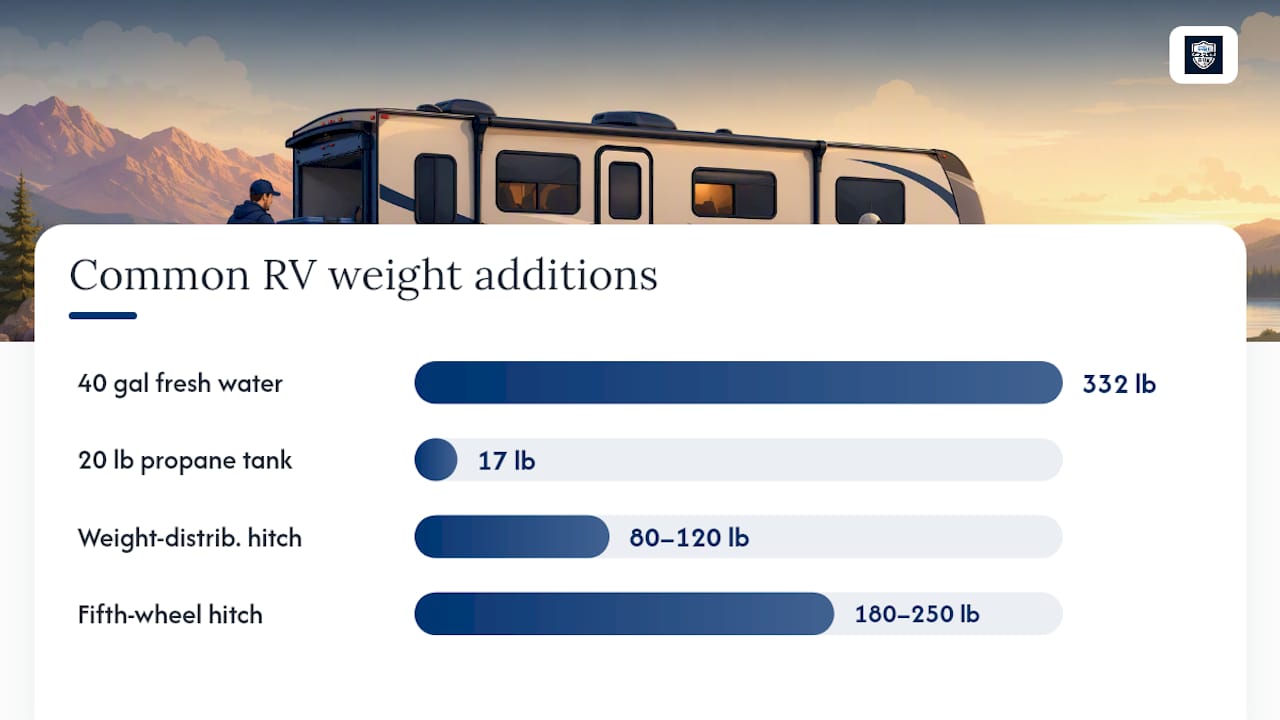
Water and propane conversions come up constantly in this math, so keep the constants handy: fresh water weighs 8.3 pounds per gallon, and a standard 20-pound propane tank weighs roughly 17 pounds full (the “20 lb” refers to the propane itself, not the tank). A A 40-gallon fresh water tank filled to capacity adds significant weight, which many owners forget to account for until they’re already over budget.
Hitch hardware adds weight too. Weight-distribution hitches typically add 80 to 120 pounds to the payload equation, while fifth-wheel hitches commonly add 180 to 250 pounds or more depending on the model.
Here are three worked examples using average trailer weight data to show how the numbers play out across different rig sizes:
Notice how quickly a seemingly generous payload figure shrinks once water and hitch hardware are subtracted. That’s before you’ve added passengers, kitchen supplies, camp chairs, or the case of water bottles everyone brings “just in case.” Dealer-installed options like solar arrays, upgraded batteries, or awnings quietly eat into this same number, which is exactly why the sticker on a new rig rarely matches what you’ll experience after a few seasons of ownership.
How Do You Weigh an RV to Verify These Numbers?
The only way to know your actual payload usage is to put the rig on a certified commercial scale, and CAT scales, found at most truck stops across the country, are the standard choice for RV owners doing this correctly.
- Locate a CAT scale near your route using the CAT Scale app or website, and plan to weigh with a load that represents how you’ll actually travel.
- Ask for a full weigh ticket that breaks out each axle, not just a single gross weight. Most scales will provide steer axle, drive axle, and trailer axle figures separately for a small fee.
- Weigh loaded exactly as you’d travel, meaning full water and propane, packed cargo, and passengers aboard if possible, since manufacturer dry weights routinely omit dealer-installed accessories and full fluids.
- Compare each axle reading to its GAWR, not just the total to GVWR. It’s entirely possible to be under your total gross weight while one axle is dangerously over its individual rating, particularly on trailers where cargo tends to shift toward the rear.
Many owners choose to weigh twice: once close to empty to establish a real UVW baseline, and once fully loaded for a trip to see exactly how much of their payload budget is in use. That comparison tells you more than any spec sheet ever will.
Pro Tip: Weigh axle-by-axle even if your total weight looks fine. An unevenly loaded trailer can pass the gross-weight check and still overload a single axle, which accelerates tire wear and raises blowout risk long before the scale ticket would ever flag a problem.
Ignoring axle-specific numbers is one of the more common ways owners end up with a rig that “should” be fine on paper but handles poorly, sways at highway speed, or chews through tires faster than expected.
Why Payload Often Limits You Before Towing Capacity Does
Shoppers spend a lot of energy comparing towing capacity between trucks, but payload capacity is frequently the number that runs out first. A truck rated to tow 12,000 pounds might only have 1,600 pounds of payload, and tongue or pin weight eats directly into that smaller number.
Tongue weight on a travel trailer is commonly estimated as about 10% to 15% of the trailer’s total loaded weight. Pin weight on a fifth wheel typically runs higher than tongue weight, often estimated in a proportional range that varies by trailer.
Several items quietly consume payload that buyers rarely budget for:
- Weight-distribution hitches: 80 to 120 pounds
- Fifth-wheel hitches: 180 to 250+ pounds
- Generators and extra batteries: 50 to 150 pounds combined
- Toolboxes and spare parts: 30 to 80 pounds
- Rooftop solar arrays: 20 to 60 pounds
This is why professionals lean on the 80% rule: keep total loaded weight at or below 80% of maximum rated capacity, leaving room for uneven terrain, wind, fuel fluctuations, and the gear you inevitably add after the first trip. It’s conservative by design, and that’s the point. A margin that feels excessive on a calm highway becomes the difference-maker on a mountain grade in a crosswind.
Your Pre-Departure Payload Checklist
Run through this list before every trip, not just the first one:
- Weigh the rig loaded as you plan to travel, ideally axle-by-axle at a commercial scale.
- Subtract your weighed total from GVWR to see exactly how much payload margin remains.
- Place heavy items low and centered over the axles, never in overhead cabinets or the very back of the trailer.
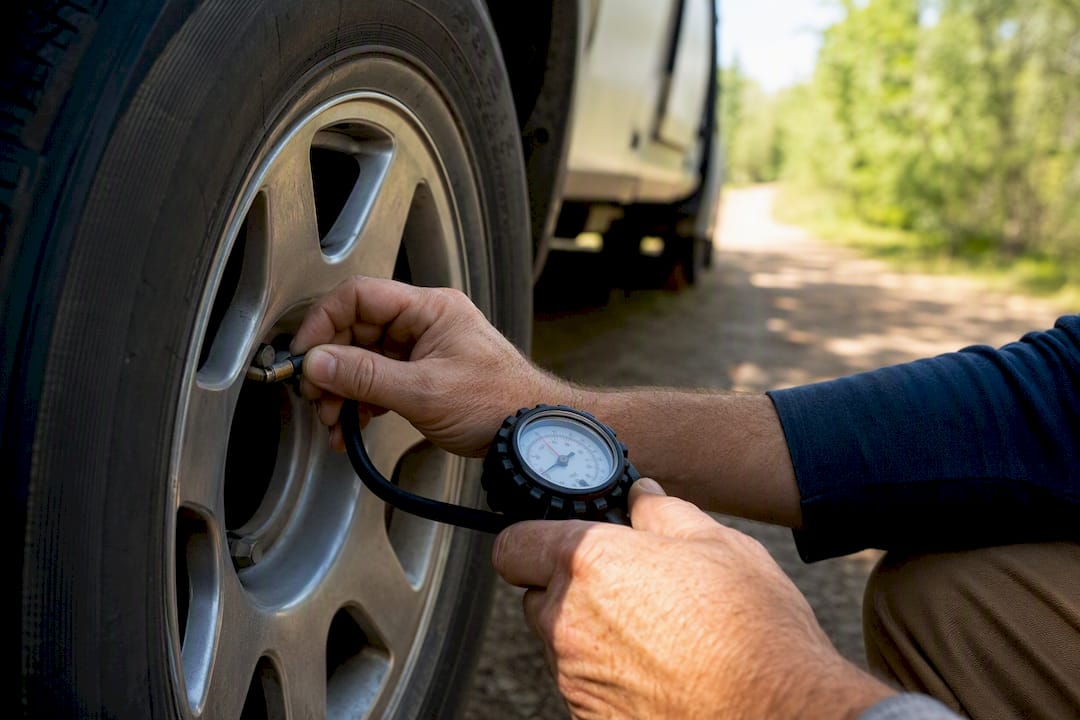
- Check tire pressures against the load rating stamped on the sidewall, adjusting for your actual weighed load.
- Verify hitch setup and tongue or pin weight with a hitch scale or by comparing before-and-after axle readings.
- Confirm your headcount matches sleeping capacity assumptions, since that RVIA figure of 154 pounds per position may not reflect your actual travel group.
If you’re over capacity, you have real options: offload gear you don’t need for this trip, fill water tanks only after arrival instead of before departure, swap heavy gear for lighter alternatives, or reconsider whether this tow vehicle and trailer pairing was ever a good match. Repeated overload situations, or any suspension modification you’re considering to compensate, are worth a conversation with a suspension specialist or RV technician rather than a guess.
Pro Tip: If you’re consistently within 200 pounds of your payload limit trip after trip, that’s not a packing problem. It’s a sign the rig itself is undersized for how you actually use it.
What Mistakes Push RVs Over Their Payload Limit?
The same handful of errors show up again and again, and most of them trace back to trusting a number that was never meant to represent real-world use.
- Trusting the advertised dry weight as if it reflects the RV you’ll actually drive off the lot, when dealer-installed options routinely add hundreds of pounds.
- Forgetting tongue or pin weight counts against the tow vehicle’s payload, not just the trailer’s own rating.
- Undercounting passengers and pets, especially on longer trips where extra people or animals join partway through.
- Ignoring individual axle limits in favor of checking only the total gross weight.
If you notice sway, sluggish braking, or bottomed-out suspension on the road, treat it as an immediate signal: pull over safely, redistribute weight toward the front and center of the trailer, reduce speed, and get to the nearest scale as soon as practical. Longer term, fixes range from reorganizing storage and reducing how much water you carry while traveling, to trading toward a tow vehicle with a higher payload rating or a lighter trailer altogether.
How Gently Used RVs Helps You Verify Payload Before You Buy
Every listing on Gently Used RVs is built to show GVWR and UVW as spec fields, not buried in a PDF brochure, so you can compare payload potential across listings before you ever contact a seller. Because private sellers and dealerships list free of charge, the marketplace covers everything from Class A motorhomes to teardrop trailers, which means you can filter by RV type and weight range until you find rigs that actually fit your tow vehicle’s real payload budget.
The AI-powered autofill tool extracts year, make, model, specs, and pricing directly from a dealer’s own listing page, which reduces the missing or inconsistent spec fields that plague many private classified posts. Still, a complete listing is a starting point, not a substitute for your own scale ticket once you’re seriously considering a rig.
- Check listings for both GVWR and UVW fields before requesting more details
- Use RV type and GVWR filters to narrow results to your tow vehicle’s payload range
- Treat listed dry weight as a floor, not a guarantee, and plan to weigh before finalizing a purchase
- Cross-reference RV type overviews for typical payload ranges by class before committing to one category
If you’re comparing multiple candidates, a quick side-by-side of listed specs can save a wasted trip to see a rig that was never going to fit your payload needs:
| What to check | Where it appears | Why it matters |
|---|---|---|
| GVWR | Listing spec sheet | Sets the absolute weight ceiling for the rig |
| UVW / dry weight | Listing spec sheet | Starting point for your payload math, not the final word |
| RV type and length | Listing title and filters | Narrows results to rigs your tow vehicle can realistically handle |
Pro Tip: Before scheduling a viewing, message the seller and ask directly whether the listed weight reflects factory dry weight or a weighed figure with installed options. That one question filters out a surprising number of mismatched expectations.
Browsing the dealer directory is worth doing alongside your online search, since an in-person inspection lets you confirm the door-sticker numbers match what’s advertised before you’re financially committed.
Is RV payload capacity the same as towing capacity? No. Payload capacity is what the RV or tow vehicle can carry on its own structure, including passengers and cargo. Towing capacity is what a vehicle can pull behind it. Tongue and pin weight bridge the two, since that weight transfers from the trailer onto the tow vehicle’s payload.
How do I find my RV’s payload capacity? Check the Tire and Loading Information label inside the driver’s door jamb, which lists GVWR and often payload directly. Subtract UVW from GVWR if payload isn’t printed outright.
What happens if I exceed my RV’s payload capacity? Exceeding payload strains tires, brakes, and suspension components beyond their rated limits, increasing blowout risk, extending stopping distances, and potentially voiding warranty coverage tied to load limits.
Does payload capacity include water and propane? Yes, for straight payload calculations. The CCC variant specifically subtracts full fresh water and propane weight, so CCC is always a smaller number than raw payload.
How much does a gallon of water weigh for RV calculations? Fresh water weighs 8.3 pounds per gallon, so a 40-gallon tank adds 332 pounds when full, a figure many owners forget to budget for.
Why do manufacturer dry weight numbers differ from real-world weight? Dry weight reflects the RV as built at the factory, before dealer-installed accessories, full fluids, and any aftermarket upgrades are added, which is why a scale ticket is the only reliable source for actual weight.
What is tongue weight, and does it count against payload? Tongue weight is the downward force a travel trailer exerts on the tow vehicle’s hitch, typically 10% to 15% of the trailer’s loaded weight, and it counts directly against the tow vehicle’s payload capacity.
What is pin weight on a fifth wheel? Pin weight is the equivalent of tongue weight for fifth wheels, typically running 15% to 25% of the trailer’s total weight, and it also counts against the tow vehicle’s payload rather than its towing capacity alone.
Where can I weigh my RV to check payload usage? Commercial CAT scales, common at truck stops nationwide, provide certified total and axle-by-axle weights for a small fee and are the standard method for verifying real-world RV weight.
Can I use an online calculator instead of a real scale? Online tools can help you plan and estimate remaining payload, but they explicitly note they don’t replace an actual scale ticket, since they can’t account for how your specific rig was built or optioned.
Does GAWR matter if my total weight is under GVWR? Yes. You can be under your total GVWR while one axle exceeds its individual GAWR, particularly if cargo is loaded unevenly toward the rear of a trailer.
How much weight do hitch systems add to my payload math? Weight-distribution hitches typically add 80 to 120 pounds, while fifth-wheel hitches commonly add 180 pounds or more, and both must be included in your payload calculations.
Is CCC the same number as payload capacity? No. CCC subtracts full fresh water and propane weight (and sometimes an RVIA sleeping-capacity allowance) from payload, making it a smaller, more conservative cargo figure.
What is GCWR, and is it different from GVWR? GCWR is the maximum combined weight of the tow vehicle and trailer together, fully loaded. GVWR applies to a single vehicle on its own.
How often should I re-weigh my RV? Re-weigh anytime you add permanent equipment, change your typical passenger count, or notice handling changes like sway or sluggish braking, and ideally once per season as a baseline check.
Can dealer-installed options really change my payload significantly? Yes. Solar arrays, extra batteries, awnings, and generators can collectively add well over 100 pounds, meaning two RVs of the same model can have meaningfully different real-world payload budgets.
What’s the RVIA sleeping-capacity weight standard? The RVIA standard assumes 154 pounds per designated sleeping position when manufacturers calculate CCC, which may not reflect your actual travel group’s weight.
Should I trust the payload number in an online RV listing? Treat it as a strong starting point, especially when a listing includes complete GVWR and UVW fields, but always confirm with a scale ticket before finalizing a purchase decision.
An Editorial Take on Real-World Payload Math
The conventional advice on payload capacity treats it like a one-time lookup: find the sticker, note the number, move on. That approach fails the moment a dealer adds a solar panel or a buyer skips weighing a trailer after installing a generator. The research here points to a sharper conclusion: payload is a moving target that only a scale ticket can pin down, and the sticker is a starting estimate at best.
What’s overrated is obsessing over towing capacity while ignoring payload, especially tongue and pin weight, which quietly consumes far more of a truck’s margin than most buyers expect. What’s underrated is axle-by-axle verification. Plenty of rigs pass a gross-weight check while one axle silently exceeds its rating.
If you take one thing from this guide, prioritize the scale ticket over the brochure. Everything else, the formulas, the worked examples, the checklist, exists to help you interpret that ticket correctly once you have it.
Sources
Beyond the citations woven throughout this guide, the KBB payload guide, Arvee’s CCC breakdown, RVBlogger’s towing analysis, Curt’s trailer weight tables, and the OffGridRVHub payload calculator are worth bookmarking. Find a local CAT scale before your next trip and run the numbers before you load, not after.
- KBB — Payload capacity guide
- RVBlogger — How much RV can I really tow?
- Curt Manufacturing — Trailer weight guide