
Geographic location is the single most powerful factor determining what you pay for an RV, outweighing seasonality, unit features, and even model year in many markets. The 2026 Outdoor Hospitality Pricing Report confirms that state-level differences create the largest source of price variance across the entire RV and campground sector. Whether you’re buying a used Class A motorhome or shopping for a travel trailer site in a new state, why RV location affects price is the question that will save you thousands. This guide breaks down the data at every level, from state-by-state gaps to waterfront premiums, so you can negotiate from a position of knowledge.
Why RV location affects price more than any other factor
Geography is the dominant pricing factor for RV sites and used RV retail values, consistently overshadowing seasonality, hookup type, and even slide-out count. The reason is straightforward: local supply and demand set the floor and ceiling for every transaction. A seller in a high-demand coastal market operates in a completely different pricing environment than a seller in a rural midwestern state, even if both are listing the same 2022 Forest River Wildwood.
Location price effects operate on two distinct levels. The macro level covers state and regional differences driven by population density, tourism traffic, and campground scarcity. The micro level covers property-specific attributes like waterfront access, proximity to national parks, and site configuration. Both levels matter, and ignoring either one leaves money on the table.

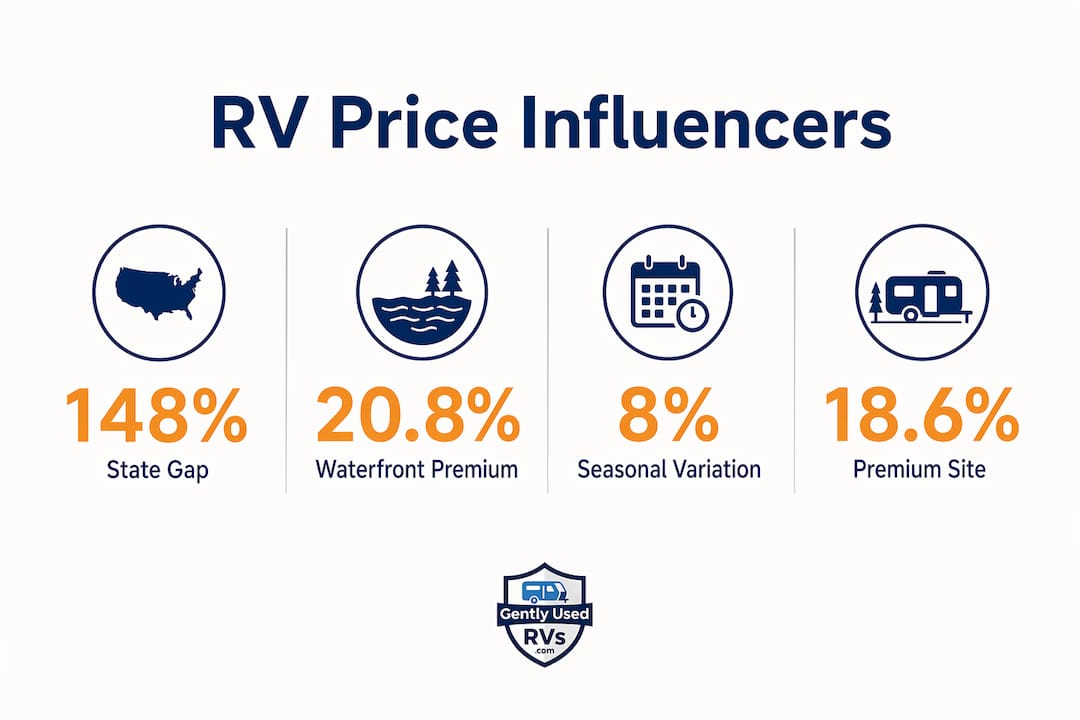
Seasonal variations in RV site pricing average about 8% nationally. That number sounds meaningful until you compare it to the 148% gap between the highest and lowest-priced states. Timing your purchase for the off-season is a minor lever. Choosing the right region is a major one.
How do state and regional differences create price gaps?
The 148% median nightly rate gap between Delaware at $109 and North Dakota at $44 is the starkest proof that where you park matters more than when you park. Delaware’s proximity to major East Coast population centers, combined with limited campground inventory, drives demand far above what supply can absorb. North Dakota has the opposite dynamic: vast open land, fewer tourists, and campgrounds competing for a smaller pool of visitors.
This state-level pricing reality carries directly into the used RV retail market. Buyers in high-cost states are already conditioned to pay more for RV experiences. That willingness to pay transfers to vehicle purchases. A Class C motorhome listed in coastal California or New England will attract buyers who expect premium pricing. The same unit listed in rural Montana may sit longer and sell for less, simply because the local buyer pool is smaller and less price-conditioned.
The table below shows how median RV site pricing varies across selected states, based on 2026 data:
| State | Median Nightly Rate | Pricing Tier |
|---|---|---|
| Delaware | $109 | Highest |
| California | $85 | High |
| Florida | $78 | High |
| Texas | $62 | Mid |
| Ohio | $55 | Mid |
| North Dakota | $44 | Lowest |
Campground fee pricing rises sharply in prime areas because supply constraints and high consumer willingness to pay for the full experience bundle sustain elevated rates. Campground expansions are slow and expensive. New sites in high-demand regions rarely come online fast enough to cool prices. That structural scarcity is a permanent feature of coastal and tourist-heavy markets.
Pro Tip: If you’re buying an RV to use primarily in a high-cost state, factor the local site rate environment into your total cost of ownership calculation. A $10,000 price difference on the vehicle can evaporate quickly if nightly rates are $40 higher than you budgeted.
Does micro-location drive bigger premiums than site type?
Waterfront RV sites command a 20.8% premium over standard sites, and premium-designated sites carry an 18.6% premium. Those numbers dwarf the difference between a pull-through and a back-in site, which runs around 8%. The lesson is clear: what surrounds the site matters more than what the site itself offers in terms of hookup configuration.
Proximity to popular destinations amplifies this effect significantly. Campgrounds within 10 miles of national parks like Yellowstone, Zion, or the Great Smoky Mountains charge rates that reflect the scarcity of nearby alternatives. Wine country regions in California’s Sonoma and Napa counties show the same pattern. Buyers and renters pay for access, not just acreage.
The comparison below shows how micro-location features stack up against site configuration in terms of price premium:
| Feature | Approximate Premium |
|---|---|
| Waterfront access | 20.8% |
| Premium-designated site | 18.6% |
| Pull-through vs. back-in | ~8% |
| Full hookups vs. partial | ~6% |
Site-level features linked to location create price premiums larger than hookup or configuration differences. This finding reshapes how smart buyers should evaluate RV site value. Paying extra for a pull-through when a waterfront back-in is available at a similar price is a poor trade.
Pro Tip: When evaluating an RV purchase that includes a deeded or leased site, get a comparable analysis of nearby waterfront versus inland sites. The location premium is real and quantifiable, not just a seller’s talking point.
How does local inventory affect used RV prices?
Regional inventory depth influences retail RV values and transaction timing in ways that national averages completely miss. Black Book’s Q2 2026 data shows that markets with elevated dealer inventory produce more selective buyer behavior. Buyers in those markets take longer to decide, negotiate harder, and walk away more often. Sellers who don’t account for local inventory levels end up overpriced and sitting.
The effect is most pronounced for towables and entry-level units. When a regional dealer network is carrying excess fifth wheels or travel trailers, private sellers in that same area face direct competition from discounted new inventory. That pressure softens used prices faster than any national trend would suggest.
Here is what local inventory conditions mean in practice for buyers and sellers:
- Elevated local inventory signals a buyer’s market. Negotiate confidently and expect sellers to move on price.
- Tight local inventory signals a seller’s market. Buyers should act faster and expect less room to negotiate.
- NADA valuations incorporate regional data inputs, causing the same RV to show different retail ranges depending on your zip code. Always run a location-specific NADA check, not a national average.
- Black Book uses auction data to track wholesale trends by region. It reflects what dealers are actually paying, not what they’re asking.
- Market segmentation by region drives price differentiation more than broad national trends. A Class A motorhome selling briskly in Florida may be slow-moving inventory in the Pacific Northwest.
Understanding which tool to use matters. NADA is retail-consumer focused and useful for private party transactions. Black Book is auction-data based and more relevant for dealer-to-dealer pricing. Using the wrong benchmark for your local market is a common and costly mistake. You can explore RV types and classes to understand how vehicle category interacts with regional pricing before you run any valuation.
How can buyers and sellers use location data to negotiate better?
Local cleared comps and active listings are more reliable than national averages for pricing used RVs realistically. A comp is a recently sold comparable unit in your specific market. It tells you what buyers in your area actually paid, not what a national database thinks they should have paid. That distinction is worth thousands of dollars in negotiation.
Follow these steps to apply location knowledge directly to your next RV transaction:
- Pull local active listings first. Search for the same year, make, and model within 100 miles of your target location. Note the asking prices and how long each unit has been listed.
- Identify cleared comps. Look for listings that have sold or been removed recently. A unit that sold in 14 days was priced right for the local market. One sitting for 90 days was not.
- Account for micro-location premiums. If you’re buying an RV with a deeded site, apply the waterfront or proximity premium data before making an offer.
- Check regional inventory levels. Use the RV dealer directory to gauge how many units are available near you. High dealer inventory means you have leverage.
- Separate location from timing. Seasonal discounts average 8% nationally. Location differences can exceed 100%. Don’t wait for winter pricing if you’re already in a low-cost region.
- For sellers: price to your local market, not the national listing average. A quick-sale pricing strategy built on local comps will outperform a strategy built on NADA national ranges every time.
Buyers looking for value should consider searching in adjacent lower-cost regions and transporting the unit. The cost of a one-way tow or drive from a lower-priced state can be significantly less than the price premium you’d pay buying locally in a high-demand market. That’s a real arbitrage opportunity that most buyers never consider.
Key takeaways
Geographic location is the dominant RV price factor, with state-level gaps exceeding 100% and micro-location premiums adding another 20% on top of baseline rates.
| Point | Details |
|---|---|
| State gaps dwarf seasonality | A 148% price gap between states far outweighs the 8% average seasonal variation. |
| Waterfront access pays off | Waterfront sites carry a 20.8% premium, making location features more valuable than hookup type. |
| Local inventory sets the tone | Elevated regional inventory softens used RV prices and gives buyers real negotiating power. |
| Use local comps, not national averages | Cleared local comparables reflect what buyers in your market actually paid. |
| Valuation tools vary by geography | NADA and Black Book both adjust for region, so always run a location-specific check. |
Location pricing is the insight most RV buyers miss
I’ve watched buyers spend weeks obsessing over whether to buy in spring versus fall, convinced that seasonal timing is the key to getting a deal. In my experience, that’s the wrong variable to fixate on. The 8% seasonal swing is real, but it’s noise compared to the 148% state-level gap the 2026 data confirms.
The buyers who consistently get the best deals are the ones who understand their local market cold. They know which dealers are sitting on excess inventory. They know that a waterfront site adds 20% to an RV park model’s value before you even look at the unit itself. They know that a Class A listed in a saturated Florida market in Q2 is a completely different negotiation than the same unit listed in a tight Pacific Northwest market.
What surprises most people is how transparent this data has become. Tools like NADA and Black Book now incorporate regional inputs directly. The RV seller’s market dynamics shift by zip code, not just by quarter. That’s genuinely useful information if you know how to read it.
My honest advice: before you make any offer, spend 30 minutes pulling local active listings and checking regional inventory levels. That half hour of research is worth more than any national pricing guide. Location is the variable that moves the needle most. Everything else is a footnote.
— Christopher
Find rvs priced for your market on Gentlyusedrvs
Understanding why RV location affects price is only half the equation. The other half is finding listings that reflect real local market conditions, not inflated national asking prices.

Gentlyusedrvs is a free marketplace where private sellers and dealerships list used RVs across the U.S., Canada, and internationally. Search results are geotargeted, so you see the closest available units first. Browse used RVs for sale by location, or explore the full RV types guide to match your needs to the right class before you start negotiating. Listings are free to post, with no commissions or hidden fees. Whether you’re buying or selling, you get transparent pricing in a market that rewards local knowledge.
FAQ
Why does RV location affect price so much?
Location controls local supply and demand, which sets the baseline for every transaction. A 148% price gap between the highest and lowest-priced states shows how dramatically geography shifts the market floor.
Is seasonal timing or location more important for RV pricing?
Location is far more important. Seasonal variations average about 8% nationally, while state-level geographic differences can exceed 100%.
How do waterfront or premium sites affect RV value?
Waterfront RV sites command a 20.8% premium over standard sites. That premium reflects buyer willingness to pay for location-linked experience, not just physical amenities.
Should i use NADA or black book to price my RV locally?
Use both, but understand the difference. NADA incorporates regional inputs for retail consumer valuations, while Black Book tracks wholesale auction data by region. For private party sales, NADA’s location-adjusted retail range is the better starting point.
How do i find local comps for a used RV?
Search active and recently removed listings within 100 miles of your target location. Local cleared comps and time-on-market data give you a far more accurate picture of what buyers in your area will actually pay than any national average.