RV Towing Capacity Explained: A Family Buyer’s Guide

RV towing capacity is the maximum weight your vehicle can safely pull, and getting it wrong puts your family at serious risk. The industry term for this limit is gross combined weight rating (GCWR), and it governs every RV purchase decision you make. Understanding what is RV towing capacity means knowing your GCWR, your vehicle’s curb weight, your payload, and how those numbers interact before you ever hitch up. This guide breaks down the full calculation, the factors that shrink your real-world limit, and how to match the right RV to your specific vehicle.
What is RV towing capacity and how does it work?
RV towing capacity is the maximum weight a tow vehicle can pull, as determined by the manufacturer’s GCWR. The GCWR covers the combined weight of your loaded truck or SUV plus the loaded trailer. Exceed it, and you risk brake failure, transmission damage, and loss of vehicle control.
Three numbers define your towing situation:
- GCWR (Gross Combined Weight Rating): The maximum total weight of tow vehicle plus trailer, fully loaded.
- GVWR (Gross Vehicle Weight Rating): The maximum loaded weight of the trailer alone.
- Payload capacity: The maximum weight your tow vehicle can carry, including passengers, cargo, and hitch equipment.
Published towing numbers are idealized figures. Manufacturers calculate them assuming only a driver in the cab. Add a family of four, luggage, and a full tank of gas, and your real available towing capacity drops fast. That gap between the brochure number and your actual limit is where most towing mistakes happen.
How to calculate RV towing capacity
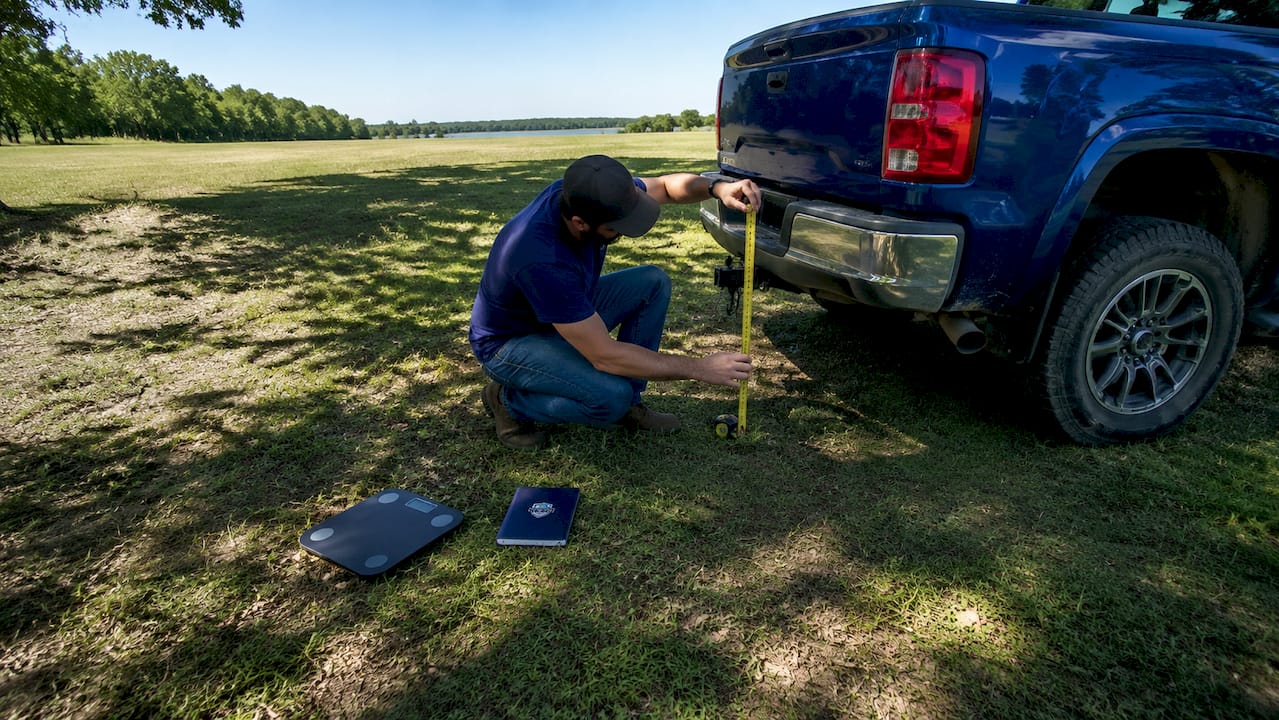
The core formula is straightforward:
Towing Capacity = GCWR minus (Curb Weight + Payload)
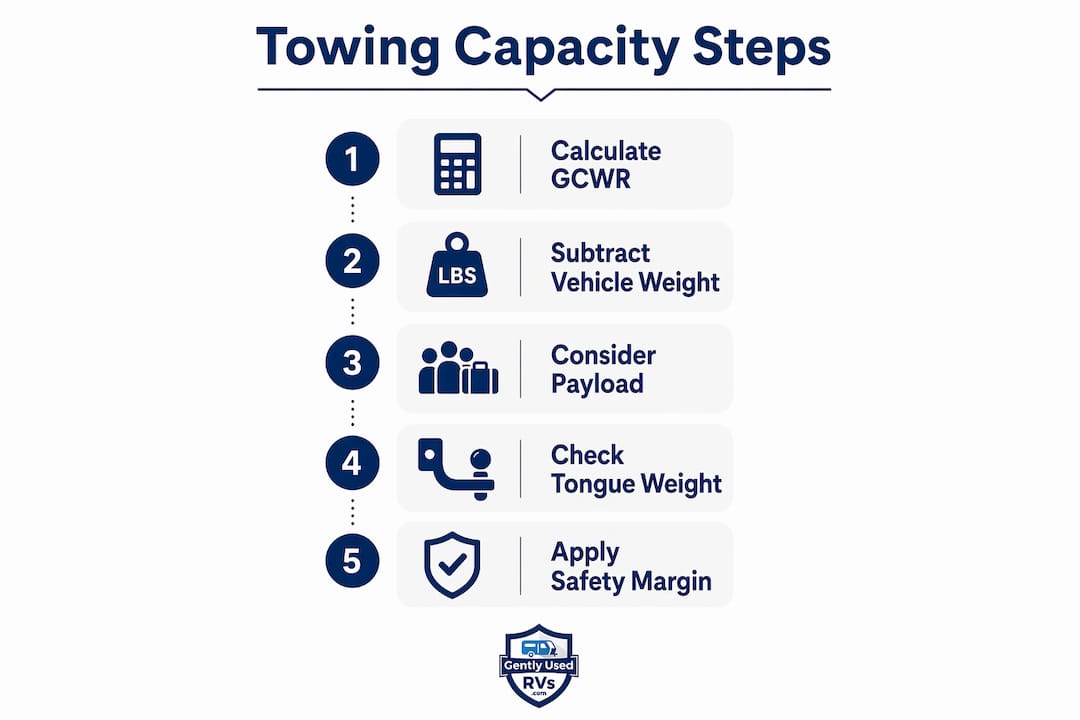
Here is how to apply it step by step:
- Find your GCWR. Check your owner’s manual or the manufacturer’s towing guide for your specific truck or SUV trim and engine.
- Determine your curb weight. This is the weight of your vehicle with a full tank of fuel but no passengers or cargo.
- Calculate your actual loaded vehicle weight. Add passengers, gear, food, tools, and hitch weight to the curb weight.
- Subtract from GCWR. The result is your true available towing capacity for that specific trip.
- Apply the 80% safety buffer. A 20% margin is the standard recommendation to account for hills, headwinds, and emergency braking.
Understanding tongue weight
Tongue weight is the downward force the trailer hitch places on your vehicle’s receiver. For travel trailers, tongue weight should be 10–15% of the loaded trailer weight. Fifth wheels require a pin weight of 15–25% of loaded trailer weight for stability. A 10,000 lb travel trailer should put roughly 1,000–1,500 lbs on your hitch ball.
| Weight Term | Definition | Where to Find It |
|---|---|---|
| GCWR | Max combined weight of truck plus trailer | Owner’s manual or manufacturer website |
| GVWR | Max loaded weight of trailer alone | Trailer door jamb sticker |
| Curb weight | Vehicle weight with full fuel, no load | Owner’s manual or door jamb sticker |
| Payload capacity | Max added weight in/on tow vehicle | Driver-side door jamb sticker |
| Tongue weight | Downward hitch force from trailer | Calculated as % of loaded trailer weight |
What factors affect RV towing limits?
Your tow rating on paper and your safe towing limit on the road are two different numbers. Several real-world variables shrink the gap between them.
- Payload capacity is usually the first limit you hit. Half-ton trucks often have tow ratings of 10,000–13,000 lbs, but payload capacities of only 1,400–1,800 lbs. Load up four adults, a dog, camping gear, and a weight-distribution hitch, and you may have only 600–800 lbs of payload left for tongue weight.
- Dry weight figures lie. Manufacturer dry weights underestimate real trailer weight by 800–1,500 lbs once you add batteries, propane, water, food, and gear. Never plan a trip using dry weight as your baseline.
- Hitch equipment adds real weight. Weight-distribution hitches add 80–120 lbs to your payload calculation. Fifth wheel hitches add 180–250 lbs. Both must be counted against your payload capacity.
- Terrain and conditions reduce your margin. Mountain grades, strong crosswinds, and high temperatures all stress your drivetrain and brakes beyond flat-road ratings.
- Improper tongue weight creates sway or steering loss. Low tongue weight causes trailer sway, while excessive tongue weight overloads your rear axle and reduces front-wheel steering control.
Pro Tip: Never tow above 80% of your vehicle’s rated towing capacity. On a truck rated for 10,000 lbs, treat 8,000 lbs as your hard ceiling. That buffer is what keeps you in control when a semi passes you at 70 mph.
Weight-distribution hitches deserve special mention here. These hitches improve stability by spreading tongue weight load across all axles of the tow vehicle, reducing rear sag and improving steering feel. If you are towing a travel trailer over 5,000 lbs, a weight-distribution hitch is not optional. It is a safety requirement.
How to verify your vehicle’s towing capacity safely
Knowing the formula is one thing. Confirming your actual numbers before a trip is what keeps your family safe. Here is how to do it right:
- Check the door jamb sticker first. Your tow vehicle’s payload capacity is printed on the driver-side door jamb. This sticker is your most important piece of paper. It tells you exactly how much weight you can add to the vehicle before it is overloaded.
- Weigh your rig at a CAT scale. Certified CAT scales are available at most truck stops and cost around $12–$15. Weigh your fully loaded truck and trailer separately, and compare those numbers to your ratings. Manufacturer specs vary. Real weights depend on your specific load habits and fluid levels.
- Calculate tongue weight from your loaded trailer weight. Multiply your loaded trailer weight by 0.12–0.15 for travel trailers, or 0.20 for fifth wheels. That gives you a target tongue weight range to verify against your payload capacity.
- Never rely on dry weight for planning. Add at least 1,000 lbs to any manufacturer dry weight figure to estimate your real loaded trailer weight before you shop or hitch up.
Pro Tip: Use the free towing calculator at Time To RV or Camping World’s tow guide to cross-check your numbers before every trip. These tools account for payload, tongue weight, and GCWR in one place.
The most common mistake families make is checking only the tow rating and ignoring payload. A Ford F-150 with a 13,000 lb tow rating can still be dangerously overloaded with a 7,000 lb trailer if the payload capacity is already consumed by passengers and gear. Check both numbers every single time.
How to match your RV choice to your vehicle’s capacity
Once you know your real available towing capacity, you can shop with confidence. Different RV types carry very different weight profiles, and matching them to your vehicle matters more than matching them to your wish list.
| RV Type | Typical Loaded Weight | Typical Tongue/Pin Weight | Minimum Tow Vehicle |
|---|---|---|---|
| Pop-up camper | 1,500–3,500 lbs | 150–525 lbs | Midsize SUV or half-ton truck |
| Teardrop trailer | 1,000–3,000 lbs | 100–450 lbs | Compact SUV or crossover |
| Travel trailer (small) | 4,000–7,000 lbs | 400–1,050 lbs | Half-ton truck |
| Travel trailer (large) | 7,000–12,000 lbs | 700–1,800 lbs | Heavy-duty half-ton or 3/4-ton truck |
| Fifth wheel | 12,000–20,000 lbs | 2,400–5,000 lbs | 3/4-ton or 1-ton truck with fifth wheel hitch |
| Class A motorhome | Self-propelled | Tows a dinghy vehicle | Rated by motorhome GCWR |
Travel trailers are the most flexible option for families because they span a wide weight range. A lightweight travel trailer under 5,000 lbs loaded can be pulled by many half-ton trucks and larger SUVs. Fifth wheels require a dedicated bed-mounted hitch and a 3/4-ton or 1-ton truck in almost every case. For a detailed side-by-side comparison, the fifth wheel vs. travel trailer guide at Gently Used RVs walks through the weight and hitch differences clearly.
If your current vehicle cannot safely tow the RV you want, you have two choices: downsize the RV or upgrade the truck. Upgrading to a 3/4-ton truck like a Ram 2500, Ford F-250, or Chevy Silverado 2500 typically raises your tow rating to 14,000–18,000 lbs and your payload to 2,500–3,500 lbs. That opens up most fifth wheels and large travel trailers. The RV classes guide at Gently Used RVs covers how each RV class aligns with different tow vehicle types.
Key takeaways
RV towing capacity is determined by your GCWR minus your fully loaded vehicle weight, and payload capacity is almost always the first limit you will hit before you reach your tow rating.
| Point | Details |
|---|---|
| GCWR drives the calculation | Subtract your loaded truck weight from GCWR to find your true available towing capacity. |
| Payload limits come first | Half-ton trucks often run out of payload before they hit their tow rating, especially with passengers and gear. |
| Dry weights mislead buyers | Add 800–1,500 lbs to any manufacturer dry weight to estimate real loaded trailer weight. |
| Tongue weight must be in range | Travel trailers need 10–15% tongue weight; fifth wheels need 15–25% pin weight for safe towing. |
| Always use the 80% buffer | Cap your towing at 80% of your rated maximum to maintain control in real-world conditions. |
The number most buyers ignore until it’s too late
Here is what I have seen trip up family buyers more than anything else: they check the tow rating, fall in love with a trailer, and never look at the payload sticker. I have talked with families who bought a beautiful 9,000 lb travel trailer for their half-ton truck, only to discover their payload capacity was already half-consumed by the family and their gear. The math did not work, and they had to sell the trailer at a loss.
The other thing I will say plainly: brochure specs are marketing, not safety guarantees. A truck rated to tow 13,000 lbs achieves that number under ideal test conditions with one driver and no cargo. Your real-world trip looks nothing like that. When you add three kids, two adults, a week of food, camping chairs, bikes, and a full fresh water tank, your available towing capacity can drop by 2,000 lbs or more before you even hook up the trailer.
Weigh your rig. Use CAT scales. Do it before your first trip and again whenever your load changes significantly. That 15-minute stop at a truck stop is the cheapest insurance you will ever buy for your family’s safety on the road.
— Christopher
Find RVs that match your towing capacity on Gently Used RVs
Once you know your numbers, shopping gets a lot easier and a lot safer. Gently Used RVs is a free online marketplace where private sellers and dealerships list Class A, B, and C motorhomes, travel trailers, fifth wheels, pop-up campers, toy haulers, and more across the United States and Canada.

Browse the full RV types guide to compare weight ranges across every RV category before you commit. If you are ready to search listings by type and location, start browsing RVs on Gently Used RVs today. No account needed to search, and listings are geotargeted so you see the closest options first. You can also connect with local dealers through the RV dealer directory to find inventory that fits your tow vehicle’s real-world capacity.
FAQ
What is the basic formula for RV towing capacity?
Towing capacity equals your GCWR minus your fully loaded vehicle weight, including passengers, cargo, and hitch equipment. Always apply an 80% safety buffer to the result.
Why does payload capacity matter more than tow rating?
Payload capacity is often the first limit reached because tow ratings assume only a driver, ignoring passengers, gear, and hitch weight. Exceeding payload overloads your axles and tires even if you are under the tow rating.
How much does a travel trailer actually weigh when loaded?
Loaded travel trailers weigh 800–1,500 lbs more than their manufacturer dry weight once you add batteries, propane, water, food, and gear. Always use loaded weight for towing calculations.
What tongue weight percentage is safe for a travel trailer?
Travel trailers require tongue weight of 10–15% of the loaded trailer weight. A 7,000 lb loaded trailer should put 700–1,050 lbs on the hitch ball for safe, sway-free towing.
Can I tow a fifth wheel with a half-ton truck?
Most half-ton trucks lack the payload capacity to safely handle a fifth wheel hitch plus pin weight. A 3/4-ton or 1-ton truck is the standard minimum for fifth wheel towing due to the 15–25% pin weight requirement.