
A tire kicker RV buyer is someone who asks questions, requests photos, and even schedules visits, but has no real intent or ability to buy your rig. They eat up hours you could spend on serious prospects. Treat them as low-priority leads from the first message.
Here’s why that distinction matters for your bottom line: every hour you spend answering a tire kicker’s fortieth question about your fifth wheel’s suspension is an hour a genuine buyer sat waiting for a reply. RVs are big-ticket, high-consideration purchases, so some slow, cautious inquiries are normal. But tire kickers aren’t cautious. They’re stalled, often indefinitely, and they rarely admit it.
Before you invest more time in any new lead, run through these immediate checks:
- Ask for a budget range and a target purchase date in your first reply.
- Request basic prequalification (financing status or proof of funds) before scheduling a visit.
- Watch for vague or shifting answers about timeline. That’s your earliest warning sign.
- Cap free-form question threads. If someone’s fifth email still hasn’t mentioned price or timing, ask directly.
Key Takeaways
A tire kicker RV buyer asks questions and inspects listings without real intent or ability to purchase, and consistent upfront screening is the only reliable way to filter them out before they cost you time.
| Point | Details |
|---|---|
| Definition matters | A tire kicker inspects and questions without buying intent; a research buyer eventually commits when given a clear next step. |
| Screen every lead the same way | Ask budget, timeline, financing status, and decision authority before scheduling any in-person visit. |
| Watch for repeated stalling | Three vague or non-committal answers in a row on budget, timeline, or appointments is your signal to disengage. |
| Some conversions are worth trying | A real number, a named date, and acknowledged decision-makers together suggest a lead worth one more low-effort push. |
| Gently Used RVs filters early | Detailed AI-built listings, geotargeting, and paid visibility tiers help serious buyers self-select before they even message you. |
Table of Contents
- What Does “Tire Kicker” Actually Mean for RV Sellers?
- What Are the Warning Signs of a Tire Kicker RV Buyer?
- Why Do Tire Kickers Cost RV Sellers More Than Time?
- How Do You Pre-Screen an RV Buyer Before Wasting Your Weekend?
- How Should You Respond to a Tire Kicker Without Burning Bridges?
- Can a Tire Kicker Turn Into a Real Buyer?
- What Do Real Tire-Kicker Scenarios Look Like for RV Sellers?
- How Do Marketplace Features Cut Down on Tire Kickers?
- How Gently Used RVs Helps You Filter Out Low-Intent Buyers
- Sources
What Does “Tire Kicker” Actually Mean for RV Sellers?
The Cambridge Dictionary defines a tire kicker as someone who appears interested in buying something, asks a lot of questions or inspects it closely, but ultimately doesn’t buy. Applied to RVs, that’s the shopper who wants a full walkthrough of your Class C’s electrical system, then never mentions money again.
The phrase comes from car lots, where buyers would literally kick a vehicle’s tires as a folk inspection ritual, a way to look serious without actually assessing anything. According to Wiktionary, the term evolved into sales slang for lookers who waste a seller’s time without progressing toward a purchase. RV dealers picked up the same language decades ago. A dealer slang dictionary still lists “tire kicker” as standard shop-floor vocabulary, used to justify why a salesperson won’t chase a lead past a certain point.
Here’s the nuance most sellers miss: not every slow-moving buyer is a tire kicker. Gartner’s research on the modern buying journey shows buyers spend real time on independent research before they ever contact a seller, checking comps, reading reviews, comparing floor plans. That’s normal, even healthy, behavior. A genuine early-stage researcher eventually narrows down and commits to next steps. A true tire kicker never does. The test isn’t how many questions someone asks. It’s whether they move forward when you give them a clear path to buy.
What Are the Warning Signs of a Tire Kicker RV Buyer?
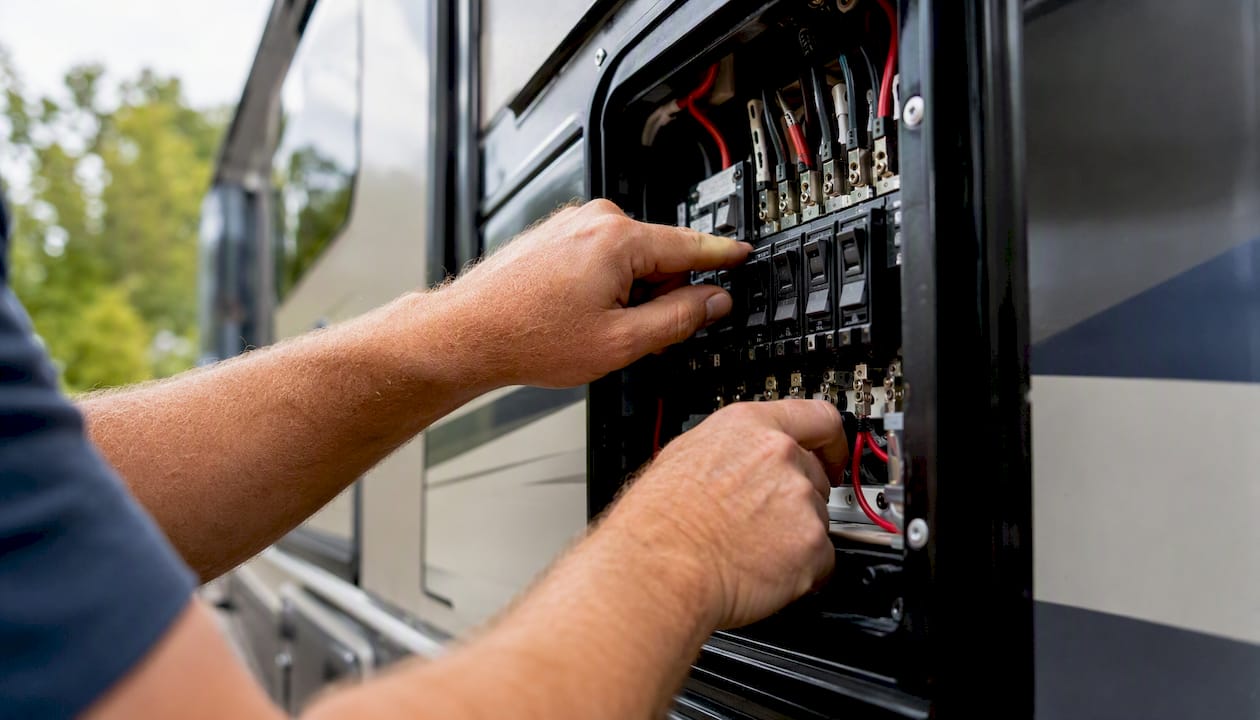
Certain behaviors show up again and again in RV listings, and once you’ve seen the pattern, you’ll spot it fast. Pipedrive’s sales research describes tire kickers as leads who enjoy the process of looking but “can’t or won’t ever come to a buying decision.” RV sellers see a version of this constantly.
Watch for these patterns in messages and calls:
- Repeated requests for more photos of areas already shown, especially cosmetic detail with no questions about mechanics or price.
- Rescheduling a walkthrough two or three times without a firm rebooking.
- Aggressive haggling before they’ve even seen the unit in person, often opening well below asking price with no justification.
- Vague answers when you ask about budget or timeline (“just looking around,” “not in a rush,” “depends”).
- Long threads of technical trivia questions, tank sizes, axle ratings, generator specs, that read more like curiosity than due diligence can be managed better by following these DIY RV Maintenance Tips for Beginners.
- Test-drive or walkthrough requests with no mention of financing, trade-ins, or how they’d pay.
Some of these overlap with legitimate early research, and that’s where sellers get tripped up. A buyer asking about your travel trailer’s insulation package because they’re weighing it against another listing is doing homework. A buyer asking the same question five different ways over two weeks, with no mention of when they’d decide, is stalling. Anecdotal reporting from Gypsy Journal RV Travel Newspaper backs this up: dealership staff describe tire kickers as people who take test drives and ask endless questions specifically because they enjoy the experience, not because they’re building toward a decision.
Why Do Tire Kickers Cost RV Sellers More Than Time?
The obvious cost is hours. The less obvious cost is what those hours replace.
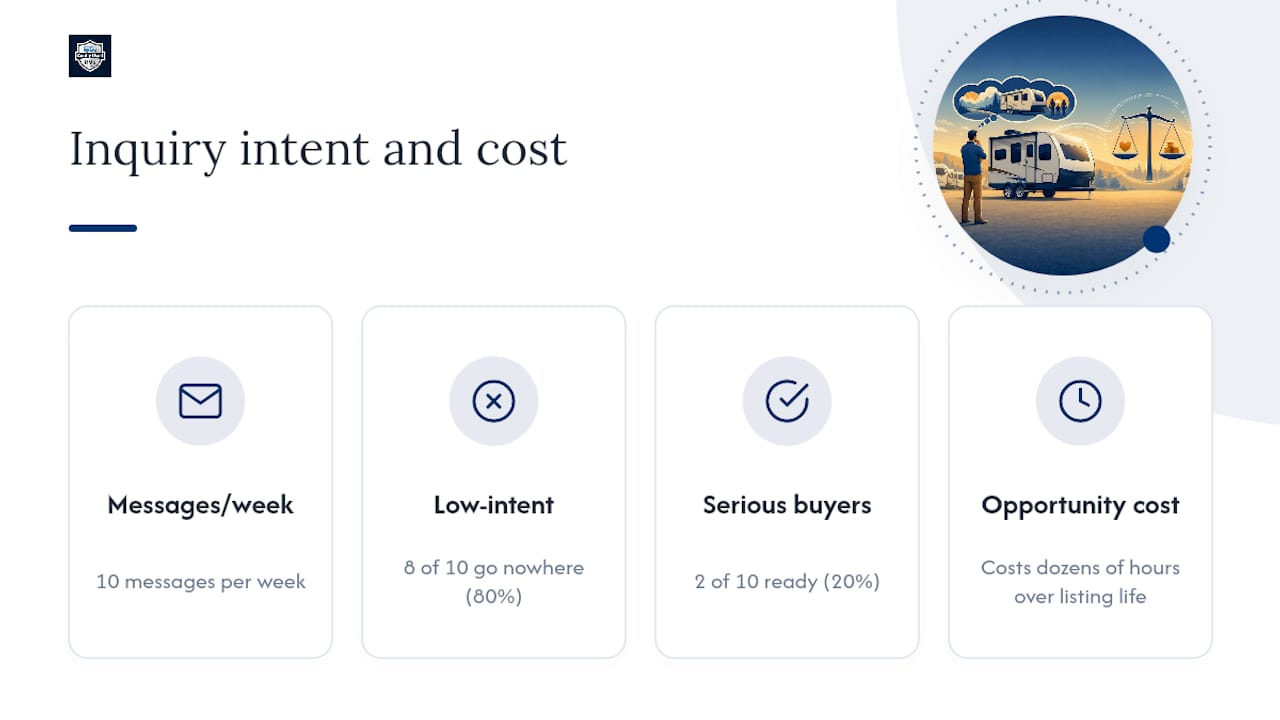
A classifieds-focused seller guide reports that many RV listings draw a high share of low-intent inquiries, and that screening buyers upfront can save sellers dozens of hours over the life of a listing. If you’re fielding ten messages a week and eight of them go nowhere, you’re not just losing time. You’re losing bandwidth you’d otherwise spend responding fast to the two buyers who are actually ready.
That’s the real opportunity cost. RV buyers move on quickly when a seller is slow to respond, especially in a competitive local market where several similar units are listed within driving distance. Every hour spent walking a tire kicker through your slide-out mechanism is an hour a serious buyer spends messaging someone else’s listing instead. If you’re unsure how demand conditions in your area affect how much slack you can afford here, it’s worth understanding what an RV seller’s market means for your listing’s competitive position.
There’s a safety dimension too. Anonymous, low-commitment inquiries, especially ones involving vague out-of-state buyers, partial payment offers, or last-minute pickup requests, carry real fraud and personal-safety risk. Forum threads full of private-seller experiences, like the ones collected on The RV Forum, document sellers who avoided scams or dangerous situations specifically because they refused to skip verification steps for a buyer who wouldn’t commit. Treating vague inquiries as low priority isn’t just about efficiency. It’s about protecting yourself.
How Do You Pre-Screen an RV Buyer Before Wasting Your Weekend?
A five-minute screening exchange up front saves you from a wasted Saturday showing your motorhome to someone who was never going to buy it. Build this into your first or second reply, every time, no exceptions.
- Ask for a budget range. Not “what’s your budget” open-ended, but a direct range: “Are you looking in the $35,000 to $45,000 range, or somewhere else?” Vague or dodged answers are your first flag.
- Ask for a timeline. “Are you hoping to buy in the next two weeks, or is this more exploratory?” A serious buyer usually has a rough date in mind, even if it’s flexible.
- Ask about financing or funds. “Will you be financing this, or paying cash?” If financing, a preapproval letter is a fair ask before you schedule an in-person walkthrough.
- Confirm decision authority. For couples or families, ask whether both decision-makers will be present at the showing. A spouse who “still needs to see it” after a deposit conversation is a stall tactic in disguise.
- Confirm location and transport logistics. If they’re out of state, ask how they plan to view, inspect, and transport the unit. Real buyers usually have a plan; tire kickers get vague fast.
- Request VIN acknowledgment and basic history interest. A serious buyer will usually ask about title status, accident history, or want the VIN to run a report themselves.
- For high-value units, ask for a small refundable deposit to hold a firm appointment. This one step filters out a huge share of casual lookers.
Pro Tip: If a buyer balks at a refundable, fully-disclosed deposit to hold an appointment slot, that reaction alone tells you most of what you need to know. Serious buyers understand why sellers protect their time; tire kickers treat any friction as a reason to disappear.
Once you’ve asked these questions, you’ll know within one exchange whether to schedule a visit or quietly deprioritize the thread. If someone answers all five with specifics, book the appointment. If they dodge two or more, hold off on investing more time until they clarify.
How Should You Respond to a Tire Kicker Without Burning Bridges?
You don’t need to be rude to set boundaries. You need a script, a policy, and the discipline to follow both even when a lead seems promising on the surface.
Phone script for an initial qualifying call:
- Open warm: “Thanks for reaching out about the trailer. Happy to answer questions. Quick ones first so I can point you to the right info fast.”
- Ask directly: “What’s your rough budget, and are you hoping to buy in the next few weeks, or still early in the process?”
- Close toward action: “If that timeline and range work, let’s set up a time to see it in person this week.”
Email template to request proof of intent:
“Thanks for your interest in the [model year and make]. Before we schedule a walkthrough, could you share your budget range, target timeline, and whether you’ll be financing or paying cash? I’m also happy to hold a firm appointment slot with a small refundable deposit if that’s easier for your schedule.”
Email template to end a fruitless conversation:
“I appreciate your interest, but since we haven’t been able to pin down a timeline or budget, I’m going to prioritize other buyers for now. Feel free to reach back out once you’re ready to move forward, and I’ll be glad to help.”
For a decision rule, keep it simple:
- If a lead gives you three vague or non-committal answers in a row, budget, timeline, and appointment confirmation, disengage.
- If they reschedule a confirmed visit more than once without a firm rebooking, stop chasing.
- If they ask for a price drop before ever seeing the unit, respond once with your firm price and move on if there’s no follow-up.
If price negotiation is where most of your tire-kicker friction shows up, it helps to walk in with a clear stance on used RV price negotiation so you’re not improvising boundaries mid-conversation.
Can a Tire Kicker Turn Into a Real Buyer?
Sometimes, yes. Not every hesitant lead is a lost cause, and writing everyone off too fast costs you sales you could have closed with a little patience.

Look for these signals that a borderline lead is actually salvageable: they give you a real number when pressed on budget, they name an actual date (“we’re selling our current unit by the fifteenth”), and they acknowledge who else is involved in the decision instead of dodging the question. Those three things together suggest someone genuinely working through a process, not stalling indefinitely.
If you see that mix, try low-effort conversion tactics before writing them off. Offer a short, real deadline: “I’ve got another showing scheduled Thursday, so if you want first look, let’s connect before then.” Give a clear next step instead of open-ended availability: “Here’s a link to book a 20-minute walkthrough slot” beats “let me know when works.” And ask for a small, low-stakes commitment, like a refundable deposit to hold the appointment, rather than a big irreversible one.
But know when to stop. If you’ve offered a deadline and a clear next step twice and gotten silence or another vague dodge, the return on further effort drops fast. As sales professionals often note, some buyers use questions and mild negotiation as a way to stay engaged in the process rather than to move toward it. Chasing that pattern past two attempts usually costs more in time than it returns in closed deals.
What Do Real Tire-Kicker Scenarios Look Like for RV Sellers?
Theory only gets you so far. Here’s how three common situations actually play out, with the response that works.
- The local looker who won’t talk numbers. A buyer messages about your travel trailer, asks about the awning, the water heater, and the tire age, then goes quiet when you ask their budget. Respond once: “Happy to answer more, but can you share your target price range so I know if we’re in the same ballpark?” If they dodge again, hold your next reply until they answer. Most genuine buyers answer immediately; most tire kickers vanish or keep asking unrelated questions.
- The out-of-state buyer offering partial payment sight unseen. Someone contacts you from three states away, says they love the listing, and offers to wire a partial deposit before arranging inspection or transport. Treat this as a safety issue, not just a qualification issue. Require a verified deposit through a traceable method, confirm identity, and never release keys, title, or full payment before funds clear completely. The private-seller experiences shared on The RV Forum consistently show that sellers who insisted on verified funds and clear title transfer steps avoided the scams that catch sellers who skip those checks.
- The serial comparer booking visits across five listings. A buyer schedules a walkthrough with you and, in casual conversation, mentions they’re also seeing four other units this week. That’s not automatically bad, comparison shopping is normal, but it’s a cue to set a boundary. Say plainly: “Totally understand you’re comparing options. I can hold this slot for you, but if another offer comes in first, I’ll need to move forward with them.” That framing keeps you from becoming their free research stop while still leaving room for a real decision.
How Do Marketplace Features Cut Down on Tire Kickers?
A big share of tire-kicker volume gets filtered out before a message ever reaches your inbox, if your listing and platform are doing their job. Detailed specs, transparent pricing, and clear photos give casual browsers enough information to self-select out, which means the people who do reach out are further along.
On Gently Used RVs, a few platform mechanics do this filtering work for you:
- Geotargeted search results show your listing first to buyers physically close enough to actually view and buy it, cutting down on window-shopping from people who were never going to travel for a purchase.
- The AI-powered autofill tool lets you build a complete, detailed listing in seconds by pulling specs, photos, and pricing from an existing URL, so your listing reads as thorough and credible from the start instead of sparse and vague, which itself discourages idle browsing.
- Paid upgrade tiers, like Silver’s statewide visibility or Gold’s nationwide reach with live buyer chat and appointment scheduling, put your listing in front of buyers who are actively searching a specific radius rather than passively scrolling.
- Dealer inventory integration for enterprise plans keeps larger inventories organized and synced automatically, which frees dealership staff to spend screening time on leads instead of listing maintenance.
Pro Tip: A complete, specific listing does more pre-screening than any script you’ll write. Buyers who read a full spec sheet and still message you with basic questions you already answered are often the ones most worth deprioritizing.
If you sell through a dealership, comparing how private sellers and dealers each handle qualification can sharpen your own process; the dealership versus private seller guide breaks down where the screening burden typically falls in each model.
A Seller’s Note on Living With This
I’ve watched sellers burn entire weekends on buyers who were never going to sign anything, and I’ve watched other sellers close deals in three days flat because they asked one direct question early: “What’s your timeline?” The difference usually isn’t the RV. It’s whether the seller protected their own time from the start. None of the screening steps here require you to be cold or suspicious of every buyer who reaches out. They just require consistency, the same questions, the same boundaries, every single time, regardless of how promising a lead feels in the moment. Apply the checklist even when your gut says this one’s different. Screen every lead the same way, every time.
How Gently Used RVs Helps You Filter Out Low-Intent Buyers
Every tactic in this guide gets easier when your listing itself is doing part of the screening work before a single message lands in your inbox. Gently Used RVs is built around that idea: a free marketplace where detailed, transparent listings attract buyers who already know what they want, rather than casual browsers filling time.

The AI autofill tool builds a complete, specific listing from an existing URL in seconds, pulling year, make, model, specs, price, and photos so nothing looks vague or incomplete. Geotargeting puts your RV in front of buyers close enough to actually follow through, and paid upgrade tiers like Silver and Gold expand your reach to serious shoppers actively searching a wider radius, complete with live buyer chat and appointment scheduling on the Gold tier. Dealerships managing larger inventories get automatic sync and unlimited listings through the dealer directory, freeing up staff time for buyers who are actually ready to move.
If you’re ready to list a unit with the kind of detail that filters out casual lookers before they ever message you, start your free listing on Gently Used RVs today.
Sources
- Cambridge Dictionary — tire kicker (US entry)
- Pipedrive — What is a Tire Kicker? Learn How to Handle Them
- Gartner — B2B buying journey insights