
Used RV financing is the process of securing a loan to purchase a pre-owned recreational vehicle, with options ranging from secured RV loans to unsecured personal loans and specialty lender programs. This used rv financing options guide covers every major loan type, the credit and down payment factors that shape your rate, and the exact steps to apply without overpaying. Whether you are financing used campers from a private seller or a dealership, the right loan can make the difference between a manageable monthly payment and a financial stretch you will regret. Lenders like Bankrate-listed specialty lenders, Good Sam Finance Center, and LendingTree each serve different buyer profiles, so knowing which door to knock on first saves real money.
What used RV financing options are available?
Used RV financing falls into three main categories: secured RV loans, unsecured personal loans, and specialty lender programs. Each works differently and suits a different buyer situation.
Secured RV loans use the vehicle itself as collateral. Because the lender can repossess the RV if you default, they take on less risk and offer lower rates. Secured RV loan rates start as low as 6.49% for borrowers with excellent credit. The catch is that most mainstream lenders only finance RVs under 10–15 years old, so a 2008 Class A motorhome may not qualify.
Unsecured personal loans require no collateral. That flexibility comes at a cost. Unsecured loan rates range from just under 7% to nearly 36% depending on your credit score, and the average personal loan rate sat at 12.28% as of june 2026. Unsecured loans work well for older RVs that secured lenders will not touch, or for buyers who want to skip the inspection and appraisal process.
Specialty lender programs sit between the two. Lenders like My Financing USA and RV Loan Wizard work with buyers who have credit scores as low as 550, though rates run between 14.74% and 19.95% at that tier. Specialty lenders may also extend financing up to 20 years for diesel motorhomes, which mainstream banks simply do not offer.
Here is a quick comparison to anchor your decision:
| Loan type | Typical rate | Best for | Key requirement |
|---|---|---|---|
| Secured RV loan | 6.49% and up | RVs under 15 years old | Collateral, good credit |
| Unsecured personal loan | 7%–36% | Older or lower-value RVs | Credit score, income proof |
| Specialty lender program | 14.74%–19.95% | Lower credit scores | Down payment, inspection |
- Secured loans require comprehensive and collision insurance, often costing $900–$1,500 annually.
- Unsecured loans skip the insurance mandate, which can make them cheaper overall on older, lower-value RVs.
- Private party RV purchases require specialty lenders, since most mainstream banks only finance dealership sales.
How do credit scores, down payments, and loan terms affect your rate?
Your credit score is the single biggest lever on your interest rate and approval odds. Loan approval depends heavily on your income-to-debt ratio and credit score, making financial preparation critical before you apply. Buyers with scores above 700 typically qualify for the best secured rates. Scores between 550 and 650 push you into specialty lender territory with noticeably higher rates.
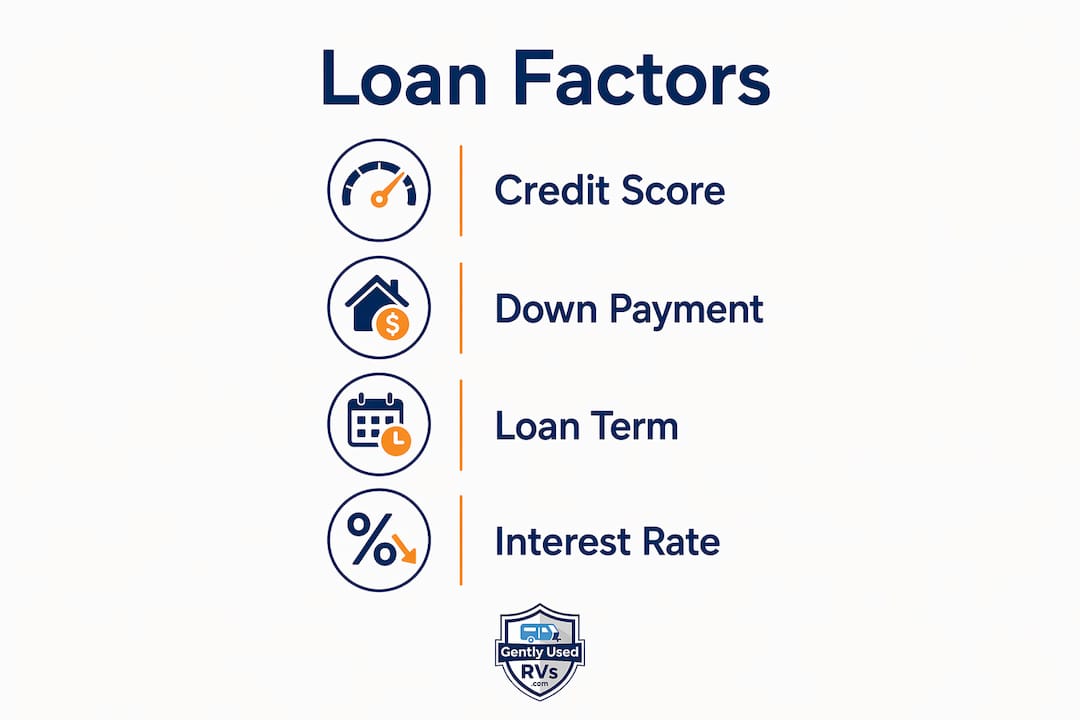
Down payments directly affect your loan-to-value ratio. Lenders prefer down payments of 10–20% on secured loans. A larger down payment lowers the lender’s risk, which often translates to a better rate and a smaller monthly payment. On a $40,000 used fifth wheel, a 20% down payment saves you from financing $8,000 more than necessary.
Loan term length is where buyers often trip themselves up. Used RV loan terms generally range from 5 to 15 years, with 20-year terms available for loans above $50,000. A longer term lowers your monthly payment but raises the total interest you pay over the life of the loan. A 15-year term on a $35,000 loan at 9% costs thousands more in interest than a 10-year term on the same loan.
Key factors to watch before you apply:
- Credit score below 650: Expect rates above 14% and possible down payment requirements of 20% or more.
- Down payment under 10%: Lenders may decline the application or charge a higher rate to offset risk.
- Loan term over 15 years: Reserved for high-value loans; extending terms to manage payments is a warning sign.
- Insurance costs: Budget $900–$1,500 per year for mandatory coverage on secured loans.
Pro Tip: If you keep extending your loan term just to make the monthly payment work, that is a signal to reconsider the purchase price. Extending loan terms to their limits means the RV may be outside your budget. Look at a less expensive model or a smaller RV type instead.
How to apply for and secure the best used RV financing
Getting pre-approved before you shop is the most underused move in used camper financing. Pre-approval tells you exactly how much you can borrow and at what rate, so you walk into any negotiation with real numbers. It also prevents dealers from steering you toward their in-house financing, which often carries a markup.
Follow these steps to apply efficiently:
- Check and improve your credit score. Pull your free report from AnnualCreditReport.com. Dispute any errors. Pay down revolving balances before applying.
- Gather your documents. You will need proof of income (pay stubs or tax returns), a government-issued ID, and details on the RV you want: year, make, model, VIN, and asking price.
- Get pre-approved from at least three sources. Apply to a bank, a credit union, and a specialty RV lender. Comparing offers before visiting a dealer leads to better pricing and terms. Credit unions often beat banks on rate by a meaningful margin.
- Compare the full loan cost, not just the monthly payment. Use a free loan calculator to run the total interest paid over the full term for each offer.
- Negotiate the RV price separately from the financing. Dealers bundle these on purpose. Lock in your best loan offer first, then negotiate the purchase price. Our price negotiation tips can help you save thousands on the sticker price before you even discuss financing.
- Factor in insurance and maintenance. Secured loans require full coverage insurance. Add that annual cost to your budget before signing.
Pro Tip: Lenders require detailed RV information for secured loan applications. Have the VIN, year, make, model, and a current appraisal or market value estimate ready before you call. It speeds up approval and signals that you are a prepared borrower.
Common mistakes to avoid:
- Accepting dealer financing without comparing outside offers first.
- Ignoring the total loan cost and focusing only on monthly payments.
- Skipping insurance cost estimates when budgeting.
- Applying to multiple lenders in a short window without understanding how hard inquiries affect your score.
Private seller vs. dealership: how does financing differ?
Buying from a private seller is often cheaper on the sticker price, but financing gets more complicated. Most mainstream banks and credit unions only finance RV purchases through licensed dealerships. Specialty lenders and online platforms fill this gap, offering private party RV loans with higher scrutiny and sometimes larger down payment requirements.
Dealership purchases come with built-in financing options, but that convenience has a cost. Dealers mark up the interest rate they receive from lenders, pocketing the difference. The RV itself may also carry a higher asking price than a comparable private sale unit. That said, dealerships handle title transfers cleanly and often provide inspection records, which reduces your risk.
Private sales carry real risks you need to manage:
- Title issues: Always verify a clean title through your state’s DMV before agreeing to any terms. A lien on the title can block your financing entirely.
- No inspection records: Require a pre-purchase inspection from an independent RV technician. Lenders financing private sales often require this anyway.
- Scam exposure: Red flag city if a seller pushes you to wire money or skip the paperwork. Our private seller buying guide walks you through every verification step.
- Financing timeline: Private party loans can take longer to close. Build extra time into your purchase agreement.
“Lenders view RVs as luxury items with stricter underwriting. Stable financial ratios and collateral can improve loan approval odds and terms.” — Good Sam Finance Center
If you are buying from a private seller and want the best loan terms, get pre-approved through a specialty lender before you make an offer. That way you know exactly what the lender will accept as collateral and what documentation they need from the seller.
Key takeaways
Securing affordable RV loans requires comparing secured loans, unsecured personal loans, and specialty lender programs before committing to any single offer.
| Point | Details |
|---|---|
| Secured vs. unsecured loans | Secured loans offer lower rates but require collateral, insurance, and a newer RV. |
| Credit score impact | Scores below 650 push you into specialty lender rates of 14.74%–19.95%. |
| Down payment strategy | A 10–20% down payment lowers your rate and reduces total interest paid. |
| Private seller financing | Specialty lenders handle private party loans; mainstream banks typically do not. |
| Total cost budgeting | Add $900–$1,500 annually for mandatory insurance when calculating loan affordability. |
My honest take on financing a used RV
After watching a lot of buyers go through this process, the biggest mistake I see is treating the monthly payment as the only number that matters. A $350 monthly payment sounds manageable until you add $1,200 a year in insurance, $800 in maintenance, and fuel costs for a Class A diesel. The real number is closer to $600 a month in total ownership cost, and that changes the math entirely.
My advice: get pre-approved before you fall in love with a specific RV. Once you are emotionally attached to a particular unit, your negotiating position weakens and you are more likely to accept a bad loan just to close the deal. Pre-approval keeps you grounded.
I also think buyers underestimate credit unions. They consistently offer lower rates than banks on RV loans, and they are more willing to work with buyers who have a solid income but an imperfect credit history. Call two or three local credit unions before you apply anywhere else.
If you find yourself stretching a loan to 15 years on a $25,000 travel trailer, that is a signal to look at a less expensive RV or a smaller RV type. A well-maintained pop-up camper or truck camper at half the price might serve your needs just as well and leave your finances in much better shape. The RV community is full of people who downsized their first purchase and never looked back.
— Christopher
Ready to put your financing knowledge to work?
You now know the loan types, the rate ranges, and the steps to apply. The next move is finding the right RV to finance.

Gently Used RVs lists used motorhomes, travel trailers, fifth wheels, pop-up campers, and more from private sellers and dealerships across the United States and Canada. Browse by RV type to match your loan budget to the right vehicle category. If you want to work directly with a dealer who can assist with financing, the RV dealer directory connects you with trusted sellers near you. No account required to search. Start browsing at Gently Used RVs and apply what you have learned here before you make your first offer.
FAQ
What credit score do I need for a used RV loan?
Most mainstream lenders prefer a credit score of 700 or higher for the best secured RV loan rates. Specialty lenders will work with scores as low as 550, though rates at that level run between 14.74% and 19.95%.
Can I finance a used RV that is over 10 years old?
Yes, but mainstream lenders typically decline RVs older than 10–15 years. Specialty lenders and online platforms offer financing for older RVs, often with a larger down payment and a required inspection.
How much down payment do I need for a used RV loan?
Lenders prefer 10–20% down on secured RV loans. A larger down payment reduces your loan-to-value ratio and often earns you a lower interest rate.
Can I get financing for a used RV from a private seller?
Most banks and credit unions only finance dealership purchases. Specialty lenders like My Financing USA offer private party RV loans, typically with stricter documentation requirements and higher down payments.
How long are typical used RV loan terms?
Used RV loan terms range from 5 to 15 years for most purchases. Loans above $50,000 may qualify for 20-year terms. Longer terms lower monthly payments but increase total interest paid over the life of the loan.