Used RVs are a smarter purchase than new models for most buyers because they sidestep the steepest part of the depreciation curve, deliver lower insurance costs, and put higher-quality rigs within reach of a realistic budget. According to J.D. Power data cited by Peak Credit Union, a new RV can lose roughly 50% of its purchase price within the first five years. That single fact is the foundation of the used-versus-new debate. Whether you’re a first-time buyer or a family upgrading from tent camping, understanding why used RVs are better than new is the difference between a smart investment and an expensive lesson.
Why used RVs beat new ones on depreciation
Depreciation is the largest financial factor in the used RVs vs new debate, and it almost always favors the used buyer. A new Class A motorhome or fifth wheel starts losing value the moment it rolls off the dealer lot. That loss is not gradual. It is front-loaded, steep, and largely unavoidable for the original owner.
J.D. Power data shows new RVs can shed up to half their value in five years. That means a $100,000 motorhome could be worth $50,000 or less by year five. The original owner absorbs that loss. You, as the used buyer, do not.
Used RVs depreciate at a much slower rate once they pass the three-to-five-year mark. The sharpest drop has already happened. What you buy is a more stable asset. That stability matters if you plan to resell in five to ten years, because your own depreciation exposure is far smaller.
“Depreciation is the silent cost most new RV buyers never calculate before signing the paperwork.” — Peak Credit Union
Here is what that curve looks like in practical terms:
- Year 1: A new RV can drop 15 to 25% in value immediately after purchase.
- Years 2 to 5: Continued steep decline, often reaching 40 to 50% total loss.
- Years 5 and beyond: Depreciation slows significantly. Used buyers enter here.
- Resale position: A used buyer who paid fair market value faces far less value erosion over the same holding period.
This is not a minor financial nuance. It is the core reason why choosing a used RV protects your money in a way that buying new simply cannot match.
How total ownership costs favor the used buyer
Purchase price is only one number. Smart buyers compare total cost of ownership across every expense category before deciding. When you run those numbers, used RVs win on multiple fronts beyond the sticker price.
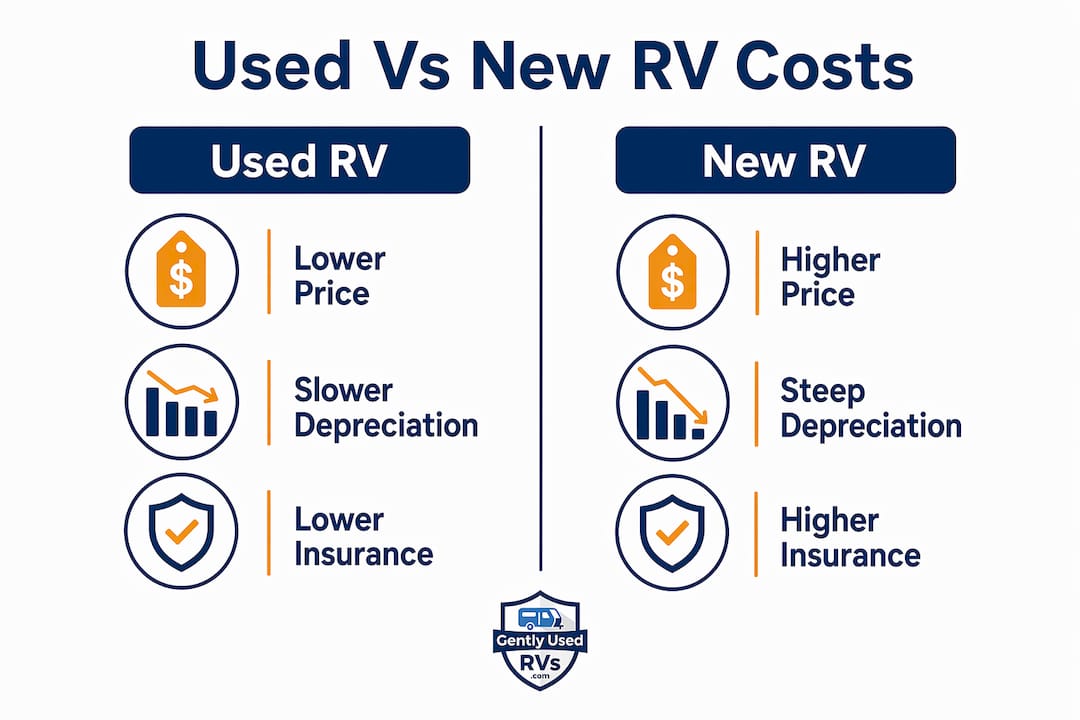
Insurance is one of the clearest wins. Used RVs carry lower premiums because insurers base rates on the vehicle’s current market value. A three-year-old travel trailer is worth less than a new one, so your annual premium reflects that. Over five years, those savings add up to real money.

Financing is another factor worth calculating carefully. A lower purchase price means a smaller loan, a lower monthly payment, and less total interest paid over the life of the loan. If you finance a $45,000 used fifth wheel instead of an $80,000 new one, the monthly difference can be several hundred dollars. That is money you can put toward campsite fees, fuel, or upgrades.
Maintenance is the one area where used RVs require honest attention. Older rigs may need repairs that a new model would not. However, a well-maintained used RV with a documented service history is not a money pit. It is a known quantity. You can budget for it.
- Calculate the full five-year cost: purchase price, depreciation, insurance, loan interest, and estimated maintenance.
- Compare that number against the equivalent five-year cost for a comparable new model.
- Factor in the resale value you can realistically expect at the end of your ownership period.
- Only then decide which option actually costs less.
Pro Tip: Never compare a used RV’s sticker price to a new RV’s sticker price in isolation. Run the five-year total cost of ownership for both, and the used RV advantage becomes undeniable in most scenarios.
What you can actually afford in the used market
One of the most underrated advantages of buying used is what your budget unlocks. Used RVs are tens of thousands of dollars cheaper than their original new price, which means your dollar goes significantly further in the used market.
Consider a family with a $60,000 budget. In the new market, that budget gets you a mid-range travel trailer or a modest Class C motorhome. In the used market, that same $60,000 could put you in a lightly used Class A motorhome, a premium fifth wheel from Keystone or Forest River, or a well-equipped toy hauler with features that would cost $90,000 or more new.
This is not about settling for less. It is about getting more. The used market is where buyers access brands and floorplans that would otherwise be out of reach. A Tiffin Allegro, a Newmar, or a Winnebago View that is four years old and in excellent condition is a far better rig than a brand-new entry-level model at the same price point.
The used market also gives you access to proven model years. RV manufacturers frequently change floorplans, materials, and construction methods. A model year that earned strong owner reviews is a known quantity. Buying a used 2021 or 2022 model with a track record beats gambling on a new model year with unresolved manufacturing issues.
- Access to premium brands: Tiffin, Newmar, Airstream, and Winnebago all appear in the used market at prices well below new.
- Larger floorplans: The same budget that buys a 24-foot new trailer can buy a 32-foot used one.
- Proven reliability: Owner forums and model-year reviews tell you exactly what to expect before you buy.
- Negotiation leverage: Private sellers and dealers both have more flexibility on used pricing than on new inventory.
How inspection and due diligence reduce your risk
The most common concern about buying used is condition uncertainty. That concern is valid but manageable. Thorough inspection is the tool that converts an unknown used RV into a known, quantified purchase. Skip the inspection and you are taking a real risk. Do it right and you are buying with confidence.
The inspection process for a used RV should follow a structured checklist. Vision RV’s 2026 guidelines identify the highest-risk areas clearly.
- Moisture and water intrusion: Check every ceiling corner, slide-out seal, and wall seam for soft spots, staining, or bubbling. Water damage is the most expensive repair in RV ownership.
- Roof condition: Walk the roof if safe to do so. Look for cracks, gaps, or pooling areas. Cracked roof sealant or multiple layers of caulking are red flags for hidden water intrusion history.
- Tire age: Tires degrade with age even if they look fine. Check the DOT date code on the sidewall. Tires older than five to seven years need replacement regardless of tread depth.
- Appliance and system function: Test the furnace, air conditioner, water heater, refrigerator, and all slide-outs. Bring a voltage meter to check shore power connections.
- Frame and undercarriage: Look for rust, cracks, or signs of collision repair. Structural issues are deal-breakers.
Pro Tip: Always inspect in daylight. Shadows and overcast conditions hide roofing seam gaps and sidewall delamination that are obvious in direct sunlight. Schedule your inspection for a clear morning.
Hiring a certified inspector from the National RV Inspectors Association (NRVIA) costs between $150 and $500 depending on the rig size. That fee is trivial compared to discovering a $10,000 water damage repair after purchase. For any used RV over $20,000, a professional inspection is non-negotiable. You can also review the used RV safety checklist at Gentlyusedrvs for additional verification steps before committing to a purchase.
Used RVs vs new: who should buy which
Used RVs are the right choice for most buyers, but not every buyer. Here is an honest breakdown.
Buy used if you:
- Have a fixed budget and want maximum rig for your money
- Plan to use the RV seasonally rather than full-time
- Are a first-time buyer who wants to test RV life before committing to a large new purchase
- Are comfortable doing a thorough inspection or hiring a professional
- Want to minimize depreciation exposure and protect resale value
New might make sense if you:
- Want a full manufacturer warranty with no condition unknowns
- Plan to customize the floorplan or features from the factory
- Intend to use the RV full-time for many years and want the latest safety technology
- Have the budget to absorb the depreciation cost without financial strain
| Factor | Used RV | New RV |
|---|---|---|
| Purchase price | Significantly lower | Full retail price |
| Depreciation exposure | Minimal (already absorbed) | Steep in years 1 to 5 |
| Insurance cost | Lower | Higher |
| Warranty coverage | Limited or none | Full manufacturer warranty |
| Customization | What you see is what you get | Factory options available |
| Inspection required | Yes, critical | Not required |
The data points consistently in one direction. For budget-conscious buyers, families testing RV ownership, and anyone who wants more rig for less money, the advantages of buying used RVs are clear and measurable.
Key takeaways
Used RVs deliver better financial value than new models for most buyers because depreciation, insurance, and financing costs all favor the used side of the market.
| Point | Details |
|---|---|
| Depreciation advantage | New RVs lose up to 50% of value in five years; used buyers skip that loss entirely. |
| Lower total ownership cost | Insurance, financing, and purchase price are all lower on used RVs than comparable new models. |
| Greater buying power | The same budget buys a larger or higher-quality rig in the used market than in the new market. |
| Inspection is non-negotiable | A professional NRVIA inspection for $150 to $500 eliminates most condition risk on used purchases. |
| Know your buyer profile | Used RVs suit most buyers; new makes sense only for full-timers or those needing factory customization. |
The real math most buyers ignore
I have watched buyers walk away from excellent used rigs because the new model at the dealership had that fresh smell and a shiny warranty card. Then I have watched those same buyers sell their new RV three years later at a $30,000 loss and wonder what happened. The depreciation math is not complicated. It is just uncomfortable to confront at the point of sale.
The buyers who come out ahead are the ones who treat an RV purchase like a real financial decision, not an emotional one. They run the five-year total cost of ownership. They hire an inspector. They research the model year on owner forums before they ever walk into a dealership or contact a private seller. They are patient enough to wait for the right used rig instead of buying the first new one that catches their eye.
One thing I always tell people considering a used RV: the inspection is your best friend. A $300 professional inspection has saved buyers from $15,000 water damage repairs more times than I can count. The risk in buying used is real, but it is manageable. The risk in buying new and absorbing that depreciation curve is also real, and far fewer buyers account for it.
If you are a first-time buyer or a family trying to make RV ownership work on a real budget, the used market is where the value lives. Be patient, be thorough, and do not let a new-RV sales pitch distract you from the numbers.
— Christopher
Find your next used RV on Gentlyusedrvs
Ready to put this research to work? Gentlyusedrvs is a free classifieds marketplace where private sellers and dealerships list used RVs across the United States, Canada, and internationally. No account required to browse. No commissions or hidden fees.

You can search across every RV type, including Class A, B, and C motorhomes, travel trailers, fifth wheels, toy haulers, and pop-up campers, all filtered by location so you see the closest listings first. Whether you are looking for a lightly used Winnebago Thrive or a Forest River Solaire, the full inventory is free to explore. Start browsing today and find the rig your budget actually deserves.
FAQ
Why do used RVs depreciate slower than new ones?
Used RVs have already absorbed the steepest part of the depreciation curve, which hits hardest in the first three to five years. After that initial drop, value loss slows significantly, giving used buyers a more stable asset.
Is a used RV worth it if it needs repairs?
A used RV with documented maintenance history and a clean professional inspection is worth it for most buyers. Factor estimated repair costs into your offer price, and the total cost of ownership still typically beats buying new.
What should I always inspect before buying a used RV?
Focus on moisture intrusion, roof sealant condition, tire age, slide-out function, and all major appliances. Water damage and structural issues are the costliest repairs and the most important to catch before purchase.
How much can I save buying used instead of new?
Used RVs are tens of thousands of dollars cheaper than comparable new models, and lower insurance premiums add further savings over the ownership period. The exact amount depends on the rig type, age, and condition.
When does buying a new RV make more sense than used?
New RVs make sense for full-time RVers who need a complete manufacturer warranty, buyers who want factory customization, or those with the budget to absorb early depreciation without financial strain.