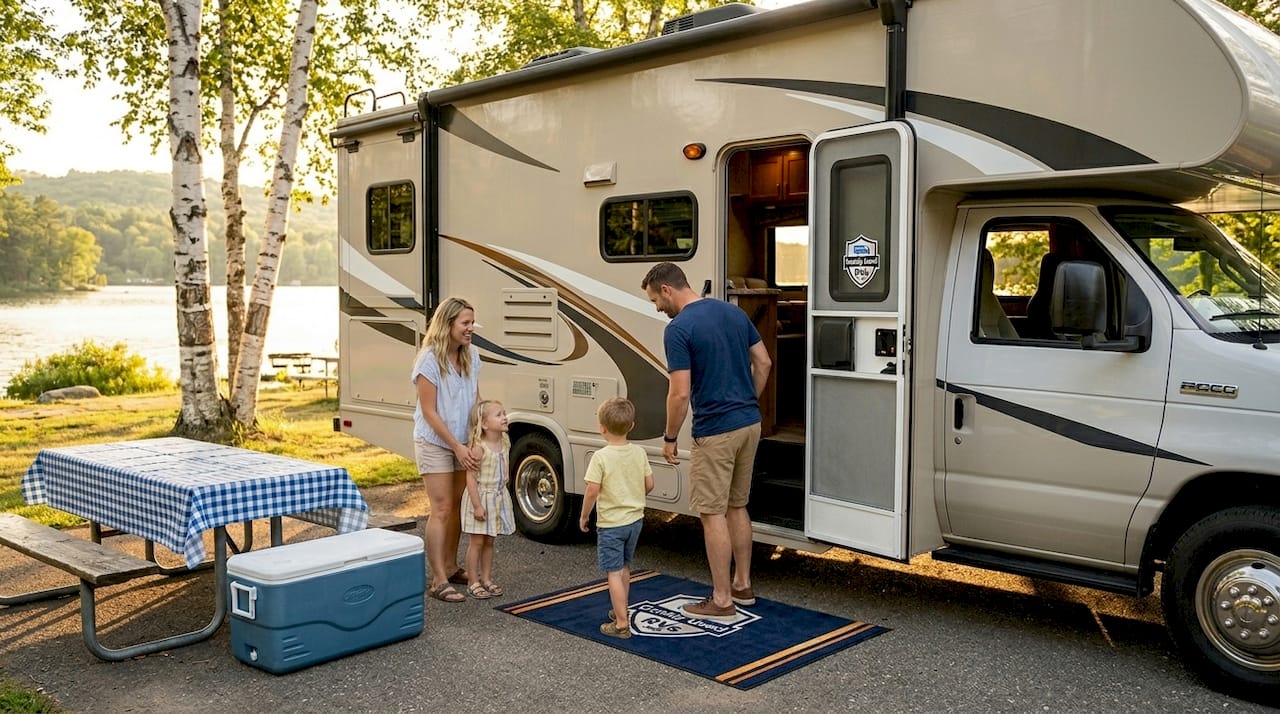
The best RVs for families are defined by three non-negotiable features: dedicated sleeping zones for parents and kids, enough seatbelts to seat every passenger safely, and a floorplan that makes daily life on the road feel manageable rather than chaotic. Not every RV marketed as “family-friendly” actually delivers on those promises. Models like the Airstream Flying Cloud 30FB Bunk, the Heartland Prowler 2600BH, and the Highland Ridge Open Range 335RBS set the standard for what family vacation RV options should look like in 2026. This guide breaks down the top picks by class, budget, and safety profile so you can match the right rig to your family’s actual needs.
1. Best RVs for families: the Airstream Flying Cloud 30FB Bunk
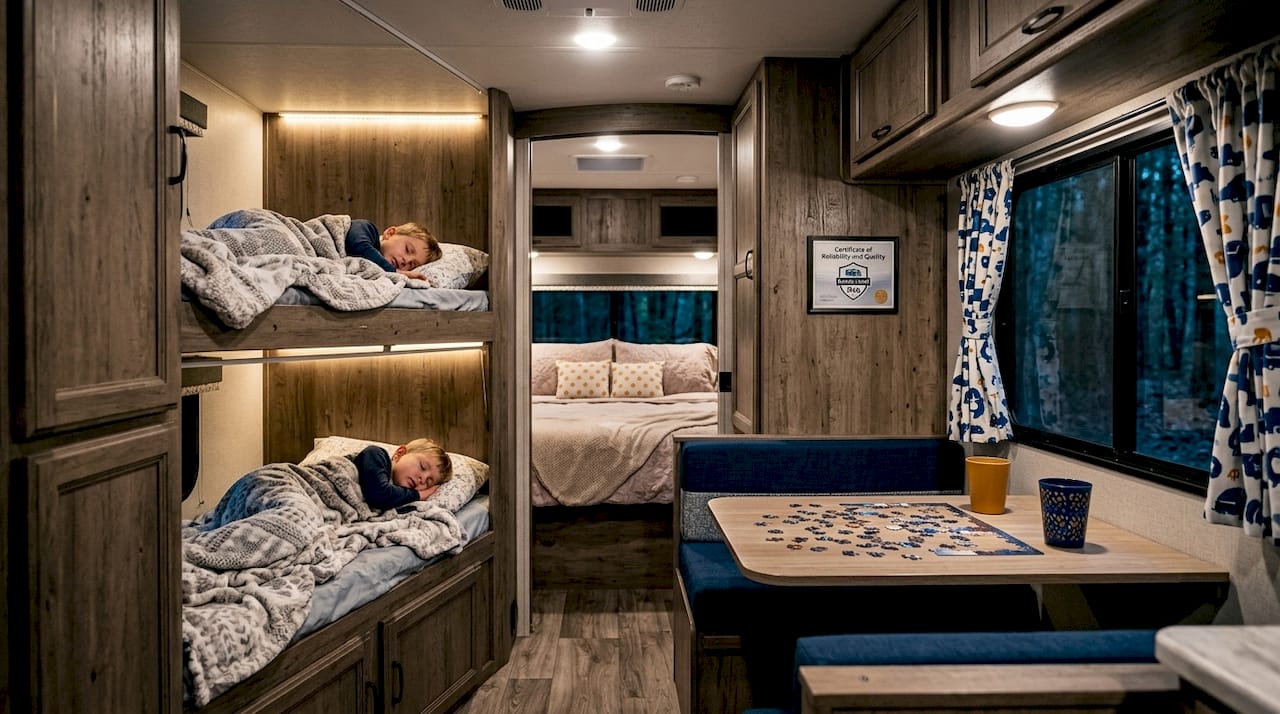
The Airstream Flying Cloud 30FB Bunk is the gold standard for families who want comfort and capacity without sacrificing build quality. It sleeps up to eight with dual sleeping zones that physically separate the parents’ space from the kids’ area. That separation matters more than most buyers realize until night three of a road trip.
The front primary bedroom gives adults genuine privacy. The rear section features full-size bunk beds plus convertible sleeping options for extra guests or older kids. Airstream’s aluminum construction also holds resale value better than most competitors in the travel trailer segment.
- Sleeps: Up to 8
- Key feature: Dual sleeping zones with front primary bedroom
- Best for: Families of 4 to 6 with school-age kids
- Tow requirement: Heavy-duty half-ton or three-quarter-ton truck
2. Heartland Prowler 2600BH: the best budget travel trailer for families
The Heartland Prowler 2600BH is the most practical affordable family RV on the market right now. It fits up to eight travelers in a 29.5-foot by 8-foot footprint, with double-over-double bunks rated at 600 pounds each. That bunk rating is significant because it means older teens and adults can use them without worry.
The layout includes convertible living spaces that pull double duty as sleeping areas, plus enough storage to handle the gear overload that comes with traveling with kids. For families who want a bunkhouse layout without a luxury price tag, the Prowler 2600BH delivers more square footage per dollar than most competitors in its class.
- Sleeps: Up to 8
- Key feature: Double-over-double bunks at 600 lbs capacity each
- Best for: Budget-conscious families of 4 to 8
- Tow requirement: Half-ton truck minimum
Pro Tip: Look for rear bunk setups with their own entry door. Models like the Brinkley Model I 294 include a private rear entry that lets kids come and go from the campsite without tracking mud through the entire RV.
3. Highland Ridge Open Range 335RBS: luxury family RV for extended trips
The Highland Ridge Open Range 335RBS is over 39 feet long with four slide-outs, a king-size bed, and a flexible mid-bunk multipurpose room. This is the rig for families who spend weeks at a time on the road and need a living space that doesn’t feel like a compromise. Think condo-level amenities in a towable package.
The four slide-outs expand the interior dramatically when parked, giving kids room to spread out and adults a proper kitchen and living area. The multipurpose bunk room can serve as a kids’ bedroom, a home office, or a gear storage zone depending on the trip. The trade-off is real: you need a heavy-duty three-quarter-ton or one-ton pickup to tow it safely.
- Sleeps: 6 to 8
- Key feature: Four slide-outs plus flexible mid-bunk room
- Best for: Families doing extended stays or full-time travel
- Tow requirement: 3/4-ton or 1-ton pickup required
4. Airstream Rangeline Touring Coach: best camper van for families with young kids
The Airstream Rangeline Touring Coach is the best camper van for families who prioritize safety for toddlers and infants. It includes bench seating with a LATCH system for car-seat installation, which is rare in any RV class and nearly unheard of in a Class B design. For families with children under five, that single feature changes the safety equation entirely.
The optional pop-top roof expands sleeping capacity to four, making it workable for a family of three or four on weekend trips. It drives like a large van, which means most adults with standard driving experience can handle it without special training. The trade-off is limited space compared to Class C or travel trailer options, so it works best for shorter trips or smaller families.
- Sleeps: Up to 4 with pop-top
- Key feature: LATCH system for car-seat installation
- Best for: Families with infants or toddlers, weekend trips
- Tow requirement: None (self-propelled Class B)
5. How Class A, B, and C motorhomes compare for families
Choosing between RV classes is one of the most consequential decisions a family makes before buying. Each class has a distinct trade-off between space, drivability, and sleeping capacity.
| RV Class | Sleeping Capacity | Seatbelts | Kitchen Size | Bathroom | Best Use |
|---|---|---|---|---|---|
| Class A | 6 to 10 | 4 to 6 | Full-size | Full bath | Extended trips, large families |
| Class B (Camper Van) | 2 to 4 | 2 to 5 | Compact galley | Wet bath or none | Weekend trips, small families |
| Class C | 5 to 7 | 5 to 6 | Mid-size | Full bath | Best all-around family option |
Class C motorhomes typically provide 5 to 7 sleeping spots and 5 to 6 seatbelts, which covers most families of four or more. They drive like large SUVs and include cab-over bunk beds that kids love. Class A models offer the most interior space and the most luxury, but they require more driving skill and a larger budget. Class B campervans are the easiest to drive and park, but their sleeping capacity tops out at four, which limits their usefulness for families with multiple kids.
6. Safety considerations every family must know before buying
RV passenger safety is the most under-discussed topic in the family RV space, and the facts are sobering. RV seatbelts often fail to meet federal motor vehicle safety standards and are not crash-tested, which means children sitting in the RV’s living area during travel are not protected the way they would be in a car or truck.
The safest place for young children during travel is in the towing vehicle’s cab or in the motorhome’s driver compartment, where proper seatbelts and LATCH systems are present. This is not a minor preference. It is the recommendation from child passenger safety experts, and it should shape how you plan seating before you ever pull out of the driveway.
Here are the safety priorities every family should check before finalizing an RV purchase:
- Confirm the number of crash-tested seatbelts in the driver compartment or towing vehicle
- Verify LATCH anchor points if you have children in car seats (the Airstream Rangeline is one of the few RVs with this feature)
- Plan seating arrangements for toddlers and infants before buying, not after
- Secure all loose items in the living area before driving to prevent projectile hazards
- Choose RVs with at least four seatbelts and child seat tethers in the forward-facing seating area
Pro Tip: If you have a toddler in a rear-facing car seat, map out exactly where that seat will be installed during travel before you commit to any RV. Many families discover this problem after purchase.
7. Budget vs. luxury: which family RV fits your travel style?
The gap between budget and luxury family RVs is not just about price. It is about how long you plan to travel and how much daily comfort matters to your family.
The Heartland Prowler 2600BH sits firmly in the budget tier. It sleeps eight, handles a full family’s gear, and tows behind a standard half-ton truck. For families who camp a few weekends per year, it delivers everything they need without overspending. The Highland Ridge Open Range 335RBS is the opposite end of the spectrum. Its four slide-outs, king-size bed, and flexible bunk room make it feel like a vacation home rather than a camping rig. Families who travel for weeks at a time will use every square foot of it.
Here is a quick breakdown to guide your decision:
- Budget tier (Heartland Prowler 2600BH): Under $40,000 new, sleeps 8, bunkhouse layout, half-ton tow vehicle
- Mid-range (Airstream Flying Cloud 30FB Bunk): Premium build quality, dual sleeping zones, strong resale value
- Luxury tier (Highland Ridge Open Range 335RBS): 39-plus feet, four slide-outs, condo amenities, requires 1-ton truck
The honest question to ask yourself is this: how many nights per year will your family actually sleep in this RV? If the answer is fewer than 20, a budget bunkhouse trailer will serve you better than a luxury rig that sits in storage most of the year. If you are planning extended road trips or seasonal travel, the investment in a larger, more comfortable unit pays off in livability.
Key takeaways
The best RVs for families combine dedicated sleeping zones, crash-tested seatbelts in the driver area, and a floorplan sized to match both your family and your travel frequency.
| Point | Details |
|---|---|
| Sleeping zones matter | Choose RVs with separate parent and kid sleeping areas to avoid nightly sofa conversions. |
| Seatbelt safety is critical | RV living area seats are not crash-tested; young children should ride in the towing vehicle or driver compartment. |
| Class C is the best all-around | Class C motorhomes offer 5 to 7 sleeping spots and 5 to 6 seatbelts, making them the top choice for most families. |
| Match the rig to trip length | Budget bunkhouse trailers suit weekend campers; luxury slide-out models justify their cost only for extended travel. |
| LATCH systems are rare and valuable | Only a few RVs like the Airstream Rangeline include car-seat LATCH anchors, making them uniquely suited for families with toddlers. |
What I’ve learned from watching families choose the wrong RV
I have seen the same mistake play out dozens of times. A family falls in love with a floor plan at a show, buys it based on how it looks parked, and then discovers on the first trip that the sleeping arrangement is a nightmare, the kids have nowhere to put their gear, and nobody thought about where the toddler’s car seat goes during the drive.
The families who get this right do one thing differently. They walk through the RV as if they are actually living in it for five days, not admiring it for five minutes. They open every cabinet, sit in every seat, and ask where each child will be during travel hours. That last question is the one most dealers never raise, and it is the most important one you can ask.
My honest take is that Class C motorhomes are underrated for families. They are not glamorous, but they drive well, sleep a family of five or six comfortably, and do not require a commercial-grade tow vehicle. For most families doing two to four trips per year, a well-chosen used Class C from a platform like Gentlyusedrvs will outperform a brand-new travel trailer that was bought for the wrong reasons.
Resale value also matters more than most first-time buyers realize. Airstream holds value better than almost any other brand. Heartland and Highland Ridge are solid mid-tier options that depreciate predictably. Buying used through a trusted marketplace gives you access to these models at a fraction of the new price, which means you can afford a better floorplan than your budget would allow at a dealership.
— Christopher
Find your family’s next RV on Gentlyusedrvs
Ready to put these recommendations into action? Gentlyusedrvs is a free classifieds marketplace where private sellers and dealerships list used RVs across the U.S., Canada, and internationally. You can browse listings without creating an account, and search results are geotargeted so you see the closest options first.

Whether you are looking for a budget bunkhouse travel trailer like the Prowler 2600BH or a spacious Class C motorhome, Gentlyusedrvs has inventory across every category. Start by reviewing the RV types guide to understand the differences between Class A, B, and C motorhomes, travel trailers, and fifth wheels before you search. Then browse used RVs for sale to find family-friendly layouts near you at prices that make sense for your budget.
FAQ
What is the best RV class for a family of four?
Class C motorhomes are the best all-around choice for a family of four, offering 5 to 7 sleeping spots, 5 to 6 seatbelts, and full bathrooms while driving like a large SUV. Travel trailers with bunkhouse layouts are a strong alternative if you already own a capable tow vehicle.
Are RVs safe for kids during travel?
RV living area seats are not crash-tested and often fail federal safety standards, so children should ride in the towing vehicle cab or motorhome driver compartment during travel. The Airstream Rangeline is one of the few RVs with a LATCH system for car-seat installation inside the vehicle.
How many people can a family travel trailer sleep?
Most family-oriented travel trailers sleep six to eight people. The Heartland Prowler 2600BH sleeps up to eight in a 29.5-foot footprint, while the Airstream Flying Cloud 30FB Bunk also accommodates eight with dedicated parent and kid sleeping zones.
What should I look for in a family-friendly RV?
Prioritize at least four crash-tested seatbelts, separate sleeping areas for adults and kids, a full bathroom, and enough storage for family gear. Avoid RVs that require nightly sofa conversions as the primary sleeping arrangement for children.
Is it better to buy a new or used family RV?
A used family RV from a reputable marketplace gives you access to better floorplans at lower prices, and brands like Airstream hold their value well enough that a used unit is still a quality purchase. Buying used also lets you avoid the steepest portion of the depreciation curve that hits new RVs in the first two years.