RV Dealer Lead Generation: The Dealer’s Playbook

The most effective RV dealer lead generation combines inventory-driven capture, channel-specific targeting, and a sub-10-minute first response. Dealers who treat motorhomes and towables as separate buyer funnels, build floorplan-level landing pages, and respond with a personal video before a competitor even sends an auto-reply consistently outperform those running generic campaigns. A practical starting point: sync your inventory to a dealer-facing marketplace like Gently Used RVs and activate a dealer plan that routes geotargeted leads directly to your CRM.
Three plays move the needle fastest:
- Floorplan landing pages + dynamic inventory ads that pause automatically when a unit sells, so you never spend budget on a sold coach.
- Tow/payload and payment calculators embedded at the top of every VDP to qualify buyers before they ever call.
- Personal video replies via MMS within 10 minutes of an inbound lead, showing the exact unit the buyer asked about.
Key Takeaways
Effective RV dealer lead generation requires inventory-driven capture, split funnels for motorhomes and towables, and a first response under 10 minutes to consistently convert leads into appointments.
| Point | Details |
|---|---|
| Split your funnels | Route motorhome leads to payment-focused reps and towable leads to tow-capacity-focused reps from the first contact. |
| Build floorplan-level VDPs | One landing page per unit or floorplan, with a payment tool above the fold and a gated e-price button, outperforms generic category pages. |
| Respond in under 10 minutes | Speed-to-lead is the single most reliable predictor of appointment conversion; a personal video reply raises the bar further. |
| Track appointment rate, not lead volume | Cost per lead is a starting metric; appointment rate, show rate, and lead-to-sale conversion tell you what is actually working. |
| Gently Used RVs dealer plans | Automatic inventory sync, AI autofill, and geotargeted listings give dealers a ready-built VDP and lead capture channel without manual feed management. |
Table of Contents
- How does the RV buyer funnel work, and what should you capture at each stage?
- Which channels should you run, and what does each one need to do?
- How do floorplan landing pages and dynamic inventory ads actually convert buyers?
- Why do video walk-throughs and fast personal responses win more appointments?
- How should you capture, route, and qualify RV leads in your CRM and DMS?
- How do you turn RV shows and retargeting into a steady lead pipeline?
- What KPIs should you track, and what do realistic costs and timelines look like?
- What mistakes do dealers make, and what compliance rules apply?
- How Gently Used RVs helps dealers capture qualified leads
- What actually moves units fastest: a few rules of thumb
- Ready to sync your inventory and start capturing local leads?
- Sources
How does the RV buyer funnel work, and what should you capture at each stage?
Motorhome and towable buyers move through fundamentally different funnels, and treating them the same is one of the most expensive mistakes a dealer can make. Motorhome buyers research over an extended period, often starting with YouTube tours and lifestyle content before they ever visit a VDP. Their primary anxiety is monthly payment and financing qualification. Towable buyers move faster and lead with a practical question: “Will my truck pull this?”
Segment your capture strategy from the first click based on which funnel the buyer is in.
Funnel stage breakdown:
- Discovery (awareness): Buyer is watching YouTube walkthroughs, browsing Instagram lifestyle content, and reading “best Class A under $150K” articles. Capture method: retargeting pixel, video view audience, and email opt-in for a “buyer’s guide” PDF.
- Consideration (research): Buyer lands on floorplan pages, uses a payment or tow calculator, and compares two or three units. Capture method: gated e-price request, chat widget, and appointment scheduler embedded on the VDP.
- Intent (decision): Buyer submits a lead form, calls the dealership, or requests a test drive. Capture method: immediate CRM entry, lead routing to the right salesperson, and a video reply within 10 minutes.
Seasonal timing matters here. Buyers who start researching in January and February are typically planning a spring purchase. Build your pipeline in winter with awareness campaigns, then shift budget to conversion-focused search and retargeting in March and April. A month-to-month program structure lets you scale spend up in spring and pull back in late fall without being locked into a long-term agency contract.
Which channels should you run, and what does each one need to do?
Search and dynamic inventory ads capture the highest-intent leads. Meta and YouTube build the upper funnel and feed retargeting pools. Running all four together, with CRM nurturing connecting them, produces the best overall lead quality for RV dealers.
Google Ads and search
Target floorplan-specific and model-specific keywords, not just broad terms like “RVs for sale.” A buyer searching “2025 Forest River Rockwood 2516F travel trailer” is far closer to a purchase than someone searching “buy an RV.” Use call extensions on every ad group and deep-link ads to the specific VDP, not your homepage. Dynamic search ads work well for large inventories because they automatically generate headlines from your live inventory pages.
Meta (Facebook and Instagram) ads
Meta excels at early-stage prospecting and lifestyle-driven creative. Lead forms built natively inside Facebook reduce friction for mobile users and can pre-populate fields from the buyer’s profile. Expect longer nurture cycles from Meta leads compared to search. The buyer who clicks a Facebook ad showing a fifth wheel at a lakeside campsite is still dreaming, not deciding. Plan a multi-week email and retargeting sequence before expecting an appointment.

Pro Tip: If Facebook goes down or restricts your ad account, you may lose access to your entire audience overnight. Diversify by maintaining a presence on an independent marketplace so your inventory stays visible regardless of platform outages. Here’s why that matters more than most dealers realize.
YouTube and video
Unit walkthroughs with timestamped chapters are particularly effective for out-of-state buyers who cannot visit in person. A multi-minute tour of a Class A motorhome, with chapters for the cockpit, bedroom, bathroom, and storage bays, gives a remote buyer enough confidence to schedule a virtual appointment.
Third-party marketplaces
Marketplace leads tend to arrive with strong purchase intent because the buyer was already searching inventory, not just browsing content. The critical requirement is fast DMS/CRM handoff. A marketplace lead that sits unrouted for two hours is effectively a lost lead.
RV shows and events
Geo-fencing the perimeter of an RV show lets you serve ads to attendees on their phones while they walk the floor. Pair that with an event-specific landing page and a QR code at your booth, and you capture contact information from buyers who may never have found your dealership otherwise.
| Channel | Primary role | Key KPI | Creative format | Integration requirement |
|---|---|---|---|---|
| Google Search Ads | High-intent capture | Cost per lead (CPL) | Text ads, call extensions | Live inventory feed, VDP deep links |
| Dynamic Remarketing | Re-engage VDP visitors | Return visit rate | Auto-generated unit images | Product feed / inventory sync |
| Meta Lead Ads | Upper-funnel prospecting | Lead form completion rate | Lifestyle video, carousel | CRM auto-import |
| YouTube | Awareness + retargeting pool | View-through rate, 50% watch | Unit walkthroughs, chapters | Pixel + CRM tag |
| Marketplace listings | Intent-stage capture | Appointment request rate | Photos, specs, price | DMS/CRM handoff |
| RV shows / events | Local pipeline spike | Leads captured on-site | QR landing page, booth | Event-specific lead form |
How do floorplan landing pages and dynamic inventory ads actually convert buyers?
Build one landing page per floorplan or unique inventory unit. Floorplan-level pages outperform generic model pages because RV shoppers search by specific features, sleeping capacity, dry weight, and slide configurations, not just brand names. A buyer searching “bunkhouse travel trailer with outdoor kitchen” needs to land on a page that answers exactly that question, not a generic “travel trailers” category page.
Landing page checklist:
- Headline includes the year, make, model, and floorplan name or number.
- Tow/payload tool or monthly payment calculator appears above the fold, before the photo gallery.
- Gated “Click for E-Price” button keeps you MAP-compliant while capturing the buyer’s contact information. Pricing guidance for used inventory can help you set competitive but compliant price points.
- Clear CTAs: text us, click-to-call, and an appointment scheduler, all visible without scrolling.
- Embedded video walkthrough link, ideally a YouTube private link hosted directly on the page.
- Floorplan-specific specs: sleeping capacity, dry weight, GVWR, garage length for toy haulers, and fresh/gray/black water tank sizes.
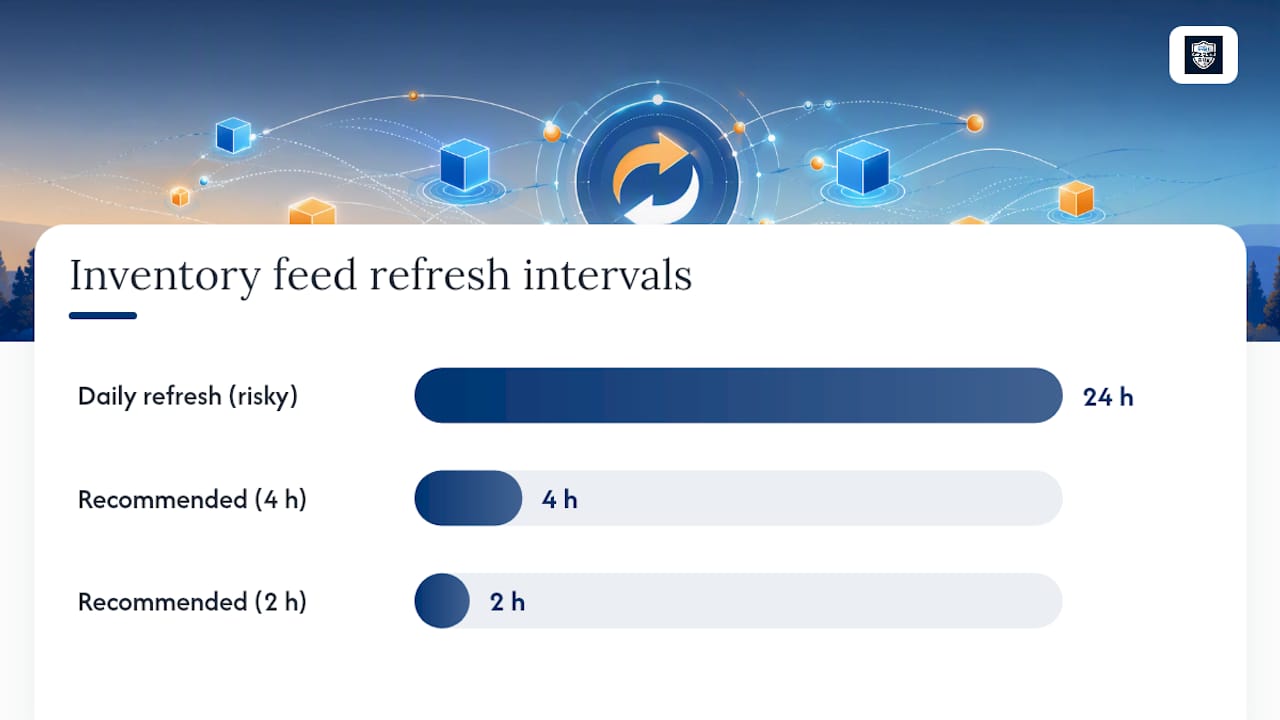
For dynamic inventory ads, the feed is everything. If your inventory feed updates every 24 hours, you risk running ads on units that sold yesterday. Aim for a feed refresh every 2–4 hours. Set auto-pause rules so ads for sold units stop immediately. Use the stock number in your ad copy; it makes tracking easier and lets your sales team pull up the exact unit the moment a buyer calls.
Pro Tip: Include the stock number in the ad’s display URL path (e.g., /unit/STK-4821). When a buyer calls and says “I saw unit 4821,” your team knows exactly which coach to pull up, which cuts call time and signals professionalism.
Payment-first messaging works especially well for motorhome buyers. Integrating options like PayPal Credit into your payment calculator expands the pool of buyers who can close by offering an additional financing path alongside traditional dealer financing.
Why do video walk-throughs and fast personal responses win more appointments?
Speed is the single most reliable differentiator in RV sales. The dealer who responds first usually gets the appointment, and a personal video reply raises the bar even higher. A buyer who receives a 45-second MMS video of the exact unit they asked about, from a real salesperson, within 10 minutes of submitting a form, is far more likely to show up than one who gets an automated email two hours later.
How to build a fast video reply process:
- Create a short template script for each unit category: one for motorhomes (cockpit, living area, bedroom, storage), one for travel trailers (hitch area, kitchen, sleeping, outdoor kitchen if equipped), and one for toy haulers (garage, ramp, living area).
- Record the walkthrough on a smartphone in landscape mode. Keep it 30–60 seconds for an MMS reply, 4–8 minutes for a full YouTube VDP embed.
- For MMS delivery, keep the video file under 25MB. Most carriers cap MMS at that size. Compress with a free tool like HandBrake if needed.
- Host the full walkthrough as an unlisted YouTube video and embed it on the VDP. Send the short clip via MMS and include the VDP link in the same text.
- Get SMS/MMS consent at the point of lead capture. A simple checkbox on your lead form (“I agree to receive text messages from [Dealership Name]”) satisfies basic TCPA requirements. More on compliance below.
Operational SLA targets:
- First response to any inbound lead: under 10 minutes during business hours.
- First scheduled follow-up for early-stage (awareness/consideration) leads: within 24–72 hours.
- Video walkthrough delivery for hot leads (intent stage): same day, ideally within the first response.
How should you capture, route, and qualify RV leads in your CRM and DMS?
Integration and automated routing are table stakes now. The dealer who routes leads fast and scores them correctly closes more deals with the same headcount. A lead that sits in a general inbox for 90 minutes while a salesperson finishes a test drive is a lead your competitor is already calling.
Lead capture flow:
- Source (Google, Meta, marketplace, show) → capture form or chat widget → automated enrichment (truck make/model for towable buyers, budget range, trade-in status) → lead score → routing rule.
Key fields to capture at the form level:
- Stock number or floorplan of interest.
- Tow vehicle make, model, and year (for towable leads).
- Monthly payment target or total budget.
- Trade-in equity estimate.
- Phone number and explicit SMS consent.
Lead scoring signals:
- Towable buyer who listed a tow vehicle: higher score (self-qualified on fit).
- Motorhome buyer who completed a payment calculator: higher score (payment-aware).
- Form submitted from a VDP (vs. a generic contact page): higher score (unit-specific intent).
- Soft credit pre-qualification completed: highest score, route immediately to F&I-ready salesperson.
DMS/CRM integration checklist:
- Live inventory feed connected to your CRM so lead records auto-populate with unit details.
- Two-way status updates: when a unit sells in the DMS, the CRM flags any open leads on that unit for immediate follow-up with an alternative.
- Sales activity tracking tied to lead source so you can measure close rate by channel.
- Attribution tags on every lead record: source, campaign, ad group, and keyword where possible.
Speed-to-lead matters more than almost any other operational variable. Propellant Media’s guidance for RV sales teams consistently points to first-response time as a primary driver of appointment conversion. Set your CRM to alert the assigned salesperson by text the moment a new lead arrives, not just by email.
How do you turn RV shows and retargeting into a steady lead pipeline?
Shows and events create short-term spikes in local buyer interest. Without geo-fencing and a structured retargeting sequence, that spike evaporates by Monday morning. Pair them correctly and you extend a three-day show into a three-week pipeline.
Step-by-step event capture sequence:
- Pre-event (2 weeks out): Launch a geo-targeted campaign to a 25-mile radius around the show venue. Drive traffic to an event-specific landing page with a “Schedule a Show Appointment” CTA and a limited-time offer (e.g., complimentary PDI inspection with purchase at the show).
- On-site (show days): Display a QR code at your booth that links to the same landing page. Capture name, phone, email, and unit of interest. Use a tablet or a simple form tool like Typeform or JotForm for fast entry.
- Post-event (days 1–7): Launch a geo-fenced retargeting campaign targeting devices that were physically present at the show venue during show hours. Serve a video walkthrough ad for the top three units you displayed.
- Post-event (days 7–21): Email and SMS sequence for captured leads: day 1 video walkthrough, day 4 payment calculator link, day 7 appointment CTA, day 14 “still available” update.
Retargeting audiences to build and maintain:
- VDP viewers (visited a specific unit page but did not submit a form).
- Form starters (began a lead form but did not complete it).
- Video viewers who watched 50% or more of a walkthrough.
- Show booth visitors captured via geo-fence.
Event checklist:
- Tablet or device for on-site lead capture, with a mobile-friendly form pre-loaded.
- QR code printed at booth-visible size, linked to the event landing page.
- Show-specific inventory feed highlighting the units physically present at the show.
- Appointment blocks reserved in your CRM calendar for show-day and post-show follow-ups.
What KPIs should you track, and what do realistic costs and timelines look like?
Track quality metrics, not just volume. Raw lead count is a vanity metric.
Recommended KPI set:
- Cost per lead (CPL) by channel.
- Appointment rate (leads that become scheduled appointments).
- Show rate (appointments that actually arrive).
- Lead-to-sale conversion rate.
- Days to close by channel and unit type.
- Return on ad spend (ROAS) by campaign.
Simple attribution approach: Tag every lead with a first-touch source (the channel that generated the initial contact) and a last-touch sale tag (the channel or touchpoint active at the time of purchase). Tie both back to the deal record in your DMS so you can calculate actual revenue per channel, not just leads per channel.
| Channel | Typical CPL range | Appointment rate | Weeks to steady performance |
|---|---|---|---|
| Google Search Ads | $30–$90 | 15%–20% | 6–10 weeks |
| Meta Lead Ads | $50 | 8%–10% | 4–8 weeks |
| YouTube / Video | $5–$15 (CPV) | Lower direct; feeds retargeting | 8–10 weeks |
| Marketplace listings | Low to no ad cost | 20%–30% (intent-stage) | 1–4 weeks |
| RV shows / events | Variable (booth cost) | 25%–35% (on-site capture) | Immediate spike |
These ranges reflect general industry patterns from WebFX’s RV dealer guidance and Propellant Media’s motorhome sales playbook. Your actual numbers will vary by market, inventory mix, and creative quality. Budget at least 90 days before drawing firm conclusions about search campaign performance. Video and retargeting take longer to optimize because they depend on audience size, and audiences take time to build.
Monitor RVIA’s industry trend data quarterly. Shipment forecasts and consumer sentiment shifts directly affect which unit types to prioritize in your campaigns and how aggressively to spend in a given season.
What mistakes do dealers make, and what compliance rules apply?
Slow response, broken inventory feeds, and MAP violations cost more than any bad creative campaign. These are fixable operational problems, and fixing them often produces faster results than launching a new ad channel.
Common mistakes and how to fix them:
- Slow follow-up: Set a hard SLA of under 10 minutes for inbound leads. Use CRM alerts via SMS to the assigned salesperson, not just email.
- Generic landing pages: Every ad should deep-link to the specific unit or floorplan VDP, not the homepage or a category page.
- Not gating price: Displaying the full price publicly on a unit that has MAP restrictions puts you at risk. Use a “Click for E-Price” button to capture the lead and stay compliant.
- Un-synced inventory ads: Running ads on sold units wastes budget and frustrates buyers. Set your feed to refresh every 2–4 hours and enable auto-pause on sold status.
- Skipping F&I pre-qualification: Letting unqualified buyers book test drives wastes your sales team’s time. Add a soft credit pre-qualification step for high-ticket units.
- Mis-attributing leads: Counting every phone call as a “Google Ads lead” when some came from your marketplace listing or a show follow-up skews your budget decisions. Tag every source.
Compliance checklist:
- MAP rules: Never advertise below the manufacturer’s minimum advertised price. Use gated pricing (e-price request) to stay compliant while still capturing buyers. The RVDA provides dealer-specific operational guidance on pricing practices.
- FTC financing disclosures: The FTC’s consumer guidance on vehicle financing recommends clear, accurate disclosures in all financing communications. Never imply a payment without disclosing the full terms, including APR, term length, and total cost.
- TCPA/SMS consent: You must have explicit written consent before sending marketing texts or MMS videos. A checkbox on your lead form is the minimum. Keep records of consent for every contact in your CRM.
- Recordkeeping for finance offers: If you advertise a specific APR or monthly payment in an ad, keep documentation of the offer terms and the date it was valid.
When evaluating lead generation vendors or agencies, ask specifically whether their platform supports MAP-safe pricing display and whether their lead forms include TCPA-compliant SMS consent fields. These are not optional features.
How Gently Used RVs helps dealers capture qualified leads
Gently Used RVs is built around the inventory-driven, dealer-facing features that the tactics above depend on. The platform’s AI-powered autofill tool imports a listing from any dealer website or marketplace URL in seconds, extracting year, make, model, specs, price, and photos automatically. That means your inventory goes live fast, without manual data entry for every unit.
Platform features mapped to the tactics in this guide:
- Floorplan-friendly VDPs: Each listing functions as a standalone unit detail page, searchable by type, features, price, and location.
- Enterprise dealer plans ($2,500–$7,500/location/month): Unlimited inventory with automatic sync, so your listings stay current without manual updates.
- Geotargeted search results: Buyers see the closest available units first based on their location and your listing tier, which means local buyers find your inventory before out-of-area competitors.
- Paid upgrade tiers: Bronze ($29.99/month), Silver ($59.99/month), and Gold ($199 per 6 months) expand your listing’s geographic reach from 50 miles to statewide to nationwide, with live buyer chat and appointment scheduling at the Gold tier.
- AI autofill: Paste a URL from your existing DMS or website and the platform populates the listing automatically.
Use case examples:
- A dealer running a post-show follow-up campaign can direct retargeting ads to specific unit listings on the platform, giving out-of-state buyers a clean VDP with photos, specs, and a chat widget.
- A service-driven dealership capturing trade-in leads can list incoming trade units immediately after appraisal, capturing local buyers before the unit even hits the lot.
Explore the dealer directory to see how other dealerships are listing inventory, or go directly to the dealer sign-up page to review plan options and start an inventory sync.
What actually moves units fastest: a few rules of thumb
Most dealers overcomplicate this. After reviewing the channel data, the funnel mechanics, and the compliance requirements, a few things stand out as consistently true regardless of lot size or market.
Fast follow-up beats better creative, every time. A mediocre ad that generates a lead you call in 8 minutes outperforms a polished campaign where leads sit for two hours. If you can only fix one thing this week, fix your response time.
Price gating is not a trick. It is a qualification tool. The buyer who clicks “Get E-Price” and fills out a form is more serious than the buyer who bounces because they saw a number and moved on. Gate the price, capture the contact, and let your sales team have the conversation.
Video is the great equalizer for smaller lots. A large dealer group can outspend you on Google. They cannot out-personalize a 45-second video from a real salesperson showing the exact unit a buyer asked about. That personal touch is free to produce and nearly impossible to scale at a corporate level.
Three rules of thumb for any lot:
- Split your funnels early. The moment a lead comes in, route towable buyers to a tow-capacity-focused salesperson and motorhome buyers to a payment-focused one. Different questions, different conversations.
- Measure appointment rate per salesperson, not just per channel. A channel can look weak because one salesperson has a 10% appointment rate while another has 35%. The channel is not the problem.
- Protect MAP while gating price. You can compete aggressively on value without violating manufacturer pricing requirements. Gate the price, disclose fully, and let the unit sell itself.
Ready to sync your inventory and start capturing local leads?
Gently Used RVs gives dealers a faster path from inventory to qualified buyer than running every channel independently. Instead of building landing pages from scratch, managing a separate marketplace feed, and hoping your DMS syncs correctly, you get automatic inventory sync, AI-powered autofill, and geotargeted search results from day one.

Enterprise dealer plans cover unlimited inventory with automatic updates, so your listings never show a sold unit. Upgrade tiers scale your geographic reach from local to statewide to nationwide as your budget grows, with live buyer chat and appointment scheduling included at the Gold level. Month-to-month options mean you are not locked in while you test what works for your market.
Dealers who want to see how their inventory looks on the platform can browse the dealer directory or go straight to the dealer sign-up page to review plan options and connect their inventory feed today.
Sources
- Lead Generation Tactics for RV Motorhome Sales Teams - Propellant Media
- Lead Generation for RV Dealers: 11 Strategies - WebFX
- News & Insights - RV Industry Association (RVIA)
- RV Dealers Association - RVDA
- Consumer
- PayPal Credit - PayPal