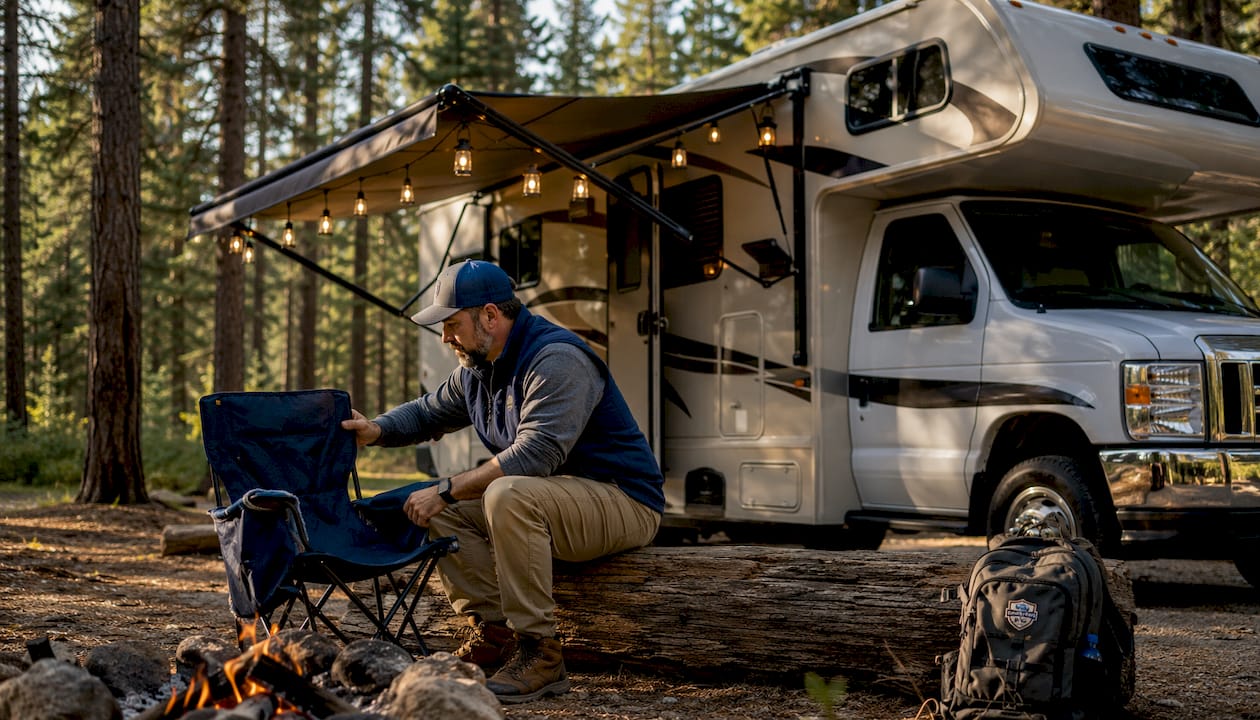
Boondocking means camping without water, electric, or sewer hookups — no campground infrastructure, often no fee, and usually on public land managed by the Bureau of Land Management or U.S. Forest Service. For buyers and sellers of used RVs, understanding where it’s allowed and what your rig needs to handle it is the difference between a great trip and a costly breakdown miles from nowhere.
Top four actions before your first off-grid outing:
- Verify stay limits and land ownership using agency maps before you park anywhere
- Run a short test trip to measure your rig’s actual water and power consumption
- Pack a minimum of 1 gallon of water per person per day as your planning baseline. Increase for hot climates, cooking, or extended cleaning.
- Call any retail store directly before assuming overnight parking is permitted
Pro Tip: Pick a site within two hours of home for your first trip and arrive at least two hours before sunset. You’ll have daylight to scout the access road, set up camp, and drive home if something breaks.
Table of Contents
- What is boondocking and where is it allowed in the U.S.?
- How do you find specific boondocking spots?
- What permissions, stay limits, and etiquette do you need to know?
- Water, power, waste, and safety checklist for off-grid camping
- How do you test a used RV and check it for boondocking capability?
- Your first boondocking trip: a compact step-by-step plan
- Key Takeaways
- The part most buyers and sellers skip
- Find your next boondock-ready RV on Gently Used RVs
- Useful sources to bookmark
What is boondocking and where is it allowed in the U.S.?
Boondocking, also called dispersed camping, is camping outside developed campgrounds without hookups. It’s often free, primitive, and legal on millions of acres of U.S. public land. The term covers everything from a remote desert pull-off to a Walmart parking lot overnight.
Primary public-land sources:
- Bureau of Land Management (BLM): Manages roughly 245 million acres, primarily across the western U.S. Most BLM land is open to dispersed camping without a permit. Nevada, Utah, Arizona, Colorado, and Wyoming are the richest states for BLM access.
- U.S. Forest Service (USFS): Manages 193 million acres of National Forest land across the country, including forests east of the Rockies. Most allow dispersed camping under the same general 14-day rule. The critical planning document is the Motor Vehicle Use Map (MVUM), which shows exactly which roads are open to motor vehicles and where dispersed camping is permitted.
- State lands: Some states, like Washington’s Department of Fish and Wildlife areas and New Mexico’s state land pass program, offer additional free or low-cost options. Rules vary sharply by state.
Private and membership options fill the gaps when public land isn’t nearby. Harvest Hosts is a membership program that lets self-contained RVs stay overnight at wineries, farms, and breweries. Boondockers Welcome connects RVers with private hosts who offer a spot on their property. Both typically limit stays to 24 hours.
Retail courtesy parking at Walmart, Cracker Barrel, and some Cabela’s locations is a legitimate overnight option when you’re in transit. Store-level permission is always required — never assume. Go inside, ask the manager on duty, arrive late, leave early, and buy something.
Stay-limit baseline: BLM and USFS rules typically cap consecutive stays at 14 days within a 28-day period. After that, you must move, and often a substantial distance.
How do you find specific boondocking spots?
Community apps and agency maps are how most RVers locate actual sites. No single official database lists every legal boondocking location, so cross-referencing tools is standard practice.
Recommended tools:
- Campendium: Best for detailed user reviews, GPS coordinates, cell-signal reports, and rig-size notes. The free camping filter is especially useful for BLM land.
- iOverlander: Global coverage with offline regional map downloads. Lists dump stations, water refills, and propane sources alongside camping spots.
- FreeRoam: Overlays BLM and USFS boundaries directly on the map, helping you confirm you’re on legal public land and not adjacent private or tribal land.
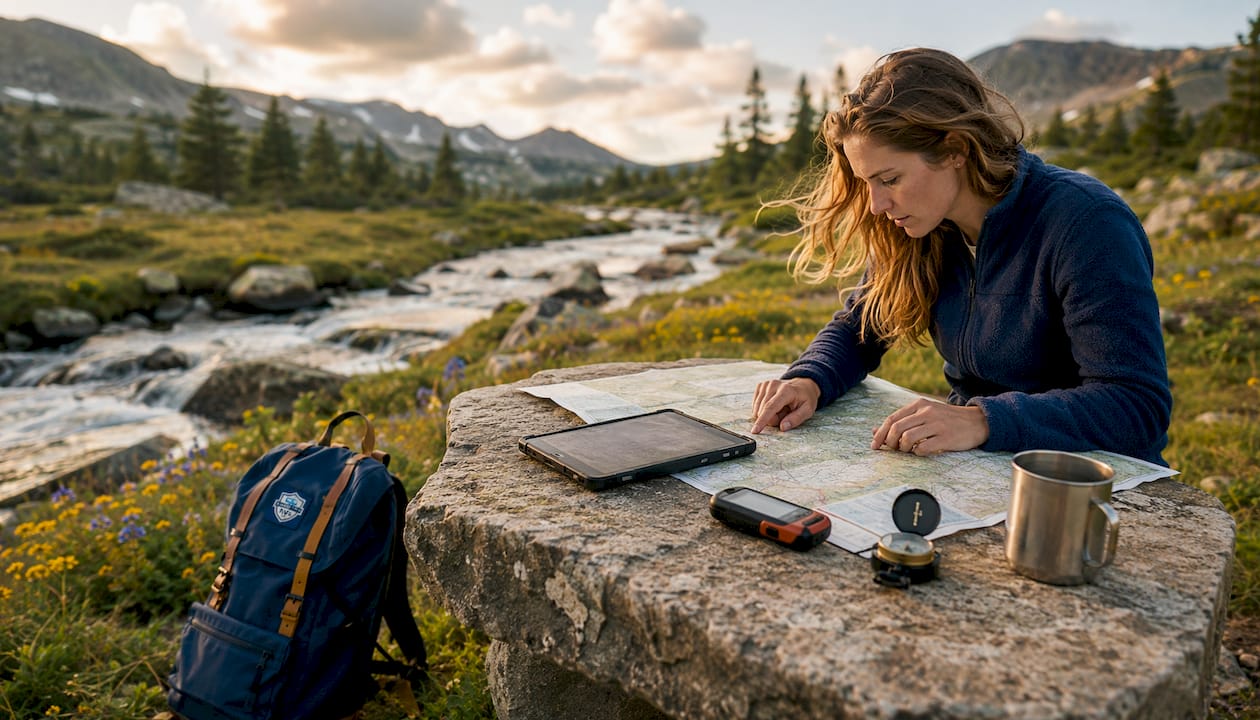
- MVUMs (Motor Vehicle Use Maps): Download these from the USFS website or the Avenza Maps app before you leave. They’re the authoritative source for which forest roads are open and where dispersed camping is permitted.
- BLM interactive maps and GIS tools: Use these to verify land ownership boundaries. Unfenced, unsigned land is not automatically BLM land.
Pro Tip: Save offline maps and GPS coordinates before you leave cell range. Cross-check recent user photos and comments (within 60–90 days) for road conditions, gate changes, and cell-signal reality. A single old review is not enough.
For buyers planning trips in fishing or backcountry areas, wilderness-safety packing advice from outdoor recreation guides can complement your boondocking prep.
What permissions, stay limits, and etiquette do you need to know?
Getting the rules wrong isn’t just inconvenient. Fines, towing, and in serious cases criminal charges are real consequences for illegal camping or fire violations.
Before you arrive:
- Contact the local BLM field office or ranger district to confirm current rules, closures, and fire restrictions
- Read posted signage at the trailhead or road entry point
- Check the agency website for seasonal closures and permit requirements
Stay limits and the move requirement: Most BLM areas enforce a 14-day limit within a 28-day period. After hitting that limit, you typically must move a substantial distance, often a significant number of miles or to a different ranger district, not simply shift to an adjacent site. USFS rules follow a similar structure but check the specific forest’s MVUM and district regulations.
Fire rules: Fire restrictions change frequently during summer and fall. Violating a fire ban on public land can carry steep fines, and starting a wildfire is a felony in most states. Always check with the specific land manager before lighting anything.
Leave No Trace for RV boondockers:
- Use established sites and existing fire rings where available
- Pack out all trash, including gray water if no dump station is accessible
- Avoid driving on vegetation or moving rocks to level your site
- Never dump black or gray tanks on the ground
Pro Tip: Retail overnight parking is a courtesy, not a right. Call the store manager, not the corporate hotline, and confirm permission for that specific location before you pull in.
Water, power, waste, and safety checklist for off-grid camping
Resource planning is where most first-timers underestimate what they need. Measure your rig’s actual consumption on a short test trip before committing to anything remote.
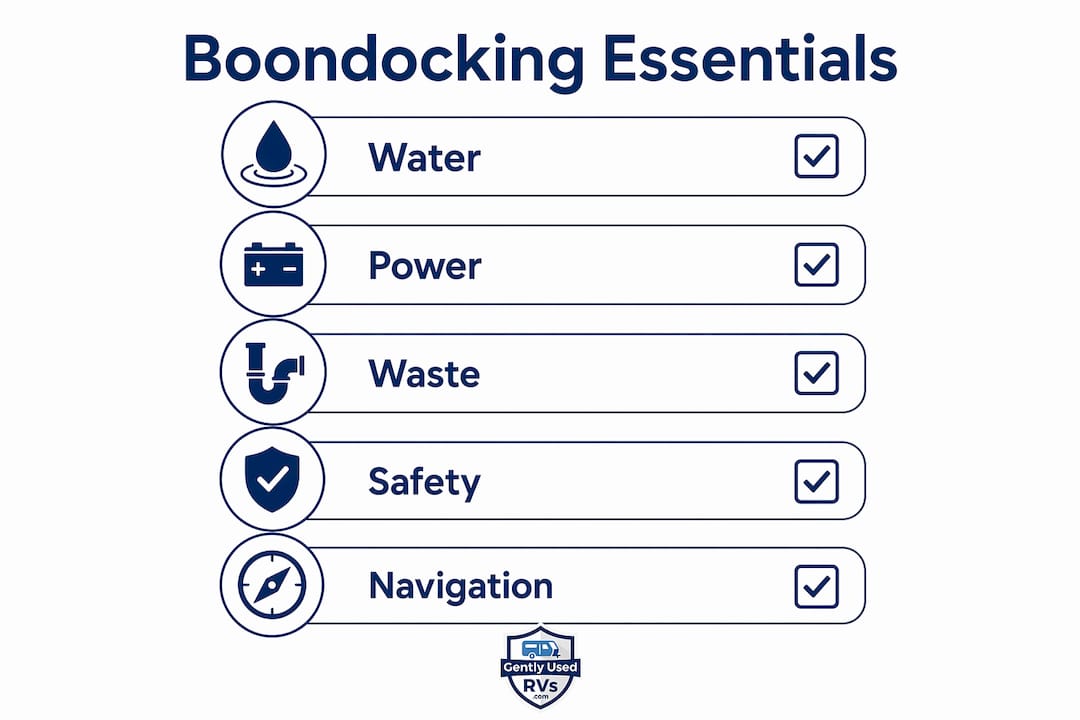
Water: Plan on a minimum of 1 gallon per person per day as a conservative baseline. Increase that figure for hot climates, cooking, or extended cleaning. A 30-gallon fresh tank supports two people for roughly two weeks at the minimum rate, but real-world use is usually higher. Map dump stations and potable water fill locations before you leave.
Power: Solar panels, a battery bank (lithium holds charge better in temperature extremes), and a generator cover most needs. Size your battery bank based on measured consumption from a test trip, not manufacturer estimates.
Waste: Know your black and gray tank capacities. A full black tank ends a trip early. Carry a portable waste tank if your gray fills faster than your black. Review proper black tank procedures before your first outing.
Communications and safety:
- Download offline navigation maps and save your site’s GPS coordinates
- Carry a satellite communicator or personal locator beacon for areas without cell service
- Tell someone your exact location and expected return date
- Carry spare fuel, basic tools, and a first-aid kit
- Arrive at least two hours before sunset to scout the road and set up in daylight
For connectivity planning while off-grid, the remote work RV lifestyle guide covers power and internet options in detail.
How do you test a used RV and check it for boondocking capability?
A rig that looks fine at a dealership can reveal serious gaps the moment you’re 40 miles from the nearest town. Test before you commit.
Pre-buy checklist for buyers:
- Battery and charging system health (load test, not just a voltage check)
- Solar panel output and charge controller condition
- Generator start, run time, and load performance
- Fresh, gray, and black tank integrity and pump pressure
- Roof seals, slide seals, and window seals for water intrusion
- Tire age, tread, and sidewall condition for rough access roads
- Turning radius and clearance for narrow forest roads
On-site test protocol: Take a practice trip within two hours of home and measure actual water and power draw over 24 hours. Test the dump and fill procedure. Practice low-speed backing on a road that approximates the access conditions you expect. This one step catches more problems than any inspection checklist.
For sellers, include in your listing:
- Solar panel wattage and battery type/age
- Fresh, gray, and black tank sizes in gallons
- Generator model and recent service date
- Inverter capacity if installed
Matching your rig to the right boondocking style starts with understanding RV types and configurations. A Class B van and a 40-foot Class A have very different access options.
Pro Tip: Ask the seller for a short video of systems running under load: lights, water pump, refrigerator on propane or 12V, and inverter. If they can’t or won’t provide it, that’s worth noting before you hand over a deposit.
Your first boondocking trip: a compact step-by-step plan
Keep the first trip short, close, and low-stakes. The goal is data, not adventure.
Day before:
- Download offline maps and save GPS coordinates for your site and two backup sites
- Confirm land ownership and current fire restrictions with the agency
- Fill fresh water tank, charge batteries, and top off propane
- Pack the safety kit: first aid, spare fuel, basic tools, and emergency contacts
Arrival day:
- Scout the access road in your tow vehicle or a smaller vehicle first
- Arrive at least two hours before sunset
- Level and set up the rig, then record your starting battery state and water level
- Locate the nearest dump station and water fill on your offline map
First night and morning:
- Record actual power draw and water use after 24 hours
- Note cell signal, road conditions, and any site issues for future reference
Contingencies:
- Road impassable: use your pre-saved backup site within 25–30 miles
- Tanks fill early: locate the nearest dump station and plan an early departure
- Weather changes: check forecasts before you leave and have a plan to exit before conditions deteriorate
Pro Tip: If staying longer would push you past the 14-day stay limit, identify your next site before you hit day 12. Moving at the last minute on a tight timeline is how rigs get damaged on unfamiliar roads.
Key Takeaways
Boondocking success comes down to knowing where you’re legally allowed to camp, testing your rig’s real consumption before a remote trip, and listing accurate system specs when buying or selling a used RV.
| Point | Details |
|---|---|
| Primary boondocking lands | BLM and U.S. Forest Service land together cover over 400 million acres where dispersed camping is generally permitted. |
| Stay limit rule | Most BLM and USFS areas cap stays at 14 days within a 28-day period; moving 25–30 miles is typically required after the limit. |
| Water baseline | Plan on a minimum of 1 gallon per person per day as a conservative baseline; increase for hot climates, cooking, or extended cleaning. |
| Test trip first | A short trip within two hours of home measures real water and power draw before you commit to remote travel. |
| Gently Used RVs | Buyers can filter for boondock-ready rigs and sellers can list solar specs, tank sizes, and generator details on the platform. |
The part most buyers and sellers skip
Most boondocking guides focus on the destination. The smarter focus is the rig itself, specifically whether the person selling it actually knows what it can do off-grid, and whether the buyer has verified those claims before driving into the backcountry.
Sellers who include solar wattage, battery type and age, and tank capacities in their listings attract more serious buyers and close faster. Vague listings like “solar ready” or “off-grid capable” without specs are a red flag for any experienced boondocker. Buyers who skip the test trip and take the seller’s word for battery health are the ones who end up stranded with a dead house battery on night one.
The Gently Used RVs platform makes it straightforward to include this level of detail in a listing. Buyers can request specifics directly through the platform before committing to a showing. That transparency benefits both sides of the transaction and reduces the kind of buyer remorse that generates bad reviews and reversed sales.
Find your next boondock-ready RV on Gently Used RVs
Gently Used RVs is a free classifieds marketplace where private sellers and dealerships list used RVs across the United States, Canada, and internationally. There are no commissions and no hidden fees for sellers. Buyers can browse listings without creating an account, with search results geotargeted to show the closest rigs first.
If you’re buying, the RV types guide helps you match rig class and configuration to your boondocking plans before you start shopping. Sellers can highlight solar specs, tank sizes, and generator details directly in their listing to attract buyers who know exactly what they need off-grid. The AI-powered autofill tool imports specs and photos from any existing listing URL in seconds.
Browse current travel trailer listings or post your rig for free and reach buyers actively searching for boondock-capable used RVs.
Useful sources to bookmark
Use agency maps for boundary verification and legal confirmation. Use community apps for real-world road conditions and recent access reports.
Official land-manager resources:
- BLM recreation camping guidance: stay limits, field office contacts, and interactive maps
- U.S. Forest Service MVUM portal (via fs.usda.gov): download Motor Vehicle Use Maps by forest before you leave cell range
Community apps:
- Campendium: GPS coordinates, user reviews, cell-signal reports, and free camping filters for BLM and National Forest land
- iOverlander: global coverage, offline regional maps, dump stations, and water refill locations
- FreeRoam: BLM and USFS boundary overlays to confirm legal camping zones
Membership programs:
- Harvest Hosts: overnight stays at farms, wineries, and breweries for self-contained RVs
- Boondockers Welcome: private-host network for one-night stays on residential properties
- Escapees RV Club: community resources, boondocking guides for beginners, and member forums
| Source | Best used for |
|---|---|
| BLM.gov camping page | Stay limits, field office contacts, official maps |
| USFS MVUM portal | Road access and dispersed camping rules by forest |
| Campendium | User reviews, GPS coordinates, cell-signal reports |
| iOverlander | Offline maps, dump stations, water refills |
| FreeRoam | BLM/USFS boundary verification |
| Harvest Hosts / Boondockers Welcome | Private-host overnight options |