
An RV weight distribution hitch is a towing device that redistributes a trailer’s tongue weight across all axles of both the tow vehicle and trailer, restoring level ride height and improving steering, braking, and stability. Without one, a heavy trailer pushes down on the rear of your tow vehicle, lifting the front wheels and reducing control. Industry guidelines recommend using a weight distribution system whenever your trailer exceeds 5,000 lbs or the tow load surpasses 50% of your vehicle’s gross vehicle weight rating. Getting this right is not optional. It is the foundation of safe RV towing.
How does an RV weight distribution hitch work to improve towing stability?
Weight distribution hitches use spring bars or chains mounted between the hitch head and trailer frame brackets to redistribute tongue weight across all axles. The spring bars create upward leverage on the trailer tongue and downward force on the front axle of the tow vehicle. That force transfer levels out the rig and restores proper tire contact on all four corners of your truck or SUV.

The result is a vehicle that steers and brakes the way it was designed to. Without this redistribution, rear axle overload causes the front tires to lose grip, which makes steering feel vague and braking distances longer.
Sway control is a separate but related function. Some hitches integrate sway control directly into the head unit, while others require an add-on friction bar or dual-cam system. Integrated systems are generally more convenient because you do not need to disconnect them before backing up. Add-on sway bars are effective but add steps to your setup routine.
| Feature | Integrated sway control | Add-on sway bar |
|---|---|---|
| Ease of use | High — no removal needed for reversing | Moderate — must disconnect to back up |
| Sway reduction | Excellent | Good |
| Cost | Higher upfront | Lower upfront |
| Setup complexity | Lower | Higher |
Pro Tip: If you tow frequently or on highways with heavy crosswinds, pay the premium for integrated sway control. The time saved and the confidence gained on the road are worth every dollar.
What are the key features to look for in a weight distribution hitch?
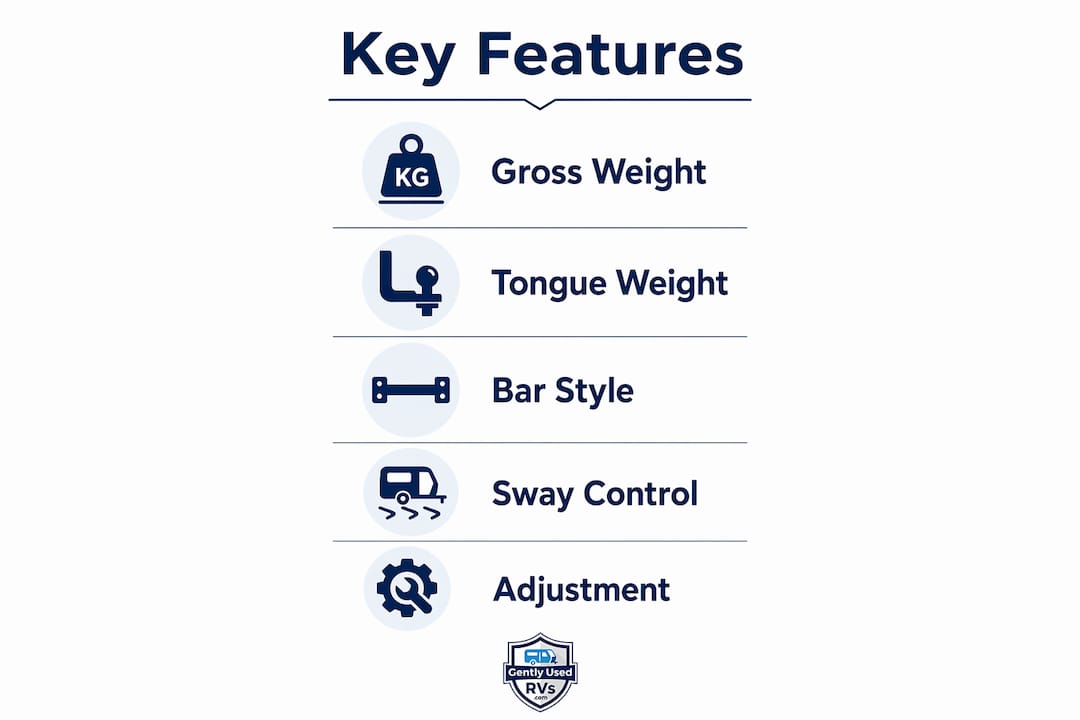
Gross trailer weight rating and tongue weight rating are the two numbers that matter most. Your hitch must be rated at or above your trailer’s actual tongue weight, which should consistently represent 10–15% of your total GTW for stable towing. A 10,000 lb trailer should have a tongue weight between 1,000 and 1,500 lbs. Match your hitch rating to that number, not to your trailer’s maximum possible weight.
Bar style: round bar vs. trunnion bar
Round bar systems are the most common and widely available. They use cylindrical spring bars that clip into the hitch head. Trunnion bar systems mount differently, with the bars pivoting directly from the head. Trunnion designs tend to offer a lower profile and easier hookup, but they cost more. Chain systems, used by some manufacturers, replace spring bars with chains and are known for quiet operation and reduced vibration.
Sway control options
Not all weight distribution hitches include sway control. Budget models often omit it entirely, requiring a separate sway bar purchase. Four-point sway control systems, found on premium hitches, provide the highest level of stability. If your trailer is longer than 25 feet or you travel in windy regions, four-point integrated control is the right call.
Adjustment and live tuning
Advanced systems now offer real-time live adjustment, letting you fine-tune spring bar tension while the rig is loaded without crawling under the trailer. This matters because load distribution changes when you add passengers, water, or gear mid-trip. A hitch with live adjustment removes the guesswork from rebalancing.
- GTW and tongue weight ratings: Match to your actual loaded trailer weight, not the trailer’s maximum capacity.
- Shank length and drop: Verify the shank fits your receiver and achieves the correct hitch head height.
- Ease of hookup: Look for hitches that allow backing without removing sway bars.
- Built-in scale: Some modern heads include a tongue weight scale, which removes the need for a separate gauge.
Pro Tip: Budget systems deliver roughly 90% of the leveling performance of premium models. If you tow a few times a year with a mid-size trailer, a well-rated budget system is a smart choice. If you tow weekly or haul a large fifth wheel, invest in a premium unit with integrated four-point sway control.
How to install and set up a weight distribution hitch properly
Correct installation separates a safe rig from a dangerous one. Setup errors are the most common cause of poor hitch performance, and initial setup time is frequently underestimated by first-time buyers. Follow these steps carefully.
- Measure your hitch height before coupling. Park on level ground. Measure the height of your receiver from the ground. Then measure the trailer coupler height. The difference tells you how much drop or rise your shank needs.
- Couple the trailer and check for rear sag. Attach the trailer to the ball without engaging the spring bars. Measure the front and rear bumper heights of your tow vehicle. Note any drop at the rear.
- Set the hitch head angle. Adjust the head so the spring bars run parallel to the ground or angle slightly upward toward the trailer. Consult your hitch manual for the exact specification.
- Engage the spring bars and recheck bumper heights. After engaging the bars, your tow vehicle’s front bumper should return to within about 1 inch of its unloaded height. If it does not, increase spring bar tension.
- Verify tongue weight. Tongue weight should fall in the 10–15% of GTW range. Use a tongue weight scale or a hitch with a built-in gauge to confirm.
- Torque all fasteners to spec. Follow the torque values in your hitch manual. Under-torqued hardware loosens on the road. Over-torqued hardware can crack the receiver.
- Test drive and recheck. Drive a short distance, then stop and inspect all connection points. Recheck bumper heights and listen for unusual noise.
Regular maintenance keeps the system performing safely. Lubricate the ball, coupler, and spring bar contact points before every trip. Inspect the spring bars for cracks or deformation every season. Replace worn components immediately.
Pro Tip: Take photos of your bumper heights before and after engaging the spring bars. Those numbers become your personal baseline for every future hookup, saving you setup time on every trip.
When do you need a weight distribution hitch and what are the towing benefits?
The threshold is clear. Use a weight distribution system whenever your trailer weight exceeds 5,000 lbs or your tow load exceeds 50% of your vehicle’s GVWR. Below those numbers, a standard ball mount may be sufficient. Above them, towing without weight distribution creates real danger.
Rear sag is the most visible symptom of improper weight distribution. When the trailer tongue pushes down on the hitch ball, the rear of the tow vehicle drops, the front lifts, and headlights point skyward. Steering becomes light and unpredictable. Braking distances increase because the front tires carry less weight and generate less stopping force.
A weight distribution hitch restores proper axle loading, which directly improves steering response, shortens braking distances, and reduces trailer sway. On windy highways or uneven roads, that difference is the margin between a safe trip and a serious accident.
The handling and braking improvements from a properly set weight distribution system are measurable on every drive. Tires wear more evenly because the load is spread correctly. Suspension components last longer because no single axle absorbs the full shock of road imperfections.
Weight distribution is also just one part of a complete towing system. A properly rated receiver, trailer wiring, and a brake controller for trailers over a certain weight are all required for full safety. No single component does the job alone. Understanding your RV towing capacity before you buy or hook up is the smartest first step.
The benefits of a correctly installed weight distribution hitch include:
- Restored front-axle steering control
- Shorter, more predictable braking distances
- Reduced trailer sway in crosswinds and on uneven pavement
- Even tire wear across all axles
- Reduced stress on tow vehicle suspension and frame
Key Takeaways
A weight distribution hitch is the single most important towing accessory for any trailer over 5,000 lbs, because it restores axle balance, improves steering, and reduces sway that can cause accidents.
| Point | Details |
|---|---|
| Know your threshold | Use a weight distribution system for trailers over 5,000 lbs or loads over 50% of GVWR. |
| Match ratings to real weight | Tongue weight must stay at 10–15% of GTW; choose a hitch rated for your actual loaded tongue weight. |
| Sway control is not automatic | Many hitches omit sway control; confirm whether your system includes it or requires an add-on bar. |
| Installation precision matters | Measure bumper heights before and after engaging spring bars to verify correct tension every time. |
| Hitch is part of a system | Pair your hitch with a rated receiver, trailer wiring, and a brake controller for complete towing safety. |
What I’ve learned after years of watching RV owners get this wrong
Most towing problems I see trace back to one of two mistakes: buying a hitch that is not rated for the actual loaded tongue weight, or skipping the post-installation bumper height check. Both are avoidable.
The misconception that bothers me most is the assumption that all weight distribution hitches include sway control. They do not. I have seen owners drive thousands of miles with a hitch that leveled their rig perfectly but did nothing to control sway, because they never added the required sway bar. Read the spec sheet before you buy.
Live adjustment systems have genuinely changed the experience for frequent towers. Being able to fine-tune tension after loading passengers and gear, without getting under the trailer, is a real quality-of-life improvement. If you tow more than a handful of times per year, that feature pays for itself in convenience and accuracy.
One more thing: usability matters more than most weight distribution hitch reviews admit. A hitch you can hook up in 10 minutes, back up without disconnecting, and operate quietly is one you will set up correctly every single time. A complicated system gets shortcuts taken on it. Shortcuts cause accidents. Choose the system you will actually use properly, not just the one with the highest rating on paper.
— Christopher
Ready to find an RV that fits your towing setup?
Getting the right weight distribution hitch starts with knowing what you are towing. The RV type, size, and loaded weight all determine which hitch system you need. Gently Used RVs makes it easy to browse RV types and towing specs across every category, from travel trailers and fifth wheels to toy haulers and Class A motorhomes.

Whether you are shopping for your first towable or upgrading to a larger rig, Gently Used RVs connects you with private sellers and dealerships across the United States and Canada. Browse listings for free, no account required. When you are ready to match your tow vehicle to the right trailer, the RV dealer directory is a great place to find dealers who can also help you source compatible towing accessories.
FAQ
When is a weight distribution hitch required?
A weight distribution hitch is required when your trailer weighs over 5,000 lbs or when the tow load exceeds 50% of your tow vehicle’s GVWR. Both conditions create rear sag and steering instability that a standard ball mount cannot correct.
What tongue weight is safe for towing?
Tongue weight should represent 10–15% of your total gross trailer weight. A tongue weight outside that range increases sway risk and reduces braking performance, regardless of hitch type.
Do all weight distribution hitches control sway?
No. Many weight distribution hitches level the trailer but do not include sway control. Some systems require a separate friction sway bar or dual-cam add-on to reduce trailer sway effectively.
How do I know if my weight distribution hitch is set up correctly?
After engaging the spring bars, your tow vehicle’s front bumper should return to within approximately 1 inch of its unloaded height. If the front is still significantly lower than normal, increase spring bar tension and recheck.
What other towing accessories do I need alongside a weight distribution hitch?
A properly rated receiver, trailer wiring harness, and a brake controller are all required for a complete and safe towing system. A weight distribution hitch improves load balance but does not replace these components.