
An RV value guide hands you a range, not a magic number, and which end of that range matters depends entirely on your deal. Trading in? Lean toward wholesale. Selling to a dealer for cash? Expect their offer to sit well below private-party. Selling to another RV owner yourself? That’s where the real money is.
TL;DR:
- Wholesale values are generally about 15% lower than private-party fair-trade prices, while dealer asking prices are roughly 25% above that baseline.
- Accurate RV pricing requires checking multiple sources, including guidebooks, local listings, and private-party estimators, and comparing them within your region.
- Market demand and depreciation are heavily influenced by interest rates, fuel prices, seasonal shifts, and RV type, requiring frequent local updates.
- Water damage and structural condition dominate value for towables, whereas mileage and maintenance history are critical for motorhomes.
- Using multiple valuation tools and comparing them against real local listings ensures a more reliable and negotiable selling or trading price.
Table of Contents
- What RV Value Guides Actually Tell You
- Wholesale vs. Dealer vs. Private-Party: Which Number Is Yours?
- How to Get an Accurate RV Value in Your Local Market
- How Gently Used RVs Helps You Verify and Act on a Valuation
- What Toolkit Should You Actually Use?
- How Depreciation Chips Away at RV Value
- Why Today’s Economy Is Reshaping RV Prices
- Motorhomes, Travel Trailers, and Fifth Wheels Value Differently
- The Editorial Take: Stop Treating a Single Number as Gospel
- Ready to Test Your Number in the Real Market?
- Sources
What RV Value Guides Actually Tell You
Every valuation tool falls into one of three buckets, and confusing them is the fastest way to leave money on the table or overpay.
Guidebooks like NADA’s Consumer Vehicle Values are the industry’s long-standing reference point. Dealers and appraisers lean on NADA numbers for trade-ins and wholesale benchmarking. That’s the book value: a conservative, dealer-friendly baseline, not what a private buyer will pay you.
Dealer and listing aggregators scrape or compile asking prices from lots and marketplaces. These are useful for gauging what’s actually for sale in your area right now, but they carry a built-in bias. Asking prices aren’t sale prices. A dealer lot can sit at inflated numbers for months before a rig actually moves.
Private-party estimators try to bridge the gap. Tools like PickRV’s fair-trade calculator model what a realistic buyer actually pays, landing between wholesale and dealer asking. Multi-source platforms such as CamperCost go further, cross-referencing guidebook data with live listings to show several comparable values side by side rather than one flat figure.
The takeaway across all three: the number you get is a starting point, not a verdict.
- Guidebooks: best for trade-in and wholesale reference
- Listing aggregators: best for gauging current lot inventory and asking-price trends
- Private-party calculators: best for setting a realistic sale-to-owner price
- Multi-source tools: best for triangulating all three at once
Wholesale vs. Dealer vs. Private-Party: Which Number Is Yours?
Wholesale is what a dealer pays you or credits you on a trade. Dealer asking is what a lot charges a retail customer for that same class of RV. Private-party is what one owner pays another, no middleman, no lot overhead.
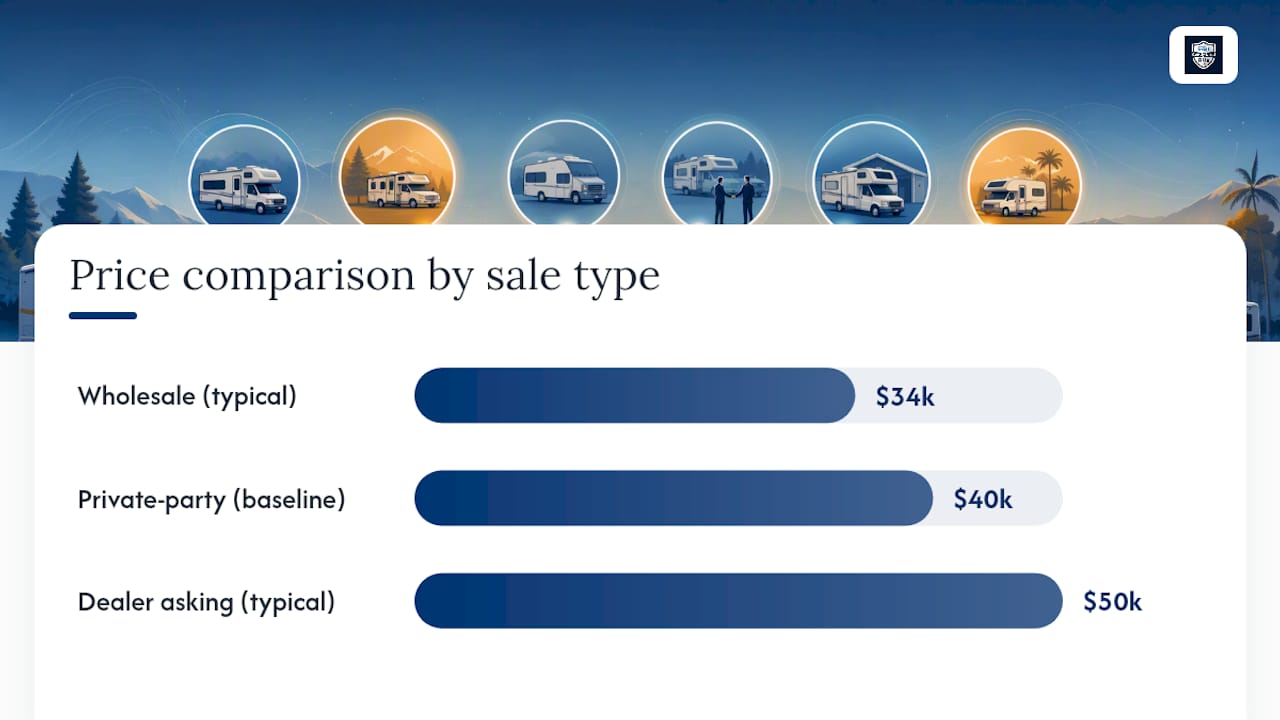
The gap between these numbers isn’t random. According to PickRV’s published methodology, wholesale values typically run about 15% below private-party fair-trade prices, while dealer asking prices often sit roughly 25% above that same private-party baseline. That spread covers dealer reconditioning costs, lot overhead, and profit margin. It’s also why a $40,000 private-party estimate might correspond to a $34,000 trade-in offer and a $50,000 sticker price at the same dealership.
Which number should you chase?
- Trading in at a dealer: anchor to wholesale/book value, and don’t expect much negotiation room above it.
- Selling to a dealer for cash: expect an offer close to wholesale, sometimes slightly above if they need that model on their lot.
- Selling private-party: target the fair-trade estimate, then adjust up or down based on local comps.
Before trusting any tool’s output, check two things: does it disclose which value type it’s showing, and how often is the underlying data refreshed? Services like J.D. Power’s RV Connect publish update cadences and historical series precisely because stale data quietly skews every number downstream.
How to Get an Accurate RV Value in Your Local Market
Getting a defensible number takes about an hour of work, and skipping steps is how sellers underprice a rig or buyers overpay for one.
- Gather exact identifiers. Pull the VIN, confirm the exact trim and floor plan, and list every factory and aftermarket option (solar, upgraded suspension, slide-out awnings). Vague model matching is where valuation errors start.
- Document condition with photos. Shoot the roof, undercarriage, interior seals, and any known repair history. This becomes your evidence when a buyer or dealer disputes your number.
- Run three lookups. Check one guidebook value (NADA), one live-listing search for your exact model within a few hundred miles, and one private-party estimator like PickRV.
- Pull at least 10 nearby comps. Regional demand drives more price variance than almost anything else, so a comp search limited to your state, or even your region, matters more than a national average.
- Adjust for condition specifics. Motorhomes hinge heavily on engine mileage and service records. Towables like travel trailers and fifth wheels live and die by water-damage history and structural integrity, not odometer readings, since they don’t have one.
- Set three numbers. Your dealer-accept floor (near wholesale), your realistic private-sale target (fair-trade estimate adjusted for comps), and your listing asking price (target plus 5% to 10% negotiation room).
Pro Tip: Search sold listings, not just active ones, whenever you can find them. An RV that’s been sitting on the market for 90 days at a certain price tells you that price is too high, not that it’s the market rate.
Once you have those three numbers, you’ll know instantly whether a dealer’s cash offer is fair or whether your asking price needs adjusting before you list.
How Gently Used RVs Helps You Verify and Act on a Valuation
A guidebook number is only useful once you’ve checked it against what’s actually happening in your market, and that’s where most valuation tools fall short. They can’t show you a real, live rig for sale twenty miles away.
Gently Used RVs closes that gap directly. Search results are geotargeted, meaning buyers and sellers see the closest comparable listings first, which is exactly the kind of local comp data that guidebooks and national aggregators can’t replicate. Because regional demand is one of the biggest drivers of price variance, seeing what’s actually parked and priced in your area beats any national average.
The platform’s AI-powered autofill tool also solves a quieter problem: input errors. Paste in a URL from a dealer site or another marketplace, and it pulls the year, make, model, specs, and photos automatically, reducing the typos and mismatched trim levels that throw off a valuation before you even start comparing numbers.
A few other advantages worth knowing about:
- Listing for free means you can test a price publicly and gauge real buyer interest without paying a commission or listing fee.
- No account is required to browse, so you can research comps as a buyer without friction.
- The marketplace covers every RV category, from Class A motorhomes to teardrop trailers, so your comps are apples-to-apples rather than cross-category guesses.
- Community-focused safety content helps both buyers and sellers spot scam listings before money changes hands.
What Toolkit Should You Actually Use?
No single resource covers every angle, so treat valuation as a five-category toolkit rather than a one-stop lookup.
Book guides (NADA and similar) give you the industry-standard wholesale baseline that dealers themselves reference, which makes them essential for trade-in conversations but weak for gauging what a private buyer will actually pay.
Listing aggregators show current asking prices across dealer lots and marketplaces. They’re strong for spotting inventory trends and weak for showing real transaction prices, since asking and selling rarely match.
Private-party calculators like PickRV estimate fair-trade value between wholesale and retail, which makes them the most relevant single number for a private sale, though they still benefit from a local comp check.
Dealer cash offers, from services like Good Sam’s Valuator, give you a fast, no-negotiation number. Useful for convenience, but understand it reflects that dealer’s inventory needs, not your rig’s market ceiling.
Licensed appraisers matter mainly for high-value motorhomes, insurance disputes, or estate situations where a formal written appraisal carries legal weight.
For the local-comp piece of this toolkit, browsing Gently Used RVs’ marketplace listings directly, or checking the dealer directory for trade-in options, fills in what national guides can’t see.
How Depreciation Chips Away at RV Value
Depreciation hits RVs harder and faster than most owners expect, and it doesn’t move in a straight line.
After that initial cliff, depreciation slows into a steadier decline, typically driven by mileage and engine wear for motorhomes, and by cosmetic condition, appliance age, and water-damage history for towables. A well-maintained travel trailer with no leaks can hold value surprisingly well into its second decade, while a motorhome with a tired engine or neglected maintenance records can fall well below book value regardless of exterior appearance.

Brand reputation and build quality also affect the depreciation curve. Some manufacturers hold value better than others simply because their build quality earns a stronger resale reputation among used buyers. That’s part of why two RVs of the same age and category can carry noticeably different valuations. This is precisely why a static guidebook number, checked once and trusted for months, becomes unreliable. Depreciation is a moving target, and the only way to track it accurately is to recheck comps close to the actual time you plan to buy or sell.
Why Today’s Economy Is Reshaping RV Prices
RV values right now are being shaped by forces that have little to do with the rig itself. Interest rates affect financed purchases directly, and when borrowing costs rise, buyer demand for financed units softens, which puts downward pressure on asking prices across the used market.
Fuel prices swing demand between RV categories in a way many owners don’t anticipate. When gas and diesel prices spike, smaller travel trailers and lightweight fifth wheels that can be towed by a standard truck often hold value better than large Class A motorhomes with poor fuel economy, simply because ongoing ownership costs matter more to buyers during those stretches.
Seasonal demand compounds all of this. Spring and early summer consistently bring the strongest buyer activity as camping season approaches, while values tend to soften through late fall and winter when fewer people are shopping. Market analysts have noted that RV valuations are shifting in ways that catch buyers off guard, largely because regional and seasonal demand swings faster than most guidebook updates can capture. That’s the core argument for checking live local listings alongside any static guide, since a number that was accurate three months ago may already be stale.
Motorhomes, Travel Trailers, and Fifth Wheels Value Differently
Treating every RV category the same way in a valuation tool is one of the most common mistakes owners make, because the factors driving value differ substantially by type.
Motorhomes (Class A, B, and C) carry an engine, transmission, and chassis, which means mileage and service history weigh heavily on value, much like a standard vehicle. A Class A with 40,000 miles and complete maintenance records will consistently value higher than an identical model with 90,000 miles and gaps in its service log, even if both look immaculate inside.
Travel trailers and fifth wheels have no engine, so mileage is irrelevant. Instead, water-damage history and structural condition are the dominant value factors for towables. A trailer with a history of roof leaks or soft flooring can lose significant value regardless of how many miles it’s been towed, while a well-sealed unit with no water intrusion history holds value far better than its age alone would suggest.
This distinction matters when you’re using a value guide, because a tool built primarily around motorhome mileage data won’t weigh water damage the way a towable-specific estimator does. Fifth wheels add one more wrinkle: hitch type and compatibility with your tow vehicle can affect the practical buyer pool, and a smaller pool of compatible buyers can soften private-party demand even when the rig itself is in excellent shape.
The Editorial Take: Stop Treating a Single Number as Gospel
Most advice on RV valuation still points readers to one lookup tool and calls it done. That’s backwards. The research is consistent on this point: a book value, a live-listing check, and a private-party estimator each measure something different, and none of them alone reflects what will actually happen in a transaction near you.
The conventional wisdom oversells precision. A single tool output feels authoritative because it’s a specific number, but specificity isn’t the same as accuracy. What actually works is triangulation, book value for the floor, comps for the ceiling, condition adjustments for the fine-tuning, and treating regional data as more reliable than any national average.
If you take one thing from this guide, prioritize local comps over guidebook precision. A number that ignores what’s parked and selling within driving distance of you isn’t wrong exactly, it’s just answering a different question than the one you’re asking.
— Christopher
Ready to Test Your Number in the Real Market?
Once you’ve built your three-point price range, the fastest way to confirm it is to see how it performs against live listings. Browse current RV listings by type to compare your rig against similar motorhomes, travel trailers, and fifth wheels currently for sale, or list your own RV for free on Gently Used RVs to see how buyers respond to your asking price with zero commission and no listing fees. The platform’s AI autofill tool pulls your specs automatically from any existing listing URL, so setting up a test listing takes minutes, not hours. If you’re weighing a dealer trade-in against a private sale, the RV dealer directory makes it easy to compare offers side by side before you commit either way. And if your RV doubles as a stationary dwelling or you’re considering that route, it’s worth reviewing zoning requirements before that decision affects your valuation strategy.
Sources
- RVs are being valued differently — here’s what buyers need to know (RV Travel)
- Consumer Vehicle Values | NADA
- RV value calculator — instant fair-trade estimate · PickRV
- RV Pricing & Depreciation Calculator — Multi-Source Intelligence AI | CamperCost