
RV travel costs in 2026 are defined by five core expense categories: fuel, campground fees, insurance, maintenance, and food. A 7-day, 800-mile family trip runs $1,300–$2,400 for owners and $2,400–$4,300 for renters. Campground fees have climbed sharply due to inflation and dynamic pricing, while fuel prices create real budget pressure at $4.50–$5.00 per gallon nationwide. Propane, activity fees, and hidden campground charges add up faster than most travelers expect. Getting your 2026 RV trip budget right from the start saves you from painful surprises on the road.
How much does a typical RV trip cost in 2026?
The cost of RVing in 2026 depends heavily on whether you own your rig or rent one. Owners of a Class C motorhome or travel trailer spending a week on the road typically pay $1,300–$2,400 total. Renters pay significantly more, with the same trip costing $2,400–$4,300 once rental fees are added. A two-week, 2,000-mile trip roughly doubles those figures: $2,700–$4,900 for owners and $5,000–$8,600 for renters.
Six line items drive nearly every RV trip budget:
- RV rental or ownership cost: Rental rates vary by rig class and season. Ownership eliminates this line but adds depreciation and maintenance.
- Fuel: The single largest variable cost for most trips.
- Campground fees: Range from $0 (boondocking) to $100+ per night at premium parks.
- Food: Cooking in the RV cuts costs dramatically compared to eating out every meal.
- Activities and entrance fees: National park passes, tours, and local attractions add $100–$300 per week.
- Miscellaneous: Propane refills, dump station fees, and laundry.
Vehicle type shapes your fuel math directly. A Class C motorhome achieves 8–12 mpg, while a truck towing a fifth wheel averages around 13 mpg. On an 800-mile trip at $5 per gallon, a Class C burning 10 mpg spends roughly $400 on fuel alone. That number climbs fast on longer routes.
Pro Tip: Budget your fuel at $5 per gallon regardless of current pump prices. Regional spikes and towing efficiency losses make conservative estimates far more accurate.
What factors drive 2026 campground fees?
Campground pricing in 2026 is no longer predictable. Dynamic hotel-style pricing at private RV parks means the same site can cost $40 on a Tuesday and $90 on a Friday in July. Major events like the FIFA World Cup and national holidays push availability down and prices up across entire regions.
Here is what you are actually dealing with across campground types:
- Private campgrounds: $35–$80 per night on average, with peak season rates hitting $60–$100+ at popular destinations.
- State and national parks: Generally cheaper, but amenities are fewer and reservations fill months in advance.
- Monthly RV park rentals: $400–$1,200 per month depending on location and hookup type.
- Boondocking: BLM and national forest dispersed camping costs $0 per night. You trade hookups for free nights, which works well for self-contained rigs.
Hidden fees are the real budget killer. Advertised nightly rates frequently exclude resort fees, metered electricity charges, and site-lock fees. A site listed at $55 can easily ring up at $75 once those extras appear at checkout.
Pro Tip: Always call the campground directly and ask for the total out-the-door price before booking. Get the number with electric, resort fees, and any site premiums included.
How to realistically budget for fuel and maintenance in 2026
Fuel is where most RV budgets go wrong. Fuel prices averaging $4.50–$5.00 per gallon nationwide create a tough baseline, and towing or driving a large motorhome drops your efficiency by 30–40% compared to a standard vehicle. Travelers who plan fuel costs using the manufacturer’s highway mpg rating consistently run short.

The math is straightforward once you use realistic numbers. A truck towing a travel trailer at 13 mpg over 2,000 miles burns about 154 gallons. At $5 per gallon, that is $770 in fuel for the driving portion alone. A Class C at 10 mpg over the same distance burns 200 gallons, costing $1,000. These are not worst-case numbers. They are realistic 2026 figures.
Maintenance is the expense category travelers underestimate most. RV maintenance averages $300–$400 per month for full-timers, with major repairs running $1,000–$2,000 annually. Labor rates at RV service centers now average $120–$170 per hour. Parts for proprietary RV systems can be slow to ship and expensive to source. In summer 2026, warranty repairs are taking weeks due to shop backlogs and labor shortages. That repair downtime costs you campground fees and lost trip days.
Common unexpected repairs include:
- Refrigerator failures: RV absorption fridges are expensive to replace.
- Inverter or converter issues: Electrical problems are among the most common service calls.
- Tire blowouts: RV tires age out faster than most owners realize.
- Slide-out motor failures: Mechanical slides require professional service.
- Roof seal deterioration: Catching this late leads to water damage that multiplies repair costs.
Pro Tip: Set aside a dedicated repair fund of at least $1,000 per year, separate from your routine maintenance budget. Treat it like a non-negotiable line item, not an afterthought.
What other expenses affect your RV travel budget?
RV insurance is a cost that varies more than most travelers expect. Coverage runs $200–$3,500+ per year depending on rig type and policy. Travel trailers typically land in the $200–$800 range annually. Class C motorhomes run $1,000 or more per year for full-coverage policies. Skimping on coverage to save money is a false economy when a single accident or theft claim can cost tens of thousands.
Beyond insurance, several other costs shape your monthly spend:
- Propane: $30–$100 per month depending on how much you cook, heat, and run appliances.
- Food: Cooking most meals inside the RV keeps food costs close to what you spend at home. Eating out regularly can add $50–$100 per day for a family of four.
- Recreational fees: National park entrance passes, state park day-use fees, and guided tours add $100–$300 per week.
- Connectivity: Cell boosters, satellite internet plans, and campground Wi-Fi upgrades are real costs for remote workers or families with kids.
For families considering RV types and their cost implications, the rig you choose shapes nearly every expense category. A smaller travel trailer costs less to tow, insure, and maintain than a Class A diesel pusher. That difference compounds over a full season of travel.
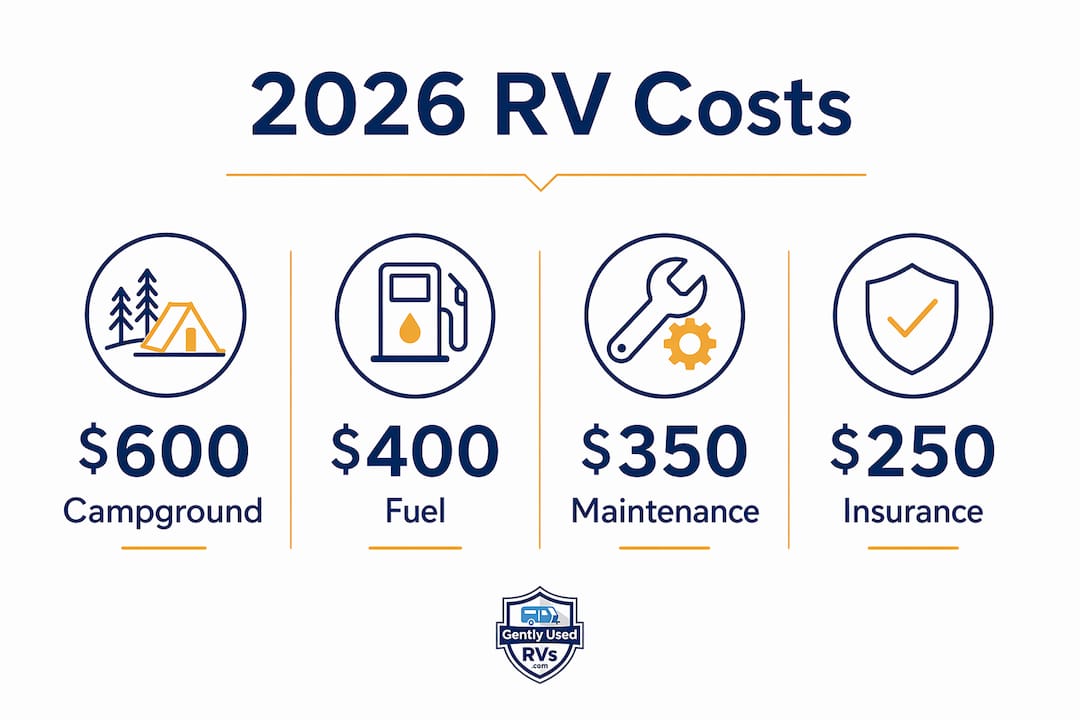
Full-time travelers should build a monthly budget that accounts for all categories together. A realistic monthly spend for a couple full-timing in a mid-size rig looks like this:
| Expense category | Estimated monthly cost |
|---|---|
| Campground fees | $600–$1,200 |
| Fuel | $400–$800 |
| Insurance | $85–$290 |
| Maintenance and repairs | $300–$400 |
| Propane and utilities | $30–$100 |
| Food and dining | $600–$1,000 |
| Activities and fees | $100–$300 |
How do travel style and timing affect your 2026 RV budget?
Travel pace and season are two of the most controllable budget variables. Summer 2026 is seeing a 15% year-over-year increase in RV bookings, which pushes campground prices and availability to their limits. Traveling in shoulder seasons like may, september, or october cuts campground costs noticeably and reduces competition for reservations.
Your travel pace creates a real tradeoff:
- Frequent movers spend more on fuel but can use free boondocking sites to offset campground costs.
- Stationary travelers save on fuel but pay full monthly site rates, which can exceed $1,200 in high-demand areas.
- Regional pricing varies widely. California and coastal destinations run significantly higher than the Midwest or rural Southeast.
Segmented budgeting by trip leg is more accurate than a flat daily rate. Break your trip into segments by region and calculate fuel, campground, and activity costs separately for each leg. A week in a California coastal park costs far more than the same week in a national forest in Wyoming. Treating them as identical in your budget guarantees you will run short.
Booking campgrounds 3–6 months ahead for summer travel is no longer optional. It is the only reliable way to lock in reasonable rates before dynamic pricing pushes them higher.
Key takeaways
A realistic 2026 RV trip budget requires segmented cost planning across fuel, campground fees, maintenance, insurance, and food, with conservative fuel estimates and a dedicated repair fund built in from the start.
| Point | Details |
|---|---|
| Owner vs. renter cost gap | Owners pay $1,300–$2,400 for a week-long trip; renters pay $2,400–$4,300 for the same trip. |
| Fuel math matters | Use $5 per gallon and real towing mpg (8–13 mpg) to avoid budget shortfalls on the road. |
| Campground fees are unpredictable | Dynamic pricing and hidden fees mean always confirming the total out-the-door cost before booking. |
| Maintenance is non-negotiable | Budget $300–$400 per month for routine upkeep and set aside $1,000+ annually for major repairs. |
| Timing controls your costs | Shoulder-season travel and segmented budgeting by trip leg reduce total RV travel expenses significantly. |
What I’ve learned about budgeting for RV travel in 2026
The single biggest mistake I see travelers make is treating RV travel like a hotel trip with wheels. It is not. Your rig is a moving home, and it demands a home-level budget for maintenance, repairs, and insurance.
Fuel and campground costs get all the attention, but maintenance is the quiet budget wrecker. I have watched people plan meticulous fuel spreadsheets and then get blindsided by a $1,400 refrigerator repair in the middle of a trip. The repair fund is not optional. It is the difference between a trip that stays fun and one that turns stressful.
Boondocking changed my perspective on campground costs entirely. Free nights on BLM land are genuinely free, and the tradeoff in amenities is smaller than most people assume if your rig has a decent solar setup and fresh water capacity. Mixing boondocking nights with paid campgrounds cuts your average nightly cost dramatically over a long trip.
One thing I tell every family planning their first big trip: book your campgrounds early and call to confirm the real price. The advertised rate is a starting point, not the final number. Hidden fees are the norm now, not the exception. Verify before you commit.
Finally, if you are weighing ownership versus renting, run the full math for your specific travel frequency. Renting makes sense for one or two trips per year. If you plan to travel more than 30 days annually, owning a used rig almost always wins on total cost, especially when you factor in how RV location affects pricing and resale value.
— Christopher
Planning your 2026 trip starts with the right RV
Choosing the right rig is the first real budget decision you make. A Class B van costs far less to fuel and insure than a Class A diesel, but it limits how many people travel comfortably. A travel trailer gives you flexibility without the motorhome price tag.

Gently Used RVs makes it easy to browse used motorhomes, travel trailers, fifth wheels, and more without creating an account. Listings are geotargeted, so you see the closest options first. Start by reviewing the RV types guide to understand which rig fits your budget and travel style. When you are ready to find a seller, the RV dealer directory connects you with trusted dealerships near you. Buying used is one of the most effective ways to reduce your total cost of RVing in 2026 before your first mile.
FAQ
How much does a week-long RV trip cost in 2026?
A 7-day, 800-mile trip costs $1,300–$2,400 for RV owners and $2,400–$4,300 for renters, covering fuel, campgrounds, food, and activities.
What is the average campground fee in 2026?
Private campgrounds charge $35–$80 per night on average, with peak season rates reaching $60–$100+ at popular destinations. Always confirm the total price including resort and electric fees before booking.
How much should I budget for RV maintenance in 2026?
Budget $300–$400 per month for routine maintenance and set aside $1,000–$2,000 annually for major repairs. Labor rates at service centers average $120–$170 per hour.
What does RV insurance cost in 2026?
RV insurance ranges from $200 to $3,500+ per year. Travel trailers average $200–$800 annually, while Class C motorhomes typically cost $1,000 or more for full coverage.
How can I reduce my RV travel expenses in 2026?
Mix boondocking nights on BLM or national forest land with paid campgrounds, travel in shoulder seasons, cook most meals in the RV, and book campgrounds 3–6 months ahead to lock in lower rates before dynamic pricing kicks in.