
Wire transfers are risky in RV sales because they’re fast and final. Once a receiving bank accepts the funds, there’s often no getting them back, which is exactly why scammers love them. If you’re about to send or accept a wire for an RV, stop first and verify the wiring instructions through an independent phone number or a face-to-face meeting, never through the same email or text thread the request arrived in.
Three risks show up again and again in RV deals:
- Finality: once a wire clears, reversing it is rare and often impossible.
- Instruction tampering: fraudsters hijack email threads and swap in their own account details, a tactic security researchers call business email compromise, or BEC.
- Cash-pickup and overpayment scams: crooks route stolen or refunded money through services like MoneyGram or Western Union, where it’s picked up in cash within minutes.
The FTC puts it bluntly: wiring money to someone you haven’t met is a lot like handing over cash. Add SWIFT-based international transfers into the mix, and tracing a bad wire across borders gets even harder.
Key Takeaways
Wire transfer fraud succeeds in RV sales because wires are fast, final, and easy to route through cash-pickup networks, so independent verification before sending funds is the single most effective defense.
| Point | Details |
|---|---|
| Wires are final | Once a receiving bank accepts a wire, reversal is rare and often impossible. |
| Verify by phone, independently | Call a number you sourced yourself, never one from the payment request itself. |
| Watch for instruction changes | Any last-minute swap in banking details is a major red flag requiring reverification. |
| Escrow beats wiring strangers | Escrow services or in-branch verified wires carry far less risk for private-party RV deals. |
| Report fast if scammed | Contact your bank, the wire company, and ReportFraud.FTC.gov immediately. |
Table of Contents
- How Wire Transfers Work And Why Speed Plus Finality Matter
- Why Scammers Favor Wire Transfers In RV And Vehicle Deals
- What Do Common RV Wire Scams Actually Look Like?
- What’s The Verification Checklist Before You Wire Money?
- Safer Payment Alternatives For RV Buyers And Sellers
- What To Do If You Suspect A Wire Transfer Scam
- The One Verification Habit That Blocks Most Wire Scams
- Where To Learn More And Report Wire Fraud
- Frequently Asked Questions
- Sources
How Wire Transfers Work And Why Speed Plus Finality Matter
A wire transfer moves money directly between banks using secure messaging networks, Fedwire for domestic transfers and SWIFT for international ones. There’s no middleman holding funds in limbo. The sending bank instructs the receiving bank to credit an account, and once that happens, the transaction is essentially done.
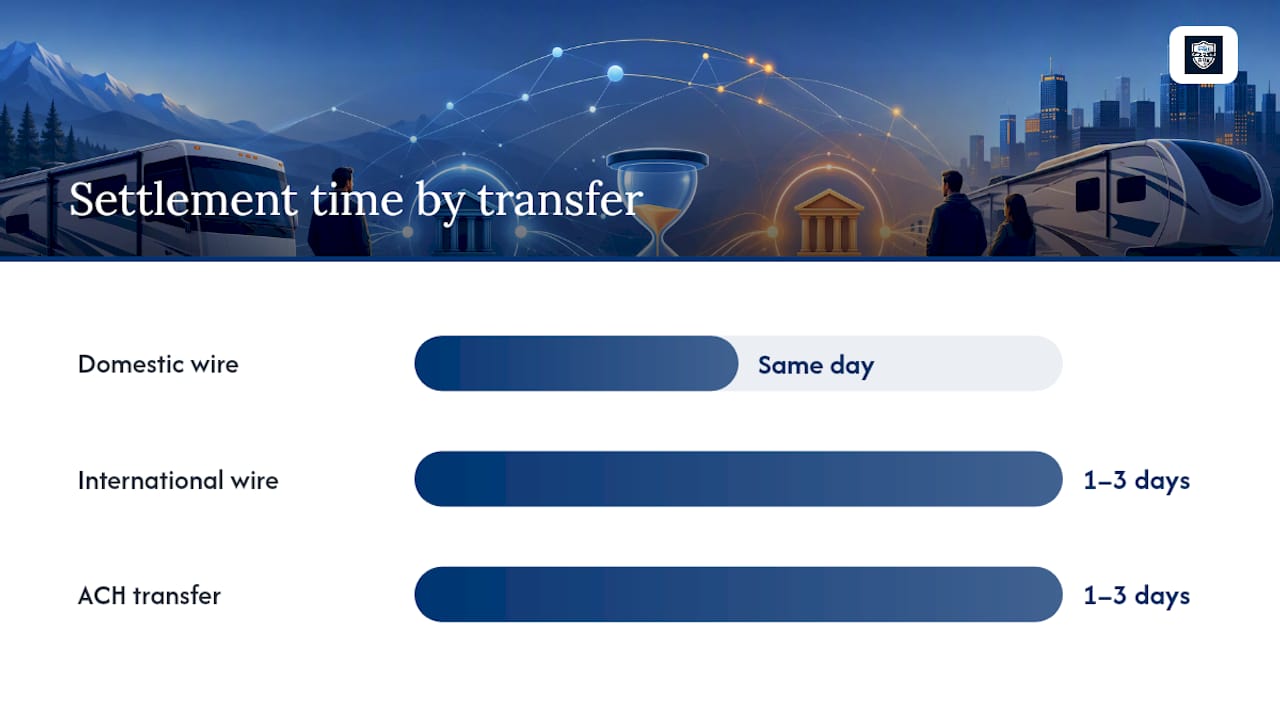
Domestic wires typically settle the same business day, while international wires can take one to three days depending on intermediary banks and time zones. That speed is the whole point for legitimate RV buyers who want to lock in a deal before someone else does. It’s also exactly why scammers push for wires over anything slower.
The legal fine print matters here too. Commercial wire disputes fall under UCC Article 4A, which asks whether the bank used “commercially reasonable” security procedures, a much narrower bar than the consumer protections under Regulation E for things like debit card fraud, according to LegalClarity. In plain terms, wired money doesn’t carry the same safety net as a credit card chargeback.
Compare your options:
- Wire transfer: fast, low reversal odds, moderate fees.
- ACH transfer: slower (one to three days), still hard to reverse once settled, usually free or low-cost.
- Credit card: slower to arrange for large private sales, but chargeback protections exist.
- Escrow: slowest, highest protection, moderate fees split between parties.
Why Scammers Favor Wire Transfers In RV And Vehicle Deals
Scammers gravitate toward wires for the same reasons legitimate buyers do: speed and finality. Once funds land, there’s no recall button. Pair that with global cash-pickup networks like MoneyGram and Western Union, and a scammer can convert your money to untraceable cash before you’ve even realized something’s wrong.
The attack methods vary, but a few show up constantly:
- Business email compromise (BEC): attackers gain access to a seller’s or buyer’s email and quietly redirect payment instructions.
- Account takeover: stolen credentials let criminals impersonate a real party mid-negotiation.
- Man-in-the-browser malware: malicious software alters wiring details on the victim’s own screen without their knowledge, a risk ACI Worldwide flags as a persistent bank security challenge.
- Last-minute instruction swaps: a “corrected” account number arrives just before closing, timed to catch you off guard.
RV sales are uniquely exposed because they combine high dollar amounts, remote buyers and sellers who’ve never met, and a listing ecosystem spread across classifieds sites and forums. That’s a lot of trust placed in strangers over a purchase that can run into six figures.
Pro Tip: Treat wiring instructions like a password, not a casual detail. Never accept them as final unless you’ve confirmed them through a channel the sender didn’t control.
What Do Common RV Wire Scams Actually Look Like?
Red flags tend to repeat themselves once you know what to watch for. Here are the patterns that show up most often in RV sale scams.
The overpayment refund trick. A buyer sends a cashier’s check for more than the agreed price, then asks the seller to wire back the difference. The original check later bounces, and the seller is on the hook for the wired refund. Red flags: unsolicited overpayment, urgency to refund quickly, unfamiliar bank on the check.
Escrow impersonation. Scammers spoof a title company or “buyer protection” service, sending professional-looking emails with wiring instructions that route to their own account. Red flags: a domain that’s almost but not quite right, pressure to wire before a supposed deadline, no verifiable business address.
Cash-pickup demands. A buyer insists on paying through MoneyGram or Western Union for a cash pickup rather than a traceable bank transfer. Red flags: refusal to use any other payment method, requests to send funds to a name that doesn’t match the seller, insistence on secrecy.
The mid-negotiation instruction swap. Everything looks normal in an email thread until, days later, a message arrives saying “please use this updated account instead.” Red flags: any change to banking details introduced by email alone, a slightly altered sender address, no phone confirmation offered.
RV forums are full of near-miss stories that follow this exact shape. A buyer wires a deposit to a seller who “can’t meet in person right now,” the RV never existed, and the money disappears into a MoneyGram pickup halfway across the country.
What’s The Verification Checklist Before You Wire Money?
Before you send or accept a single dollar, work through these steps in order.
- Verify identity directly. Meet in person or do a video call. A real seller or buyer will not dodge this.
- Confirm bank account ownership. Ask for a voided check, a bank-stamped account confirmation, or use micro-deposits to prove the account belongs to who they say it does.
- Validate the wiring instructions independently. Call a phone number you found yourself, on the bank’s official website or a previously verified contact, never one pulled from the email that contains the instructions.
- Cross-check the RV’s paperwork. For sellers, that means the title, a signed bill of sale, and the VIN. For buyers, that means proof of funds and identity verification before you commit.
- Watch for last-minute changes. If wiring details shift anytime after the initial agreement, treat it as a hard stop until reverified by phone.
This mirrors the safety habits laid out in Gently Used RVs’ scam safety guide, and it lines up with the private seller buying steps worth reviewing before any private-party deal.
Pro Tip: For long-distance sales, consider a small test transfer of $1 to $5 before wiring the full amount, or use a licensed escrow service. If the trial transfer fails or the “seller” refuses one, you’ve just saved yourself a much bigger loss.
Safer Payment Alternatives For RV Buyers And Sellers
A wire isn’t your only option, and in most private-party RV deals it shouldn’t be your first choice.
- Escrow services: a neutral third party (often a bank or attorney) holds funds until both sides confirm the deal is complete. Higher safety, moderate fees, best suited to long-distance sales.
- Bank cashier’s checks: widely accepted, but verify authenticity in person at the issuing bank before releasing the RV. Fake cashier’s checks are common enough that this step isn’t optional.
- Certified checks and same-bank transfers: solid options when buyer and seller share a bank, since funds move internally with less exposure.
- Buyer/seller protection platforms: some payment services offer dispute resolution, though they come with fees, hold times, and payout caps worth checking in advance.
A wire still makes sense in one specific scenario: both parties meet at a bank branch in person, the seller’s account ownership is confirmed on the spot, and the wire is initiated under bank staff supervision. That’s a fundamentally different risk profile than wiring to a stranger you found in an online listing.
What To Do If You Suspect A Wire Transfer Scam
Speed matters more than almost anything else once you suspect fraud. Work through this immediately:
- Call your bank first. Ask them to contact the receiving bank and request a wire recall. Reference the transaction number, date, and amount.
- Contact the wire company directly if you used MoneyGram, Western Union, or a similar service, and ask about their fraud reversal process.
- Preserve everything: emails, texts, screenshots of wiring instructions, transaction receipts.
- Report the fraud to Reportfraud, file an IC3 complaint if business email compromise is involved, and notify local law enforcement.
Be realistic about outcomes. Once cash is picked up through a money-transmitter network, funds are often unrecoverable, and even bank-to-bank recalls only work if the receiving bank hasn’t already released the money. Recovery depends heavily on how fast you act and whether the receiving institution cooperates.
The One Verification Habit That Blocks Most Wire Scams
If you take away a single habit from all of this, make it this one: always confirm wiring instructions by calling a phone number you found independently, never one supplied in the same email or text that contains the payment details.
This single step blocks the majority of BEC and instruction-tampering schemes, because it breaks the attacker’s control over the communication channel. Industry security guidance from Wells Fargo recommends exactly this approach for any high-value wire.
Here’s how to put it into practice:
- Look up the bank or business’s number through their official website, not the email signature.
- Ask directly: “Can you confirm the account number and routing number you sent me?”
- Request a bank-stamped account verification or a similar written confirmation.
Pro Tip: If you run or manage listings on a marketplace, log every verification step you take, the phone number called, the date, who you spoke with, following the best practices from How to Verify Item Authenticity on Any Marketplace. That record becomes critical if a dispute or fraud claim comes up later.
A Note From Inside The Marketplace
We watch for suspicious wiring requests every day, patterns like brand-new accounts pushing buyers toward cash-pickup payments or sellers who refuse video calls. A reputable classifieds site should offer a real scams page, recommend safer payment flows, and never pressure you toward wiring as the default. Read our safety guide before your next deal, and know that platform-level monitoring is only a backstop. Your own verification call is still the strongest line of defense.
Ready to browse RVs from sellers who list transparently? Start with Gently Used RVs, where you can search listings, filter by RV type, and connect directly with sellers without paying a browsing fee. If you’re weighing dealer protections against a private-party deal, our RV Types Guide can help you match the right vehicle class to your budget and payment comfort level.
Where To Learn More And Report Wire Fraud
A few resources are worth bookmarking before you ever need them.
- FTC Consumer Advice: explains wire transfer risks and how to spot common scam setups.
- Reportfraud: the primary portal for reporting wire fraud and tracking scam patterns nationally.
- Wells Fargo’s wire transfer safety guide: practical bank-level advice on validating instructions before sending money.
- LegalClarity’s guide to wiring laws and rights: breaks down your legal protections, and their limits, under Article 4A.
File a complaint with the FBI’s IC3 if business email compromise is suspected, and always loop in your bank’s fraud department the moment something feels off.
Frequently Asked Questions
Are wire transfers reversible if I send one by mistake? Rarely. Once the receiving bank accepts a domestic wire, it’s typically final. Your best shot is asking your bank to request a recall immediately, but success depends entirely on whether the funds are still sitting in the receiving account.
Is it ever safe to wire money for an RV purchase? Yes, but only under specific conditions: both parties meet in person, account ownership is confirmed on the spot, and the transfer happens at a bank branch rather than remotely based on emailed instructions.
Why do scammers prefer MoneyGram or Western Union over bank wires? Cash-pickup services let scammers collect funds in person within minutes, often under a false name, making the transaction essentially untraceable once picked up.
What should I do first if I think I’ve been scammed? Call your bank immediately and request a wire recall, then contact the wire company if one was used, preserve all records, and report the fraud to ReportFraud.FTC.gov.
How is a wire transfer different from an ACH transfer for RV payments? Wires settle the same day and are harder to reverse; ACH transfers take longer to clear but can sometimes still be disputed within a limited window, giving buyers slightly more protection.
This article is general information, not a substitute for advice from a qualified financial advisor. Consult a qualified financial professional about your own circumstances before acting on anything here.
Sources
- What to know before you wire money | Consumer Advice
- Safety tips for wire transfers | Wells Fargo
- Wire Transfers: How they work, security & fees | J.P. Morgan
- Is Wiring Money Safe? Scams, Laws, and Your Rights | LegalClarity