
A statewide RV search returns every listing inside a single state, nothing more and nothing less. It sits between a local radius search (typically 20–50 miles from your ZIP code) and a full national sweep, making it the right scope when you want more options than your backyard offers but aren’t ready to deal with cross-country transport logistics.
When does statewide make sense? Three situations come up most often:
- You’re hunting a specific model or floorplan that rarely surfaces locally (a diesel pusher Class A, a toy hauler with a specific garage length, a park model in a Sun Belt state).
- You suspect regional price differences are working in your favor — states with large RV dealer networks or high seasonal turnover often carry more inventory at lower prices.
- You want dealer and private-seller listings in one pass, filtered by RV type, length, price range, title condition, and hookup specs, without scrolling through results from three time zones away.
Listing sources in a statewide search include private sellers, franchise and independent dealers, aggregated dealer feeds, and campground or park directories. Geotargeted platforms rank the closest results first by default, though paid visibility tiers can push a seller’s listing higher regardless of distance.
Pro Tip: Before you commit to a state, check whether it has a strong dealer presence or a high concentration of the RV type you want. Sunbelt states like Florida, Texas, and Arizona tend to carry deep fifth-wheel and Class A inventory year-round.
Key Takeaways
A statewide RV search is the most practical scope when local inventory is too thin and national logistics are too complex — use it deliberately, with inspection and transport costs budgeted before you start.
| Point | Details |
|---|---|
| When to go statewide | Choose statewide scope when local inventory is too thin or a specific model is hard to find nearby. |
| Top verification steps | Get the VIN first, run a history report, confirm clean title and no liens before any payment. |
| Budget beyond purchase price | Reserve funds for inspection ($150–$400), transport, and state registration fees before negotiating. |
| Pickup logistics | Use RVParkway’s 2,491+ park listings to book a full-hookup staging site near the seller. |
| Start on Gently Used RVs | Free listings, geotargeted results, and statewide visibility upgrades make it a practical first stop. |
This article is general information, not a substitute for advice from a qualified lawyer. Consult a qualified legal professional about your own circumstances before acting on anything here.
Table of Contents
- How does a statewide RV search actually work?
- Step-by-step: how to run an effective statewide RV search
- What to expect: timeline, costs, and common pitfalls
- How to verify listings and avoid scams
- Legal and privacy basics you should know
- Tools and resources that make statewide searches easier
- Why statewide searches are worth the extra effort
- Gently Used RVs makes statewide searches faster and free
- Sources
How does a statewide RV search actually work?
Marketplaces implement statewide filtering in one of three ways: a hard state-boundary geo-filter, a radius set wide enough to cover the state, or a nationwide index with a state dropdown applied at the results layer. The first method is the cleanest because it excludes listings just across the border that inflate your result count without adding real options.
Geotargeting shapes what you see first. On platforms that use it, the closest listings appear at the top of results by default. Paid visibility upgrades change that order. A seller who upgrades to a statewide tier (like the Silver plan on Gently Used RVs at $59.99/month) gets their listing surfaced to buyers anywhere in the state, not just those within a 20-mile radius. That means your results may mix nearby private sellers with dealer listings from the other end of the state, ranked partly by distance and partly by the seller’s tier.
Filters that matter most for a statewide search:
- RV type: Class A, B, or C motorhome; travel trailer; fifth wheel; toy hauler; pop-up camper; truck camper; park model; teardrop trailer
- Length and tow/weight specs: critical if you have a specific tow vehicle or storage pad
- Year range and price ceiling: narrows results fast without hiding good deals
- Title condition: clean, salvage, rebuilt — always filter for clean title first
- Seller type: dealer vs. private party (dealers often include limited warranties; private sellers may price lower)
- Hookup and amenity specs: relevant if you plan to stage the RV at a campground near the seller before transport
AI-assisted search is also emerging. Conversational tools that let you describe needs in plain language, such as InteractRV’s AI Search Assistant, can surface units matching specific feature combinations that rigid filter UIs miss — useful when your requirements are unusual.
Step-by-step: how to run an effective statewide RV search
Follow this workflow from first search to keys in hand.
- Set your scope. Choose the target state based on inventory depth, price trends, or model availability. Check the RV types guide to confirm which category and specs you need before you filter.
- Apply filters. Set RV type, length, year range, price ceiling, and title status (clean only). Add hookup or feature requirements if they’re non-negotiable.
- Sort and shortlist. Sort by distance first, then re-sort by price to spot outliers. Note seller type — dealer listings often include more photos and service history; private listings may have more room to negotiate.
- Initial verification. Request the VIN, ask for photos of the VIN plate and odometer, and run a vehicle history report. Confirm the title is in the seller’s name and check for open liens.
- Inspection and logistics. Hire an independent mobile RV inspector before you agree on a final price. Get at least three transport quotes if you’re not driving it home. Check oversize-load permit requirements for your route.
- Close the deal. Use a buyer-protected payment method or escrow for high-value transactions. Get a written bill of sale, confirm the lien release, and complete DMV title transfer in your home state.
Checklist contacts to have ready: seller (primary contact), independent inspector, licensed RV transporter, your state’s DMV (for title transfer timeline), and the seller’s state DMV (for lien release confirmation).
What to expect: timeline, costs, and common pitfalls
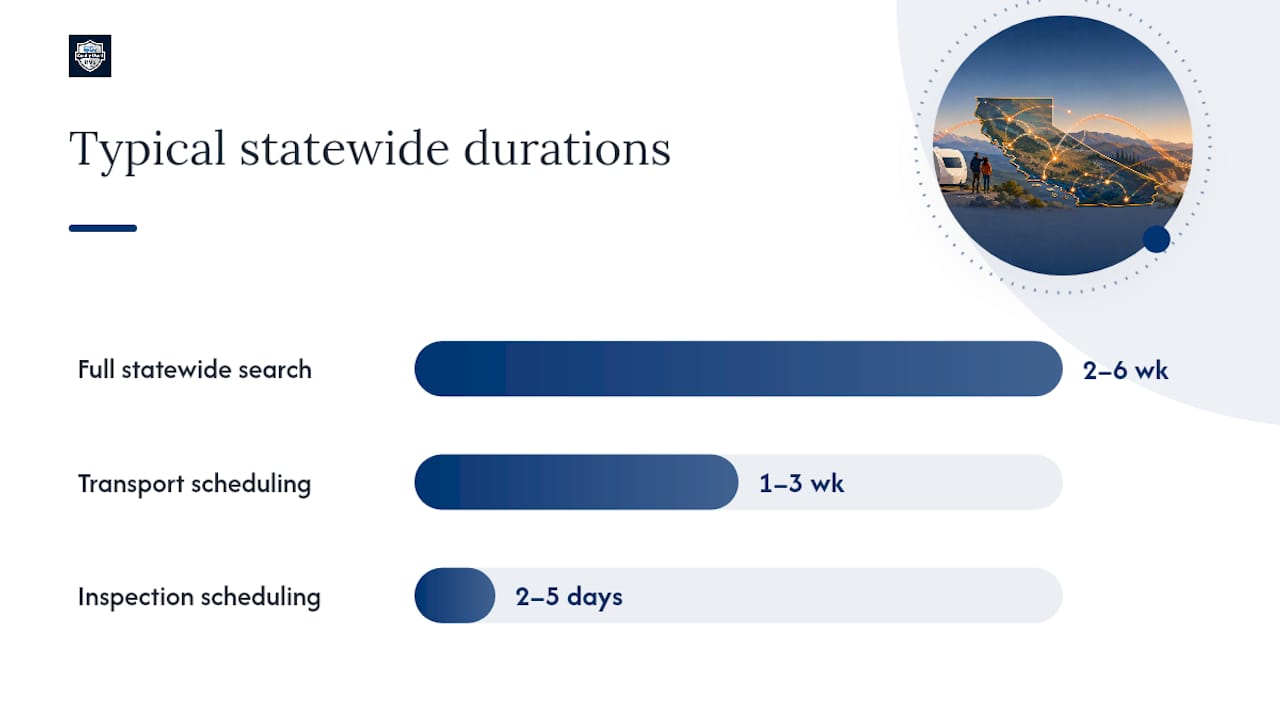
A realistic statewide search runs two to six weeks from first search to delivery, depending on how quickly you find the right unit and how far it needs to travel.
Typical timeline:
- Research and shortlisting: a few days to two weeks
- Inspection scheduling and negotiation: two to five days
- Transport scheduling: one to three weeks (longer for popular routes or oversized rigs)
- Title transfer and registration: varies widely by state, from a few days to several weeks
Budget line items beyond the purchase price:
- Independent inspection: typically $150–$400 depending on rig size and inspector travel
- Transport: varies by distance and rig size; get three quotes
- Sales tax and registration fees in your home state (these differ significantly by state)
- Potential repairs flagged at inspection
- Travel costs if you inspect in person
For pickup logistics, campground directories are genuinely useful. RVParkway lists 2,491+ RV parks across all 50 states with site-level details including hookup types, amp service, and pet policies — so you can book a nearby full-hookup site for inspection staging instead of relying on a seller’s driveway or a parking lot. Some high-demand state park systems book months in advance, so check availability early if you’re planning an in-person pickup.
Common pitfalls:
- Skipping a lien check and discovering the title is encumbered after you’ve paid
- Underestimating transport lead times, especially for wide-body or tall rigs that need oversize permits
- Trusting listings with only two or three photos — always request a video walk-through
- Ignoring state-specific registration fees, which can add hundreds of dollars to your total cost
How to verify listings and avoid scams
Red flags show up fast when you know what to look for. Treat any of these as a hard stop:
- Price is 20–30% below comparable listings with no explanation
- Seller refuses a video walk-through or live call
- Pressure to wire funds or pay via gift card
- VIN on the listing doesn’t match the VIN plate in photos
- Title state doesn’t match the seller’s claimed location
- Mileage or condition inconsistencies between photos and description
Verification checklist:
- Ask for the VIN before any other conversation.
- Run a vehicle history report using the VIN.
- Request photos of the VIN plate, odometer, roof, undercarriage, and any known problem areas.
- Confirm the title is clean, in the seller’s name, and free of liens.
- Ask for service records or maintenance receipts.
- Use escrow or a verified dealer transaction for any purchase over $10,000.
- Hire an independent inspector before finalizing price.
Pro Tip: Get your transport quotes before you finish negotiating the purchase price. An inspection that reveals a roof issue or slide problem can affect both the price you offer and the transport method you need — knowing both numbers upfront gives you real leverage.
For a deeper look at online transaction safety, the RV buying safety guide covers red-flag patterns and secure payment methods in detail.
Legal and privacy basics you should know
Law enforcement generally needs a warrant or owner consent to search an RV, similar to a home, though exigent circumstances can change that. Rules vary by state, so don’t assume your state’s standard applies to the seller’s state.
On the privacy side, protect yourself during the transaction:
- Don’t share a driver’s license, Social Security number, or bank details until you’ve verified the seller’s identity and confirmed the listing is legitimate.
- Use escrow or a payment service that holds funds until title transfer is confirmed.
- Communicate through the marketplace’s messaging system until you’re confident the seller is real.
If a title dispute, lien issue, or ownership question arises, consult a local attorney or the DMV in the seller’s state before you transfer any money. A $200 legal consultation is cheap compared to a disputed title on a $40,000 motorhome.
Tools and resources that make statewide searches easier
The right combination of tools covers four needs: finding listings, planning pickup logistics, verifying the vehicle, and arranging transport.
Marketplace features to prioritize:
- State-level geo-filter (not just a wide radius)
- Advanced filters for RV type, length, tow weight, and price
- Seller-type filter (dealer vs. private)
- In-platform messaging to request additional photos or video
- Geotargeted result sorting so closest listings appear first
Pickup and staging logistics:
- FindStayRV for fast booking of RV sites, including full-hookup and pull-through inventory, when you need a staging spot quickly
- For state park reservations near pickup locations, check ReserveAmerica, Recreation.gov, or the state park camping guide at RVmapper for reservation tips and cancellation alerts
Inspection and transport:
- Independent mobile RV inspectors (search NRVIA-certified inspectors for your target state)
- Licensed RV carriers; always verify their insurance and get three quotes
- Check oversize-load permit requirements for your specific route before booking
VIN and title checks:
- Run a vehicle history report through a recognized provider using the VIN
- Check lien status through the DMV in the seller’s state
- Confirm title brand (clean, salvage, rebuilt) before any payment
For private sellers thinking about listing locally vs. reaching a wider audience, the same principles apply: clear photos, accurate specs, and honest condition descriptions attract serious buyers faster.
Why statewide searches are worth the extra effort
Most buyers default to a local radius search because it feels safer and simpler. That instinct makes sense for common units. But when you’re after something specific — a low-mileage Class B diesel, a fifth wheel with a specific bunkhouse layout, a park model priced below market — the local pool is often too shallow to find it.

The real cost of a statewide search isn’t the search itself. It’s the inspection and transport budget you have to reserve before you start. Buyers who skip that planning end up either overpaying for transport after they’ve already committed emotionally to a unit, or walking away from a good deal because the logistics surprised them. Build those costs into your ceiling price from day one, and a statewide search becomes a straightforward tool rather than a gamble.
One honest caution: if a comparable unit is available locally for a few thousand dollars more, the math often favors the local deal once you add inspection fees, transport, and your time. Statewide scope pays off most when the price differential is real and the unit is genuinely hard to find nearby.
Gently Used RVs makes statewide searches faster and free
Gently Used RVs is a free marketplace where private sellers and dealers list used RVs at no cost, and buyers search without creating an account. Search results are geotargeted, so the closest listings appear first. Sellers who want statewide visibility can upgrade to the Silver tier ($59.99/month), which surfaces their listing to buyers anywhere in the state — that’s what keeps statewide inventory fresh and competitive for buyers.

The AI autofill tool lets sellers pull listing details directly from any dealer URL in seconds, which means more complete, accurate listings for you to evaluate. Every RV category is covered: Class A, B, and C motorhomes, travel trailers, fifth wheels, toy haulers, pop-up campers, truck campers, park models, and teardrop trailers.
To start your statewide search now, browse the RV types guide to lock in your filters, then head to the main used RV listings page and set your state. No account needed.