RV Generators Explained: A Beginner’s Complete Guide
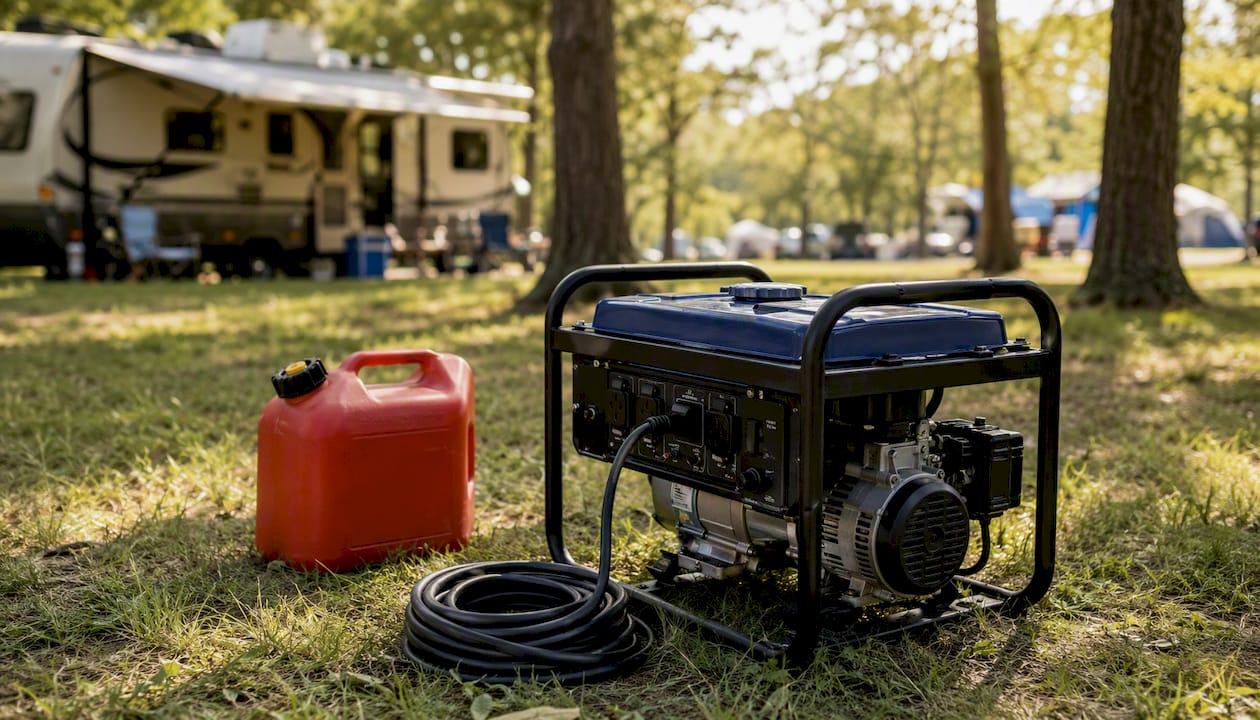
An RV generator is a fuel-powered device that produces 120V AC electricity for your rig — essentially on-demand campground power when shore power or solar isn’t available. It combines an internal combustion engine with an alternator to generate electricity wherever you park.
Do you need one? Two quick questions settle it. First, do you plan to run a rooftop air conditioner off-grid? Second, will you spend multiple nights away from electrical hookups? If both answers are yes, a generator is close to non-negotiable. If you mostly stay at campgrounds with shore power and your electrical needs are modest, you may get by without one — at least at first.
Key Takeaways
An RV generator is a fuel-powered device that produces 120V AC electricity — and sizing it correctly to your simultaneous appliance load is the single most important decision you’ll make before buying one.
| Point | Details |
|---|---|
| What a generator does | Converts fuel to 120V AC via engine and alternator; powers appliances and charges batteries through a transfer switch. |
| Sizing rule of thumb | 30A rigs need 2,500–3,600W; 50A rigs with dual A/C typically require 6,000–12,000W. |
| Safety non-starter | Portable generators must always run outdoors, at least 10–20 feet from openings; CO detectors are mandatory. |
| Inverter vs. conventional | Inverter generators run quieter and produce cleaner power — the right choice for most campground and boondocking use. |
| Hybrid strategy | Run the generator 2–3 hours to recharge batteries; let solar and batteries carry quiet overnight loads. |
Table of Contents
- How an RV generator makes and delivers electricity
- What types of RV generators are available?
- What can a generator actually power in your RV?
- How to size a generator for your RV
- How to run a generator safely
- Maintenance basics that keep your generator running
- Generator vs. solar and portable power stations
- Recommended brands and what they’re best suited for
- What I’d tell every new RV owner about generators
- Ready to find an RV that fits your power needs?
- Sources
How an RV generator makes and delivers electricity
The flow is straightforward: fuel feeds an internal combustion engine, the engine spins an alternator, and the alternator produces 120V AC power. That power travels to your RV’s breaker panel, where it splits two ways — directly to 120V outlets and appliances, or through a converter/inverter-charger that steps it down to replenish your 12V battery bank.
One critical component sits between your generator and shore power: the transfer switch. Its job is to make sure only one power source feeds the system at a time. Without it, generator power and shore power could collide in the panel, which is a serious electrical hazard. Most factory-installed generators include an automatic transfer switch that handles this without any input from you.
The battery-charging side of this equation matters more than most beginners expect. Your converter takes the generator’s AC output and converts it to DC to charge your 12V batteries, which then power lights, fans, water pumps, and other low-draw 12V loads. Winnebago’s power source documentation notes that onboard generators can deliver roughly 35 amp-hours per hour of charging in practical use — enough to meaningfully restore a depleted battery bank in a few hours.
Key components your generator interacts with:
- Transfer switch — routes power from generator or shore power, never both
- Breaker panel — distributes 120V AC to outlets and appliances
- Converter/inverter-charger — converts AC to DC for battery charging
- Battery bank — stores energy for 12V loads and inverter-powered AC loads
- Shore power inlet — the alternative input the transfer switch manages
Pro Tip: Running your generator for 2–3 hours to recharge a depleted battery bank is usually more fuel-efficient than running it continuously to power everything. Charge the batteries, shut it down, and let the inverter carry the quiet loads.
What types of RV generators are available?
Two big splits define the generator market: built-in versus portable, and inverter versus conventional.
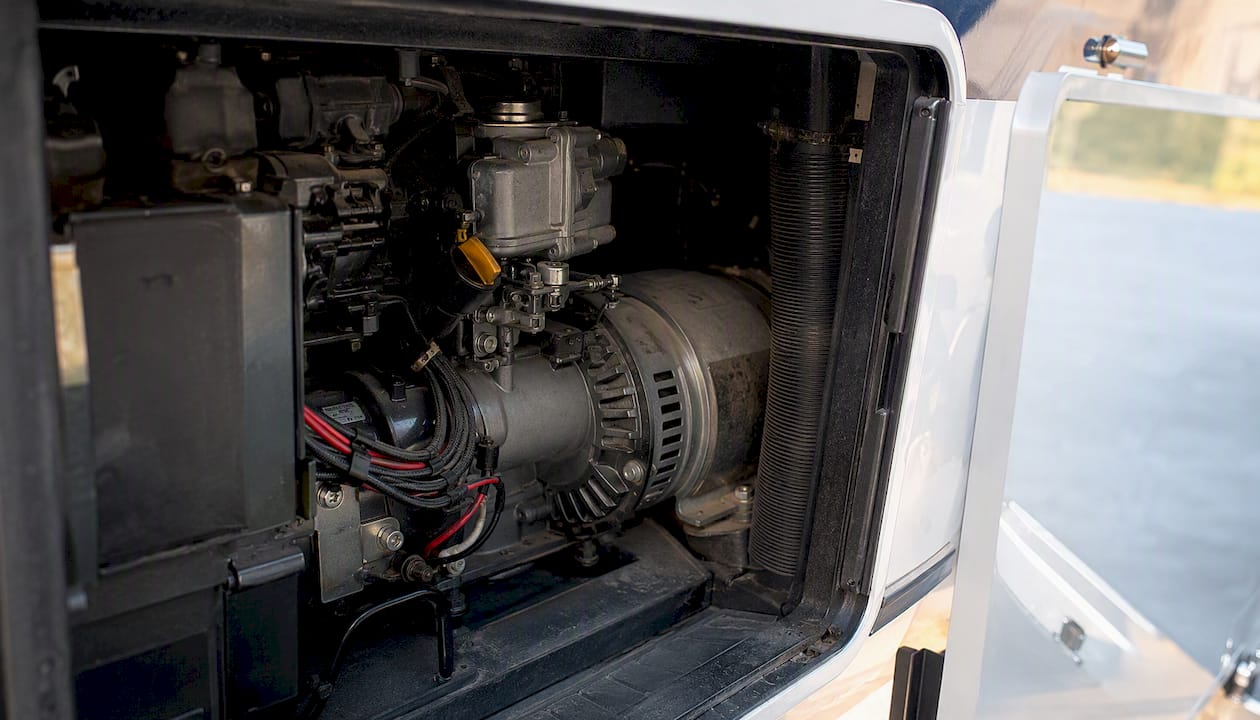
Built-in (fixed-mount) generators are factory-installed or professionally mounted inside a dedicated compartment. They wire directly into the RV’s electrical system with an automatic transfer switch, run on the same fuel tank as the engine in many motorhomes, and — critically — can operate while the RV is in motion to power rooftop A/C or charge batteries in transit. Class A and Class C motorhomes commonly come with them from the factory. The tradeoff is cost, installation complexity, and the need for a service center when something goes wrong.
Portable generators sit outside the RV, connected via a power cord to an inlet on the exterior. They’re flexible — you can use one across multiple rigs or lend it to a friend — but they must always be placed outdoors, well away from windows and vents, and they cannot be used while driving.
The inverter-versus-conventional question is where most beginners should focus their attention. Inverter generators are the preferred choice for most RVers because they’re quieter, more fuel-efficient at partial loads, and produce cleaner “pure sine wave” power that won’t damage sensitive electronics like laptops, CPAP machines, or modern TVs. Conventional generators are cheaper per watt but run louder and produce “dirtier” power with more harmonic distortion.
Fuel options each carry real tradeoffs:
- Gasoline — widely available, lower upfront cost, but shorter shelf life and higher consumption at heavy loads
- Diesel — better fuel efficiency, longer runtime, and shares fuel with diesel motorhomes; less available at rural stations
- Liquid propane — clean-burning, long shelf life, and convenient if your RV already runs a propane system; lower energy density means slightly more fuel consumed per hour
Brand signals worth knowing: Cummins/Onan is the dominant name in factory-installed motorhome generators, found across a huge share of Class A and Class C rigs — their service network is broad. Generac offers portable and reconditioned options that can reduce upfront cost. Honda portable inverter generators are widely respected for quiet operation and long-term reliability. Fischer Panda specializes in compact diesel and DC-output units, popular with full-timers and high-end builds where space and noise are premium concerns.
For a deeper look at which RV types typically come with built-in generators, the class-by-class breakdown helps narrow your shopping list before you start comparing specs.
What can a generator actually power in your RV?
RV generators produce 120V AC that can run rooftop air conditioners, kitchen appliances, entertainment systems, and feed the converter/inverter-charger to replenish 12V batteries. Here’s what that looks like in practice, with typical watt ranges:
Starting watts matter because motors — A/C compressors and refrigerator compressors especially — draw a large surge of power at startup, sometimes double their running load. Your generator must handle that spike without tripping.
A 2,500–3,600W generator can typically run:
- One rooftop A/C unit (13,500 BTU) plus lights and a phone charger
- A microwave and coffee maker simultaneously
- The converter to charge your battery bank
You’ll need 6,000W or more for:
- Dual rooftop A/C units
- A residential refrigerator running alongside an A/C unit
- An electric water heater at the same time as other heavy loads
How to size a generator for your RV
A 30-amp shore power connection equals roughly 3,600 watts; many 30A RVs function well on 2,500–2,800W generators, while 50A rigs with dual A/C commonly require 6,000–12,000W. Here’s a repeatable method to find your number:
- List every appliance you’ll run at the same time. Be honest — not everything you own, just what you’d realistically run simultaneously on the hottest afternoon of your trip.
- Note the running watts for each. Check the appliance label or use the table above as a starting reference; the RV Tech Library appliance load chart is a reliable cross-check.
- Add all running watts together. This is your continuous load.
- Add the highest single starting-watt spike from your list (almost always the A/C compressor).
- Multiply the total by 1.20–1.25 to build in a 20–25% safety margin. Running a generator near its rated ceiling shortens its life and risks voltage sag.
Sample calculation: One 13,500 BTU A/C (1,700W running + 3,200W starting), microwave (900W), LED lights (100W), and battery charger (400W). Running total: 3,100W. Add the A/C starting spike: 3,200W. Peak demand: 6,300W.
For inverter generators, always check the spec sheet for rated continuous watts versus peak/surge watts. The rated continuous figure is what you can sustain; the peak figure is only available for a few seconds.
How to run a generator safely
Safety here isn’t optional. Carbon monoxide (CO) is colorless, odorless, and lethal — and generators produce it in quantity. Every generator safety rule flows from that fact.
Core rules to follow every time:
- Portable units go outside, always. Place them at least 10–20 feet from any window, door, or vent opening, and never in an awning-covered area where exhaust can pool.
- Install a CO detector inside your RV and test it before every trip. Many states require them in RVs, and they’re cheap insurance.
- Never run a generator in a garage, storage bay, or any enclosed space, even briefly.
- Use proper grounding and a quality surge protector between the generator and your RV’s inlet to protect appliances from voltage spikes.
- Check campground quiet hours before you start up. Most campgrounds enforce generator quiet hours — commonly 10 PM to 6 AM or 8 AM — and some sites require shore power only. Violating these rules gets you asked to leave.
Fixed-mount generators in motorhomes can run while driving, which is a genuine convenience for keeping the interior cool on long summer hauls. Portable units must stay off and secured during travel — no exceptions.
For startup, let the generator warm up for 30–60 seconds before connecting heavy loads. On shutdown, turn off high-draw appliances first, then shut down the generator. This reduces voltage spikes and protects both the generator and your appliances.
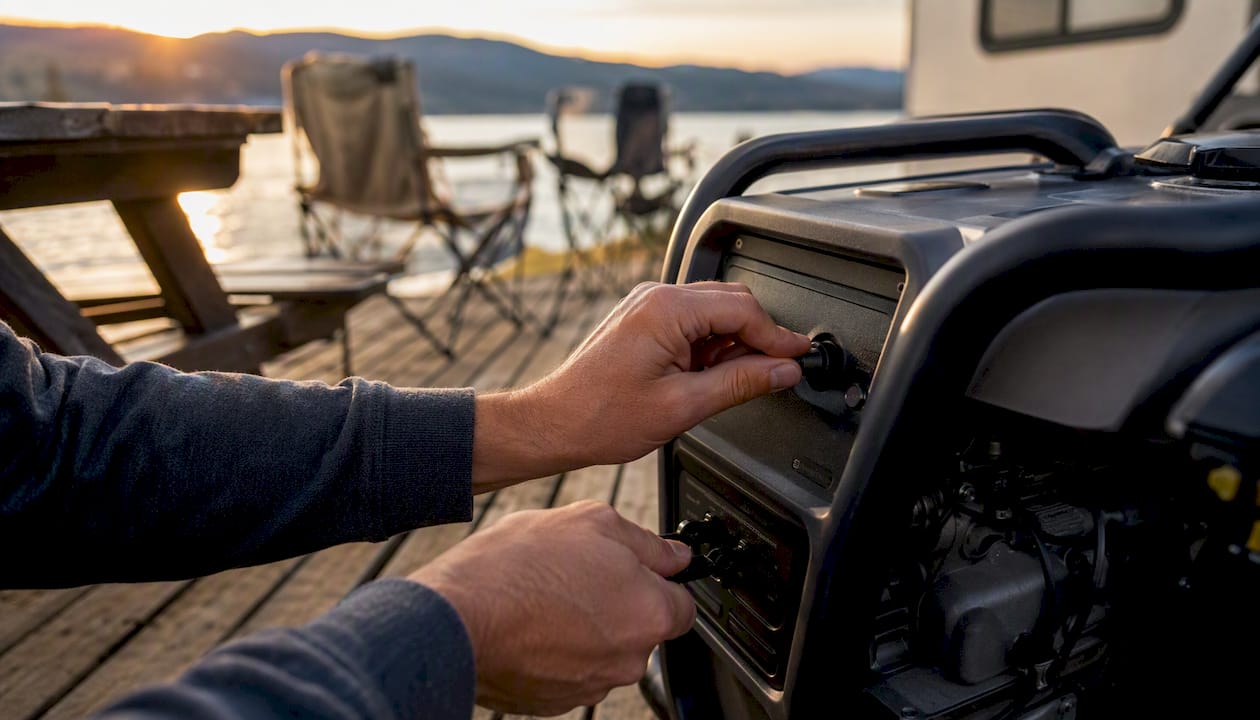
Pro Tip: Park with your generator exhaust side facing away from neighboring sites. Combined with a sound-reducing enclosure or a generator “quiet box,” this simple orientation can cut perceived noise at your neighbor’s site noticeably.
Maintenance basics that keep your generator running
A neglected generator is a generator that won’t start when you need it most. The maintenance list is short, and most of it you can do yourself.
Regular tasks:
- Oil changes — most RV generators need an oil change every 100–150 hours of operation or at least once per season. Check your owner’s manual for the exact interval and oil spec.
- Air filter inspection — inspect every 50 hours or monthly during heavy use; replace when dirty or clogged.
- Fuel filter — replace annually or per the manufacturer’s schedule; a clogged fuel filter is a top cause of hard starting.
- Spark plugs — inspect annually; replace if fouled or worn. Gasoline generators are more sensitive to plug condition than diesel units.
- Exercise runs — if your generator sits unused for more than 30 days, run it under load for 30 minutes. This prevents fuel varnish buildup, keeps seals lubricated, and confirms it’ll start when you need it.
- Fuel stabilizer — add stabilizer before any storage period longer than 30 days. Stale gasoline is the single most common cause of a generator that won’t start after winter.
Basic troubleshooting: if the generator won’t start, check the fuel valve (open?), battery charge (low battery is common on built-in units), and choke setting. Poor output or flickering power often points to a dirty air filter or a failing voltage regulator. Excessive smoke — especially blue or black smoke — signals an engine or fuel issue that warrants a service visit.
A well-maintained RV generator typically lasts 1,000–2,000 hours before needing major service, and many built-in units reach well beyond that with consistent care.

Generator vs. solar and portable power stations
A generator isn’t always the right answer. Understanding where it wins — and where it doesn’t — saves you money and frustration.
Where a generator has the clear advantage:
- Running rooftop A/C for extended periods (solar rarely keeps up with A/C demand alone)
- Rapid battery recovery after heavy use or multiple cloudy days
- High-draw appliances like electric water heaters and microwaves
- Multi-day boondocking where battery capacity would otherwise run out overnight
Where solar + battery wins:
- Silent overnight power for lights, fans, and entertainment
- Short trips with light electrical loads
- Campgrounds with strict generator quiet hours
- Reducing fuel cost and maintenance over the long run
The practical hybrid strategy most experienced RVers land on: size your battery bank and inverter for the loads you want to run quietly, then use the generator primarily for rapid battery recovery or occasional high-draw loads. Run it for 2–3 hours on cloudy days or after heavy use, then shut it down and let the batteries carry the quiet loads through the night. This approach minimizes fuel consumption and noise while keeping full flexibility.
Portable power stations (sometimes marketed as “solar generators”) are battery systems, not combustion generators. They’re excellent for light loads and quiet operation, but most can’t sustain a rooftop A/C for more than an hour or two. If A/C is a priority, a combustion generator remains the more practical choice. For guidance on pairing battery backup with your RV power setup, the battery backup buying guide from Atticus Goods covers the key selection criteria clearly.
Recommended brands and what they’re best suited for
Shopping for a generator gets easier once you match the brand to your use case.
- Cummins/Onan — the standard for factory-installed motorhome generators. If you’re buying a used Class A or Class C, there’s a good chance it already has an Onan unit. Their dealer and service network across the U.S. is a genuine long-term advantage. Common output range: 4,000–12,500W for built-in units.
- Generac — a practical choice for portable and reconditioned options. Generac’s buying guides help beginners navigate the inverter-vs-conventional decision, and reconditioned units can meaningfully reduce upfront cost. Portable range: 2,000–6,500W.
- Honda — the benchmark for quiet, reliable portable inverter generators. Honda’s EU series runs at 49–57 dB depending on load, which is genuinely neighbor-friendly at most campgrounds. Best for 30A rigs and owners who prioritize low noise and long-term reliability. Range: 2,000–3,000W for most RV-relevant models.
- Fischer Panda — compact diesel and DC-output units built for full-timers and high-end builds where space is tight and noise matters. Their units are significantly more expensive but deliver diesel efficiency and very low acoustic output. Range: 2,000–8,000W.
Quick buying checklist before you purchase:
- Match wattage to your calculated load (running watts + highest starting spike + 20% margin)
- Confirm fuel type matches your rig and travel habits
- Verify the noise rating (dB at 23 feet is the common spec — aim for under 60 dB for campground use)
- Check transfer-switch compatibility if you’re adding a portable to an existing RV inlet
- For built-in units, confirm the service network in your primary travel region
For motorhome-specific guidance on which classes typically come with factory generators, the motorhomes explained guide at Gently Used RVs breaks it down by class.
What I’d tell every new RV owner about generators
Most beginners overthink the generator decision and underthink the battery side of it. Here’s the honest take: for your first rig, a mid-range portable inverter generator in the 2,500–3,500W range covers the majority of real-world needs without locking you into a large upfront investment.
That’s hard on the engine and wastes fuel. Size for your typical simultaneous load, not your theoretical maximum, and stagger heavy appliances when you can.
The hybrid approach is where most RVers eventually land: a modest generator for battery recovery and high-draw moments, paired with a growing solar and lithium battery setup for quiet, fuel-free power the rest of the time. Start with the generator, audit what you actually use, and build the solar side from there.
Before you shop, audit your appliance list, decide honestly how often you’ll boondock, and calculate your wattage target using the step-by-step method above. Then browse listings on Gently Used RVs or consult a local dealer once you have a number in hand.
Ready to find an RV that fits your power needs?

Whether you want a Class A motorhome with a factory Onan generator already installed or a travel trailer you’ll pair with a portable Honda inverter unit, Gently Used RVs has listings across every category. Browse the full inventory at Gently Used RVs — no account needed to search. When you’re ready to talk specs with a pro, the RV dealer directory connects you to dealerships near you who can walk you through generator options, transfer-switch compatibility, and installation.
Sources
Before you buy or wire anything, check the manufacturer’s spec sheet and your RV’s owner manual. These resources are the most reliable starting points:
- RV Generators Guide - RVOUTDOORLIFE
- RV Generator and Electricity Basics | Cummins Inc.
- Understanding Power Sources in a Camper Van - Winnebago
- How Do RV Generators Work? - Camping World Blog
Always review your transfer-switch documentation before connecting any generator to an existing RV inlet, and confirm campground generator policies before your trip — rules vary widely by park and state.