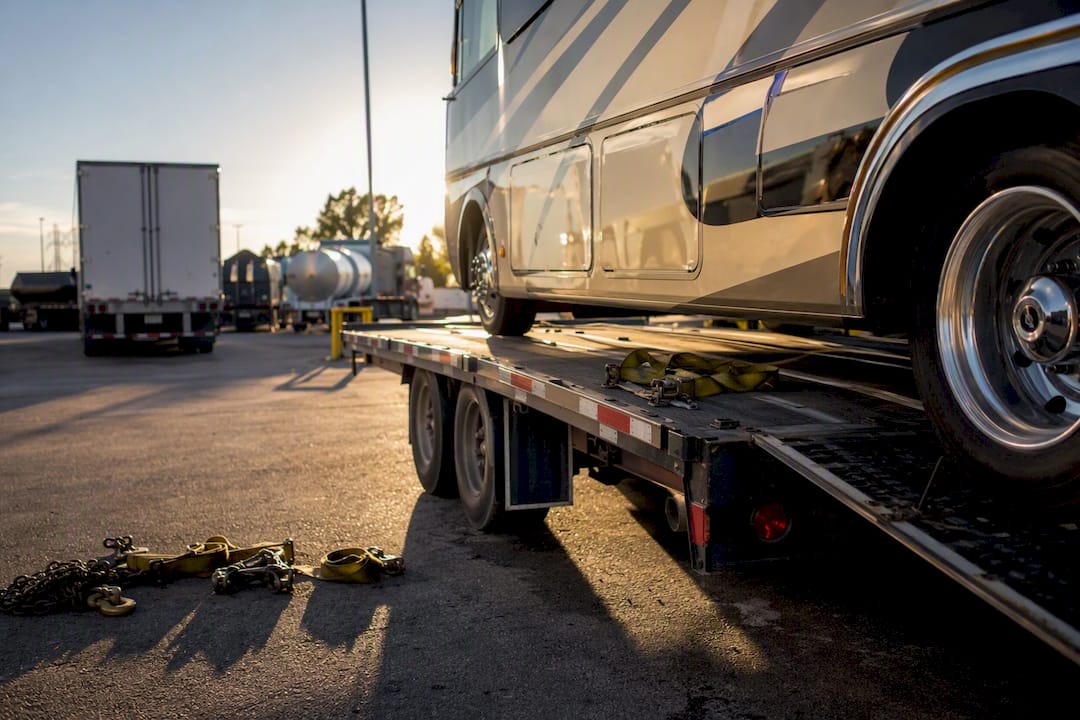
If your RV runs, a professional drive-away delivery is usually the fastest and cheapest way to ship an RV. If it’s a towable, inoperable, or a high-value coach you want to keep off the odometer, tow or flatbed transport is the smarter choice. Either way, get three written quotes and confirm insurance before you book.
TL;DR:
- Flatbed, RGN, or lowboy transport is the safest way to move valuable or non-running RVs without increasing mileage or risking mechanical damage.
- Drive-away transport is the cheapest but adds thousands of miles, making it less suitable for high-value or soon-to-be-sold RVs.
- Opting for direct carriers offers better accountability compared to broker networks and open-bid platforms, especially for expensive or fragile units.
- Build in a 15 to 35 percent cost increase during peak seasons and consider routes that require permits, escorts, or special equipment, which can add hundreds of dollars.
- Verify carrier credentials via FMCSA, ensure insurance limits cover your RV’s value, and document your RV’s condition thoroughly before pickup to protect yourself from damages.
Table of Contents
- What Are Your RV Shipping Options, and Who Should You Call?
- How Each Transport Method Actually Works
- What Does It Actually Cost to Ship an RV?
- How to Choose a Carrier or Broker You Can Trust
- Getting Your RV Ready for Pickup Day
- Who Covers What: Insurance, Permits, and the Fine Print
- When Should You Book, and What Happens at Delivery?
- How Gently Used RVs Helps You Coordinate a Shipment
- What Actually Matters When You Book RV Transport
- Ready to Ship? Start With the Right Listing
- Where to Verify Carrier Credentials and Shipping Rules
- Sources
What Are Your RV Shipping Options, and Who Should You Call?
Every RV shipping quote boils down to one of three transport methods, and each one protects against a different risk. Drive-away means a vetted driver operates your RV under its own power, which is cheap but adds miles and engine hours. Tow-away uses a dolly or tow vehicle for non-motorized units and inoperable motorhomes. Flatbed, RGN (removable gooseneck), or lowboy trailers carry your RV entirely off its own wheels, which is the only option that adds zero miles and protects against mechanical breakdowns mid-route.
The market splits between carriers, who own trucks and drive your load themselves, and brokers, who shop your job out to a network of carriers. Heavy Haulers and Horizon Transport operate largely on the broker/carrier-network model, connecting shippers with vetted trucking partners across the country. DQ Trans LLC runs as a specialized RV carrier with in-house drivers and a published multi-point inspection process. Transcar focuses on drive-away and tow logistics for standard motorhomes and trailers. Shiply operates as an open marketplace where carriers bid competitively on your job, which can produce lower quotes but shifts more vetting responsibility onto you since the winning bidder may not be who you originally researched.
Here’s how the three methods stack up on the metrics that actually matter when you’re comparing quotes:
A few things to keep in mind when narrowing your shortlist:
- Broker networks like Heavy Haulers and Horizon Transport give you access to more trucks, which can mean faster pickup during busy seasons.
- Direct carriers like DQ Trans LLC and Transcar give you a single point of accountability from quote to delivery.
- Open-bid platforms like Shiply can undercut on price, but you still need to vet whichever carrier actually wins the bid.
How Each Transport Method Actually Works
The method you choose changes almost everything about your quote, your timeline, and your risk exposure. Here’s what happens on the ground with each one.
-
Drive-away transport. A vetted, insured driver picks up your RV and operates it under its own power for the entire route. Carriers typically run driver background checks and require the RV to start, idle, brake, and steer reliably before accepting the job. The tradeoff is straightforward: you’re paying the lowest per-mile rate, but you’re also adding potentially thousands of miles to your odometer and engine hours to your generator and transmission. For a used RV you plan to sell soon, that mileage bump matters more than it sounds.
-
Tow-away and tow transport. Non-motorized units, fifth wheels, and travel trailers almost always move this way, hitched behind a carrier’s tow vehicle. Before booking, confirm the carrier’s tow rating actually matches your trailer’s loaded weight, not just its dry weight. Tow transport also becomes mandatory for motorhomes with dead engines, failed transmissions, or safety issues making driving unsafe. It sits in the middle of the cost spectrum because the carrier is hauling dead weight rather than a self-propelled unit.
-
Flatbed, RGN, and lowboy transport. This is the only method that keeps your RV’s wheels entirely off the pavement, loaded and unloaded with a winch, ramp, or crane depending on ground clearance and weight. It’s the right call for non-running rigs, extremely low-clearance units, or expensive Class A coaches where preserving resale value outweighs the premium. Oversize loads on flatbeds also face routing restrictions around low bridges, weight-limited roads, and states requiring escort vehicles, which slows transit and adds paperwork.
If you’re moving an RV outside the United States, the calculus changes again. International shipments typically use RoRo (roll-on/roll-off) vessels for wheeled units or full container shipping for smaller trailers and truck campers. Winnebago’s own guidance on shipping an RV abroad flags lithium battery export restrictions as one of the most common holdups, since many countries classify large battery banks as hazardous cargo requiring separate documentation. Lead times for ocean freight run weeks longer than domestic trucking, so build in a wide buffer if a move takes you across a border by sea.
What Does It Actually Cost to Ship an RV?
Your final invoice depends on three things: method, distance, and RV class, with surcharges layered on top. Specialized carriers report drive-away rates around $1.00 to $2.00 per mile, tow and flatbed running $2.00 to $4.00 per mile, and RGN or oversize loads climbing to $3.50 to $6.00 or more per mile.
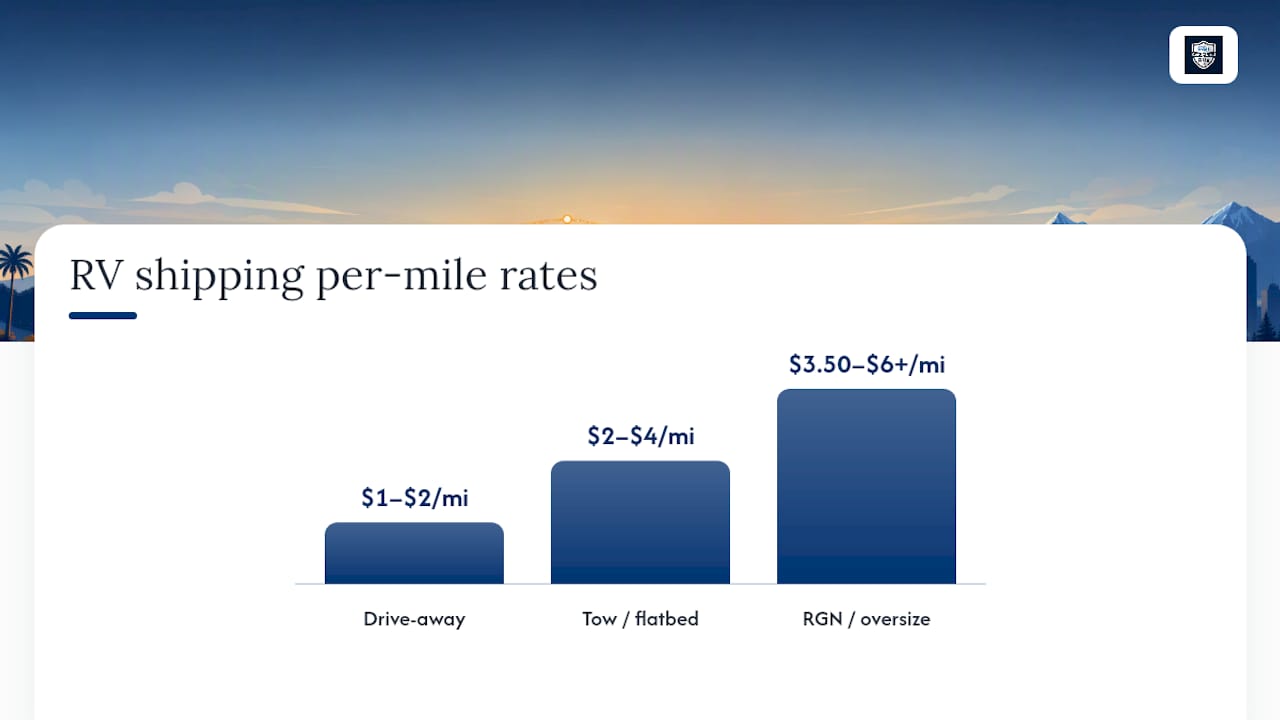
Here’s what that looks like on real routes:
Statistic Callout: Booking during peak summer months or along snowbird corridors, the routes flooding with retirees moving between northern and southern states each fall and spring, can push prices up 15 to 35 percent compared to shoulder-season rates.
Beyond the base rate, expect line items for state oversize permits (roughly $30 to $150 each, depending on the state and how many you cross), pilot or escort cars for wide loads, winch or crane fees for non-running units, and storage charges if your pickup or delivery window slips. Fuel surcharges show up when diesel prices spike mid-quarter, and a “hard to access” fee is common if your RV sits down a narrow gravel driveway or behind a low-clearance carport.
Season and route matter more than most owners expect. Carriers running snowbird migrations in October and November, or the reverse trip in March and April, often quote higher because demand outpaces available trucks. If your dates are flexible, shipping in January or February frequently produces the lowest rates of the year, sometimes 10 to 20 percent below peak pricing, since trucks are otherwise running lighter routes. Backhaul savings show up when a carrier already has a truck heading your direction empty. Ask directly if your route lines up with one of their existing runs. It often does more than you’d think.
How to Choose a Carrier or Broker You Can Trust
Every legitimate RV carrier operating across state lines has to register with the Federal Motor Carrier Safety Administration, and checking that number takes about two minutes on the FMCSA’s public database. Skip this step and you have no way to confirm the company is even legally allowed to haul your RV, let alone insured properly.
Before you sign anything, run through this checklist:
- Look up the carrier’s DOT and FMCSA number and confirm active operating status, not just a registered one.
- Request a certificate of insurance showing per-unit cargo coverage, not just a general liability minimum.
- Ask whether permits and pilot cars are itemized separately on the quote or bundled into a vague “transport fee.”
- Confirm the pickup window (a specific day, not a “sometime this week” range) and who loads or unloads the RV.
- Ask directly: “Who is the contracting carrier, and can I see their credentials?” This matters especially on broker platforms.
Three red flags should stop a booking cold: a quote with no permits listed separately, a carrier that won’t produce an insurance certificate on request, and a price that’s dramatically below every other quote you received. That last one usually means either the carrier is underinsured or planning to subcontract to whoever’s cheapest, with no guarantee of quality.
Pro Tip: Most pricing surprises come from permit and pilot-car fees that never made it onto the original quote. Insist on a written estimate that lists every permit by state, not a lump-sum “miscellaneous” line.
For high-value Class A motorhomes, don’t stop at the FMCSA minimum insurance level. Ask the carrier point-blank what their cargo policy pays out if your RV is totaled in transit, and get that number in writing before you hand over the keys.
Getting Your RV Ready for Pickup Day
Carriers move faster and charge less when your RV is prepped correctly, and a rushed pickup is where most transit damage claims start.
- Measure your RV’s exact length, width, height, and GVWR, and confirm those numbers match what’s listed on your registration and what you told the carrier for the quote.
- Walk the exterior and interior with your phone and shoot timestamped photos and video of every panel, window, and appliance, paying extra attention to existing dents, cracks, or delamination.
- Clear out personal belongings, drain the fresh, gray, and black tanks, and secure or remove anything loose inside cabinets and closets.
- Retract all slide-outs, disconnect and secure the awning, and shut off propane tanks and any auto-leveling systems completely.
- Check tire pressure and tread, test the batteries, and if the RV is inoperable, confirm with the carrier ahead of time how they plan to winch or crane it onto the trailer.
- Note any known mechanical issues in writing and hand that list to the driver at pickup, alongside your photos.
Statistic Callout: Reputable RV transport providers now run a 25-point inspection with timestamped photos at pickup, documented on a signed Bill of Lading before the RV ever leaves your driveway. That paperwork is your primary evidence if you need to file a damage claim later.
If you’re prepping the RV as part of a sale, a detailing checklist before selling covers many of the same documentation steps and can double as your pre-transport record.
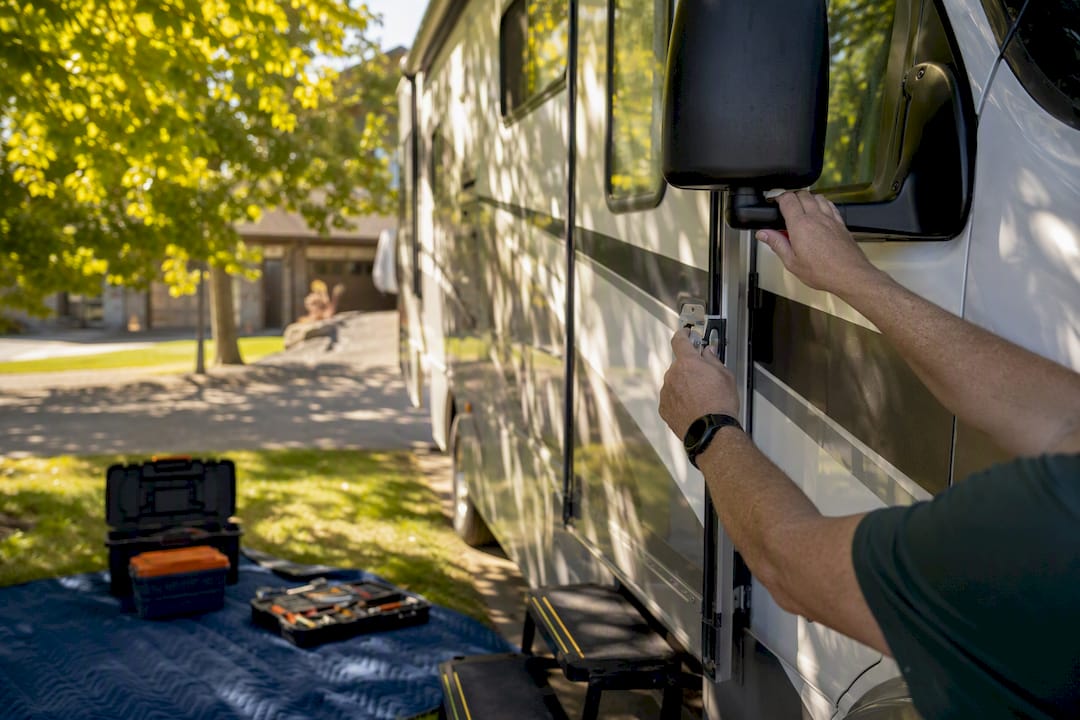
Who Covers What: Insurance, Permits, and the Fine Print
FMCSA registration confirms a carrier is legally allowed to operate, but it doesn’t tell you whether their insurance actually covers your RV’s full replacement value. Most standard cargo policies carry limits that were set with average vehicles in mind, not a $200,000 Class A diesel pusher. Ask specifically for a certificate showing the per-unit cargo limit, and if that number is lower than your RV’s value, ask what supplemental coverage options exist.
Oversize permits get billed per state your route crosses, typically running $30 to $150 each depending on the state and the width or height involved. A cross-country move touching six or seven states can rack up several hundred dollars in permits alone, on top of any pilot or escort car requirements for particularly wide loads.
A few practical realities worth planning around:
- Oversize routing often rules out nighttime driving entirely, and certain bridges or tunnels get avoided altogether, which adds time to the route.
- Rural pickup locations sometimes require staging at a nearby lot with truck access, rather than direct driveway pickup.
- Keep your registration, insurance card, and the carrier’s Bill of Lading together and easy to hand over at both pickup and delivery.
- If your RV needs to stage somewhere before pickup, a dealer directory can help you locate a lot nearby with the space to accommodate a carrier truck.
When Should You Book, and What Happens at Delivery?
For a domestic move within the continental US, book three to six weeks ahead during standard seasons and push that to six or eight weeks during peak snowbird months. International shipments need considerably more lead time given customs processing and vessel schedules.
Transit speed varies by method: drive-away runs 400 to 500 miles a day, while flatbed and oversize loads average 300 to 400 miles daily due to routing restrictions and daylight-only driving rules. A 1,500-mile drive-away trip typically wraps in three to four days; the same distance on a flatbed can stretch to five days once permit routing is factored in.
At delivery, protect yourself with a quick sequence:
- Walk the full exterior and interior before signing anything, comparing what you see against your pre-pickup photos.
- Check every item against the Bill of Lading the driver hands you, not just a visual glance.
- Photograph any new damage immediately, before the truck leaves the property.
- File a claim with the carrier the same day if you spot damage. Waiting even 24 hours can complicate the process.
How Gently Used RVs Helps You Coordinate a Shipment
Getting an accurate shipping quote starts with accurate listing data, and that’s where Gently Used RVs’ AI autofill tool earns its keep. Import a listing from any dealer site or marketplace URL and it pulls the year, make, model, and dimensions automatically, so the specs you hand a carrier match what’s actually parked in your driveway.
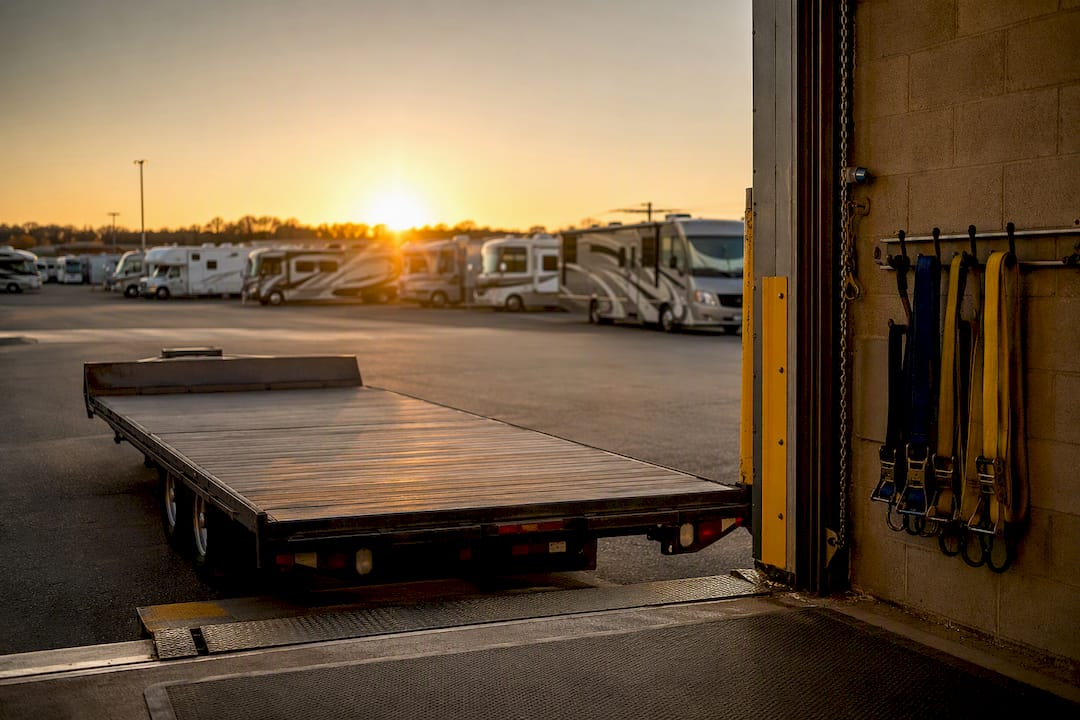
If you’re staging a pickup somewhere other than your home, the Dealer Directory helps you find a nearby lot with truck access, and the How It Works page walks through the full listing flow if you’re selling the RV as part of the move. Buyers and sellers coordinating a handoff can also use the marketplace to document condition before the carrier arrives, which keeps both sides protected if a dispute comes up later.
What Actually Matters When You Book RV Transport
Three things separate a smooth shipment from a headache: three written quotes, verified FMCSA and insurance credentials, and your own photo documentation before the carrier ever touches the RV. Skip any one of those and you’re negotiating from a weaker position if something goes wrong.
On the flatbed-versus-drive-away question, I’d pay the premium for flatbed more often than the conventional wisdom suggests. Most guides treat drive-away as the default and flatbed as the exception for “special cases.” But if you’re shipping a Class A worth six figures, or an RV you’re planning to sell within the year, those extra miles and engine hours aren’t free. They show up in your next appraisal.
— Christopher
Ready to Ship? Start With the Right Listing
Before you get a single shipping quote, you need dimensions and specs a carrier can actually trust, and that’s where most RV owners waste time hunting through owner’s manuals or guessing at GVWR. Gently Used RVs’ AI autofill tool pulls exact specs straight from any existing listing URL, so whether you’re preparing to sell or just need accurate numbers for a transport quote, you’re not starting from scratch.

If you’re coordinating a sale alongside the shipment, browsing the RV Types Guide helps confirm your unit’s category and typical dimensions match what carriers expect to see on a quote request. Sellers can list for free in minutes, and buyers can browse nearby inventory without creating an account. For packing and staging tips before the truck arrives, Boutique Moving Services has practical checklists that apply just as well to an RV as a house. If you’re ready to move forward, list your RV today and get the shipping conversation started with numbers you know are right.
Where to Verify Carrier Credentials and Shipping Rules
- Check any carrier’s registration status directly through the Federal Motor Carrier Safety Administration.
- Review permit cost ranges and prep tips in the RV Shipping Guide.
- For international moves, read Winnebago’s guide to shipping an RV abroad.
Sources
- Federal Motor Carrier Safety Administration
- RV Transport Services | Class A/B/C Shipping | DQ Trans LLC
- How to Ship an RV Abroad — Winnebago