
A salvage title RV can be a smart, conditional bargain. Cheap up front, expensive later if you skip the homework. Before you hand over a dollar, run a VIN/NMVTIS history check, book an independent pre-purchase inspection, and demand repair receipts with technician sign-offs. State title laws and insurance markets will decide whether the deal actually pencils out.
TL;DR:
- A salvage title indicates the RV was declared a total loss by an insurer, often due to severe damage like fire or flood, which greatly affects its value and insurability.
- Most states allow rebuilding a salvage RV to a rebuilt title after repairs are documented, passed a strict inspection, and the correct paperwork is filed, but the salvage history remains on record.
- Insurance for a rebuilt title RV is usually limited to liability coverage, with premiums potentially 20 to 40 percent higher, and most lenders avoid financing these vehicles altogether.
- Resale discounts for salvage or rebuilt RVs range from 20 to 50 percent or more depending on damage type, with flood and frame damage wrecking resale value due to ongoing risk concerns.
- Buyers should verify the full repair and inspection documentation, run VIN history checks first, and avoid the deal if flood damage lacks proof or if liens remain unpaid.
Table of Contents
- What Does a Salvage Title RV Really Mean?
- Can You Register a Salvage RV, and How Does Rebuilding Work?
- Insurance and Financing: What’s Actually Available?
- How Salvage Branding Changes Value and Resale
- How Do You Check and Inspect a Salvage-Title RV?
- Buy, Walk, or Negotiate: A Decision Checklist
- What Buyers Get Wrong About Salvage Listings
- Shop Salvage-Title RVs the Safer Way
- Where to Verify the Details Yourself
- Sources
What Does a Salvage Title RV Really Mean?
A salvage title gets stamped on an RV after an insurer declares it a total loss, usually because repair costs cross a percentage-of-value threshold set by the insurance company. Those thresholds and the state inspection requirements that follow vary widely from state to state, which is why the same damage can produce different title outcomes depending on where the RV was registered.
Once repairs are done and the unit passes inspection, most states will reissue it as a rebuilt or reconstructed title. A third category, non-repairable, means the RV is destined for parts only and can never legally return to the road.
The cause of the salvage brand matters more than the brand itself. Hail damage is mostly cosmetic and repairable with body work. Collision damage can range from a bent bumper to a compromised frame. Fire damage often means wiring and structural loss. Flood damage is the one that should make you slow down, since water intrusion tends to create long-term electrical and corrosion problems that surface months after the sale.
Can You Register a Salvage RV, and How Does Rebuilding Work?
Yes, most states let you retitle a salvaged RV as rebuilt once repairs are documented and the unit passes an inspection. The general path looks like this: complete the repairs, keep every receipt and photo, submit the paperwork to your state DMV, and pass whatever physical inspection that state requires before a rebuilt title gets issued.
Here’s the catch: the salvage history never disappears from the record, even after the rebuilt title is issued. It shows up on future VIN checks for as long as you own the RV and beyond.
Before you buy, ask the seller for:
- The original salvage title and the rebuilt title, side by side
- Itemized repair invoices, not just a total
- Before-and-after photos of the actual repair work
- Signed inspection or sign-off documentation from a certified technician
If any of those documents are missing, treat it as a negotiating chip, or a reason to walk. Some states demand far more rigor than others, so it’s worth checking the specific rebuild process for the state where the unit was actually rebuilt, not just where it’s currently registered.
Insurance and Financing: What’s Actually Available?
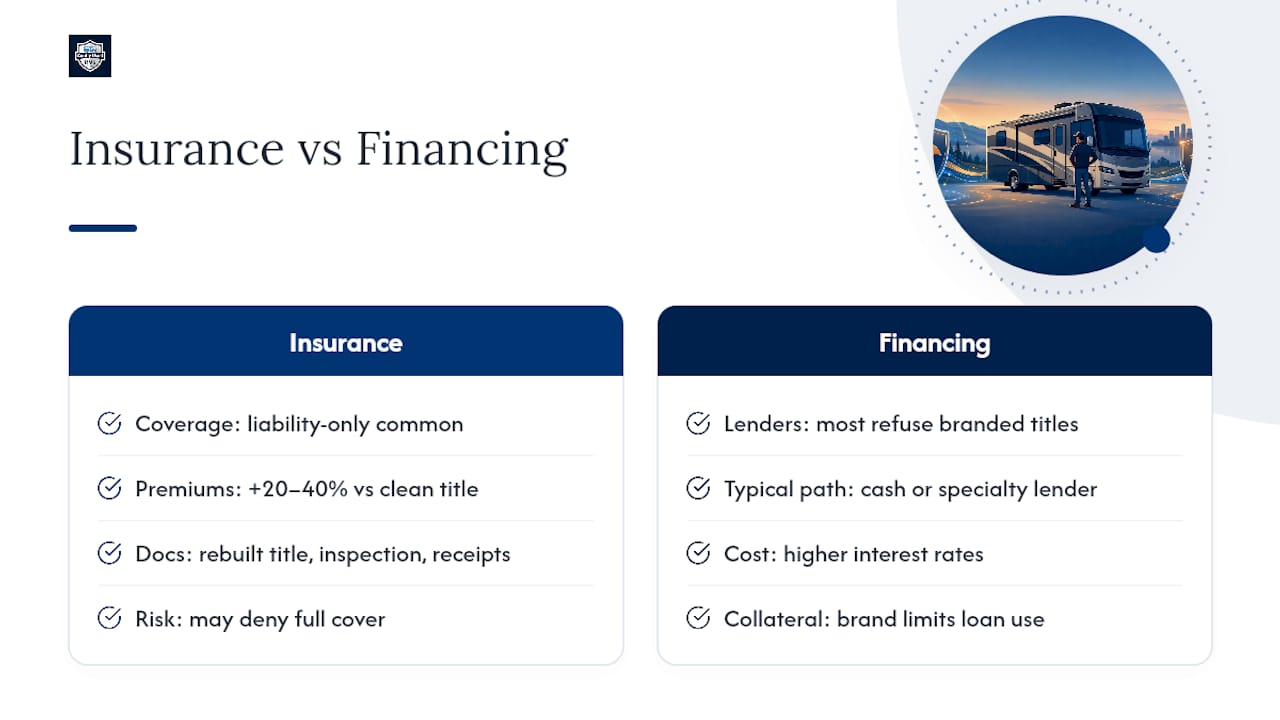
Here’s where a lot of buyers get surprised after the fact. Many insurers will only offer liability coverage on a rebuilt title RV, and when full coverage is available, premiums often run 20 to 40 percent higher than a clean-title comparable. Insurers commonly want to see the rebuilt title itself, an inspection report, and repair receipts before they’ll quote you at all.
Financing is the tougher hurdle; if you want to sell a salvage or rebuilt vehicle without fixing the damages first, RS Auto offers useful insights on handling such cases. Most traditional RV lenders won’t touch a salvage or rebuilt title because it can’t be used as reliable loan collateral. That pushes most buyers toward one of two paths: a cash purchase, or a specialty lender that works specifically with branded titles (and typically charges a higher rate for the risk).
Before you fall for a below-market price, call your insurer and price out a policy first. If you can’t get coverage that meets your state’s minimum, or the premium wipes out your savings, the “deal” isn’t really a deal.
How Salvage Branding Changes Value and Resale
Salvage and rebuilt titles typically sell at a steep discount to clean-title comparables. Sources commonly cite discounts in the 20 to 50 percent range or higher, though the exact number depends heavily on damage type, documentation quality, and how badly the local market wants that floor plan.
Damage type drives resale more than almost anything else. Hail and cosmetic collision damage recover value reasonably well once repaired. Flood and frame damage don’t, because buyers (rightly) treat them as ongoing risk rather than a fixed problem.
A simple way to set your offer: start with the clean-title market value, subtract a real repair estimate from a qualified shop, then subtract a resale buffer of a few thousand dollars to cover the fact that you’ll eventually be selling a branded title too. If the seller’s asking price doesn’t leave room for all three, keep negotiating or move on.
How Do You Check and Inspect a Salvage-Title RV?
Start with the paper trail before you ever look at the unit in person. A VIN check that pulls NMVTIS-backed records will surface title brands, prior accident history, active liens, and open recalls, using tools like CarCheckerVIN. Run it before you schedule a showing, not after you’ve already fallen for the RV.
One quirk worth knowing: VIN decoders often report the chassis manufacturer, such as Ford, rather than the coach builder, such as Winnebago. Confirm both separately so you’re not missing half the RV’s actual history.
Once the paperwork checks out, get a pre-purchase inspection (PPI) from an independent RV mechanic, ideally one familiar with standards referenced by the RVIA. A solid PPI checklist covers:
- Roof seams and slideout mechanisms for water entry points
- Frame and structural members for bends, rust, or prior welding
- LP gas lines and connections for leaks or corrosion
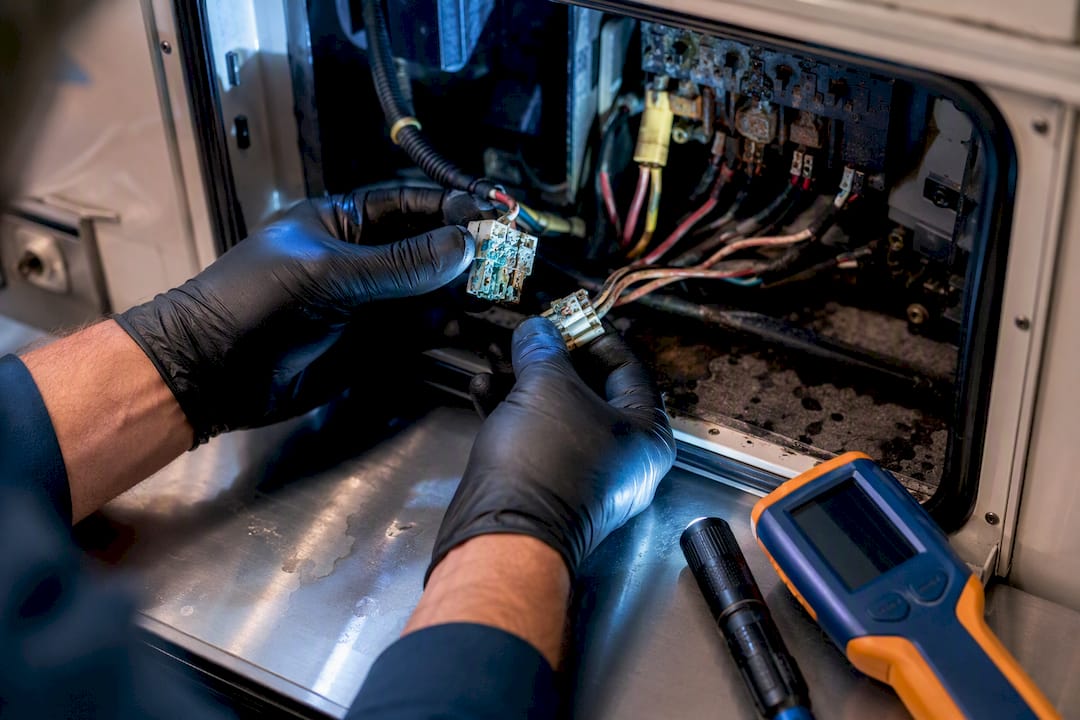
- Electrical systems, including any signs of prior water damage
- Subfloor and wall cavities for soft spots or hidden mold
Ask the seller directly for repair invoices, photos, and technician sign-offs. If they can’t produce any of it, that’s your answer.
Pro Tip: If the salvage cause was flood damage, treat it as a much higher bar to clear than hail or minor collision. Electrical gremlins from water intrusion have a habit of showing up long after the return window closes.
Buy, Walk, or Negotiate: A Decision Checklist
Run through this before you make an offer:
- Clean history check. The VIN/NMVTIS report shows a clear, explainable cause of loss, not a mystery or a flood brand with no documentation.
- Documented repairs. You have invoices, photos, and a signed inspection report tying the repair work to the actual damage.
- Passed PPI. An independent mechanic found no active structural, electrical, or water-intrusion issues.
- Insurability confirmed. You’ve already gotten a real quote and it fits your budget.
- Financing sorted. You know whether you’re paying cash or have a lender lined up who accepts branded titles.
Walk away immediately if you see a flood-damage history with no documentation, a VIN that doesn’t match the title paperwork, or a lien that hasn’t been released. None of those are negotiable.
If everything else checks out but the price is high, use the offer formula from the value section: market value minus repair costs minus a resale buffer. State your number, show your math, and let the seller counter from a position where you’ve already done the work they should have done for you.
What Buyers Get Wrong About Salvage Listings
The most common mistake we see across the marketplace isn’t a bad RV. It’s a buyer who never asked for the paperwork. Sellers frequently list a salvage or rebuilt RV without mentioning the brand outright, or they bury it in a single line of the description. Always ask directly: “Is this title salvage, rebuilt, or clean?” before you get emotionally invested.
Use the AI autofill tool on a listing to cross-check the seller’s stated specs against what the VIN actually decodes to. Geotargeted search also means you can shortlist several comparable units nearby and compare documentation quality side by side, rather than fixating on the first one you find.
— Christopher
Shop Salvage-Title RVs the Safer Way
Gently Used RVs is built for exactly this kind of careful, document-first shopping, not a race to the fastest checkout. Browse listings free, with no account required, and use the geotargeted search to compare multiple salvage or rebuilt-title units near you before you commit to a single showing.

Before you schedule a viewing, message the seller through the listing and ask for the VIN, the repair invoices, and confirmation of a clean lien release. If they hesitate or go quiet, that tells you plenty. If you’re still learning how the different RV categories affect chassis versus coach VIN decoding, the RV types guide breaks down what to expect from a Class A motorhome versus a travel trailer or fifth wheel before you run your history check.
Once your paperwork checks out and your independent PPI comes back clean, start browsing current listings and reach out to sellers directly. No commissions, no account wall, just a straight path to the unit and the documentation you need to buy with confidence.
Where to Verify the Details Yourself
Cross-check your findings using NMVTIS-backed VIN history reports for title brands and liens, your state DMV’s rebuilt-title page for exact inspection rules, and RVIA-referenced inspection standards for what a qualified PPI should cover.
Sources
- RV & Motorhome VIN Check — Free History | CarCheckerVIN
- MH Title Status Governance | iRV2 Forums an RV LIFE Community
- Rvshowoff
- What Is a Salvage Title RV? What It Means for You | HeyRV