RV Generator Buying Guide: Size, Safety & Top Picks 2026
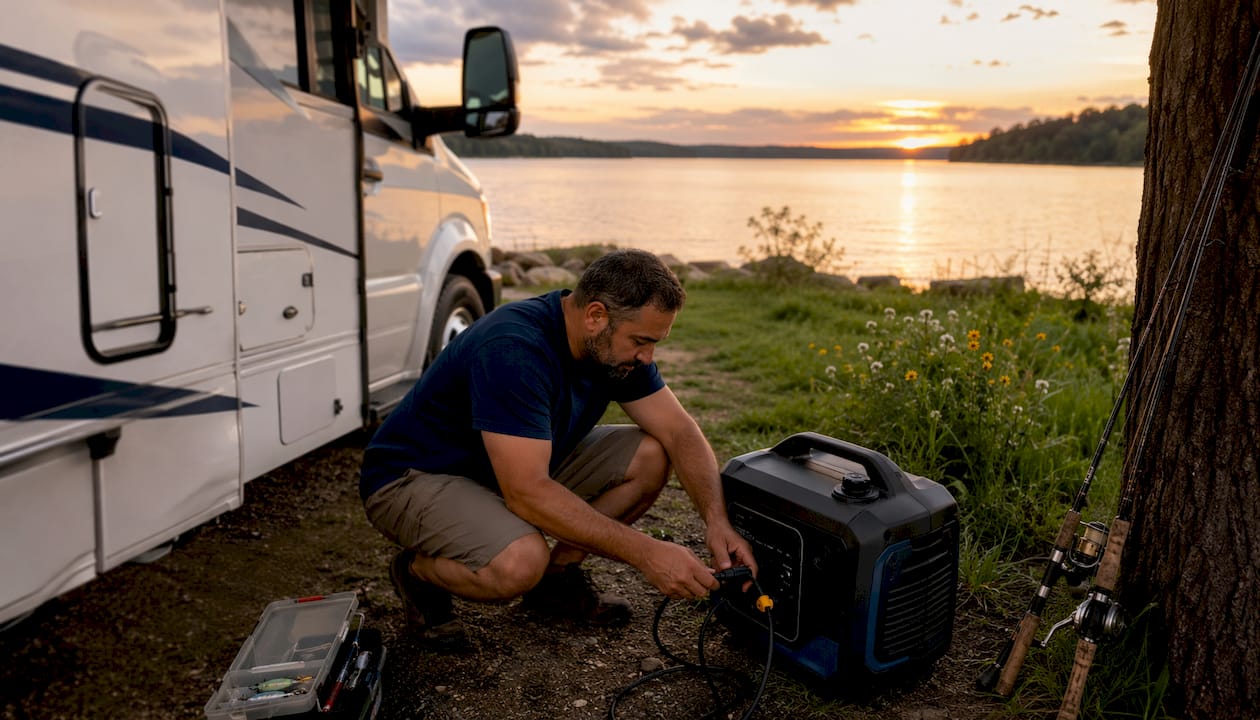
The right RV generator matches your largest power load first, then your travel style. For a pop-up camper or teardrop, a 2,000–2,400W inverter handles lights, fans, and battery charging without breaking a sweat. A 30-amp travel trailer with one air conditioner typically needs a generator rated enough to handle the air conditioner’s running and surge watts plus additional load. A 50-amp motorhome running dual ACs demands a generator sized to handle the combined power needs, which can vary widely depending on the specific appliances used. Get that number wrong and you’re either hauling a generator that’s too loud and thirsty, or you’re watching your AC stall on a 95-degree afternoon in the desert.
Here’s what actually matters when choosing:
- Power class: Match starting watts to your AC compressor’s surge draw, not just the running load.
- Generator type: Inverter generators produce clean, stable power safe for laptops, CPAPs, and modern electronics. Conventional open-frame units do not.
- Safety: Built-in carbon monoxide (CO) monitoring with automatic shutoff is non-negotiable in 2026. Models without it are a liability.
- Fuel type: Gasoline is the default, but dual-fuel and tri-fuel options add propane or natural gas flexibility for extended boondocking.
- Portability: Weight and wheel design matter more than most buyers expect until they’re hauling a 90-pound unit across gravel.
Do you actually need an RV generator?
Not every RV owner does. The honest answer depends on three things: where you camp, what you run, and what backup power you already have.
If you stay exclusively at campgrounds with shore power hookups, a generator may never leave its storage bay. But the moment you start boondocking on Bureau of Land Management land, dry camping at a fairground, or pulling into a site during a power outage, that changes fast. Air conditioners are the real deciding factor. Your battery bank and solar panels can handle lights, fans, phone charging, and even a CPAP machine. They cannot sustain a 13,500 BTU rooftop AC for more than a short burst.
Ask yourself these questions before buying:
- Do you camp off-grid or without hookups more than a few times per year?
- Do you rely on an air conditioner when temperatures climb above 80°F?
- Do you use medical devices like a CPAP that need consistent, clean power overnight?
- Does your current battery bank run out before morning on hot days?
- Would you camp more often if you had reliable power anywhere?
If you answered yes to two or more of those, a generator belongs in your setup. If you answered no across the board, solar and a quality lithium battery bank may serve you better without the noise, fuel cost, or maintenance.
Built-in vs. portable: which setup fits your rig?
The choice between an onboard built-in generator and a portable unit comes down to your RV type and how often you camp without hookups.
Built-in generators are factory-installed in most Class A and larger Class C motorhomes. They run on the RV’s existing fuel supply, start with a button from inside the coach, and integrate directly with the electrical system. For full-timers or frequent boondockers in large motorhomes, the convenience is real. The downsides are equally real: they’re expensive to repair, tied to one fuel type, and cannot transfer to a different rig if you upgrade.
Portable inverter generators are the practical choice for travel trailer owners, fifth wheel owners, and anyone who wants flexibility. You can take one generator across multiple rigs, store it when not needed, and replace it without a technician. Inverter generators produce clean sine-wave power, run significantly quieter than conventional open-frame units (typically 50–60 dB at full load), and adjust engine speed based on demand, which saves fuel.
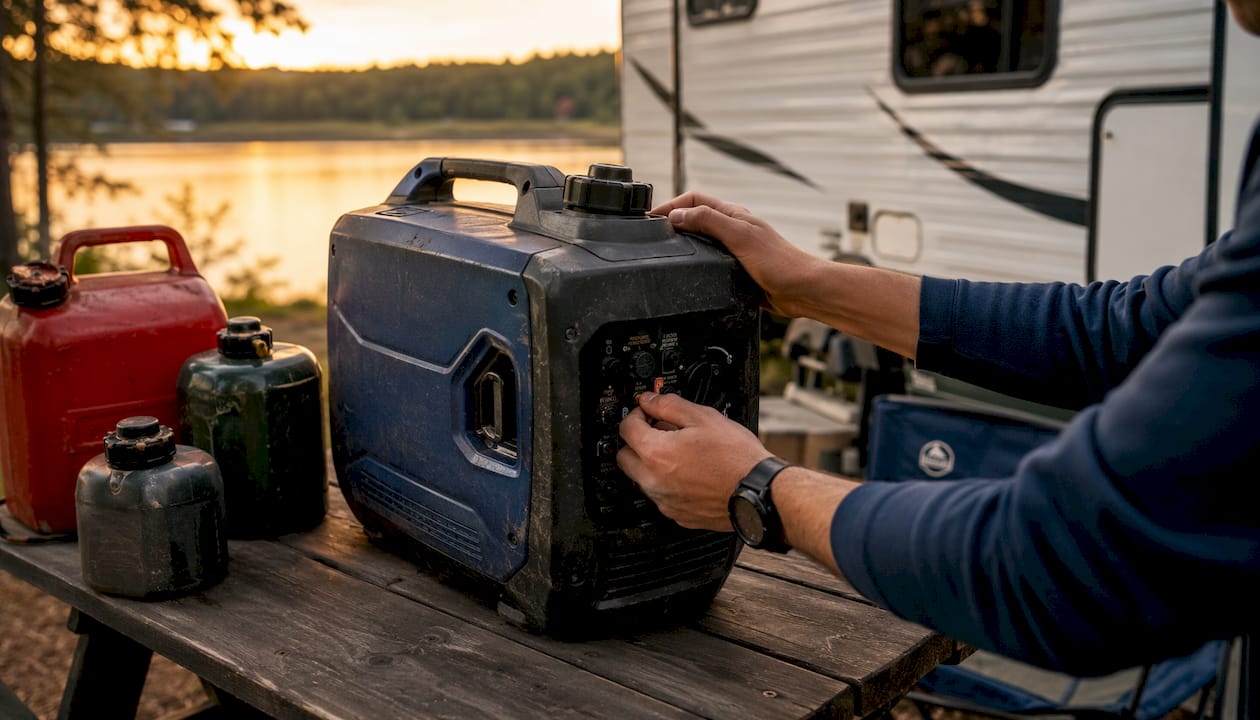
Conventional open-frame portables are louder (70–80 dB or more), less fuel-efficient at partial loads, and produce dirtier power that can damage sensitive electronics. For campsite use, they’re rarely the right call.
Pro Tip: If you own a travel trailer or fifth wheel and camp more than six weekends per year, a quality portable inverter generator in the 3,000–4,500W range will serve you better than any built-in alternative at a fraction of the cost.
How to size your RV generator correctly
Sizing comes down to three numbers: running watts, starting (surge) watts, and overlap. Get all three right and your generator runs efficiently. Miss one and you’re either tripping breakers or burning fuel on capacity you’ll never use.
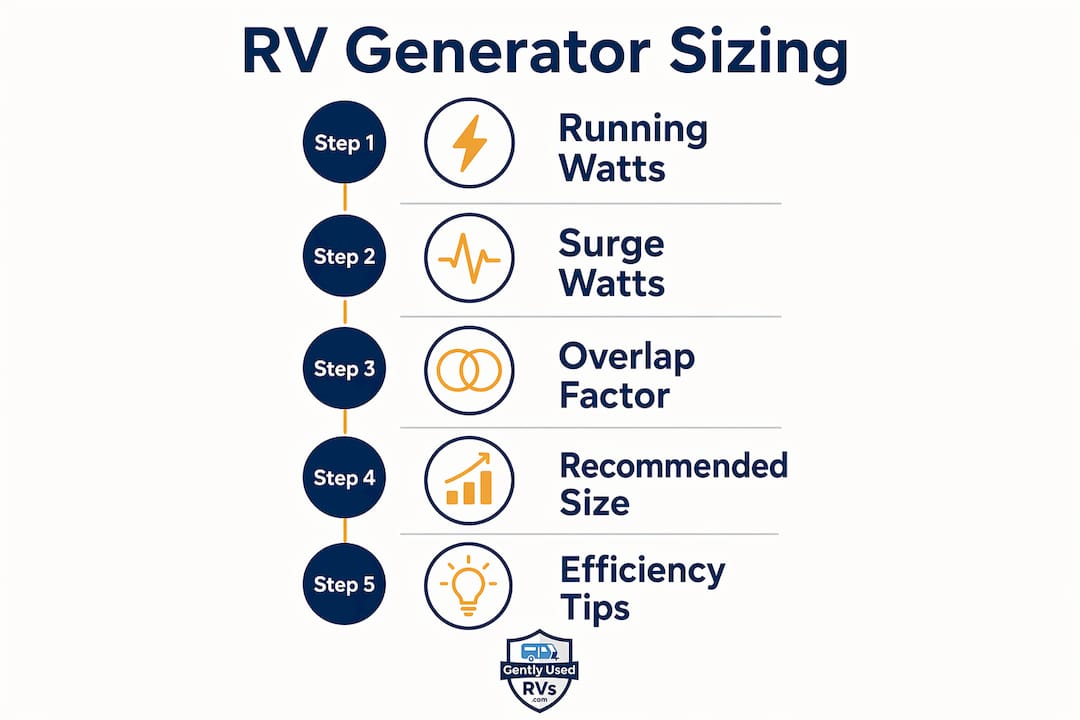
Running watts are what an appliance needs once it’s already operating. Starting watts are the brief surge a motor-driven appliance draws on startup. Air conditioners, refrigerators, and water pumps all pull 2–3 times their running wattage when the compressor kicks on. Your generator must handle that surge, not just the steady-state load.
Follow this sizing process:
- List every appliance you plan to run simultaneously.
- Find the starting watts for each motor-driven appliance (check the label or owner’s manual).
- Add the running watts of all other simultaneous loads.
- Add the highest single starting-watt figure to that running-watt total.
- Choose a generator whose peak (surge) rating meets or exceeds that combined number.
- Verify the generator runs at 50–75% of rated capacity under your typical load for best efficiency and longevity.
| RV Type | AC Units | Recommended Generator Size |
|---|---|---|
| Pop-up camper / teardrop | None | 2,000–2,400W inverter |
| 30-amp travel trailer | 1 AC (13,500 BTU) | 3,000–4,500W inverter |
| 30-amp travel trailer | 1 AC (15,000 BTU) | 4,000–4,500W inverter |
| 50-amp motorhome / fifth wheel | 2 ACs | 4,500–6,000W |
Running a generator at 25–30% of rated capacity causes excess engine wear and poor fuel economy. A 4,000W generator charging batteries and running a microwave is not safer than a 2,000W unit doing the same job. It’s just louder and less efficient.
Fuel type: gasoline, propane, or tri-fuel?
Fuel choice affects runtime, storage safety, availability on the road, and how long you can stay off-grid without resupply.
- Gasoline is the most common and widely available. Most portable generators run on it by default. The downside is shelf life: untreated gasoline degrades in as little as 30 days, which causes starting problems after storage.
- Propane (LPG) stores indefinitely, burns cleaner, and most RVers already carry propane tanks for their stove and water heater. Output drops slightly compared to gasoline on the same engine, so size from the propane rating if that’s your primary fuel.
- Natural gas is an option on some tri-fuel models for stationary or campground use where a gas line is available.
- Dual-fuel generators run on gasoline or propane, giving you a backup option when one fuel runs out mid-trip. The Champion 5000W tri-fuel generator, for example, delivers 5,000 running watts on gasoline, 4,500W on propane, and 4,050W on natural gas.
- Tri-fuel generators add natural gas to the mix, which makes them versatile for both travel and home backup use.
For extended boondocking, a dual-fuel or tri-fuel unit gives you real insurance. If you drain your gas can on day three of a remote trip, your RV’s propane supply keeps the lights on. One caution: never size a dual-fuel generator based on its gasoline rating if you plan to run it primarily on propane. The output difference is real and can leave you short when the AC compressor tries to start.
EPA regulations and safety features you can’t skip
The EPA requires all portable generators sold in the United States to meet emissions certification standards. Newer EPA-certified generators are cleaner, quieter, and built with more advanced safety technology than older designs. When you’re shopping, look for EPA certification on the spec sheet. It’s not optional for legal sale, but it also signals that the unit meets current emissions and operational standards.
Carbon monoxide poisoning is the most serious risk associated with generator use. CO is colorless, odorless, and lethal at elevated concentrations. The CDC recommends keeping generators at least 20 feet from doors, windows, and vents. Modern generators from leading manufacturers go further with integrated CO monitoring that automatically shuts the unit down when unsafe levels are detected. Honda’s CO-MINDER, Champion’s CO Shield, and WEN’s CO Watchdog all meet the ANSI/PGMA G300 safety standard for this technology.
Noise is a regulatory issue too. Many campgrounds enforce quiet hours and decibel limits. Generator noise ranges from about 50 dB to 70+ dB at 23 feet. The difference between 50 dB and 65 dB isn’t just 15 units on a scale. Because decibels are logarithmic, 65 dB is roughly 30 times louder in perceived intensity than 50 dB. That gap determines whether your neighbors complain or sleep through it.
Pro Tip: Always choose a generator that meets ANSI/PGMA G300-2018 or newer. That standard covers CO auto-shutoff, and it’s the clearest single indicator that a unit’s safety technology is current.
Key features to look for when buying
Beyond wattage and fuel, these features separate a generator you’ll love from one you’ll resent at 7 AM in a campground:
- Noise rating: Look for 58 dB or below at 23 feet for campsite-friendly operation. The Champion 4500W inverter runs at 61 dB at 23 feet, which is roughly conversation level.
- RV-ready outlet: A built-in TT-30R (30-amp) outlet lets you plug directly into your RV without an adapter. Confirm this before buying.
- Pure sine wave output: Inverter generators produce less than 3% total harmonic distortion (THD), making them safe for CPAPs, laptops, and modern appliances.
- Parallel capability: Two smaller inverter generators connected in parallel can double your output without the weight and noise of a single large unit. The tradeoff is managing maintenance on two machines instead of one.
- Economy mode: Reduces engine speed at low loads, cutting fuel consumption and noise.
- Electric or remote start: Push-button and remote start options are worth the premium for frequent users. The Cummins Onan P4500i offers push-button, remote, and pull-cord backup.
- Wheels and handles: At 90+ pounds, a telescoping handle and large wheels aren’t luxury features.
- Warranty: Three-year limited warranties are standard on quality units from Honda, Champion, WEN, and Cummins.
Matching your generator to your actual travel style
The best generator for a full-time boondocker looks nothing like the best generator for a weekend campground traveler. Buying the wrong one for your style costs you money, fuel, and patience.
Full-time boondockers and serious off-gridders need durability, multi-fuel capability, and enough wattage to run AC reliably. A tri-fuel unit in the 4,500–6,000W range with electric start and a large fuel tank fits this profile. Prioritize runtime per tank, build quality, and service center availability.
Weekend travelers and occasional campers are better served by a lighter, quieter inverter generator in the 2,000–3,500W range. Portability and noise matter more than maximum output. If you camp mostly at sites with hookups and only need backup power occasionally, a 2,000W inverter handles battery recovery, CPAP use, and small appliances without the bulk.
A few insider tips worth knowing:
- An AC soft-start kit reduces the starting surge of a 15,000 BTU air conditioner, letting you run it on a 3,000W inverter instead of a larger, heavier model.
- Managing appliance overlap prevents tripped breakers even on a 30-amp setup. Run the microwave, then the AC. Not both at once.
- Solar panels paired with a lithium battery bank reduce generator run time dramatically. Two to three hours of generator use can recover a depleted bank; you don’t need to run it all day.
Understanding your RV type is the foundation of any generator decision. A Class A motorhome with dual ACs has completely different power demands than a lightweight travel trailer.
Maintenance and care tips for RV generators
A generator that sits unused for months and then gets called on in a pinch will let you down. Consistent maintenance prevents that.
Run your generator under load for at least 30 minutes every month during the off-season. This keeps the carburetor clear, circulates oil, and charges the battery on electric-start models. Change the oil after the first 20 hours on a new unit, then follow the manufacturer’s interval (typically every 100 hours or once per season). Use a fuel stabilizer like Sta-Bil in any gasoline left in the tank during storage. Stale fuel is the single most common cause of hard-starting problems.
Check and clean the air filter every 50 hours of use, or more often in dusty conditions. Inspect the spark plug annually and replace it if the electrode shows wear or carbon buildup. Keep the exterior clean and free of debris, especially around the cooling vents. A clogged vent causes the engine to overheat and triggers the thermal shutoff.
How to connect your generator safely to the RV electrical system
The connection method depends on your RV’s electrical service and the generator’s outlets.
For a 30-amp RV, use a 30-amp generator cord (TT-30P to TT-30R) plugged directly into the generator’s TT-30R outlet and the RV’s shore power inlet. Never use a household extension cord. For a 50-amp RV running from a portable generator, you’ll need a 30-to-50-amp adapter and careful load management, since a portable generator typically cannot supply full 50-amp capacity.
Always follow this sequence: start the generator and let it stabilize for 30 seconds before plugging in the RV. This prevents voltage spikes from hitting your electronics at startup. Position the generator at least 20 feet from your RV’s windows, doors, and vents, with the exhaust pointed away from occupied areas. Never run a generator inside a garage, under an awning, or in any enclosed space, even partially.
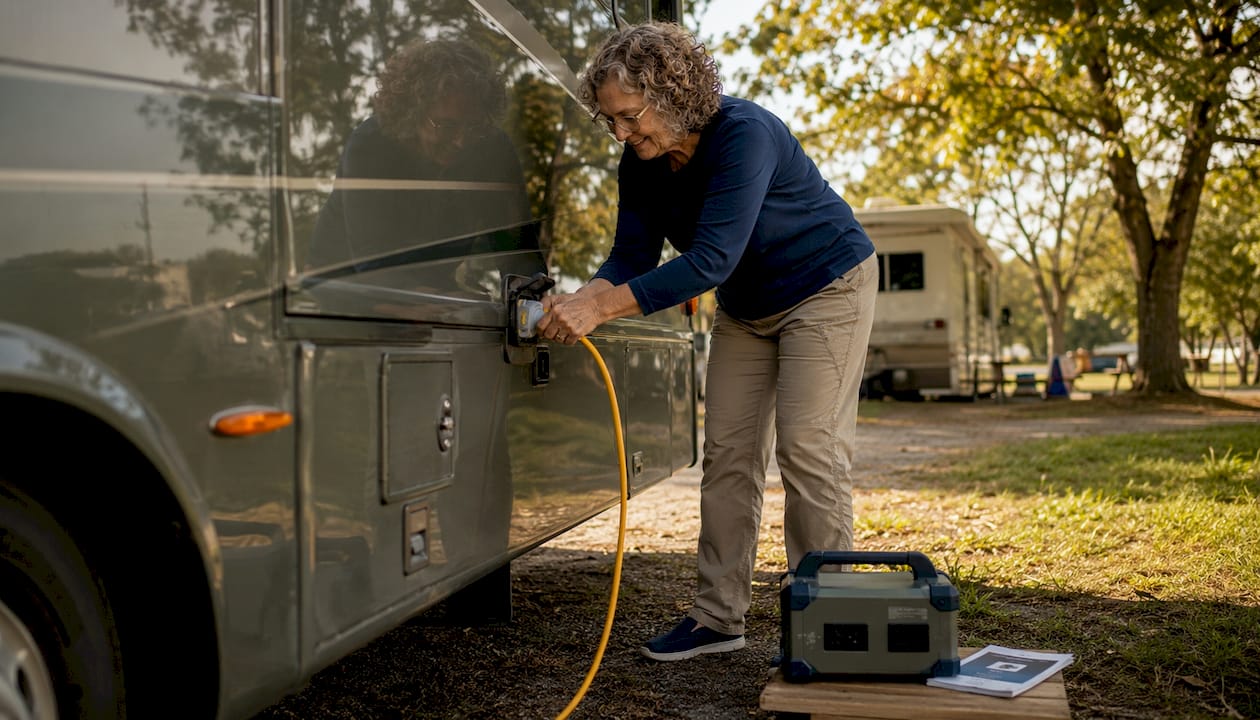
A surge protector between the generator and your RV’s inlet is a smart addition. It guards against voltage fluctuations and protects your appliances if the generator’s output drifts under heavy load.
Common troubleshooting issues and how to fix them
Generator won’t start: Check fuel level, fuel shutoff valve position, and choke setting. On electric-start models, a dead battery is the most common culprit. Charge or replace it. If the unit has sat with old fuel, drain the carburetor and refill with fresh gasoline.
AC won’t start on the generator: The generator is likely undersized for the compressor’s starting surge. Install an AC soft-start kit or upgrade to a higher-wattage generator. Also check that no other high-draw appliances are running simultaneously.
Generator runs but produces no power: Check the circuit breaker on the generator’s control panel. Most units have a reset button. If the breaker trips repeatedly, you’re overloading the unit.
Overheating and shutoff: Clear debris from cooling vents, check oil level, and reduce the load. Running at above 75% capacity in high ambient temperatures causes thermal shutoff on most modern units.
Excessive fuel consumption: A generator running at 25–30% of rated capacity burns fuel inefficiently. Downsize to a unit better matched to your actual load, or add loads to bring it into the 50–75% efficiency range.
Generator brand comparison: Honda, Champion, WEN, and Cummins
Each of the major brands in the RV generator market has a distinct profile. Here’s an honest look at where each one wins and where it falls short.
Honda sets the benchmark for quiet operation and long-term reliability. The Honda EU3000is runs at 49–58 dB and delivers 2,800 running watts with up to 20 hours of runtime on 3.4 gallons of fuel. Honda’s CO-MINDER auto-shutoff is standard on current models. The price premium is real: Honda inverter generators cost significantly more per watt than competing brands. For buyers who want the quietest possible campsite experience and plan to use the generator for years, that premium is defensible.
Champion offers the most compelling value in the inverter category. The Champion 4500W RV-Ready inverter runs at 61 dB at 23 feet, delivers 3,500 running watts, includes a built-in TT-30R outlet, and carries CO Shield auto-shutoff. At roughly 25% of the cost of a comparable Honda, it’s the go-to recommendation for budget-conscious buyers who still want clean power and RV-ready connectivity. The pull-start-only design and single-fuel (gasoline) limitation are the main drawbacks.
WEN competes directly with Champion on value. The WEN DF680iX dual-fuel inverter delivers 6,800 surge watts and 5,100 running watts on gasoline, or 6,000/4,500W on propane, with CO Watchdog auto-shutoff and a TT-30R outlet. At $798, it targets 50-amp RV owners and buyers who want dual-fuel flexibility without paying premium-brand prices. It’s heavier and louder than smaller inverter units, but for the output it provides, the value is strong.
Cummins (Onan) bridges the gap between portable and built-in. The Onan P4500i delivers 4,500 peak watts and 3,700 running watts from a 224cc engine, runs 18 hours at 25% load, and includes push-button, remote, and pull-cord start options. The telescoping handle and wheels make it genuinely manageable at 98 pounds. It’s the preferred choice for RVers who want near-built-in convenience from a portable unit.
Tips for maximizing fuel efficiency and runtime on the road
Fuel efficiency isn’t just about saving money. On a remote boondocking trip, it’s the difference between three days of power and five.
Run your generator in economy mode whenever possible. This reduces engine speed at low loads, cutting fuel consumption without sacrificing output for light tasks like battery charging or running a fan. Avoid starting the generator cold and immediately loading it with the AC. Let it warm up for 60 seconds first.
Pair generator use with solar panels and a battery bank. Use solar for the daily baseline load, batteries for quiet hours, and the generator only for recovery or AC use during peak heat. This approach can cut generator runtime from all-day to two to three focused hours. Keep your generator’s air filter clean. A clogged filter forces the engine to work harder, burning more fuel for the same output.
Finally, match the generator to the load. A well-matched generator running at 50–75% capacity uses fuel efficiently and lasts longer than an oversized unit loafing along at 25% load. If you’re shopping for your next RV and want to understand how generator needs vary by rig type, Gently Used RVs has a full breakdown of RV types and classes to help you plan before you buy.
Ready to find the right RV for your generator setup?

Choosing the right generator starts with knowing your RV. Whether you’re looking at a lightweight travel trailer that needs a compact 2,000W inverter or a Class A motorhome that demands a built-in 10,000W unit, the rig comes first. Gently Used RVs makes it easy to browse used RVs for sale across the country, with listings for every class and type. No account required to search. No commissions when you buy or sell. Just the right RV, matched to the power setup that fits your life on the road.
Key Takeaways
The right RV generator matches your AC compressor’s starting surge first, runs at 50–75% of rated capacity for efficiency, and includes CO auto-shutoff as a baseline safety requirement.
| Point | Details |
|---|---|
| Size for surge, not just running watts | Your generator must handle the AC compressor’s startup surge, which can be 2–3 times the running draw. |
| Match wattage to RV class | Pop-ups need 2,000–2,400W; 30-amp trailers need 3,000–4,500W; 50-amp motorhomes need 4,500–6,000W. |
| Choose inverter for campsite use | Inverter generators run at 50–60 dB and produce clean power safe for sensitive electronics. |
| CO auto-shutoff is a baseline requirement | Honda’s CO-MINDER, Champion’s CO Shield, and WEN’s CO Watchdog all meet ANSI/PGMA G300 standards. |
| Run at 50–75% load for best results | Operating below 30% capacity causes excess engine wear and poor fuel efficiency. |