The most common RV listing errors cost you real buyers, not just clicks. Poor photos, vague titles, missing specs, wrong pricing, and slow responses are the top culprits — and every one of them has a fast fix. Here’s the short version before we dig in:
- Too few or blurry photos → Reshoot with the 12-shot checklist below
- Vague title missing year/make/model → Rewrite using the title template in Section 4
- Missing VIN or specs → Pull from your registration and add them before publishing
- Price not based on comps → Run the rig through Good Sam RV Valuator and NADA Guides first
- Free listing stuck in a 20-mile bubble → Upgrade tier or use a $0.99 Bump to Top
- No title, maintenance records, or mod disclosures → Attach scans and note every mod in the description
- Slow or no response to inquiries → Set an auto-reply within 2 hours
- Listing highlights nothing unique → Lead with the one feature buyers can’t find elsewhere
- RV not cleaned before photos → Stage it like a home sale; buyers notice everything
- Trust-killing language (“as-is,” “don’t lowball”)** → Replace with factual, transparent copy
The sections below cover each error in depth, with before/after examples and a 30–90 minute fix plan you can run on a live listing today.
Key Takeaways
The single highest-ROI fix for any underperforming RV listing is adding complete photos and a transparent price — those two changes alone address the majority of common RV listing errors that stall sales.
| Point | Details |
|---|---|
| Photos drive first impressions | Use a minimum of 16–20 shots; professional-quality images can increase sale price by roughly 15–20%. |
| Price with comps, not emotion | Run NADA Guides and Good Sam RV Valuator; 83.3% of fast-turning dealers show pricing upfront. |
| Complete every spec field | Year, make, model, VIN, length, and sleeping capacity are search filters — missing one hides your listing. |
| Disclose mods and fees early | Upfront disclosure of modifications, repairs, and dealer fees shortens sales cycles and reduces fall-throughs. |
| Gently Used RVs | Free listings with paid reach upgrades and AI autofill reduce errors and get your listing in front of the right buyers faster. |
Table of Contents
- Your pre-listing checklist before you hit publish
- 1. Poor photos are the fastest way to lose a buyer
- 2. Vague titles and thin descriptions kill your click-through rate
- 3. Pricing mistakes that stall your sale for months
- 4. Visibility problems that keep buyers from finding your listing
- 5. Missing paperwork, poor disclosure, and slow responses that kill deals
- 6. Before/after listing examples that show the difference
- 7. How to update a live listing in 30–90 minutes
- What we’ve learned from private sellers and dealers on the platform
- Gently Used RVs makes it easier to get your listing right the first time
- Sources
Your pre-listing checklist before you hit publish
Run through this before your listing goes live. Skipping even one item is how listings stall for weeks.
- Clean and stage the RV inside and out
- Gather the title, registration, and any warranty transfer documents
- Locate maintenance records and receipts for repairs or upgrades
- Record the full VIN from the dashboard plate and confirm year, make, model, and length
- Photograph the exterior (all four sides plus 3/4 angles), interior living areas, kitchen, bathroom, sleeping areas, appliances, chassis, and VIN plate
- Run the asking price through NADA Guides and Good Sam RV Valuator; pull 3–5 comparable active listings
- Write a title using the year/make/model/key feature formula
- Complete every spec field: sleeping capacity, dry weight, slide count, engine/chassis for motorhomes
- Disclose all modifications, damage history, and known issues in the description
- Set your listing category to match the exact RV type (Class A, travel trailer, fifth wheel, etc.)
- Choose your listing tier based on how far your likely buyer pool lives from you
- Set up a dedicated contact method and draft a quick auto-reply
Pro Tip: Pull your NADA value and two or three active comps before you write a single word of your description. Sellers who price first and write second tend to anchor their copy to reality rather than wishful thinking — and that shows in how they phrase condition and features.
1. Poor photos are the fastest way to lose a buyer
Buyers make a go/no-go decision on photos before they read a word of your description. Professional-quality photos and detailed descriptions can increase sale price by a noticeable margin and build the kind of trust that gets a buyer to drive three states over.
The most damaging photo mistakes:
- Fewer than 8 images total
- Dark or blurry interior shots taken with flash pointed at mirrors
- Missing the exterior 3/4 front and rear angles
- No shot of the VIN plate, chassis, or hitch
- Cluttered interior with personal items still inside
- Skipping appliances, slide mechanisms, and roof condition
Your minimum shot list: exterior front, exterior rear, driver’s side, passenger’s side, both 3/4 angles, main living area, kitchen, bathroom, each sleeping area, appliances (fridge, stove, A/C controls), any slides open, chassis/undercarriage, hitch, and VIN plate. That’s roughly 16–20 shots, and every one earns its place.
For staging: remove all personal items, open blinds for natural light, park on a level surface with a clean background. Shoot in the morning or late afternoon to avoid harsh shadows.
Pro Tip: On an iPhone or Android, switch to HDR mode and shoot from a low angle at the exterior corners. It makes the rig look larger and more imposing — the same trick real estate photographers use on small rooms.
2. Vague titles and thin descriptions kill your click-through rate
Your title is your first handshake with a buyer. “2022 Travel Trailer — Great Condition” tells a buyer almost nothing. A buyer searching for a specific floorplan or sleeping capacity will scroll right past it.
The formula that works: [Year] [Make] [Model] [Key Feature or Floorplan] [Length if space allows]
Example: 2021 Grand Design Reflection 337RLS Fifth Wheel 38ft
That title hits year, make, model, floorplan code, type, and length in under 60 characters. A buyer who wants that exact floorplan will find it.
The listing that answers every buyer question before they have to ask it is the listing that converts. Buyers pre-inspect online and arrive at contact already 80% decided. If your listing leaves gaps, they fill those gaps with doubt — and move on.
Mandatory spec fields to complete: VIN, year, make, model, length, sleeping capacity, dry weight, slide count, fresh/gray/black water tank sizes, engine and chassis (for motorhomes), and tow rating (for trailers). Each field is a search filter somewhere. Missing one means buyers using that filter never see your listing.
3. Pricing mistakes that stall your sale for months
Overpricing is the single most common reason a listing sits. Sellers anchor to what they paid, what they put into upgrades, or what they “saw online” — without checking what similar rigs actually sold for recently.
Common pricing errors:
- Pricing above current market comps without justification
- Ignoring condition adjustments (high mileage, roof repairs, age of appliances)
- Forgetting to factor in prep fees, freight, or dealer doc fees for dealerships
- Listing a heavily modified rig at stock price without targeting the right buyer
Valuation services give private-party sellers a reality check on a modified RV’s actual cash value and can prevent overpricing that stalls a sale. Run your rig through both NADA Guides and Good Sam RV Valuator, then check 3–5 active listings for comparable year/make/model/condition.
For dealers: disclosing prep fees and freight charges up front shortens sales conversations and reduces late-stage deal fall-throughs. Hiding those costs until the buyer is in the finance office is a trust killer. Among fast-turning dealers, 83.3% of listings include pricing — and listings that show pricing and financing options generate roughly 47.9% more high-quality leads.

For a deeper pricing walkthrough, the used RV pricing guide on Gently Used RVs covers market signals and condition adjustments step by step.
4. Visibility problems that keep buyers from finding your listing
A perfect listing no one sees is still a failed listing. The most common visibility errors:
- Wrong RV category (listing a fifth wheel under “travel trailer”)
- Free tier with a 20-mile radius in a rural area where the buyer pool is thin
- Photo count capped by tier (free listings may limit uploads)
- Listing buried after 2–3 weeks with no refresh
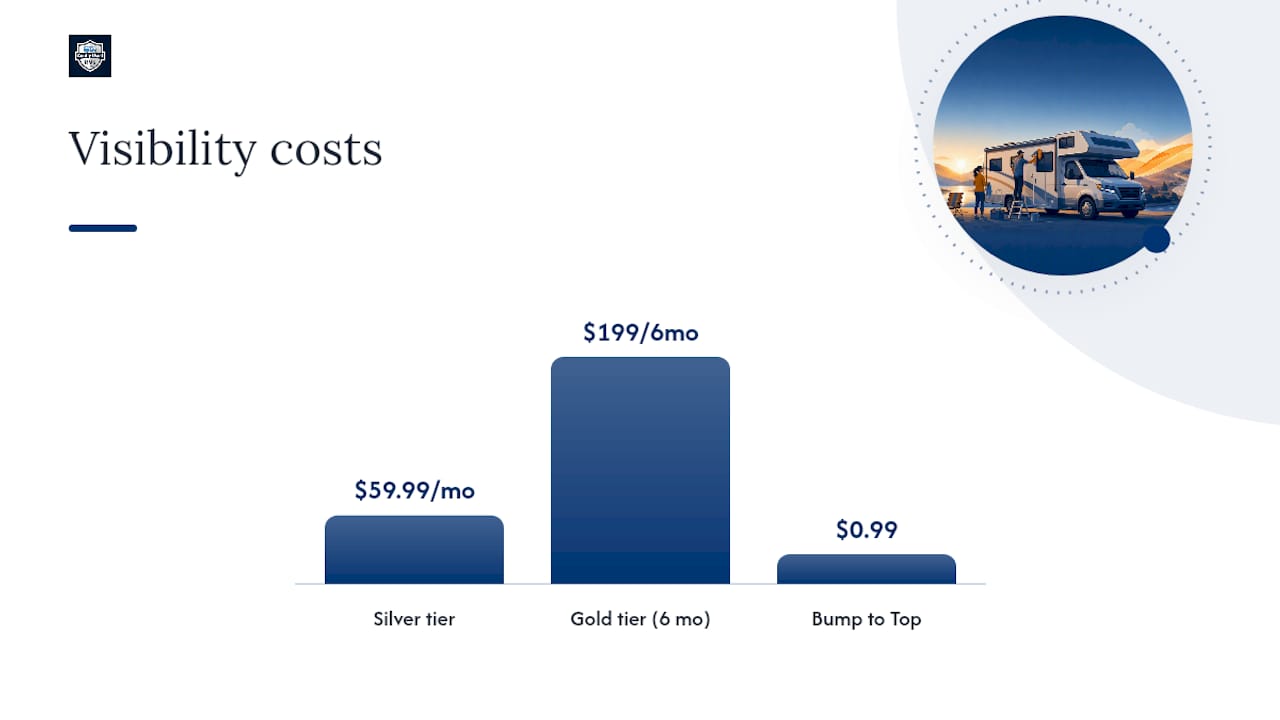
Gently Used RVs uses geotargeted search, so buyers see the closest listings first based on their location and your tier. If your rig is a specialty unit (toy hauler, park model, Class B van conversion), your buyer likely isn’t within 20 miles. A Silver tier ($59.99/mo) gives you statewide reach; Gold ($199 for 6 months) goes nationwide with live buyer chat and appointment scheduling. For a single listing on a high-value rig, the math usually favors at least a Bronze upgrade.
Pro Tip: If you’re on a free listing and it’s been live for two weeks with no inquiries, a $0.99 Bump to Top moves it back to the front of results instantly. It’s the lowest-cost visibility fix available.
Geographic pricing differences also affect what buyers expect to pay — a Class A diesel pusher in the Southwest often draws buyers from across the country. Match your tier to your likely buyer radius, not just your zip code.
5. Missing paperwork, poor disclosure, and slow responses that kill deals
Buyers doing their homework online expect to see documentation before they ever call. Missing paperwork signals risk, and risk sends buyers to the next listing.
Documents buyers commonly request:
- Clean title (or lien release letter if financed)
- Maintenance records and service receipts
- Warranty transfer documentation
- Photos of the VIN plate
- Receipts for recent repairs or upgrades
Disclose every modification, every known repair, and every cosmetic issue in the description. State it plainly: “2019 roof reseal, receipts available” or “custom solar package installed 2023, inverter specs in photos.” Sellers who stay safe during RV transactions also verify buyer identity before sharing sensitive documents and use secure payment methods for high-value transfers.
For response etiquette: reply within 2 hours during business hours. A simple template works: “Thanks for your interest in the [Year Make Model]. It’s still available. Happy to answer questions or schedule a showing — what works for you?” Slow responses are one of the most preventable deal-killers in private sales.
6. Before/after listing examples that show the difference
Example 1 — Private seller travel trailer
Before: “2019 Travel Trailer for sale. Good condition, sleeps 6. $28,000 OBO. Call for details.”
After: “2019 Keystone Passport 2400BH Travel Trailer, 28ft, Bunkhouse, Sleeps 6, $26,500 — Title in hand, maintenance records, new tires 2024. 18 photos. Priced per NADA.”
The after version adds make, model, floorplan type, length, key features, price, and trust signals. It answers the buyer’s first five questions without a phone call.
Example 2 — Modified fifth wheel
Before: “2020 Fifth Wheel, lots of upgrades, asking $55,000.”
After: “2020 Keystone Montana 3855BR Fifth Wheel, 42ft, 4-slide — Solar 400W, lithium battery bank, custom awning. $52,500. Upgrade receipts and full service history available.”
Naming the modifications and offering receipts turns a vague “upgrades” claim into a verifiable selling point.
Example 3 — Dealer VDP update
Before: “2023 Class A Motorhome. Contact dealer for price.”
After: “2023 Thor Palazzo 33.5 Class A Diesel, 33ft, 2-slide, 22K miles — $189,900. Prep and doc fees disclosed. Financing available. 14 photos.”
Showing the price and disclosing fees upfront removes the two biggest friction points for online buyers.
7. How to update a live listing in 30–90 minutes
If your listing is already live and underperforming, here’s the fix sequence:
- (5 min) Correct the title and specs. Fix year, make, model, length, and VIN. Check that the RV type category matches exactly.
- (20–30 min) Add or replace photos. Use the 16–20 shot minimum list. Delete any blurry or cluttered images.
- (10 min) Add paperwork and disclosures. Upload title photo, VIN plate shot, and note all mods and repairs in the description.
- (10 min) Update the price. Run a quick NADA check and scan 3 active comps. Adjust if you’re more than 10% above market.
- (5 min) Enable visibility upgrades. Use Bump to Top ($0.99) for a free listing, or upgrade your tier if the buyer pool is thin locally.
Pro Tip: After updating, check your listing’s view count and inquiry count at the 48-hour mark. If views are up but inquiries aren’t, the photos are working but the price or description needs another pass.
What we’ve learned from private sellers and dealers on the platform
The pattern that stands out most from watching listings perform on Gently Used RVs: sellers consistently underestimate how much a buyer has already decided before making contact. By the time someone sends an inquiry, they’ve usually compared your listing to four or five others. The listings that win that comparison aren’t always the cheapest — they’re the most complete.
Heavily modified rigs are a specific case worth calling out. A seller who spent $15,000 on solar, lithium batteries, and a custom suspension lift often prices that investment into the asking price — but the average buyer isn’t searching for those features. The listings that move modified units fastest are the ones that lead with the modification as the headline feature and target the buyer who specifically wants it, rather than pricing it as a premium over a stock comparable.
Price transparency is the other consistent pattern. Sellers who show their price, disclose their fees, and name their comps in the description spend less time on the phone justifying the number and more time scheduling showings.
Gently Used RVs makes it easier to get your listing right the first time
Fixing a listing from scratch takes time — but Gently Used RVs cuts that time significantly. The platform’s AI-powered autofill tool pulls year, make, model, specs, price, and photos directly from any dealer website or marketplace URL, so you’re not retyping specs from a window sticker or hunting for photos you already uploaded somewhere else. For dealers managing large inventories, the enterprise sync plans ($2,500–$7,500/location/month) keep listings current automatically.

Private sellers can list for free with no commissions and no hidden fees, then upgrade reach as needed: Bronze ($29.99/mo) for a 50-mile radius and up to 50 photos, Silver ($59.99/mo) for statewide visibility, or Gold ($199 for 6 months) for nationwide reach with live buyer chat and appointment scheduling. Every RV type is covered — Class A, B, and C motorhomes, travel trailers, fifth wheels, toy haulers, pop-up campers, park models, and teardrop trailers. Dealers can explore inventory tools and subscription plans built for high-volume listings. Post your listing at Gentlyusedrvs and get in front of buyers searching near you today.
Sources
- Best Site to Sell RV: Top 8 Platforms Compared for 2026 — RV Ivy
- RV Dealers Must Stick to the Basics To Succeed in 2026 — RV Pro