
If you’re shopping for your first RV, knowing what is a class c motorhome before you commit to anything could save you thousands of dollars and a lot of regret. The Class C, also called a cab-over motorhome in the industry, gets overshadowed by the flashier Class A coaches and the compact appeal of Class B vans. That’s a mistake. Class C motorhomes sit squarely in the middle, offering families and first-time buyers a balance of drivability, interior space, and price that neither extreme can match.
Table of Contents
- Key takeaways
- What is a class C motorhome, really?
- Why so many buyers choose a Class C
- Class C vs. Class A and Class B RVs
- Common misconceptions about Class C RVs
- How to choose the right Class C motorhome
- My honest take on Class C motorhomes
- Find your Class C on Gentlyusedrvs
- FAQ
Key takeaways
| Point | Details |
|---|---|
| Distinctive cab-over design | Class C motorhomes feature a sleeping or storage alcove above the cab, a signature that sets them apart from all other RV classes. |
| The “Goldilocks” RV | They offer more space than Class B vans and easier driving than Class A coaches, making them ideal for first-time buyers. |
| Size range matters | Lengths run from 21 to 41 feet, giving buyers flexibility without the intimidating footprint of a full coach. |
| National park friendly | Shorter Class C models fit the roughly 27-foot length limits common at many national park campgrounds. |
| Standard license required | Most states only require a standard driver’s license to operate a Class C, lowering the barrier to ownership. |
What is a class C motorhome, really?
A Class C motorhome is built on a cutaway truck or van chassis, most commonly the Ford E-450 or a similar platform. The defining visual feature is the over-cab section. That raised area above the driver’s cab extends forward over the cab and typically houses a sleeping bunk, though many owners convert it to a storage loft instead. This gives the vehicle its distinctive profile: a truck cab up front with a full living coach behind it.
Class C motorhomes typically span 21 to 41 feet, which means there’s real variety in the segment. A 22-footer drives much like a large moving truck. A 38-footer demands more respect on the road but rewards you with near-Class A living space. The chassis stays the same either way. You get a recognizable truck cockpit with a steering wheel, dashboard gauges, and a familiar driving position rather than the flat-faced, bus-style front end of a Class A.
Inside, Class C motorhomes are organized into distinct living zones: a kitchen with a full refrigerator, stove, and sometimes a microwave; a bathroom with shower and toilet; a dinette that often converts to a sleeping area; a rear master bedroom; and that over-cab bunk. The separation between the driving cabin and the living quarters is a key reason families keep coming back to this format.
Here’s what defines the Class C footprint at a glance:
- Over-cab sleeping or storage alcove
- Truck or van-based cockpit and chassis
- Dedicated bathroom, kitchen, and sleeping areas
- Optional slide-outs on mid-size and larger models
- Exterior storage compartments underneath the coach
Pro Tip: When viewing a Class C, measure the over-cab bunk dimensions. Many manufacturers list the bunk as sleeping two adults, but the actual clearance can be low. Kids sleep there comfortably; adults may not.
Why so many buyers choose a Class C
The popularity of Class C motorhomes among first-time buyers is not an accident. The truck-based cockpit makes them widely considered the easiest full-sized RV to drive, especially for someone stepping up from a regular pickup or SUV. You sit in a position you already recognize. The controls feel familiar. That matters when you’re still learning how to back into a campsite.

Cost is another major factor. New Class C motorhomes typically start around $70,000 and go up to $150,000 or more for premium builds with full slide-outs and upgraded finishes. Compare that to Class A coaches, which rarely start below $100,000 and can push past $500,000 for diesel pushers. A quality used Class C can fall well below $50,000, making it the most accessible way into a motorhome with real amenities.
Family suitability is where Class C models shine most. The over-cab bunk is ideal for children or guests, creating flexible sleeping configurations that most other RV classes can’t match without sacrificing living space. A well-configured Class C can comfortably sleep four to seven people, which is a range very few vehicles in this price bracket can hit.
Consider these Class C motorhome benefits at a glance:
- Easier to drive and park than Class A motorhomes
- More affordable new and used than Class A models
- Sleeps four to seven people in purpose-built configurations
- Fits shorter length-restricted campgrounds and national park sites
- Only requires a standard driver’s license in most states, unlike larger commercial vehicles
The maneuverability point deserves more credit than it usually gets. Tight state park loops, urban fuel stops, and wooded campground roads are all much less stressful when you’re in a vehicle built on a truck chassis rather than a 45-foot bus platform.
Class C vs. Class A and Class B RVs
Understanding where the Class C sits relative to its siblings helps you make a confident buying decision.
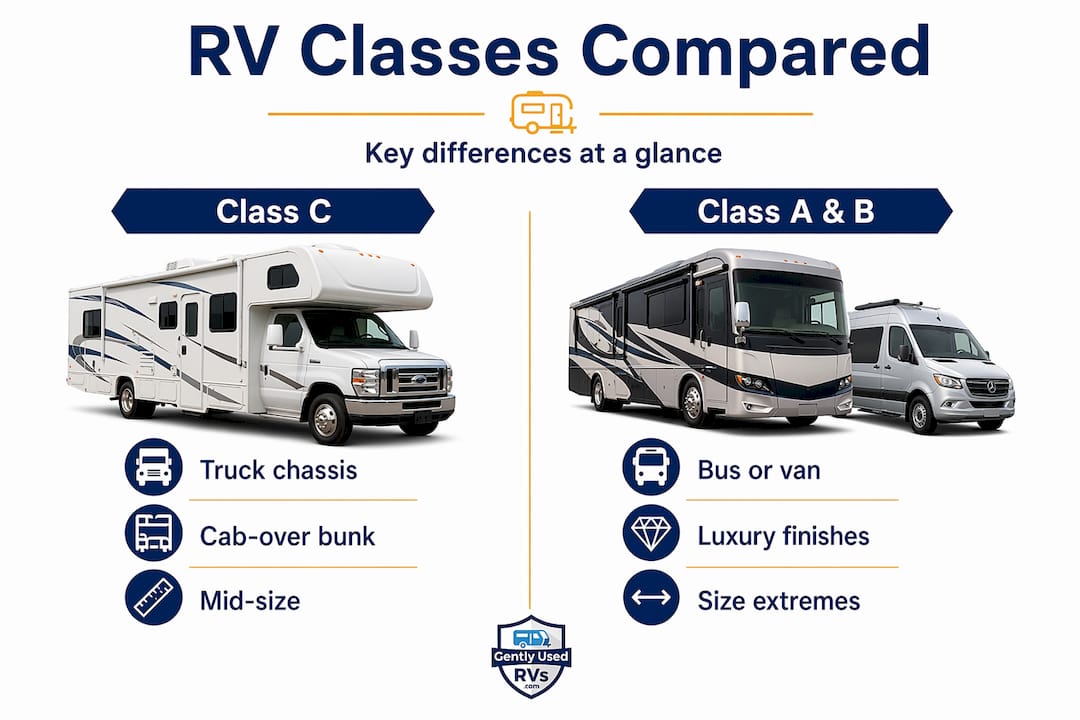
| Feature | Class A | Class C | Class B |
|---|---|---|---|
| Chassis type | Bus or commercial truck | Cutaway truck/van | Cargo van |
| Length range | 25 to 45 feet | 21 to 41 feet | 16 to 22 feet |
| Starting price (new) | $100,000 or more | $70,000 or more | $80,000 or more |
| Driver experience needed | Higher; bus-like handling | Moderate; familiar truck feel | Low; drives like a van |
| Sleeping capacity | 2 to 8 depending on build | 4 to 7 | 2 to 4 |
| Best use case | Full-time travel, luxury camping | Families, first-time buyers | Solo or couple travel, stealth camping |
What is a class A motorhome? It’s a full coach built on a bus or commercial chassis with a flat front, premium finishes, and the largest footprint in the motorhome world. The luxury is real, but so is the learning curve on the road and the impact on your wallet.
What is a class B motorhome? It’s essentially a purpose-built camper van. You get maximum fuel efficiency and everyday driveability, but living space is tight. Two people can travel comfortably; a family of four will feel the squeeze fast.
The Class C lands between those two extremes. Class A models excel at large luxury campgrounds where space is plentiful and amenities are premium. Class B vans work for couples who want to travel light and park anywhere. The Class C hits the middle ground that most buyers actually need.
Pro Tip: If you plan to visit national parks regularly, go with a Class C under 30 feet. Many popular parks restrict RVs to 27 feet or less, and finding that out after you’ve bought a 36-footer is a painful lesson.
Common misconceptions about Class C RVs
Even experienced RV shoppers get tripped up by a few consistent misunderstandings. Here are the ones that cause the most real-world problems:
-
Confusing Class C with Super C or Class B+. These look similar on the outside but are fundamentally different vehicles. Super C motorhomes use heavy-duty commercial truck platforms like Freightliner rather than standard cutaway chassis. They tow significantly more weight and cost considerably more. A Class B+ is a stretched van body, not a true Class C. Know which one you’re actually buying.
-
Assuming the over-cab bunk is always used for sleeping. Many owners remove the bunk mattress and use the alcove as a storage loft for bikes, outdoor gear, or bulky items. If you need that space for sleeping, confirm the bunk configuration before purchasing.
-
Ignoring height clearance. This one causes real damage. Roof-mounted air conditioners, satellite dishes, and ladder racks push your actual roof height well above the base chassis measurement. Many Class Cs exceed their base chassis height significantly with accessories installed. Gas station canopies, drive-thrus, and park entrance gates are all hazards. Know your full height before you roll.
-
Underestimating interior storage. The cabinetry in a Class C looks generous on a showroom floor. On a two-week trip with four people, it fills up fast. Look for exterior pass-through storage bays and overhead cabinets when evaluating models.
How to choose the right Class C motorhome
Knowing how to choose a class C motorhome comes down to matching specs to your actual travel habits, not to what looks good at a dealership.
Start with these practical filters:
- Travel party size. Sleeping four regularly? Look at models 28 feet or longer with a rear bedroom plus the over-cab bunk and a convertible dinette. Couple or family of three? A 24- to 26-footer works well without the bulk.
- Campground types. National parks and wooded campgrounds favor shorter models, ideally under 28 feet. Resort-style RV parks accommodate anything up to 40 feet.
- Towing needs. Most standard Class C motorhomes tow between 3,500 and 8,000 pounds depending on the chassis. If you need to haul a boat or car dolly, confirm the tow rating before buying, not after.
- Fuel type. Gas Class C models are less expensive to buy and service. Diesel units, often the larger models, offer better torque and fuel economy over long hauls. The upfront cost difference can be $20,000 or more.
- Budget. Set a firm total budget that includes insurance, registration, and a maintenance reserve of at least 10 percent of the purchase price.
Pro Tip: Always check the RV types breakdown on Gentlyusedrvs before narrowing your search. Understanding exactly which subcategory you’re shopping helps you filter listings faster and avoid mismatched comparisons.
Think about slide-outs carefully too. One or two slides add significant living space when parked, but they also add weight, mechanical complexity, and width when driving. A slide failure at a remote campsite is a frustrating experience you’d rather not have in year one of ownership.
My honest take on Class C motorhomes
I’ve spent years watching buyers come in overwhelmed and leave with the wrong rig. The Class A always gets the gasps at a show. The Class B gets the “oh, that’s so practical” comments. The Class C? It quietly does the work for more families than any other format.
What surprises new owners most is how quickly the driving anxiety fades. After one or two trips, the truck-based cockpit feels natural. Backing into a site stops feeling impossible. That approachable experience is genuinely underrated, and I think it’s the single biggest reason so many people stick with Class C after their first purchase.
The real adjustment is space management. The floor plan looks roomier than it lives when four people are using it simultaneously. The owners who thrive are the ones who travel light and set up quickly. They use the exterior storage well, they don’t haul unnecessary gear, and they embrace the campsite as an extension of the living space.
My advice: don’t buy more motorhome than you need in year one. Buy something that fits your current camping style. A well-priced used Class C in the 25- to 30-foot range is a smarter starting point than a fully loaded 38-footer you may trade in two years later.
— Christopher
Find your Class C on Gentlyusedrvs
Ready to put this knowledge to work? Gentlyusedrvs makes browsing used Class C motorhomes straightforward and pressure-free. No account needed to search. No commissions buried in the price. Listings are geotargeted, so the closest options show up first based on your location.

You can browse all RV classes to compare Class C motorhomes side by side with Class A and Class B options before you commit to anything. When you’re ready to shop listings directly, the used motorhome marketplace gives you access to private sellers and dealerships across the United States, Canada, and internationally. Whether you have a firm budget of $30,000 or you’re looking at a loaded diesel unit in the $90,000 range, there’s real inventory here worth your time.
FAQ
What defines a Class C motorhome?
A Class C motorhome is built on a cutaway truck or van chassis and features a distinctive over-cab sleeping or storage alcove above the driver’s cabin. Lengths typically run from 21 to 41 feet.
How is a Class C different from a Class A?
Class A motorhomes use a bus or commercial chassis with a flat front and generally offer more luxury and space, while Class C models use a truck-based cabin that is easier to drive and more affordable.
Do you need a special license to drive a Class C?
In most states, a standard driver’s license is all you need to operate a Class C motorhome, which is one reason they’re the most popular starter RV for families and first-time buyers.
What is the over-cab bunk used for?
The over-cab bunk is most commonly used as a sleeping area for children or guests, but many owners remove the mattress and use the space as a storage loft for gear and equipment.
How do I choose the right size Class C for my family?
Match length to your travel party and campground types. Families of four benefit from models 28 feet or longer, while those camping at national parks should look at models under 28 feet to stay within common length restrictions.