
Yes, you can sell an RV that still has a lien on it. Your buyer needs a clean title, so the lien has to get paid off and released, usually right at closing. The first move is simple: call your lender and request a formal payoff quote before you list the RV or set a price with a buyer.
TL;DR:
- Confirm your loan’s payoff amount with a formal payoff letter that accounts for per-diem interest to avoid shortfalls during closing.
- Know your state’s title process—Electronic Lien and Title states release liens faster, often within days, while paper titles can take approximately 10 days or more.
- Choose a sale method that matches your location and timeline, with dealer trades being lowest effort and escrow providing added security for long-distance deals.
- Never hand over keys or funds before confirming the lender received payoff and the lien was officially released to prevent legal and financial liabilities.
- List your RV transparently by noting the lien on the title, payoff timeline, and preferred closing method to set realistic buyer expectations and avoid delays.
Table of Contents
- Sell RV With Lien: Fastest, Safest, and Highest-Return Options
- How Liens, Payoff Letters, and Title Transfer Actually Work
- Dealer, Lender Branch, Escrow, or Marketplace: Which Fits Your Sale?
- Seller Checklist: What to Prepare Before You List
- Owe More Than It’s Worth? Covering the Payoff Gap
- State Title Rules and ELT Timing You Need to Plan Around
- What to Expect From Payoff Quote to Clean Title in Hand
- Steps to Verify Lien Status and Lienholder Details
- Legal Risks of Selling With an Active Lien
- Talking to Buyers About the Lien Without Scaring Them Off
- Coordinating Payoff and Closing So Nothing Slips
- Common Mistakes That Blow Up a Liened RV Sale
- Editorial Take: Why the Payoff Letter Is the Whole Game
- Ready to List? What to Do on Gently Used RVs
- Where to Verify State Rules and Payoff Procedures
- Sources
Sell RV With Lien: Fastest, Safest, and Highest-Return Options
Not every route to selling works the same way once a lender is still in the picture. Some paths are quick but cost you money. Others take patience but put more cash in your pocket.
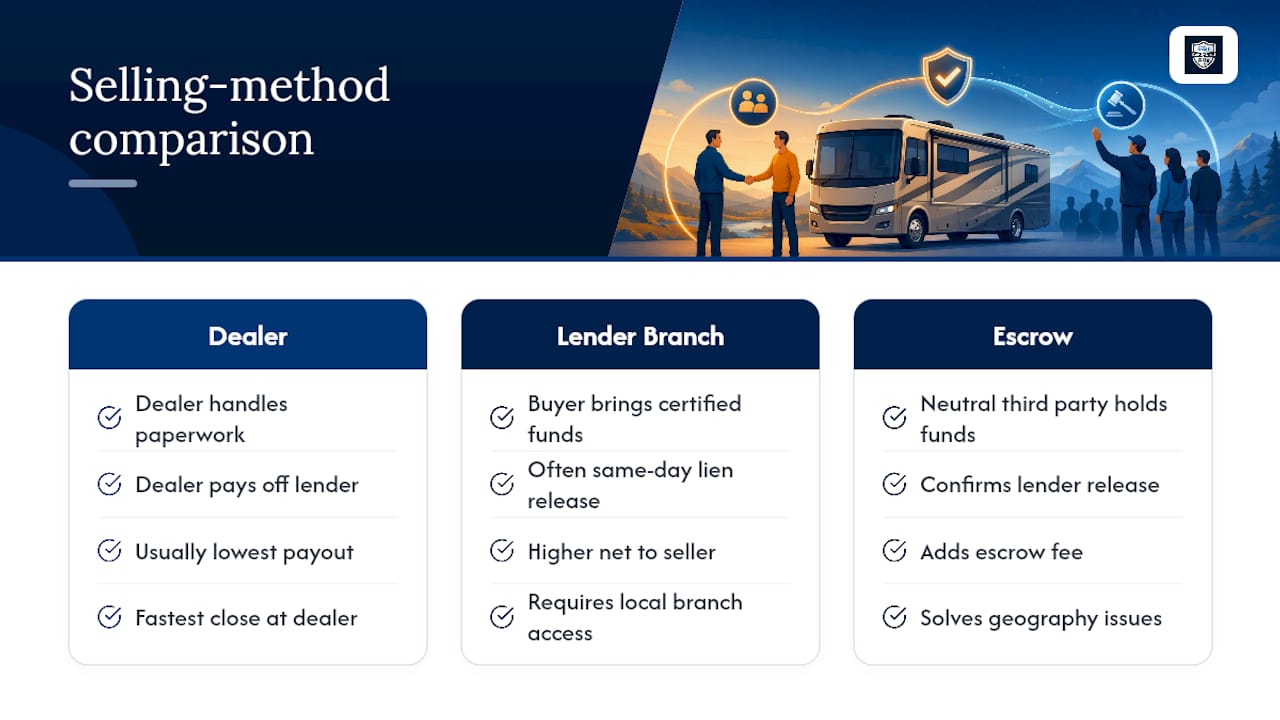
- Dealer sale or trade-in. The dealer handles the lien payoff and paperwork directly, which makes this the lowest-effort option. You typically walk away with less money than a private sale would net.
- Private sale at the lender’s branch. If your buyer is local, closing at the lender’s office is often the cleanest option. The lender can confirm payoff, release the lien, and hand over paperwork in one visit.
- Private sale through escrow. For long-distance buyers, an escrow service solves the trust problem that comes with wiring money to a stranger for an RV that still has a loan on it. Expect a service fee for the convenience.
How Liens, Payoff Letters, and Title Transfer Actually Work
A lien is the lender’s legal claim on your RV until the loan is paid. State motor vehicle departments are blunt about it: the lien must be paid or the lienholder must sign off in writing before a title can transfer to a new owner. No payoff, no clean title, no legal sale.
The document that actually matters is a formal 10-day payoff letter, not your last monthly statement. A payoff letter includes per-diem interest, meaning it tells you the exact amount owed on a specific future date, not just what you owed 30 days ago.
Pro Tip: Using a monthly statement balance instead of a 10-day payoff letter is the single biggest cause of closing-day shortfalls. LegalClarity notes that daily interest accrual can leave you short by real money if you show up with stale numbers.
Title format changes your timeline. States that use Electronic Lien and Title (ELT) systems can often update the lien record digitally within days of payoff. States still issuing paper titles require the lienholder to physically mail a release, which adds time you need to plan around. TxDMV guidance notes that lienholders generally have about 10 days after payoff to release the lien, whether that means mailing a paper title or updating the electronic record.
After payoff, your lender should provide:
- A lien release letter or satisfaction document
- An updated title (paper) or confirmation the electronic record has been cleared
- Any state-specific release form your DMV requires for the title transfer
Confirm which of these lender uses before you promise a buyer a specific closing date.
Dealer, Lender Branch, Escrow, or Marketplace: Which Fits Your Sale?
Every selling method handles the lien differently, and that difference shapes how fast you close and how much you net.
Dealer trade-in or sale puts the paperwork burden on someone else. The dealer contacts your lender, pays off the balance, and manages the title transfer as part of the transaction. It’s the path of least resistance, and it’s also usually the path of lowest payout, since dealers price in resale margin and reconditioning costs.
Private sale at the lender’s branch works best when you and your buyer both live near a branch location. The buyer’s certified funds go straight to the lender, the lien gets released on the spot in many cases, and you walk out with a clean transaction. RV Living’s guide points out that private sales typically net more money than dealer trades, but they require more coordination when a lien is still active.
Escrow closings solve the geography problem. A neutral third party holds the buyer’s funds, confirms the lien release with your lender, then disburses money to you and the remaining paperwork to the buyer. This adds a fee, but it protects both sides when the buyer can’t physically show up at your lender’s branch.
Marketplace listings widen who sees your RV in the first place. A platform like Gently Used RVs lets you set your price, describe the lien situation up front, and use geotargeted visibility so buyers who are close enough to close at a branch (or comfortable using escrow) find your listing faster.
Pro Tip: Ask your lender directly whether they’ll accept certified funds at a branch with same-day lien release, or whether you’re stuck waiting on electronic updates or mail. That one question tells you which closing method will actually work on your timeline.
Seller Checklist: What to Prepare Before You List
Getting your paperwork in order before you list saves you from awkward conversations mid-negotiation. Work through this in order:
- Request an exact payoff quote. Ask specifically about per-diem interest and how long the quote stays valid, typically 10 days.
- Confirm your title type. Find out if your state uses ELT or issues paper titles, and confirm where the physical title currently sits.
- Gather your paperwork. Pull together a bill of sale, current registration, and maintenance records. Check whether your state requires notarization on the bill of sale or title transfer.
- Pick your closing method. Decide whether you’ll close at the lender’s branch, through escrow, or via a dealer, then tell prospective buyers upfront so nobody is surprised.
- Plan for a payoff gap. If your loan balance exceeds what the RV will likely sell for, figure out now how you’ll cover the difference at closing.
Buyers respond well to sellers who have their numbers ready. Walking into a negotiation with a real payoff figure, not a guess, tends to speed up serious offers. It’s worth reviewing negotiation tactics that help you price competitively while still protecting your payoff number.
Owe More Than It’s Worth? Covering the Payoff Gap
Negative equity doesn’t stop a sale, it just adds a step. You have a few realistic ways to bridge the difference between what you owe and what a buyer will pay.
- Pay the gap in cash. This is the fastest path to a clean title. If you have the funds sitting available, closing goes smoothly and immediately.
- Take a short-term personal loan sized to the gap. This works, but it costs more in interest than paying cash. LegalClarity’s analysis suggests running the total interest cost before committing, since a quick bridge loan closed fast often beats carrying two loans for months.
- Let a dealer absorb the lien as part of a trade or consignment deal. Some dealers will roll a negative-equity RV into a deal, but expect a lower net payout in exchange for convenience.
- Coordinate a buyer’s lender with your own. If your buyer is financing the RV, their bank can sometimes pay your lender directly as part of underwriting. This is a bank-to-bank process and takes longer than a cash sale, so build in extra time.
Whichever route you choose, do the math before you commit. A bridge loan that costs you $400 in interest over 60 days is often cheaper than three more months of RV payments plus insurance on a vehicle you’re trying to unload.
State Title Rules and ELT Timing You Need to Plan Around
Title procedures aren’t uniform across the country, and that variation directly affects how long your buyer waits for a clean title.
States running Electronic Lien and Title systems can process a release digitally once the lender confirms payoff, often faster than a paper process. Paper title states still require the lienholder to mail the physical release, adding transit time on top of processing time.
- Texas requires lienholders to handle release paperwork after payoff, with about a 10-day window common for either mailing a paper title or updating the electronic record.
- Arizona advises sellers to confirm ELT status directly with the lender before assuming how fast a release will happen.
- Georgia requires lienholders to complete a formal release document, and the Department of Revenue outlines the mailing timeline sellers should expect once that release is processed.
Unless you’re closing at a lender’s branch where the release can happen on the spot, build in a buffer of days to weeks for title paperwork. Promising a buyer a same-week title when your state runs a slower paper process sets you up for a frustrated buyer and a stalled sale.
What to Expect From Payoff Quote to Clean Title in Hand
Here’s the realistic sequence: you get a payoff quote valid for about 10 days, you close through your lender, escrow, or a dealer, the lender processes the payoff, and the lien gets released either electronically or by mail. From there, the title moves to the buyer or their new lender, typically within one to 15 business days depending on your state’s process.
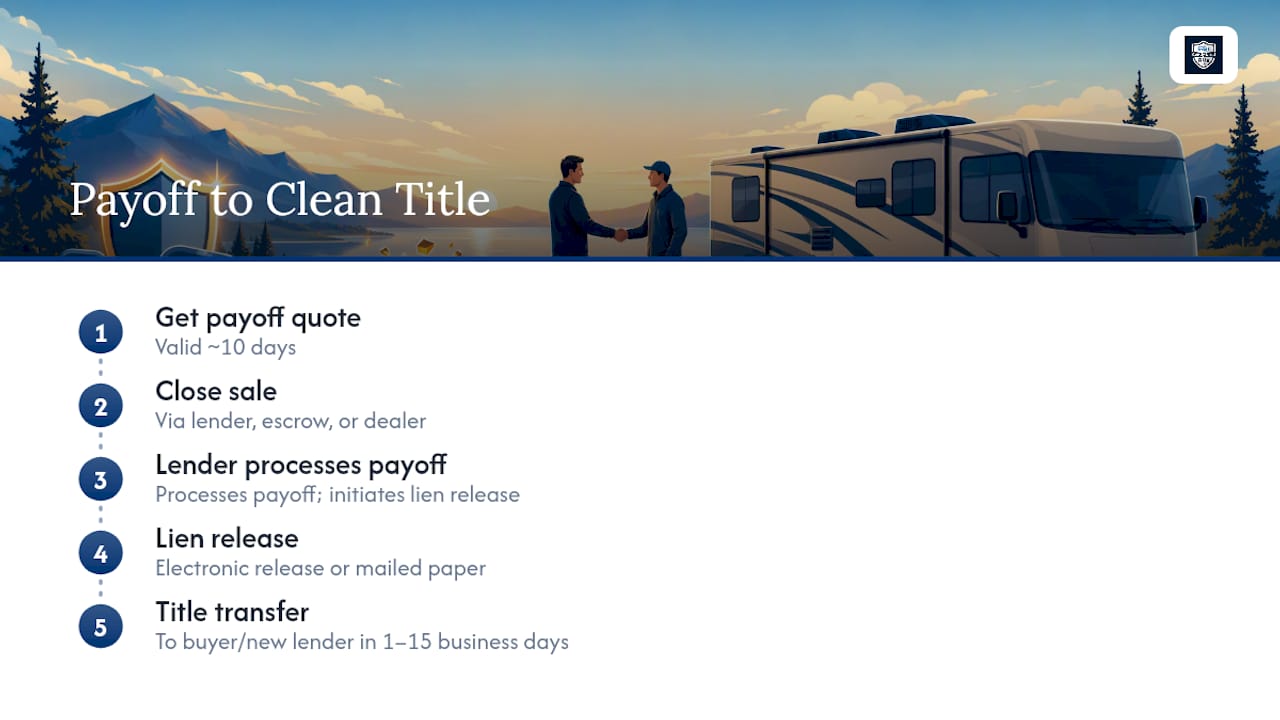
Before you hand over keys or release funds, confirm two things: that the lender or escrow account actually received the money, and that you have documented proof of the lien release or an updated title record in hand. If your state mails a paper title, get a tracking number and hold onto the lender’s written confirmation. Skipping this step is how sellers end up chasing a lender by phone weeks after the sale closed.
Steps to Verify Lien Status and Lienholder Details
Before you list anything, confirm exactly who holds your lien and how much you actually owe. Your loan may have been sold or transferred to a different servicer since you signed the original paperwork, and listing your RV with outdated lienholder information creates real delays down the line.
Start by pulling your most recent loan statement and checking the servicer’s name against what’s on your title. If your state issues paper titles, look at the actual document, the lienholder listed there should match who you’re paying monthly. A mismatch usually means your loan was sold and the title hasn’t caught up yet, which you’ll need to resolve before closing.
Call the lender directly rather than relying on an online portal balance. Ask for written confirmation of who holds the lien, the current payoff amount, and whether the title is held electronically or on paper. If you can’t reach anyone or get a runaround, check your state DMV’s title search tool, many states let you look up lien status using your VIN and license plate.
Do this early, ideally before you write your listing description. Buyers who ask about lien status (and serious ones will) expect a straight answer, not a promise to “check on it.”
Legal Risks of Selling With an Active Lien
Selling an RV without disclosing an active lien isn’t just bad practice, it can expose you to real legal trouble. Transferring a title you don’t yet clear legally is considered fraud in most states, since you’re passing ownership of a vehicle someone else still has a financial claim on.
The bigger practical risk is a failed closing. If a buyer’s lender or a title company discovers the lien after funds have already changed hands, the deal can unwind, sometimes with the buyer demanding a refund and you stuck holding an RV that’s now been driven, used, or damaged. Some states also hold sellers liable for continuing to owe on a loan tied to a vehicle they no longer possess if the lien was never properly released.
There’s also risk on the insurance side. If you sell the RV and hand over keys before the lien clears and title transfers, you may still be the legal owner of record, which means you could remain financially and legally responsible for the vehicle if something happens to it in the buyer’s hands. That’s a real gap, not a technicality.
The fix is consistent: never release the RV to a buyer until you have documented confirmation that the lender received payoff and the lien is either released or in the process of being released. Escrow exists specifically to prevent this exact scenario.
Talking to Buyers About the Lien Without Scaring Them Off
Buyers get nervous when they hear “lien,” and that’s fair, plenty of scam listings hide behind vague ownership claims. Your job is to get ahead of that nervousness with specifics, not reassurances.
State the lien status plainly in your listing description: name the lender, mention that you’ll provide a payoff letter, and explain how closing will work (lender branch, escrow, or dealer handling). Vague listings that avoid the topic read as evasive, even when the seller has nothing to hide.
When a buyer asks questions, answer with documents, not promises. Share your payoff quote once you’re in serious negotiations, and explain exactly how the money will flow: buyer funds to lender or escrow, lien release, then title to buyer. Walking a buyer through that sequence step-by-step turns a scary word into a normal transaction.
If a buyer pushes back on using escrow or a lender branch and insists on a private cash handoff instead, treat that as a caution sign. Legitimate buyers generally accept a structured closing once they understand it protects them too.
Coordinating Payoff and Closing So Nothing Slips
The tightest part of selling a liened RV is making payoff and closing happen in the same motion, without gaps where money or paperwork could go missing.
Line up your payoff quote’s expiration date with your planned closing date first. A quote valid for 10 days is worthless if your closing slips past that window, you’ll be back on the phone requesting a new one, possibly at a higher payoff amount. Confirm with your lender exactly how they want to receive funds: wire transfer, cashier’s check, or in-person certified funds at a branch.
If you’re using escrow, the escrow company typically won’t release funds to your lender until they’ve confirmed the payoff amount directly with the lender, and won’t release the remaining balance to you until the lien release is confirmed. That sequencing protects everyone, but it means you should expect the whole process to take longer than a simple cash handshake.
Whatever method you use, get everything moving on the same day if possible: buyer funds submitted, lender notified, and title paperwork requested in one continuous sequence rather than spread across a week of back-and-forth.
Common Mistakes That Blow Up a Liened RV Sale
Most failed sales trace back to a handful of avoidable errors:
- Using a stale balance instead of a formal payoff letter, which leaves you short at closing once daily interest is added in.
- Not confirming ELT versus paper title status early, leading to a buyer who expects a fast title and gets a multi-week wait instead.
- Handing over keys before funds and lien release are confirmed, which can leave you exposed if the deal falls apart afterward.
- Being vague about the lien in your listing, which makes serious buyers assume you’re hiding something and walk away.
- Skipping escrow on a long-distance sale, trusting a stranger to wire funds directly without a neutral party confirming the payoff.
Every one of these mistakes is preventable with a phone call to your lender and a little patience before you accept an offer.
Editorial Take: Why the Payoff Letter Is the Whole Game
Most advice about selling an RV with a lien treats the loan as an obstacle to work around. That framing is backwards. The payoff letter isn’t paperwork standing between you and a sale, it’s the document that actually makes the sale possible. Get it early, get it exact, and build your entire closing plan around its expiration date.
Where conventional advice falls short is in treating all closing methods as roughly interchangeable. They’re not. A lender-branch closing with a local buyer is a fundamentally different transaction than a long-distance private sale through escrow, and sellers who don’t pick their method before listing end up scrambling when a serious buyer finally shows up.
Prioritize this first: confirm your exact payoff amount and your title format before you write a single word of your listing. Everything else, your asking price, your negotiation strategy, your buyer pool, flows from those two facts. Sellers who skip that step aren’t selling an RV, they’re gambling on one.
— Christopher
Ready to List? What to Do on Gently Used RVs
Once you have your payoff quote and closing plan sorted, the actual listing process is where a marketplace built for RV sellers pays off. Learn how to close trailer sales faster with effective online dealer moves that boost your listing’s visibility and sell speed. Gently Used RVs lets you list at no cost, no commissions, no hidden fees, with visibility that starts within a 20-mile radius and can expand through paid upgrades like Bronze, Silver, or Gold if you need a wider buyer pool for a long-distance escrow closing.

Mark your listing clearly as “lien on title” and add a short note explaining your payoff timeline and preferred closing method. Serious buyers appreciate the transparency, and it filters out anyone who isn’t prepared for a structured closing. Check the How It Works page to see exactly how listing tiers and geotargeting work, browse the RV types guide to make sure your listing categorizes your rig correctly, and if a dealer trade feels like a better fit for your timeline, the dealer directory can point you toward local options. List your RV today and start coordinating with buyers who are ready to close.
Where to Verify State Rules and Payoff Procedures
Check your state’s own DMV guidance before finalizing any closing plan, since lien release timelines and required forms vary. Start with TxDMV’s lien procedures, Arizona’s vehicle lien guidance, and Georgia’s lien release requirements. For broader procedural context, LegalClarity’s overview and RV Living’s practical guide both cover payoff mechanics in plain language.
Sources
- Txdmv
- Vehicle Liens | Department of Transportation
- How to sell an RV you owe money on - RV Living
- Can I Sell My RV If I Still Owe on It? What to Know - LegalClarity
- How to Release a Lien and Security Interest on Title | Department of Revenue