Don’t Wire $40,000: RV Escrow for Private Buyers and Sellers

Escrow holds the buyer’s payment in a neutral account and releases it only after the lender’s lien is paid and the buyer accepts the RV. That’s the whole idea in one sentence. You use it when the sale happens long-distance, when the RV still has a loan on it, or when either party wants a neutral third party controlling the money instead of a wire transfer and a handshake.
TL;DR:
- Escrow holds funds until all conditions, such as inspection approval and lien clearance, are officially met; it does not release payments prematurely.
- Sellers with existing loans must satisfy the lender’s lien before passing a clear title, requiring careful timing of payoff quotes and direct lender payments.
- Escrow fees typically range from 1.9% to 2.4%, with minimum costs around $130 for low- to mid-range deals, and payment processing can delay due to lien or title transfer times.
- Proper documentation, including payoff letters, titles, bills of sale, and inspection reports, is essential to avoid delays or deal failures.
- Choosing a licensed, insured escrow provider and clarifying fee split arrangements upfront helps prevent fraud and disputes during the RV sale process.
Table of Contents
- What Escrow Explained Really Means for a Private RV Sale
- How Does Escrow Handle Liens and Lender Payoffs?
- What Are the Steps in an Escrowed RV Closing?
- What Do Escrow Fees Actually Cost?
- What Documents Do You Need for RV Escrow?
- How Do You Choose a Reputable Escrow Provider?
- A Marketplace’s View: When Escrow Belongs in the Deal
- A Seller’s Perspective on Payoff Timing
- List Your RV and Close With Confidence
- Sources
- FAQ
What Escrow Explained Really Means for a Private RV Sale
Escrow isn’t a bank account with extra paperwork. It’s a neutral holding service that holds buyer funds and releases payment only after contract conditions are met — inspection acceptance, title release, delivery confirmation. Nobody gets paid, and nobody hands over the keys, until those conditions are satisfied in writing.
That structure is what makes RV escrow different from just trusting a stranger on the internet. The service enforces the deal you already agreed to; it doesn’t renegotiate it.
Common conditions built into an RV escrow agreement include:
- Buyer inspection and written acceptance of the RV’s condition
- Confirmation the lender’s lien has been paid or released
- Proof of delivery or pickup at the agreed location
- Verification the title (or electronic title record) is clear
For a seller shipping a fifth wheel across three states to a buyer they’ve never met, escrow removes the “did the check clear” anxiety. For a buyer wiring $40,000 to someone selling a motorhome with a loan still attached, it removes the “did my money just disappear” anxiety. Both fears are legitimate, and both are exactly what a scam safety guide warns readers to take seriously before sending a dime.
How Does Escrow Handle Liens and Lender Payoffs?
Here’s the detail most first-time private sellers miss: you can absolutely sell an RV that still has a loan on it, but the lender’s lien has to be satisfied before a clean title can pass to the buyer. Until that happens, the buyer is technically purchasing a vehicle someone else’s bank has a legal claim on.
The mechanics run through the payoff quote. That number typically stays valid for only 7 to 10 days and includes per-diem interest, so the payoff amount creeps up daily until it’s paid. Some loans also carry prepayment penalties, which is why the quote can look higher than the seller’s last statement balance.
Escrow steps in two ways here:
- The escrow provider pays the lender directly from held funds once conditions are met.
- Or the buyer’s lender sends payoff funds bank to bank straight to the seller’s lender, which tends to produce the fastest, cleanest transfer when both banks cooperate.
Timing depends heavily on whether the title is paper or electronic. Electronic titles let escrow verify a DMV record update directly; paper titles mean waiting on physical mail from a lender’s title release department, which can add real delay.
Pro Tip: Request the payoff quote as close to your actual closing date as you can, and confirm the exact department and mailing address for the funds. Some lenders route payoff to a different address than the one on your monthly statement, and a misdirected check can cost you a week.
What Are the Steps in an Escrowed RV Closing?
A private RV sale with escrow follows a predictable sequence. Skipping steps or reordering them is where most disputes start.
- Agree on price and terms in writing, including who pays which fees.
- Get a lender payoff quote if the seller has an existing loan, noting its expiration date.
- Open escrow and define the release conditions both parties accept.
- Buyer deposits funds into the escrow account, not into the seller’s personal account.
- Seller ships or delivers the RV along with the title, bill of sale, and any lien paperwork.
- Buyer inspects and accepts the RV, or requests corrections per the agreed terms.
- Escrow releases funds, paying off the lender first, then sending the remainder to the seller.
Escrow fees are commonly split between buyer and seller, though splitting the fee 50/50 is a matter of agreement, not law, so put that split in writing before opening escrow, not after.
The bill of sale itself should list the VIN, make, model, year, sale price, and full legal names and addresses for both parties. If part of the payment is going directly to a lender rather than the seller, state that explicitly on the bill of sale. A limited power of attorney comes into play when the seller can’t be physically present for a DMV transaction, letting a designated party sign specific title documents on their behalf.
What Do Escrow Fees Actually Cost?
Cost is usually the first question, and the honest answer is that it scales with deal size rather than sitting at one flat number.
By the numbers: Escrow fees on RV deals commonly run about 2.4% with a minimum near $130 for transactions between $5,000 and $50,000. Move into the $50,000 to $200,000 range, and the percentage often drops to roughly 1.9%, but the minimum fee climbs to somewhere near $1,200.
A mid-range RV sale could incur escrow fees of several hundred to roughly a thousand dollars depending on the provider and their minimum fee policies. It’s not pocket change, but weighed against the risk of wiring $60,000 to a stranger with no recourse, most sellers and buyers consider it a fair trade.
Timeline is the other variable people underestimate:
- Payoff processing after the lender receives funds often takes around 10 business days, sometimes longer.
- Paper titles add mailing time on top of that; electronic titles usually move faster.
- Inspection periods typically run a few days to a week, depending on what both parties agreed to upfront.
What Documents Do You Need for RV Escrow?
Paperwork is where escrowed deals succeed or stall. Missing one document can freeze the whole closing for days.
You’ll generally need:
- The payoff letter from the seller’s lender, showing the exact amount and expiration date
- A bill of sale listing the VIN, sale price, and both parties’ legal names
- The title, or documentation of the lien release once payoff clears
- An inspection report the buyer signs off on
- An insurance binder, if the buyer is financing the purchase, since most private-party lenders require proof of coverage before releasing funds
A limited power of attorney becomes necessary when a seller can’t appear in person at the DMV for a title transaction, letting escrow or a designated agent complete specific paperwork legally. While waiting on a mailed paper title, some states issue temporary registration receipts, which buyers can use to legally drive or tow the RV in the interim. Check with your state DMV for what’s accepted locally, since rules vary. Sellers working through a lien in particular should read a guide to selling a liened RV before opening escrow, since it walks through payoff-letter timing in more detail.
How Do You Choose a Reputable Escrow Provider?
Not every “escrow” service advertised on a classified ad is legitimate, and this is where fraud tends to concentrate. A few questions separate real providers from scams.
Ask any provider you’re considering:
- Are you licensed, and do you hold funds in an insured trust account rather than a general business account?
- What’s your track record handling vehicle liens and state-specific title systems?
- What’s your typical turnaround for lender payoff and title collection?
- What happens if the deal falls through? What are your refund and dispute terms?
Watch for these red flags before you send anything:
- No written agreement or fee schedule provided upfront
- Refusal to explain how and where your funds are held
- Pressure to skip inspection or rush the release of funds
- A “too convenient” fee that’s far below the typical 1.9% to 2.4% range
Some sellers use dedicated title and closing companies instead of full escrow, which can charge lower flat fees, often in the $100 to $300 range for smaller deals without full fund-holding services. That can work for straightforward, no-lien sales, but it’s a different service than escrow, and it’s worth knowing which one you’re actually paying for.
Pro Tip: If a provider won’t show you exactly how your money is held before you commit, that’s your answer. Walk away and find one that will.
A Marketplace’s View: When Escrow Belongs in the Deal
Marketplaces like Gently Used RVs exist to connect buyers and sellers and surface listings by location, not to hold money. But the closing that happens after the introduction is where deals go right or wrong, and the platform’s safety resources consistently point long-distance or liened sales toward escrow.
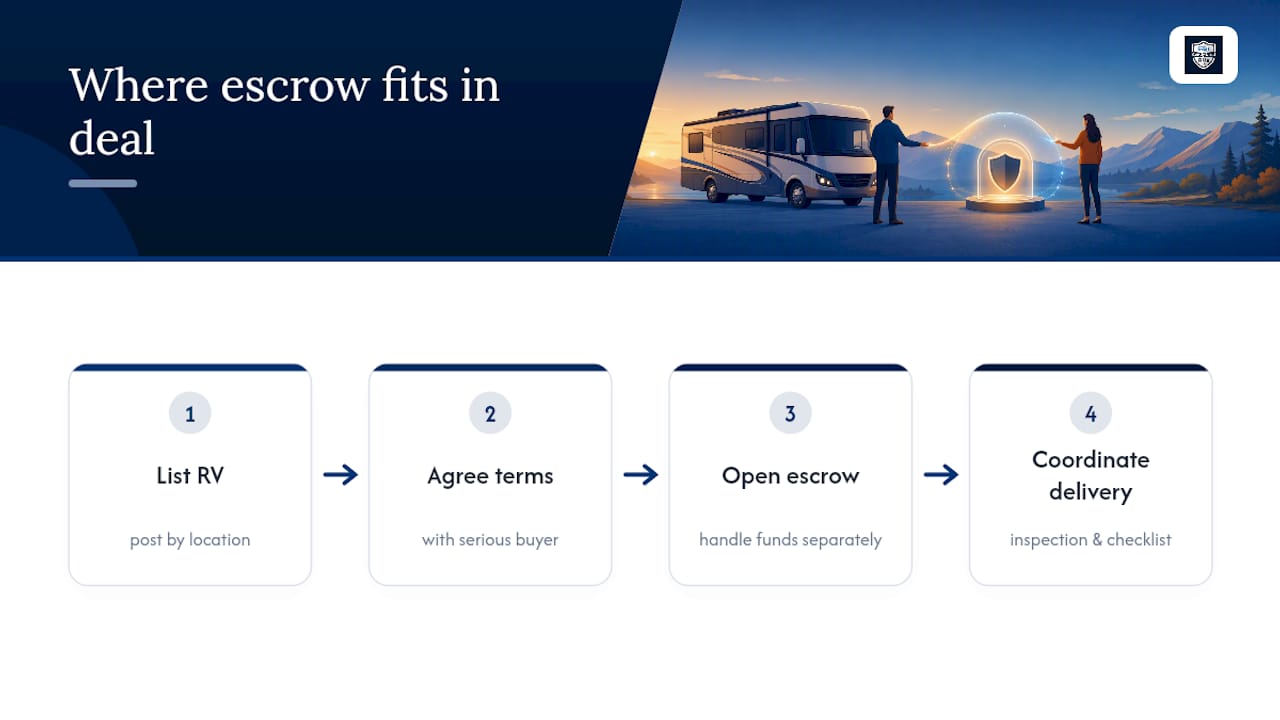
The practical flow looks like this: list the RV, agree on terms with a serious buyer, then open escrow separately to handle funds while using marketplace tools to coordinate inspection and delivery logistics, outlined in Gently Used RVs’ delivery checklist. The marketplace and the escrow provider do different jobs, and treating them as one service is a common mistake.
A Seller’s Perspective on Payoff Timing
A seller once had a payoff quote go stale by four days because the buyer’s financing took longer than expected. The lender’s updated per-diem interest added a few hundred dollars nobody budgeted for, and the deal nearly collapsed over an argument about who should eat the difference.
The lesson: get your payoff quote close to the actual closing date, not weeks ahead, and put deposit receipts and every communication in writing. Escrow can’t fix a fight that starts because nobody documented the original terms.
— Christopher
List Your RV and Close With Confidence
There are free alternatives to paying dealer commissions just to reach a buyer. Listings can be posted at no cost, with paid upgrade tiers available for wider geographic reach, more photos, or live buyer chat once serious interest arises.

If your RV still has a loan, or your buyer lives three states away, that’s exactly the scenario where Camper Ankauf macht Ihnen den Wohnmobilverkauf leicht, making your motorhome sale smooth and secure. List your rig, use the AI autofill tool to pull specs straight from an existing ad in seconds, and once you’ve got a serious buyer, open escrow to handle the payoff and funds release the right way. Browse how it fits your situation on the Gently Used RVs listings page, or check the RV types guide first if you’re not sure how your rig should be categorized before you post.
Sources
A few places to verify details before you sign anything: Escrow.com’s guide to buying an RV trailer for fee structures, LegalClarity’s payoff-to-title breakdown for lien mechanics, RV Loan Wizard’s private-party financing guide for buyer-side loan requirements, and NADA Guides for confirming fair market value before you set a price.
- Escrow
- How to Sell an RV with a Loan: Payoff to Title Transfer - LegalClarity
- How to Finance a Private-Party RV Purchase (2026 Guide) | RV Loan Wizard
- Title and Escrow Services for online RV sales - PopSells
FAQ
Who Owns the Money in an Escrow Account?
Neither party owns the funds outright while they sit in escrow. The buyer’s money is held by the neutral escrow provider and legally released only once the agreed conditions, like inspection and lien clearance, are met.
What Are the Most Common RV Loan Mistakes to Avoid?
The biggest ones are letting a payoff quote expire before closing and forgetting per-diem interest keeps adding to the balance daily. Request your quote close to the actual closing date to avoid the mismatch.
What Would the Payment Be on a $50,000 RV?
Monthly payment depends entirely on your loan term, down payment, and interest rate, so there’s no single answer without those numbers. A lender or RV loan calculator can give you an exact figure once you know your rate and term length.
Is There a “10 Year Rule” for RVs?
There’s no universal 10 year rule; it usually refers to certain RV parks, campgrounds, or lenders capping financing or entry based on the RV’s age, and those limits vary by park or financial institution. Check directly with the specific lender or campground in question rather than assuming a standard.
Do Both Buyer and Seller Pay Escrow Fees?
There’s no fixed rule; splitting the fee is a common practice, but it’s a private agreement between buyer and seller, not a legal requirement. Put whatever split you agree to in writing before opening escrow.