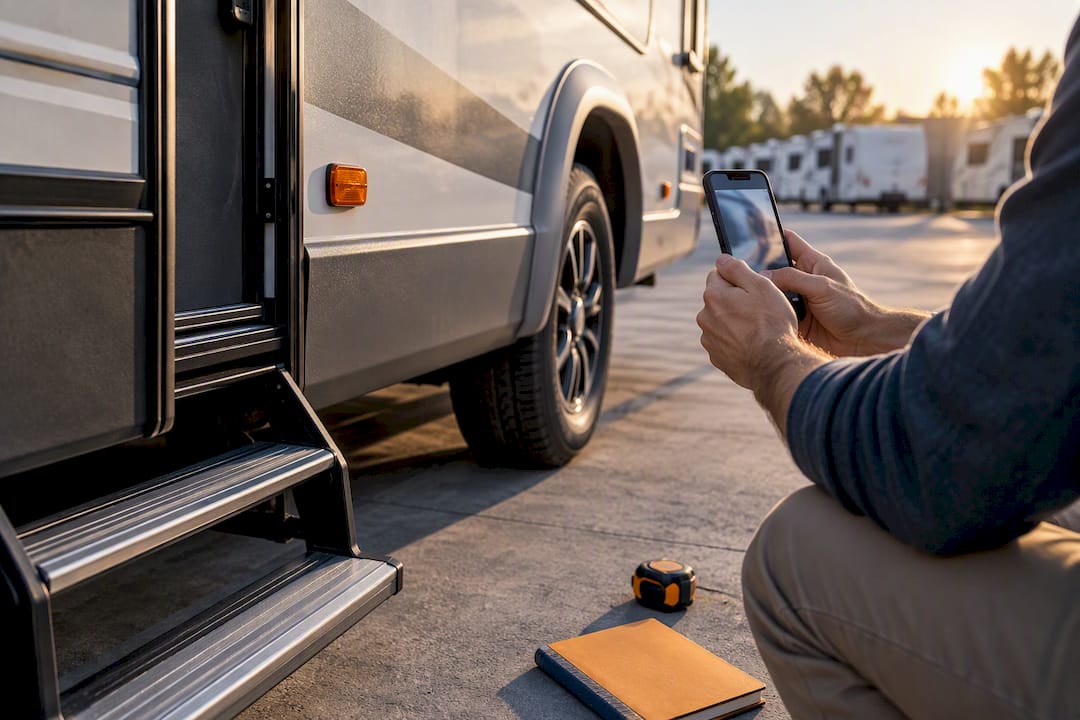
Listing an RV internationally means publishing a decision-ready listing with a clear VIN and specs, extensive photos and documentation, and a transparent price that says whether duties or fees are included. Do that well and overseas buyers can act without a dozen back-and-forth emails. This guide covers what makes a listing trustworthy across borders, not how to physically ship the unit once it sells.
TL;DR:
- Clear documentation of VIN, title, maintenance records, and high-quality photos covering key areas dramatically reduces disputes and builds trust for international buyers.
- Using escrow or verified payment processors prevents fraud and ensures funds are secured before releasing the vehicle or title.
- Listing details should specify if the price is ex-works and who covers export duties, taxes, and domestic shipping costs to avoid post-sale conflicts.
- Providing an inspection report and matching VINs across documents is essential for high-value units and helps prevent port delays and customs issues.
- Expanding marketplace reach with paid upgrades can attract overseas buyers, but substance and completeness of the listing determine actual inquiries.
Table of Contents
- What Belongs in an International RV Listing Checklist?
- How Should You Price an RV for International Buyers?
- What Payment Methods Protect You From International RV Scams?
- How Do You Prove Your RV’s Condition Without an In-Person Inspection?
- Which Marketplace Settings Help Your RV Get Found Overseas?
- What Shipping and Logistics Details Should Sellers Mention?
- What Customs and Import Rules Should Your Listing Address?
- How Does Title Transfer Work for a Cross-Border RV Sale?
- Three Priorities If You’re Listing an RV for International Buyers
- List Your RV Internationally With Gently Used RVs
- Sources
- FAQ
What Belongs in an International RV Listing Checklist?
Buyers overseas can’t kick the tires in person, so your listing has to do the convincing. Every detail you leave out becomes a follow-up question, and every follow-up question is a chance for the buyer to lose interest and move to the next listing.
Start with the hard data points that let a buyer compare your RV to others without guessing:
- VIN, year, make, model, and trim level
- Mileage or engine hours (for motorized units)
- Length, dry weight, and gross vehicle weight rating
- Fuel type and payload capacity where it applies
- Slide-outs, awnings, and major appliance brands
Photos do the heavy lifting for buyers who can’t visit. Industry guidance on export sales recommends 30 to 60 photos covering multiple VIN locations, the undercarriage, the engine bay, and every interior angle a buyer would check walking through in person. Add a short walkaround video, narrated if you can manage it, showing the unit running and the slide-outs cycling.
- Shoot the VIN plate, the frame stamp, and the title document side by side
- Photograph the roof, tires, and undercarriage, areas buyers most often ask about
- Mask account numbers or personal details on any document photo before posting
Attach the title, maintenance records, and an inspection report if you have one. If the RV carries a salvage or rebuilt title, or has a known mechanical issue, say so plainly in the description. Hiding it doesn’t make the problem disappear. It just moves the dispute to after the sale, when it’s harder for everyone to resolve.
Pro Tip: Time-stamp your walkaround video by holding a phone or a dated newspaper next to the VIN for a few seconds. It costs you nothing and it’s the fastest way to prove the unit is real and currently in your possession.
How Should You Price an RV for International Buyers?
State your currency clearly, right next to the number, every time it appears. A buyer scanning listings from another country shouldn’t have to guess whether “$45,000” means U.S. dollars, Canadian dollars, or something else. Adding an approximate conversion in a second, widely used currency (labeled as an estimate) removes that friction without committing you to an exchange rate you don’t control.
Cross-border selling guidance recommends working from a price-band strategy instead of a single fixed number: a floor price you won’t go below, a channel price you list at, and a promotional price you can offer during a push for visibility. That gives you room to negotiate without looking like you’re marking down out of desperation.
Say explicitly who covers what:
- Is the listed price “all-in,” or “ex-works” before duties, taxes, and port fees?
- Who pays for domestic transport to the port or shipping hub?
- Are inspection or documentation fees included, or billed separately?
A line as simple as “Price is ex-works; buyer arranges and pays for export shipping and destination-country duties” prevents the single most common source of post-sale disputes: a buyer who assumed the sticker price was the final price.
What Payment Methods Protect You From International RV Scams?
Escrow services or verified payment processors are the standard for a reason. They hold the buyer’s funds until agreed conditions are met, which protects you from a reversed payment and protects the buyer from paying for a unit that never gets released. Guidance on selling vehicles to distant buyers consistently points to escrow-backed payment flows as the safer standard over informal wire transfers or certified checks, both of which can be forged or reversed after you’ve already handed over keys.
A workable flow looks like this: buyer secures payment through escrow, then you release the title and hand off the unit. Bank transfers can work if you wait for actual confirmed clearing, not just a screenshot of a “sent” notice. Certified checks carry more risk than either option and we’d steer you away from accepting one from a buyer you’ve never met.
- Never release a title before funds are fully cleared and verified
- Put payment terms in writing before the deal moves forward
- Photograph the RV’s condition at handoff, with a date stamp, for both parties’ records
- Watch for buyers who overpay and ask for a refund of the difference, a classic scam pattern
- Be wary of urgency pressure (“I need this today”) paired with an unfamiliar payment method
Pro Tip: If a buyer pushes hard for a payment method outside escrow or a verified processor, treat that as the red flag it is. Legitimate international buyers expect and prefer secure payment rails; scammers avoid them.
How Do You Prove Your RV’s Condition Without an In-Person Inspection?
You can’t hand a distant buyer a set of keys and let them walk around the lot, but you can replace most of what an in-person visit accomplishes.
- Offer a third-party inspection, or cooperate fully with an inspector the buyer hires themselves
- Record a time-stamped proof-of-stock video showing the VIN, the date, and the unit’s current condition
- Provide a Bill of Sale template and masked images of the title (covering personal identifiers, not the VIN)
- Cross-check that the VIN matches exactly across the title, the dash plate, and the frame stamp
- Disclose any salvage or rebuilt title status upfront, with repair records attached if available
VIN matching across every document sounds like a formality until it isn’t. A single-digit mismatch between the title and the frame stamp can stall a shipment at a foreign port for weeks while customs sorts out whether the paperwork describes the vehicle in the container.
A VIN-match packet, photos of the VIN in three separate locations plus title images and any original option stickers, dramatically cuts down on port disputes for higher-value units. Sellers who skip this step are the ones most likely to hear from an unhappy buyer weeks after the sale.
For anything above typical resale value, a documented inspection isn’t optional. It’s the cheapest insurance you’ll buy against a dispute that costs far more than the inspection fee.
Which Marketplace Settings Help Your RV Get Found Overseas?
A listing can be perfect and still go nowhere if it’s only visible to buyers fifty miles away. Marketplace reach settings determine who actually sees your RV, and that’s a separate problem from how well you’ve documented it.
On Gently Used RVs, a free listing starts visible within a 20-mile radius for 30 days, which is fine for a local sale but does nothing for a buyer overseas. Expanding that reach is a deliberate choice, not something that happens automatically. Feature guidance on marketplace listings shows that higher-tier listings with more photos and documentation attachments tend to generate more inquiries from buyers outside the immediate area, simply because more people can find them.
Here’s a practical setup sequence worth following in order:
- Create your free listing first and get the description and specs locked in
- Use the AI-powered autofill tool to import year, make, model, specs, and photos directly from a dealer or marketplace URL, cutting down on manual entry errors
- Attach your inspection report, title documentation, and maintenance records once the base listing is solid
- Choose a paid reach upgrade (statewide or nationwide visibility) once the listing itself is decision-ready, not before
Live buyer chat and appointment scheduling, available on higher tiers, can help speed up the verification back-and-forth that international buyers often need before committing. There’s little point paying for wider reach on a listing that still has gaps a buyer would need to email you about.
What Shipping and Logistics Details Should Sellers Mention?
You don’t need to arrange the shipment yourself, but your listing should say what the buyer is walking into. Most international RV sales move through a freight forwarder or export broker the buyer engages, not the seller, so your job is disclosure, not logistics management.
State the RV’s exact dimensions and weight prominently, since these determine whether it fits standard roll-on/roll-off vessels or needs specialized flat-rack shipping, a cost difference that can run into thousands of dollars. Note the nearest major port or shipping hub to your location, since inland positioning affects the buyer’s total cost far more than most sellers realize.
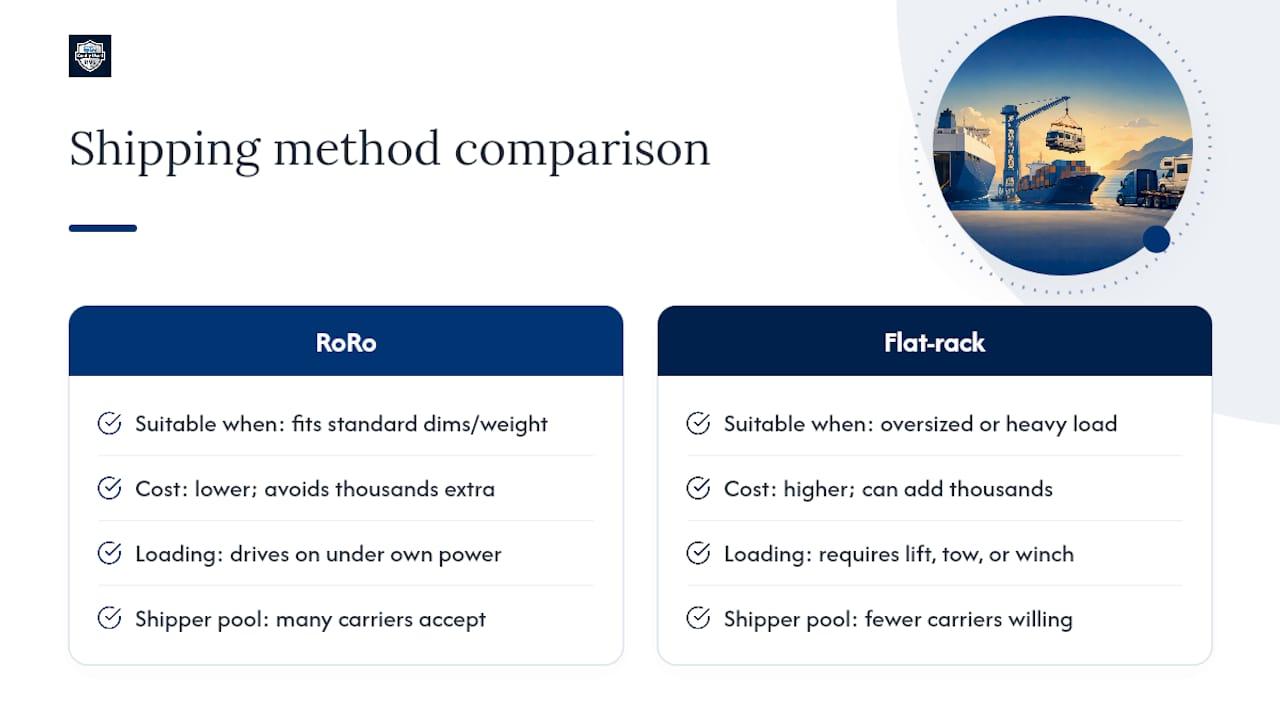
Mention whether the RV runs and drives under its own power for loading, or whether it needs to be towed or winched onto a transport vehicle. A non-running unit typically costs more to move and narrows the pool of shippers willing to handle it.
If you’re holding the unit for a period between sale and pickup, a secure storage arrangement matters. Local providers offering dedicated RV and fleet vehicle parking can bridge that gap safely if the buyer’s shipping window doesn’t line up with your timeline, keeping the unit secure and accessible for the inspector or freight company without cluttering your own property.
Be upfront that you’re not the shipping company. Say clearly in the listing that the buyer is responsible for arranging export transport, and that you’ll cooperate with their chosen carrier for pickup access and paperwork. That single sentence heads off a lot of confused messages later.
What Customs and Import Rules Should Your Listing Address?
You’re not responsible for your buyer’s home country’s import law, but a listing that acknowledges customs realities builds more trust than one that ignores them entirely.
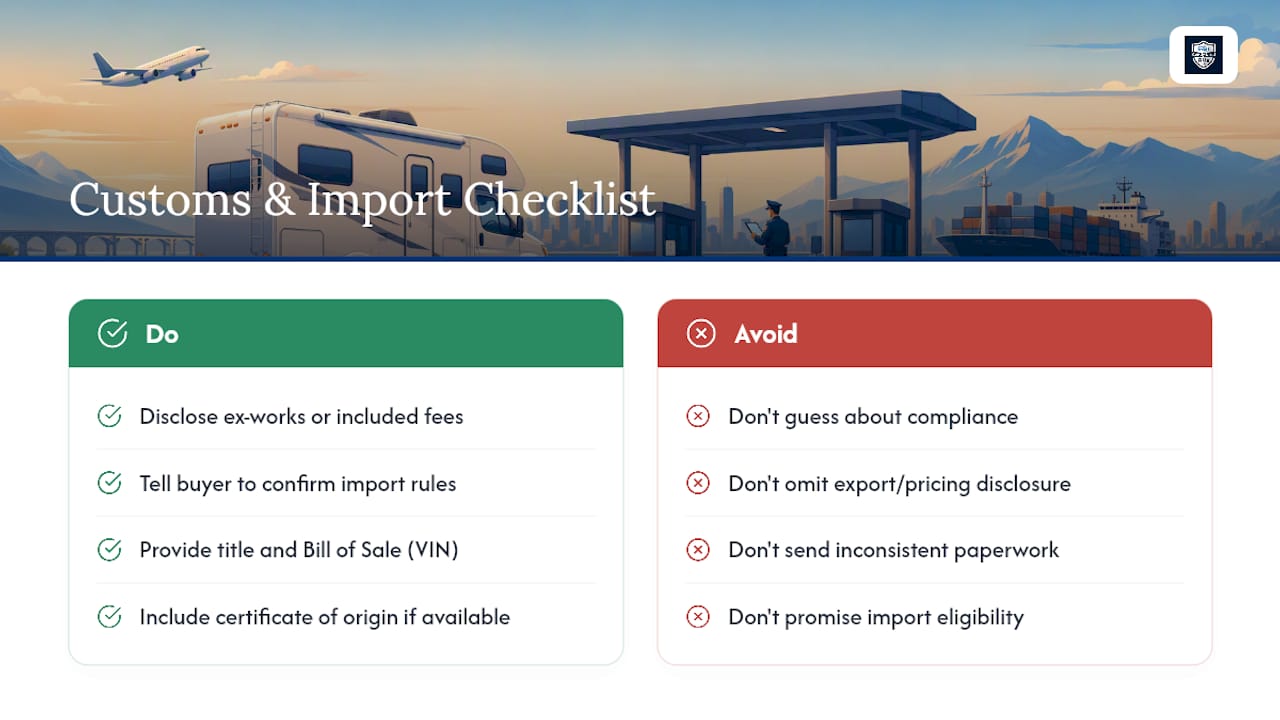
Import duties, emissions compliance, and age-based restrictions vary enormously by destination country, and some countries restrict or heavily tax RVs above a certain size or that don’t meet local emissions standards. You don’t need to research every country’s rules. You do need to make clear, in writing, that the buyer is responsible for confirming their own country’s import eligibility, duties, and taxes before completing the purchase.
State plainly whether your price is “ex-works” (buyer handles all export paperwork, duties, and destination taxes) or whether you’re including any portion of that in the price. This single disclosure, covered in the pricing section above, does double duty here: it also tells a buyer you understand that international sales carry regulatory complexity they need to plan for.
Provide clean documentation that a customs broker would want: the original title, a Bill of Sale with VIN and sale price stated clearly, and any manufacturer certificate of origin if you still have it. Customs agents in the buyer’s country will lean heavily on paperwork consistency, so the VIN-matching discipline covered earlier isn’t just a fraud safeguard. It’s also what gets a shipment cleared without delay.
If a buyer asks whether the unit meets a specific country’s import standards, don’t guess. Point them to their own customs authority or a licensed import broker rather than offering an answer you can’t verify.
How Does Title Transfer Work for a Cross-Border RV Sale?
What’s different is the timing, and that’s where sellers get into trouble.
Never sign over or release the physical title until payment has fully cleared through your chosen escrow service or verified payment processor. A buyer who has the title in hand has effectively taken possession in the eyes of most disputes, whether or not funds have actually settled. This is the single most important sequencing rule in a cross-border deal.
Keep a signed Bill of Sale as a secondary record even after the title transfers, noting the date, sale price, VIN, and both parties’ identifying information. Some destination countries require this document for their own import registration process, separate from whatever your state requires to release the title.
If your RV carries a lien, resolve it before listing internationally. A lien complicates title transfer under normal circumstances, and it becomes a much bigger problem when a foreign buyer’s customs broker or import authority discovers it after the unit has already shipped. Clear the lien first, then list.
Consult your state’s title transfer requirements and, if the sale value is significant, a professional familiar with cross-border vehicle sales before finalizing anything unusual.
Three Priorities If You’re Listing an RV for International Buyers
Get the listing decision-ready before you spend a dollar on wider reach. A gorgeous photo set and a complete document packet will out-convert a mediocre listing blasted to every country on earth, every time. Reach without substance behind it just generates questions you can’t answer fast enough to keep the buyer interested.
Start with a small pilot batch rather than committing your whole strategy upfront. List two or three units with full documentation, watch what questions international buyers actually ask, and adjust your pricing language and disclosures based on real feedback instead of guesswork.
For anything above typical resale value, spring for a verified inspection. The cost is trivial next to what a failed cross-border deal costs in time, reputation, and a unit that comes back to you weeks later no better off than when it left.
— Christopher
List Your RV Internationally With Gently Used RVs
Gently Used RVs gives you a free path to test international demand before you commit real money to it. Start a listing at no cost, then decide if the interest justifies expanding your reach.

The AI-powered autofill tool pulls year, make, model, specs, price, and photos straight from a dealer or marketplace URL in seconds, which matters most when you’re trying to get every VIN digit and spec field exactly right for a buyer overseas who can’t double-check anything in person. Once your base listing is solid, you can attach inspection reports and documentation, and higher tiers add live buyer chat so international buyers can ask questions in real time instead of waiting on email replies across time zones.
Reach settings scale with what you need. A free listing covers a 20-mile radius, Bronze extends that to 50 miles at $29.99 a month, and Silver opens statewide visibility at $59.99 a month, with a nationwide Gold tier available for sellers chasing the widest possible pool of buyers. Dealers managing multiple units can look at the dealer plans for inventory sync at scale.
Create your free listing today, import your details with the autofill tool, and treat your first upgraded listing as a pilot to see what international interest actually looks like.
Sources
- Cross-Border Selling: Global Best Practices for Dealers
- How to Sell a Car to an International Buyer? (Ship Overseas)
- Car Export Photo Documentation: International Sale Guide (2026)
FAQ
What Documents Do I Need to List an RV for International Buyers?
You need the title, a Bill of Sale template, VIN documentation, and ideally maintenance records and an inspection report. Mask personal identifiers on document photos, but keep the VIN fully visible and matching across every source.
How Many Photos Should an International RV Listing Include?
Aim for 30 to 60 photos covering the VIN in multiple locations, the undercarriage, engine bay, and full interior. A short walkaround video adds credibility a photo set alone can’t match.
Is Escrow Necessary for a Cross-Border RV Sale?
Escrow or a verified payment processor is strongly recommended over bank transfers or certified checks for long-distance vehicle sales. It protects both the buyer’s funds and your title until conditions are verifiably met.
How Much Does It Cost to List an RV on Gently Used RVs?
A basic listing is free with a 20-mile radius and 30-day duration. Paid upgrades run from $29.99 a month for Bronze up to nationwide Gold visibility, with full details on the pricing page.
Who Pays Customs Duties on an International RV Sale?
That depends entirely on how you state the price. If you list “ex-works,” the buyer typically covers duties, taxes, and shipping arrangements; state this explicitly in your listing so there’s no dispute after the sale.