Three levers move the needle on RV listing exposure: sharp, complete listing quality, aggressive freshness through wide distribution, and a small, targeted promotion to test what pulls buyers in. Fix your photos and specs first, then repost and boost reach, and finally spend a modest amount testing paid visibility before scaling anything. List on a marketplace that offers free posting and geotargeted search to put your RV in front of nearby buyers immediately, with optional upgrade tiers to test wider reach without a long commitment.
TL;DR:
- High-quality images, structured data, and honest details are crucial to improve listing ranking and attract serious buyers quickly.
- Reposting and boosting a well-optimized listing can significantly increase exposure without extra costs, especially on geotargeted platforms.
- Combining organic listings, targeted social ads, search ads, and retargeting produces better results than relying on any single channel alone.
- Listing when demand is highest, primarily in early spring, and pricing based on real market comps optimizes sale timing and value.
- Follow-up within hours and strategic delays improve chances of closing the sale by maintaining buyer interest without pressure.
Table of Contents
- Your 24 to 72 Hour Checklist to Boost RV Listing Impressions Now
- What Makes a Listing Rank and Get Clicked
- Which Advertising Channels Actually Move an RV
- When to List, How to Price, and When to Switch Tactics
- How Gently Used RVs Fits Into This Playbook
- Where RV Forums and Owner Groups Fit Into Your Exposure Strategy
- Why a Listing That Looks Great on Desktop Can Still Lose Buyers on Mobile
- How to Follow Up Without Losing a Buyer’s Interest
- Increase RV Listing Exposure: What Actually Moves the Needle
- Test Your Listing’s Reach Before You Pay for More of It
- Sources
Your 24 to 72 Hour Checklist to Boost RV Listing Impressions Now
You don’t need a marketing degree to move your listing up the results page this week. You need a short, disciplined sprint that hits the signals marketplaces and buyers both respond to.
Here’s the order that works, based on what actually changes buyer behavior fastest:
- Replace your hero photo. Shoot it in daylight, exterior three-quarter angle, no clutter in the frame.
- Add more images, including a floorplan and a walkthrough video. Buyers scroll past thin listings without a second thought.
- Rewrite your title and opening sentence. Lead with year, make, model, and the use case that sells it, like “sleeps six, tows easy with a half-ton truck.”
- Repost or bump your listing so it lands back at the top of local results instead of buried on page three.
- Turn on instant-response or fast-contact options so a serious buyer doesn’t wait six hours for a reply and move on.
- Run a one-week paid bump plus a boosted post in a local RV or camping social group to see who bites.
- Write down your starting views and lead count before you touch anything, so the test actually tells you something.
Pro Tip: Screenshot your listing’s view count on day one. Without a baseline, you’re guessing whether that Bronze upgrade or boosted post did anything at all.
What Makes a Listing Rank and Get Clicked
Photos do more selling than your description ever will, but most sellers still treat them as an afterthought. A strong photo set includes a daylight hero shot, a staged interior (bed made, counters clear), the floorplan, close-ups of the water heater, furnace, and slide mechanisms, and a 15 to 30 second walkthrough clip. Buyers who see the floorplan and multiple other unique photos, and consider small, visible upgrades like roof racks and cargo additions, engage and request information noticeably more than listings with fewer and lower-quality photos., based on marketplace benchmarking of image-rich listings. See XTR Offroad Products | Tailgate Inserts | Roof Racks | Trailgate® for accessory ideas that can boost appeal.
Your title and opening line carry more search weight than the paragraph below them. A working formula looks like this: year, make, model, key feature, use case. “2019 Forest River Rockwood 2109S, sleeps 4, easy tow behind a mid-size SUV” tells a buyer and a search filter everything they need in one glance.
Specs matter more than most sellers realize. Marketplace filters run on structured data, and a missing VIN, length, or GVWR field can knock your listing out of a buyer’s search entirely, not just push it down. If someone filters by tow weight and you left that field blank, you’re invisible to them regardless of how good your photos are.
Behavioral signals feed the algorithm too. A listing that’s been sitting untouched for six weeks reads as stale, both to the algorithm and to a buyer who wonders if it’s still available.
Honesty closes the deal once someone clicks. Include service records, note the small stuff (a stain on the dinette cushion, a slow-closing cabinet), and buyers trust the rest of your listing more because of it.
- Photograph in daylight, never with interior lights fighting window glare
- Show the floorplan even if it feels redundant to you
- List every defect once, briefly, instead of letting a buyer discover it at pickup
- Update your availability status the moment a showing falls through
Pro Tip: Film your walkthrough video vertically if you’re posting to social platforms and horizontally for the marketplace listing itself. Cropping a wrong-orientation clip kills half its impact.
For a full pre-listing walkthrough, the RV detailing checklist before selling covers the cleaning and staging steps that make your photos look like they belong in a dealership catalog.
Which Advertising Channels Actually Move an RV
Organic marketplace listings do the heavy lifting of direct discovery. Social platforms build community reach and put your RV in front of local buyers who follow camping and towing groups. Search ads capture someone actively typing “travel trailer for sale near me” right now. Programmatic display keeps your unit visible to someone still deciding, which matters more in this category than most, since RVIA’s ownership data shows roughly 8.1 million U.S. households already own an RV and another 16.9 million are actively interested, a buyer pool that typically researches for weeks before committing.
That long research window is exactly why a single channel underperforms. Combining awareness (display), intent capture (search), and recapture (retargeting) consistently outperforms any one tactic alone, since buyers touch multiple channels before they ever call.
A starter paid playbook for a private seller or small dealer looks like this:
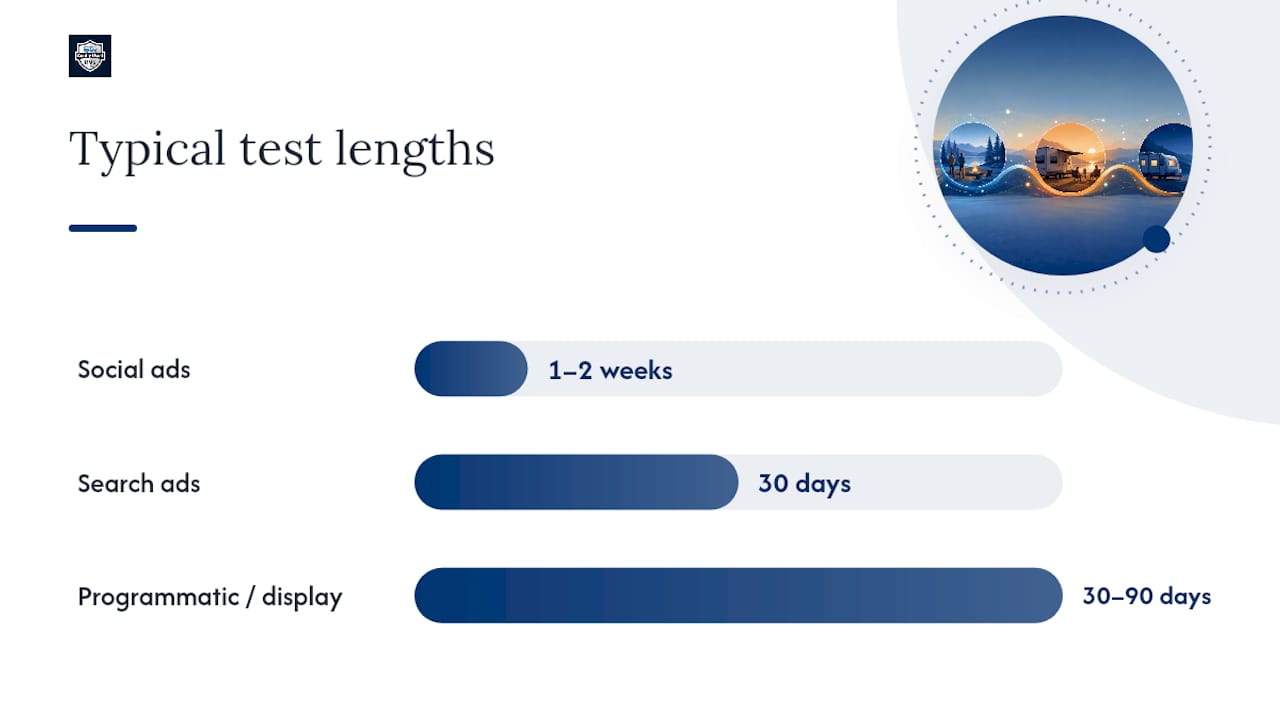
- Set a small test budget, run it for 30 days, then reassess before scaling
- Track impressions, click-through rate, cost per qualified lead, and actual calls or form fills
- Expect early traffic lift within 30 days and clearer cost-per-lead data by day 90
- Consider geo-fencing around RV shows, campgrounds, or competitor lots to catch physically present, high-intent shoppers
- Pair local search with a boosted marketplace listing to mirror what dealerships do with Google Ads and Performance Max at a fraction of the budget
| Channel | Best Role | Typical Test Length |
|---|---|---|
| Organic marketplace listing | Direct discovery and lead capture | Ongoing, refresh weekly |
| Social ads / boosted posts | Local and community reach | 1 to 2 weeks |
| Search ads | Capturing active buyer intent | 30 days minimum |
| Programmatic / display | Staying visible during research | 30 to 90 days |
Your ad creative should include a short walkthrough video opening with the exterior hero shot, the sleeping area and kitchen shown in the first 10 seconds, three strong hero photos, and a headline with two description variants to test against each other.
When to List, How to Price, and When to Switch Tactics
Spring and early summer bring the heaviest buyer traffic, since most people shop for an RV right before camping season starts, not during it. Listing in February or March gives you a head start on that demand curve instead of competing with every other seller in June.
Pricing works best anchored to real comps, not wishful thinking. Start at market rate, then use staged reductions every two to three weeks if views aren’t converting to inquiries, and consider a temporary, clearly-labeled price drop to jolt fresh interest into a stalled listing.
- Refresh photos and description every 2 to 3 weeks if the listing hasn’t sold
- Add paid promotion once organic views plateau for more than 10 days
- Watch for rising views without rising leads. That’s a pricing problem, not a photo problem
- If a private sale stalls past 60 to 90 days, weigh a dealer consignment or trade-in against continuing to carry the unit yourself
A healthy timeline looks like a view spike in the first 72 hours after any refresh, a handful of qualified leads within two weeks, and a serious offer within 30 to 45 days if pricing and photos are both doing their job.
How Gently Used RVs Fits Into This Playbook
Free posting removes the biggest reason sellers delay: cost. You can list a Class C motorhome or a teardrop trailer at no charge, then decide later whether wider reach is worth paying for.
The real test isn’t whether an upgrade tier “works” in theory. It’s whether 30 days of Bronze or Silver visibility produces more views and leads than your free listing did on its own. Run that comparison before you assume you need nationwide reach.
The AI autofill tool pulls year, make, model, specs, and photos straight from another dealer site or marketplace URL, which turns a 45-minute listing chore into something closer to five minutes. Geotargeted search means your free listing already surfaces to the closest buyers first, and upgrading to Bronze or Silver simply widens that radius. Full details on tiers and setup live on the how it works page.
Pro Tip: Post free, wait 10 days, then decide. If your view count is flat and leads are near zero, that’s your signal to test an upgrade rather than keep waiting.
Where RV Forums and Owner Groups Fit Into Your Exposure Strategy
RV owner communities move slower than paid ads but carry more trust. A recommendation or answer inside a forum thread about, say, Winnebago Class C water heater issues carries weight a banner ad never will, and that trust transfers to your listing if you show up as a real, helpful presence rather than a drive-by seller.
Facebook groups organized around specific RV types, regions, or campgrounds are the most active version of this today. Groups built around fifth wheels, toy haulers, or a specific state’s camping scene often allow member-to-member sale posts, and the audience is already self-selected as interested buyers, not casual scrollers. iRV2 and similar long-running forums work differently. You won’t post a sale ad directly in most sections, but answering questions, sharing your own maintenance experience, and linking to your listing in a signature or profile builds a trail back to you that Google eventually indexes.
The mistake most sellers make here is showing up only to post their ad, then disappearing. Communities notice that pattern fast, and it reads as spam even when the RV itself is legitimate. Spend time answering a few questions about your own rig’s quirks first. Mention you’re selling only when it’s relevant, not as the opening line.
This channel won’t produce the volume a paid campaign does. It produces something paid ads struggle with: a buyer who already half trusts you before they ever call.
Why a Listing That Looks Great on Desktop Can Still Lose Buyers on Mobile
Most RV shoppers browse from their phone, often while sitting in a campground or scrolling during a lunch break, which means a listing built and checked only on a desktop screen is gambling with its best audience. Photos that look sharp on a laptop monitor can load slowly or crop awkwardly on a phone, and a wall of unbroken text that reads fine on a wide screen becomes an scrollable slab on mobile.
Check your own listing exactly the way a buyer would: pull it up on your phone, not your computer, and scroll through it start to finish. Your hero photo should load first and fill the frame without buyers needing to zoom or rotate their screen. Break your description into short paragraphs or a few bullet points instead of one dense block, since mobile readers skim in short bursts.

Contact and response speed matter even more on a phone. A buyer scrolling RV listings during a break wants a fast reply, not a callback tomorrow, so instant-response or click-to-call options convert far better than a contact form buried at the bottom of a long page. If your listing platform offers live chat or appointment scheduling, mobile users are exactly who that feature was built for, since they’re often ready to act the moment curiosity turns into interest.
Video suffers the most on a bad mobile setup. A walkthrough clip that autoplays with sound off, loads fast, and gets to the interior within the first few seconds holds attention. One that buffers or opens in a separate app loses a shopper before they see the kitchen.
How to Follow Up Without Losing a Buyer’s Interest
Most sold RVs don’t close on the first message. They close because a seller followed up at the right moments without becoming a nuisance about it. Losing a warm lead usually comes down to timing, not price.
Respond to that first inquiry within an hour if you can manage it. Buyers browsing multiple listings at once tend to book a showing with whoever answers first, not whoever has the lowest price. If a buyer asks a specific question, like towing capacity or a maintenance record, answer that exact question directly before adding anything else. Vague or delayed answers read as evasive even when they’re not.
After an initial conversation goes quiet, a light check-in three to five days later works better than silence or a hard push. Something like confirming the RV is still available and asking if they have any other questions keeps the door open without sounding desperate. If a buyer says they’re comparing a few units, a brief follow-up highlighting one detail they didn’t ask about, like recent maintenance or a included accessory, can tip a close decision your way.
Track every conversation somewhere, even a simple notes app, so you know who you’ve already followed up with and when. Buyers who go quiet for two weeks aren’t necessarily gone. A well-timed, no-pressure nudge closes more sales than most sellers expect, mainly because most competing sellers never follow up at all.
Increase RV Listing Exposure: What Actually Moves the Needle
Most advice on this topic treats every tactic as equally important, and that’s the first mistake. Photos and specs matter more than any paid campaign you could run, because no amount of ad spend fixes a listing that gets clicked and then abandoned in four seconds. Fix the listing first. Everything else is amplification of something that’s either working or isn’t.
The conventional wisdom oversells paid ads as a fast fix. They’re not fast. They’re a measurement tool. A 30-day test tells you whether your listing converts traffic; it doesn’t manufacture demand for a listing that isn’t ready. Sellers who skip straight to a boosted post before fixing their photos usually just pay to show more people a listing that still won’t convert.
If you take one thing from this, prioritize freshness and completeness before spending a dollar. A free, well-built listing on Gently Used RVs will outperform a paid promotion sitting on top of a weak one, every time.
— Christopher
Test Your Listing’s Reach Before You Pay for More of It
Here’s what most sellers get backwards: they assume more exposure requires more money. Gently Used RVs lets you prove that wrong for free first. Post your RV at no cost, let geotargeted search put it in front of nearby buyers, and use the AI autofill tool to pull your specs and photos straight from another site in minutes instead of retyping everything by hand.

If your free listing plateaus after a week or two, that’s your cue to test an upgrade, not guess at one. Bronze widens your radius to 50 miles and lets you post up to 50 photos, while Silver takes you statewide. Run either for 30 days and compare the leads against your free-listing baseline. Dealers managing larger inventory should look at the dealer inventory tools instead, since automatic sync saves hours that a one-by-one upload would eat up.
Ready to see what your RV looks like with real reach behind it? Check the listing pricing tiers and post your first listing today.
Sources
- RV Industry Association: 2025 go RVing® owner demographic profile
- Programmatic display ads for RV motorhome buyers | Propellant Media
- Google Ads & Performance Max strategies for RV motorhome sales | Propellant Media